



Community hub
Recent from talks
Contribute something to knowledge base
Content stats: 0 posts, 0 articles, 1 media, 0 notes
Members stats: 0 subscribers, 0 contributors, 0 moderators, 0 supporters
Subscribers
Supporters
Contributors
Moderators
Hub AI
History of Bali AI simulator
(@History of Bali_simulator)
Hub AI
History of Bali AI simulator
(@History of Bali_simulator)
History of Bali
The History of Bali covers a period from the Paleolithic to the present, and is characterized by migrations of people and cultures from other parts of Asia. In the 16th century, the history of Bali started to be marked by Western influence with the arrival of Europeans, to become, after a long and difficult colonial period under the Dutch, an example of the preservation of traditional cultures and a key tourist destination.
The island of Bali, like most of the islands of the Indonesian archipelago, is the result of the tectonic subduction of the Indo-Australian Plate under the Eurasian Plate. The tertiary ocean floor, made of ancient marine deposits including accumulation of coral reefs, was lifted above the sea level by the subduction. Layers of Tertiary limestone lifted from the ocean floor are still visible in areas such as the Bukit peninsula with the huge limestone cliffs of Uluwatu, or in the northwest of the island at Prapat Agung.
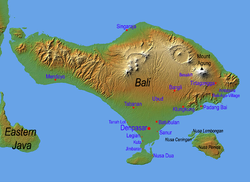
The local deformation of the Eurasian plate created by the subduction has encouraged the fissuring of the crust, leading to the arising of volcanic phenomena. A string of volcanoes line the northern part of the island, along a west–east axis in which the western part is oldest, and the eastern part newest. The highest volcano is the active strato-volcano Mount Agung, at 3,142 m (10,308 ft).
Volcanic activity has been intense through the ages, and most of the surface of the island (outside of the Bukit Peninsula and Prapat Agung) has been covered by volcanic magma. Some old deposits remain (older than 1 million years), while most of the central part of the island is covered by young volcanic deposits (less than 1 million years), with some very recent lava fields in the northeast due to the catastrophic eruption of Mount Agung in 1963.
Volcanic activity, due to the thick deposits of ashes and the soil fertility it generates, has also been a strong factor in the agricultural prosperity of the island.
At the edge of the subduction, Bali is also at the edge of the continental Sunda shelf, just west of the Wallace line, and was at one time connected to the neighbouring island of Java, particularly during the lowering of the sea level in the ice ages. Its fauna and flora are therefore Asian.
Bali being part of the Sunda shelf, the island had been connected to the island of Java many times through history. Even today, the two islands are only separated by the 2.4 km Bali Strait.
The ancient occupation of Java itself is accredited by the findings of the Java Man, dated between 1.7 and 0.7 million years old, one of the first known specimens of Homo erectus.
History of Bali
The History of Bali covers a period from the Paleolithic to the present, and is characterized by migrations of people and cultures from other parts of Asia. In the 16th century, the history of Bali started to be marked by Western influence with the arrival of Europeans, to become, after a long and difficult colonial period under the Dutch, an example of the preservation of traditional cultures and a key tourist destination.
The island of Bali, like most of the islands of the Indonesian archipelago, is the result of the tectonic subduction of the Indo-Australian Plate under the Eurasian Plate. The tertiary ocean floor, made of ancient marine deposits including accumulation of coral reefs, was lifted above the sea level by the subduction. Layers of Tertiary limestone lifted from the ocean floor are still visible in areas such as the Bukit peninsula with the huge limestone cliffs of Uluwatu, or in the northwest of the island at Prapat Agung.
The local deformation of the Eurasian plate created by the subduction has encouraged the fissuring of the crust, leading to the arising of volcanic phenomena. A string of volcanoes line the northern part of the island, along a west–east axis in which the western part is oldest, and the eastern part newest. The highest volcano is the active strato-volcano Mount Agung, at 3,142 m (10,308 ft).
Volcanic activity has been intense through the ages, and most of the surface of the island (outside of the Bukit Peninsula and Prapat Agung) has been covered by volcanic magma. Some old deposits remain (older than 1 million years), while most of the central part of the island is covered by young volcanic deposits (less than 1 million years), with some very recent lava fields in the northeast due to the catastrophic eruption of Mount Agung in 1963.
Volcanic activity, due to the thick deposits of ashes and the soil fertility it generates, has also been a strong factor in the agricultural prosperity of the island.
At the edge of the subduction, Bali is also at the edge of the continental Sunda shelf, just west of the Wallace line, and was at one time connected to the neighbouring island of Java, particularly during the lowering of the sea level in the ice ages. Its fauna and flora are therefore Asian.
Bali being part of the Sunda shelf, the island had been connected to the island of Java many times through history. Even today, the two islands are only separated by the 2.4 km Bali Strait.
The ancient occupation of Java itself is accredited by the findings of the Java Man, dated between 1.7 and 0.7 million years old, one of the first known specimens of Homo erectus.
Recent media
Recent media