
Recent from talks
Hmong–Mien languages
Knowledge base stats:
Talk channels stats:
Members stats:
Hmong–Mien languages
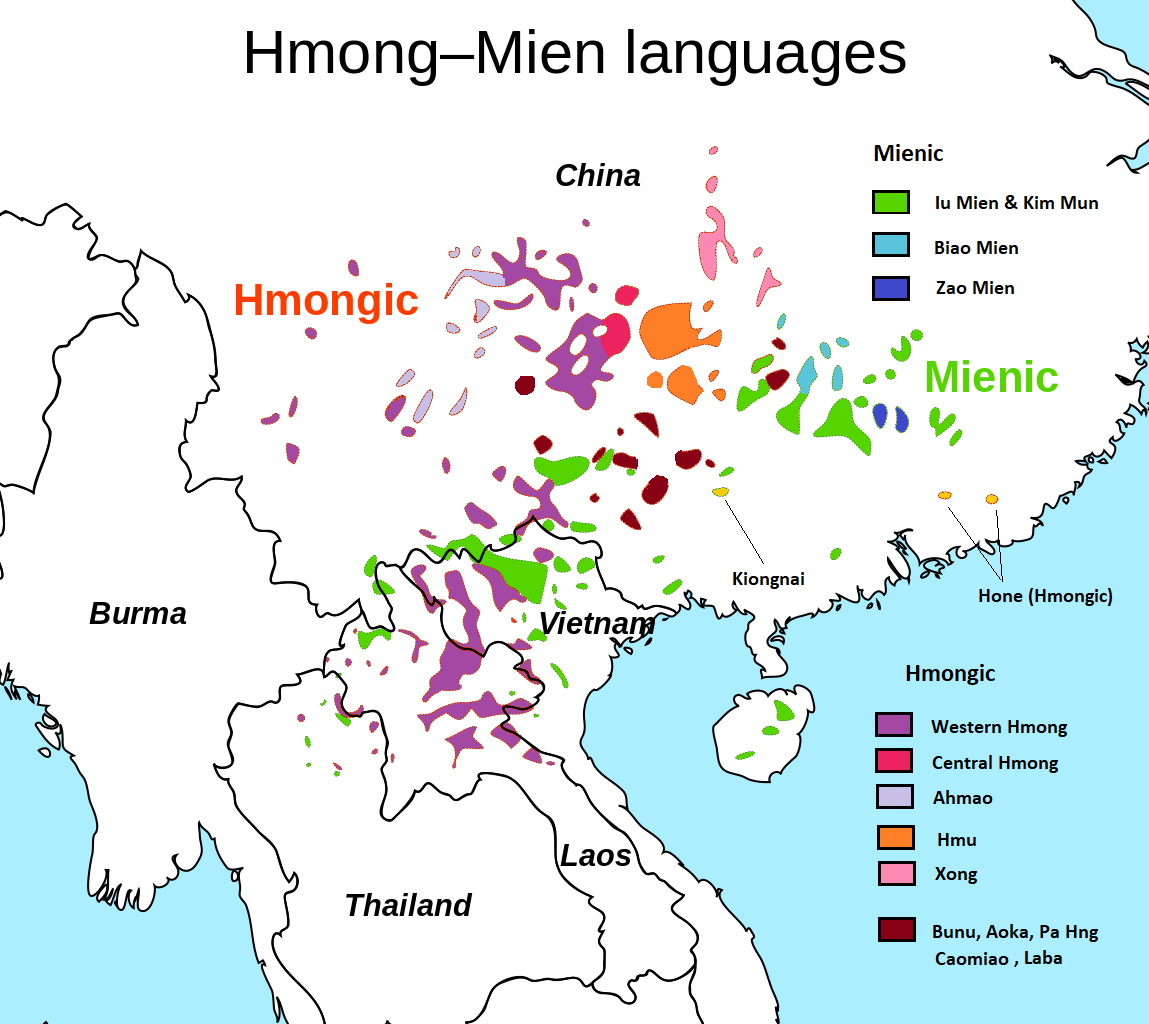
The Hmong–Mien languages (also known as Miao–Yao and rarely as Yangtzean) are a highly tonal language family of southern China and northern Southeast Asia. They are spoken in mountainous areas of southern China, including Guizhou, Hunan, Yunnan, Sichuan, Guangxi, Guangdong and Hubei provinces. The speakers of these languages are predominantly "hill people", in contrast to the neighboring Han Chinese, who have settled the more fertile river valleys. Since their migration about four centuries ago, Hmong–Mien populations have also established communities in northern Vietnam and Laos.
Hmongic (Miao) and Mienic (Yao) are closely related, but clearly distinct. For internal classifications, see Hmongic languages and Mienic languages. The largest differences are due to divergent developments in their phonological systems. The Hmongic languages appear to have kept the large set of initial consonants featured in the protolanguage but greatly reduced the distinctions in the syllable finals, in particular losing all glides and stop codas. The Mienic languages, on the other hand, have largely preserved syllable finals but reduced the number of initial consonants.
Early linguistic classifications placed the Hmong–Mien languages in the Sino-Tibetan family, where they remain in many Chinese classifications. The current consensus among Western linguists is that they constitute a family of their own, the lexical and typological similarities among Hmong–Mien and Sinitic languages being attributed to contact-induced influence.
Paul K. Benedict, an American scholar, extended the Austric theory to include the Hmong–Mien languages. The hypothesis never received much acceptance for Hmong–Mien, however. Kosaka (2002) argued specifically for a Miao–Dai family.
The most likely homeland of the Hmong–Mien languages is in Southern China between the Yangtze and Mekong rivers, but speakers of these languages might have migrated from Central China either as part of the Han Chinese expansion or as a result of exile from an original homeland by Han Chinese. Migration of people speaking these languages from South China to Southeast Asia took place during the 17th century (1600–1700). Ancient DNA evidence suggests that the ancestors of the speakers of the Hmong–Mien languages were a population genetically distinct from that of the Tai–Kadai and Austronesian language source populations at a location on the Yangtze River. Recent Y-DNA phylogeny evidence supports the proposition that people who speak the Hmong–Mien languages are descended from a population that is distantly related to those who now speak the Mon-Khmer languages.
The date of Proto-Hmong–Mien has been estimated to be about 2500 BP (500 BC) by Sagart, Blench, and Sanchez-Mazas using traditional methods employing many lines of evidence, and about 4243 BP (2250 BC) by the Automated Similarity Judgment Program (ASJP), an experimental algorithm for automatic generation of phonologically based phylogenies.
The Mandarin names for these languages are Miáo and Yáo.
In Vietnamese, the name for Hmong is H'Mông, and the name for Mien is Dao (i.e., Yao), although Miền is also used.
Hub AI
Hmong–Mien languages AI simulator
(@Hmong–Mien languages_simulator)
Hmong–Mien languages
The Hmong–Mien languages (also known as Miao–Yao and rarely as Yangtzean) are a highly tonal language family of southern China and northern Southeast Asia. They are spoken in mountainous areas of southern China, including Guizhou, Hunan, Yunnan, Sichuan, Guangxi, Guangdong and Hubei provinces. The speakers of these languages are predominantly "hill people", in contrast to the neighboring Han Chinese, who have settled the more fertile river valleys. Since their migration about four centuries ago, Hmong–Mien populations have also established communities in northern Vietnam and Laos.
Hmongic (Miao) and Mienic (Yao) are closely related, but clearly distinct. For internal classifications, see Hmongic languages and Mienic languages. The largest differences are due to divergent developments in their phonological systems. The Hmongic languages appear to have kept the large set of initial consonants featured in the protolanguage but greatly reduced the distinctions in the syllable finals, in particular losing all glides and stop codas. The Mienic languages, on the other hand, have largely preserved syllable finals but reduced the number of initial consonants.
Early linguistic classifications placed the Hmong–Mien languages in the Sino-Tibetan family, where they remain in many Chinese classifications. The current consensus among Western linguists is that they constitute a family of their own, the lexical and typological similarities among Hmong–Mien and Sinitic languages being attributed to contact-induced influence.
Paul K. Benedict, an American scholar, extended the Austric theory to include the Hmong–Mien languages. The hypothesis never received much acceptance for Hmong–Mien, however. Kosaka (2002) argued specifically for a Miao–Dai family.
The most likely homeland of the Hmong–Mien languages is in Southern China between the Yangtze and Mekong rivers, but speakers of these languages might have migrated from Central China either as part of the Han Chinese expansion or as a result of exile from an original homeland by Han Chinese. Migration of people speaking these languages from South China to Southeast Asia took place during the 17th century (1600–1700). Ancient DNA evidence suggests that the ancestors of the speakers of the Hmong–Mien languages were a population genetically distinct from that of the Tai–Kadai and Austronesian language source populations at a location on the Yangtze River. Recent Y-DNA phylogeny evidence supports the proposition that people who speak the Hmong–Mien languages are descended from a population that is distantly related to those who now speak the Mon-Khmer languages.
The date of Proto-Hmong–Mien has been estimated to be about 2500 BP (500 BC) by Sagart, Blench, and Sanchez-Mazas using traditional methods employing many lines of evidence, and about 4243 BP (2250 BC) by the Automated Similarity Judgment Program (ASJP), an experimental algorithm for automatic generation of phonologically based phylogenies.
The Mandarin names for these languages are Miáo and Yáo.
In Vietnamese, the name for Hmong is H'Mông, and the name for Mien is Dao (i.e., Yao), although Miền is also used.
Recent media