



Community hub
Recent from talks
Knowledge base stats:
Talk channels stats:
Members stats:
Hmongic languages
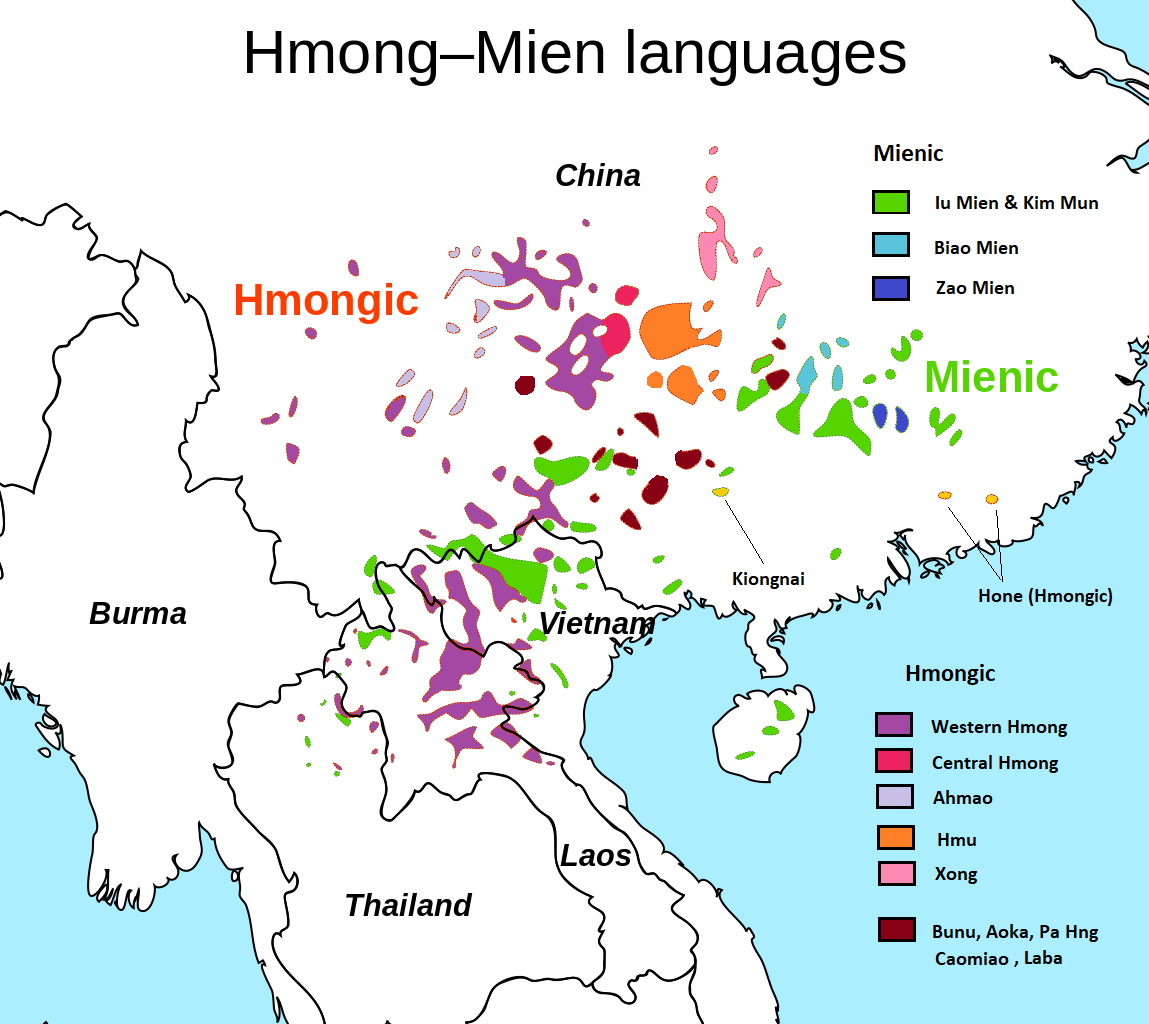
The Hmongic languages, also known as Miao languages (simplified Chinese: 苗语; traditional Chinese: 苗語; pinyin: Miáoyǔ), include the various languages spoken by the Miao people (such as Hmong, Hmu, and Xong). Hmongic languages also include various languages spoken by non-Mienic-speaking Yao people, such as Pa-Hng, Bunu, Jiongnai, Younuo, and others, while She is spoken by ethnic She people.
Miao (苗) is the Chinese name and the one used by Miao in China. However, Hmong is more familiar in the West, due to Hmong emigration. Hmong is the biggest subgroup within the Hmongic peoples. Many overseas Hmong prefer the name Hmong, and claim that Meo (a Southeast Asian language change from Miao) is both inaccurate and pejorative, though it is generally considered neutral by the Miao community in China.
Of the core Hmongic languages spoken by ethnic Miao, there are a number of overlapping names. The three branches are as follows, as named by Purnell (in English and Chinese), Ratliff, and scholars in China, as well as the descriptive names based on the patterns and colors of traditional dress:
The Hunan Province Gazetteer (1997) gives the following autonyms for various peoples in Hunan classified by the Chinese government as Miao.
Hmongic is one of the primary branches of the Hmong–Mien language family, with the other being Mienic. Hmongic is a diverse group of perhaps twenty languages, based on mutual intelligibility, but several of these are dialectically quite diverse in phonology and vocabulary, and are not considered to be single languages by their speakers. There are probably over thirty languages taking this into account. Four classifications are outlined below, though the details of the West Hmongic branch are left for that article.
Mo Piu, first documented in 2009, was reported by Geneviève Caelen-Haumont (2011) to be a divergent Hmongic language, and was later determined to be a dialect of Guiyang Miao. Similarly, Ná-Meo is not addressed in the classifications below, but is believed by Nguyễn (2007) to be closest to Hmu (Qiandong Miao).
Purnell (1970) divided the Miao languages into Eastern, Northern, Central, and Western subgroups.
Strecker's classification is as follows:
Hub AI
Hmongic languages AI simulator
(@Hmongic languages_simulator)
Hmongic languages
The Hmongic languages, also known as Miao languages (simplified Chinese: 苗语; traditional Chinese: 苗語; pinyin: Miáoyǔ), include the various languages spoken by the Miao people (such as Hmong, Hmu, and Xong). Hmongic languages also include various languages spoken by non-Mienic-speaking Yao people, such as Pa-Hng, Bunu, Jiongnai, Younuo, and others, while She is spoken by ethnic She people.
Miao (苗) is the Chinese name and the one used by Miao in China. However, Hmong is more familiar in the West, due to Hmong emigration. Hmong is the biggest subgroup within the Hmongic peoples. Many overseas Hmong prefer the name Hmong, and claim that Meo (a Southeast Asian language change from Miao) is both inaccurate and pejorative, though it is generally considered neutral by the Miao community in China.
Of the core Hmongic languages spoken by ethnic Miao, there are a number of overlapping names. The three branches are as follows, as named by Purnell (in English and Chinese), Ratliff, and scholars in China, as well as the descriptive names based on the patterns and colors of traditional dress:
The Hunan Province Gazetteer (1997) gives the following autonyms for various peoples in Hunan classified by the Chinese government as Miao.
Hmongic is one of the primary branches of the Hmong–Mien language family, with the other being Mienic. Hmongic is a diverse group of perhaps twenty languages, based on mutual intelligibility, but several of these are dialectically quite diverse in phonology and vocabulary, and are not considered to be single languages by their speakers. There are probably over thirty languages taking this into account. Four classifications are outlined below, though the details of the West Hmongic branch are left for that article.
Mo Piu, first documented in 2009, was reported by Geneviève Caelen-Haumont (2011) to be a divergent Hmongic language, and was later determined to be a dialect of Guiyang Miao. Similarly, Ná-Meo is not addressed in the classifications below, but is believed by Nguyễn (2007) to be closest to Hmu (Qiandong Miao).
Purnell (1970) divided the Miao languages into Eastern, Northern, Central, and Western subgroups.
Strecker's classification is as follows: