Hubbry Logo
Hmong languageHmong languageMain
Open search
Hmong language
Community hub
Hmong language
logo
8 pages, 0 posts
0 subscribers
Be the first to start a discussion here.
Hmong language
Hmong language
from Wikipedia

Hmong
Mong
lus Hmoob / lug Moob / lol Hmongb / lus Hmôngz (Vietnam) / 𖬇𖬰𖬞 𖬌𖬣𖬵 / 𞄉𞄧𞄵𞄀𞄩𞄰
Pronunciation[m̥ɔ̃́]
Native toChina, Vietnam, Laos, Myanmar and Thailand
EthnicityHmong
Native speakers
4.5 million[a] (2015)[1]
Hmong writing: incl. Pahawh Hmong, Nyiakeng Puachue Hmong, multiple Latin standards
Official status
Recognised minority
language in
  • China
  • Laos
  • Myanmar
  • Vietnam
  • Thailand
Language codes
ISO 639-2hmn Hmong, Mong (China, Laos)
ISO 639-3hmn – inclusive code for the Hmong/Mong macrolanguage (China, Laos), including all Core Hmongic languages, except hmf and hmv
Individual codes:
cqd – Chuanqiandian Cluster Miao (cover term for Hmong in China)
hea – Northern Qiandong Miao
hma – Southern Mashan Hmong
hmc – Central Huishui Hmong
hmd – Large Flowery Miao
hme – Eastern Huishui Hmong
hmf – Hmong Don (Vietnam)
hmg – Southwestern Guiyang Hmong
hmh – Southwestern Huishui Hmong
hmi – Northern Huishui Hmong
hmj – Ge
hml – Luopohe Hmong
hmm – Central Mashan Hmong
hmp – Northern Mashan Hmong
hmq – Eastern Qiandong Miao
hms – Southern Qiandong Miao
hmv – Hmong Dô (Vietnam)
hmw – Western Mashan Hmong
hmy – Southern Guiyang Hmong
hmz – Hmong Shua (Sinicized Miao)
hnj – Mong Njua/Mong Leng (China, Laos), Blue/Green Hmong (United States)
hrm – A-Hmo, Horned Miao (China)
huj – Northern Guiyang Hmong
mmr – Western Xiangxi Miao
muq – Eastern Xiangxi Miao
mww – Hmong Daw (China, Laos), White Hmong (United States)
sfm – Small Flowery Miao
Glottologfirs1234
Linguasphere48-AAA-a
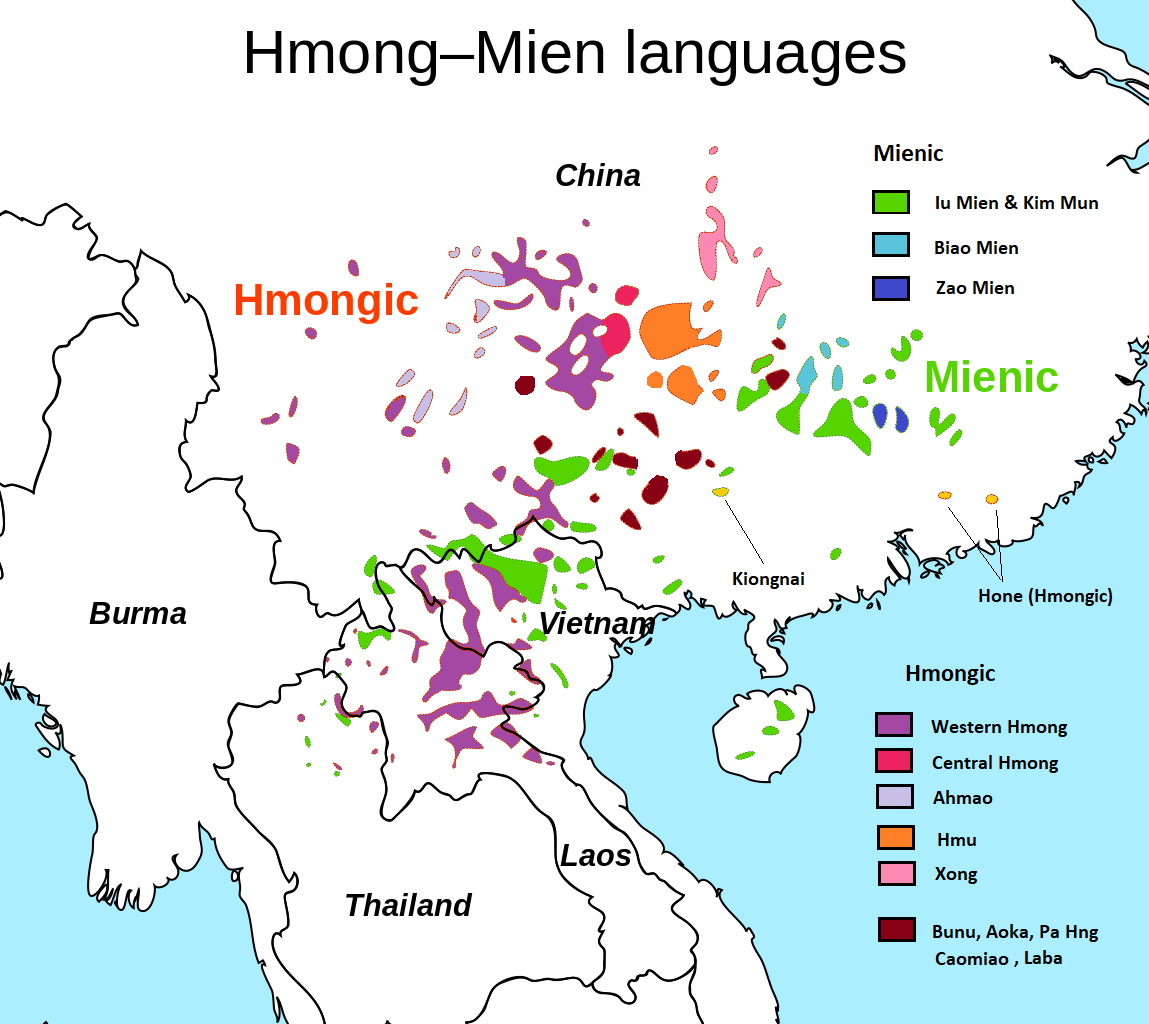
Map of Hmong-Mien languages, West Hmongic language in purple
This article contains IPA phonetic symbols. Without proper rendering support, you may see question marks, boxes, or other symbols instead of Unicode characters. For an introductory guide on IPA symbols, see Help:IPA.

Hmong or Mong (/ˈmʌŋ/ MUNG; RPA: Hmoob, CHV: Hmôngz, Nyiakeng Puachue: 𞄀𞄩𞄰, Pahawh: 𖬌𖬣𖬵, [m̥ɔ̃́]) is a dialect continuum of the West Hmongic branch of the Hmongic languages spoken by the Hmong people of Southwestern China, northern Vietnam, Thailand, and Laos.[2] There are an estimated 4.5 million speakers of varieties that are largely mutually intelligible, including over 280,000 Hmong Americans as of 2013.[3][4] Over half of all Hmong speakers speak the various dialects in China, where the Dananshan dialect forms the basis of the standard language.[5] However, Hmong Daw and Mong Leng are widely known only in Laos and the United States; Dananshan is more widely known in the native region of Hmong.

Varieties

[edit]

Mong Leng (Moob Leeg) and Hmong Daw (Hmoob Dawb) are part of a dialect cluster known in China as Chuanqiandian Miao (Chinese: 川黔滇苗; lit. 'Sichuan–Guizhou–Yunnan Miao'), called the "Chuanqiandian cluster" in English (or "Miao cluster" in other languages) since West Hmongic is also called Chuanqiandian Miao. The variety spoken from Sichuan in China to Thailand and Laos is referred to in China as the "First Local Variety" (第一土语) of the cluster. Mong Leng and Hmong Daw are just those varieties of the cluster that migrated to Laos. The names Mong Leng, Hmong Dleu/Der, and Hmong Daw are also used in China for various dialects of the cluster.

Ethnologue once distinguished only the Laotian varieties (Hmong Daw, Mong Leng), Sinicized Miao (Hmong Shua), and the Vietnamese varieties (Hmong Dô, Hmong Don). The Vietnamese varieties are very poorly known; population estimates are not even available. In 2007, Horned Miao, Small Flowery Miao, and the Chuanqiandian cluster of China were split off from Mong Leng [blu].[6]

These varieties are as follows, along with some alternative names.

  • Hmong/Mong/Chuanqiandian Miao macrolanguage (China, Laos, also spoken by minorities in Thailand and the United States), including:
    • Hmong Daw (Hmong Der, Hmoob Dawb, Hmong Dleu, Hmongb Dleub, 'White Hmong'; Chinese: 白苗, Bái Miáo, 'White Miao'),
    • Mong Leng (Moob Leeg, Moob Ntsuab, Mongb Nzhuab, 'Blue/Green Hmong'; Chinese: 青苗, Qīng Miáo, 'Blue-Green Miao'),
    • Hmong Shua (Hmongb Shuat; 'Sinicized Miao'),
    • Hmo or A-Hmo (Chinese: 角苗, Jiǎo Miáo, 'Horned Miao'),
    • Small Flowery Miao,
    • and the rest of the Chuanqiandian Miao cluster located in China.
  • Hmong languages of Vietnam, not considered part of the China/Laos macrolanguage and possibly forming their own distinct macrolanguage — they are still not very well classified even if they are described by Ethnologue as having vigorous use (in Vietnam) but without population estimates; they have most probably been influenced by Vietnamese, as well as by French (in the former Indochina colonies) and later American English, and they may be confused with varieties spoken by minorities living today in the United States, Europe or elsewhere in Asia (where their varieties may have been assimilated locally, but separately in each area, with other Hmong varieties imported from Laos and China):
    • Hmong Dô (Vietnam),
    • Hmong Don (Vietnam, assumed).

The Centers for Disease Control and Prevention (CDC) stated that the White and Leng dialects "are said to be mutually intelligible to a well-trained ear, with pronunciation and vocabulary differences analogous to the differences between British and American English."[7]

Several Chinese varieties may overlap with or be more distinct than the varieties listed above:

  • Dananshan Miao (Hmong Drout Raol, Hmong Hout Lab; called Hmong Dou in Northern Hmong), the basis of the Chinese standard of the Chuanqiandian cluster
  • Black Miao (subgroups: Hmong Dlob, Hmong Buak/Hmoob Puas; Chinese: 黑苗, Hēi Miáo)[8]
  • Southern Hmong (subgroups: Hmongb Shib, Hmongb Lens, Hmongb Dlex Nchab, Hmongb Sad; includes Mong Leng)
  • Northern Hmong (subgroups: Hmongb Soud, Hmong Be/Hmongb Bes, Hmongb Ndrous)
  • Western Sichuan Miao (Chinese: 川苗, Chuān Miáo)

In the 2007 request to establish an ISO code for the Chuanqiandian cluster, corresponding to the "first local dialect" (第一土语) of the Chuanqiandian cluster in Chinese, the proposer made the following statement on mutual intelligibility:

A colleague has talked with speakers of a number of these closely-related lects in the US, in Thailand and in China, and has had many discussions with Chinese linguists and foreign researchers or community development workers who have had extensive contact with speakers of these lects. As a result of these conversations this colleague believes that many of these lects are likely to have high inherent mutual intelligibility within the cluster. Culturally, while each sub-group prides itself on its own distinctives, they also recognize that other sub-groups within this category are culturally similar to themselves and accept the others as members of the same general ethnic group. However, this category of lects is internally varied and geographically scattered and mixed over a broad land area, and comprehensive intelligibility testing would be required to confirm reports of mutual intelligibility throughout the cluster.[9]

Varieties in Laos

[edit]

According to the CDC, "although there is no official preference for one dialect over the other, White Hmong seems to be favored in many ways":[7] the Romanized Popular Alphabet (RPA) most closely reflects that of White Hmong (Hmong Daw); most educated Hmong speak White Hmong because White Hmong people lack the ability to understand Mong Leng; and most Hmong dictionaries only include the White Hmong dialect. Furthermore, younger generations of Hmong are more likely to speak White Hmong, and speakers of Mong Leng are more likely to understand White Hmong than speakers of White Hmong are to understand Mong Leng.[7]

Varieties in the United States

[edit]

Most Hmong in the United States speak White Hmong (Hmoob Dawb) and Mong Leng (Moob Leeg), with around 60% speaking White Hmong and 40% Mong Leng. The CDC states that "though some Hmong report difficulty understanding speakers of a dialect not their own, for the most part, Mong Leng seem to do better when understanding both dialects."[7]

Phonology

[edit]

The three dialects described here are Hmong Daw (also called White Miao or Hmong Der),[10] Mong Leeg (also called Blue/Green Miao or Mong Leng),[11] and Dananshan (Standard Chinese Miao).[12] Hmong Daw and Mong Leeg are the two major dialects spoken by Hmong Americans. Although mutually intelligible, the dialects differ in both lexicon and certain aspects of phonology. For instance, Mong Leeg lacks the voiceless/aspirated /m̥/ of Hmong Daw (as exemplified by their names) and has a third nasalized vowel, /ã/; Dananshan has a couple of extra diphthongs in native words, numerous Chinese loans, and an eighth tone.

Vowels

[edit]

The vowel systems of Hmong Daw and Mong Leeg are as shown in the following charts.[13] (Phonemes particular to Hmong Daw† and Mong Leeg‡ are color-coded and indicated by a dagger or double dagger respectively.)

  1. 1st Row: IPA, Hmong RPA
  2. 2nd Row: Nyiakeng Puachue
  3. 3rd Row: Pahawh
Monophthongs
Front Central Back
oral nasal oral nasal oral nasal
Close listen

i ⟨i⟩
𖬂, 𖬃

listen

ɨ ⟨w⟩
𖬘, 𖬙

listen

u ⟨u⟩
𖬆, 𖬇

Mid listen

e ⟨e⟩
𖬈, 𖬉

listen

~ ⟨ee⟩
𖬀, 𖬁

listen

ɔ ⟨o⟩
𖬒, 𖬓

listen

ɔ̃~ɔŋ ⟨oo⟩
𖬌, 𖬍

Open listen

a ⟨a⟩
𖬖, 𖬗

listen

ã~ ⟨aa⟩
𖬚, 𖬛

Diphthongs
Closing Centering
Close component is front listen

ai ⟨ai⟩
𞄤𞄦, 𞄣
𖬊, 𖬋

listen

⟨ia⟩
𞄦𞄤, 𞄞
𖬔, 𖬕

Close component is central listen

⟨aw⟩
𞄤𞄬, 𞄢
𖬎, 𖬏

Close component is back listen

au ⟨au⟩
𞄤𞄨, 𞄠
𖬄, 𖬅

listen

⟨ua⟩
𞄧𞄤, 𞄜
𖬐, 𖬑

The Dananshan standard of China is similar. Phonemic differences from Hmong Daw and Mong Leeg are color-coded and marked as absent or added.

Dananshan Miao vowels
Front Central Back
oral nasal oral nasal oral nasal
Close i (ɨ) (added) u
Mid e en o
Open a
Diphthongs
Closing Centering
Close component is front aj ⟨ai⟩ (absent)
Close component is back aw ⟨au⟩ ⟨ua⟩
əw ⟨ou⟩
⟨eu⟩
(added)

Dananshan [ɨ] occurs only after non-palatal affricates, and is written ⟨i⟩, much like Mandarin Chinese. /u/ is pronounced [y] after palatal consonants. There is also a triphthong /jeβ/ ⟨ieu⟩, as well as other i- and u-initial sequences in Chinese borrowings, such as /waj/.

Consonants

[edit]

Hmong makes a number of phonemic contrasts unfamiliar to English speakers. All non-glottal stops and affricates distinguish aspirated and unaspirated forms, and most also distinguish prenasalization independently of this. The consonant inventory of Hmong is shown in the chart below. (Consonants particular to Hmong Daw† and Mong Leeg‡ are color-coded and indicated by a dagger or double dagger respectively.)

  1. 1st Row: IPA, Hmong RPA
  2. 2nd Row: Nyiakeng Puachue
  3. 3rd Row: Pahawh
Hmong Daw and Mong Leeg consonants
Labial Alveolar Retroflex Palatal Velar Uvular Glottal
plain lateral* plain sibilant lateral* plain sibilant
Nasal voiceless ⟨hm⟩
𞄀𞄄
𖬣𖬵
(m̥ˡ) ⟨hml⟩
𞄠𞄄
𖬠𖬰
⟨hn⟩
𞄅𞄄
𖬩
ɲ̥ ⟨hny⟩
𞄐𞄄
𖬣𖬰
voiced m ⟨m⟩
𞄀
𖬦
() ⟨ml⟩
𞄠
𖬠
n ⟨n⟩
𞄅
𖬬
ɲ ⟨ny⟩
𞄐
𖬮𖬵
(ŋ ⟨g⟩
marginal[14])
⟨ɴ⟩
𞄢
Plosive/
Affricate
tenuis p ⟨p⟩
𞄚
𖬪𖬵
() ⟨pl⟩
𞄡
𖬟𖬵
t ⟨t⟩
𞄃
𖬧𖬵
ts ⟨tx⟩
𞄔
𖬯𖬵
() ⟨dl⟩
𞄏
𖬭𖬰
ʈ ⟨r⟩
𞄖
𖬡
⟨ts⟩
𞄁
𖬝𖬰
c ⟨c⟩
𞄈
𖬯
k ⟨k⟩***
𞄎
q ⟨q⟩
𞄗
𖬦𖬵
ʔ ⟨au⟩
𞄠
𖬮𖬰
aspirated ⟨ph⟩
𞄚𞄄
𖬝𖬵
(pˡʰ) ⟨plh⟩
𞄡𞄄
𖬪
⟨th⟩
𞄃𞄄
𖬟𖬰
tsʰ ⟨txh⟩
𞄔𞄄
𖬦𖬰
(tˡʰ) ⟨dlh⟩
𞄏𞄄
𖬭𖬵
ʈʰ ⟨rh⟩
𞄖𞄄
𖬢𖬵
tʂʰ ⟨tsh⟩
𞄁𞄄
𖬪𖬰
⟨ch⟩
𞄈𞄄
𖬧
⟨kh⟩
𞄎𞄄
𖬩𖬰
⟨qh⟩
𞄗𞄄
𖬣
voiced d ⟨d⟩
𞄏
𖬞𖬰
murmured ⟨dh⟩
𞄏𞄄
𖬞𖬵
prenasalized** ᵐb ⟨np⟩
𞄜
𖬨𖬵
(ᵐbˡ) ⟨npl⟩
𞄞
𖬫𖬰
ⁿd ⟨nt⟩
𞄂
𖬩𖬵
ⁿdz ⟨ntx⟩
𞄓
𖬢𖬰
(ⁿdˡ) ⟨ndl⟩
𞄝
𖬭
ᶯɖ ⟨nr⟩
𞄑
𖬜𖬰
ᶯdʐ ⟨nts⟩
𞄍
𖬝
ᶮɟ ⟨nc⟩
𞄌
𖬤𖬰
ᵑɡ ⟨nk⟩
𞄇
𖬢
ᶰɢ ⟨nq⟩
𞄙
𖬬𖬰
ᵐpʰ ⟨nph⟩
𞄜𞄄
𖬡𖬰
(ᵐpˡʰ) ⟨nplh⟩
𞄞𞄄
𖬡𖬵
ⁿtʰ ⟨nth⟩
𞄂𞄄
𖬫
ⁿtsʰ ⟨ntxh⟩
𞄓𞄄
𖬥𖬵
(ⁿtˡʰ) ⟨ndlh⟩
𞄝𞄄
𖬭𖬴
ᶯʈʰ ⟨nrh⟩
𞄑𞄄
𖬨𖬰
ᶯtʂʰ ⟨ntsh⟩
𞄍𞄄
𖬯𖬰
ᶮcʰ ⟨nch⟩
𞄌𞄄
𖬨
ᵑkʰ ⟨nkh⟩
𞄇𞄄
𖬫𖬵
ᶰqʰ ⟨nqh⟩
𞄙𞄄
𖬬𖬵
Continuant voiceless f ⟨f⟩
𞄕
𖬜𖬵
s ⟨x⟩
𞄆
𖬮
⟨hl⟩
𞄄𞄉
𖬥
ʂ ⟨s⟩
𞄊
𖬤𖬵
ɕ ~ ç ⟨xy⟩
𞄛
𖬧𖬰
h ⟨h⟩
𞄄
𖬟
voiced v ⟨v⟩
𞄒
𖬜
l ⟨l⟩
𞄉
𖬞
ʐ ⟨z⟩
𞄋
𖬥𖬰
ʑ ~ ʝ ⟨y⟩
𞄘
𖬤
Approximant ⟨ɻ⟩
𞄣

The Dananshan standard of China is similar. (Phonemic differences from Hmong Daw and Mong Leeg are color-coded and marked as absent or added. Minor differences, such as the voicing of prenasalized stops, or whether /c/ is an affricate or /h/ is velar, may be a matter of transcription.) Aspirates, voiceless fricatives, voiceless nasals, and glottal stop only occur with yin tones (1, 3, 5, 7). Standard orthography is added in angled brackets. The glottal stop is not written; it is not distinct from a zero initial. There is also a /w/, which occurs only in foreign words.

Dananshan Miao consonants
Labial Alveolar Retroflex Palatal Velar Uvular Glottal
plain lateral* plain sibilant lateral* plain sibilant
Nasal voiceless ⟨hm⟩ (absent) ⟨hn⟩ ɲ̥ ⟨hni⟩
voiced m ⟨m⟩ (absent) n ⟨n⟩ ɲ ⟨ni⟩ ŋ ⟨ngg⟩ (added)
Plosive/ Affricate tenuis p ⟨b⟩ () ⟨bl⟩ t ⟨d⟩ ts ⟨z⟩ () ⟨dl⟩ ʈ ⟨dr⟩ ⟨zh⟩ ⟨j⟩ k ⟨g⟩ q ⟨gh⟩ (ʔ)
aspirated ⟨p⟩ (pˡʰ) ⟨pl⟩ ⟨t⟩ tsʰ ⟨c⟩ (tˡʰ) ⟨tl⟩ ʈʰ ⟨tr⟩ tʂʰ ⟨ch⟩ tɕʰ ⟨q⟩ ⟨k⟩ ⟨kh⟩
voiced (absent)
prenasalized** ᵐp ⟨nb⟩ (ᵐpˡ) ⟨nbl⟩ ⁿt ⟨nd⟩ ⁿts ⟨nz⟩ (absent) ᶯʈ ⟨ndr⟩ ᶯtʂ ⟨nzh⟩ ⁿtɕ ⟨nj⟩ ᵑk ⟨ng⟩ ᶰq ⟨ngh⟩
ᵐpʰ ⟨np⟩ (ᵐpˡʰ) ⟨npl⟩ ⁿtʰ ⟨nt⟩ ⁿtsʰ ⟨nc⟩ (absent) ᶯʈʰ ⟨ntr⟩ ᶯtʂʰ ⟨nch⟩ ⁿtɕʰ ⟨nq⟩ ᵑkʰ ⟨nk⟩ ᶰqʰ ⟨nkh⟩
Continuant voiceless f ⟨f⟩ s ⟨s⟩ ⟨hl⟩ ʂ ⟨sh⟩ ɕ ⟨x⟩ x ⟨h⟩
voiced v ⟨v⟩ l ⟨l⟩ ʐ ⟨r⟩ ʑ ~ ʝ ⟨y⟩ (w)

^* The status of the consonants described here as single phonemes with lateral release is controversial. A number of scholars instead analyze them as biphonemic clusters with /l/ as the second element. The difference in analysis (e.g., between /pˡ/ and /pl/) is not based on any disagreement in the sound or pronunciation of the consonants in question, but on differing theoretical grounds. Those in favor of a unit-phoneme analysis generally argue for this based on distributional evidence (i.e., if clusters, these would be the only clusters in the language, although see below) and dialect evidence (the laterally released dentals in Mong Leeg, e.g. /tˡʰ/, correspond to the voiced dentals of White Hmong), whereas those in favor of a cluster analysis tend to argue on the basis of general phonetic principles (other examples of labial phonemes with lateral release appear extremely rare or nonexistent[15]).

^** Some linguists prefer to analyze the prenasalized consonants as clusters whose first element is /n/. However, this cluster analysis is not as common as the above one involving /l/.

^*** Only used in Hmong RPA and not in Pahawh Hmong, since Hmong RPA uses Latin script and Pahawh Hmong does not. For example, in Hmong RPA, to write keeb, the order Consonant + Vowel + Tone (CVT) must be followed, so it is k + ee + b = keeb, but in Pahawh Hmong, it is just Keeb "𖬀" (3rd-Stage Version).

Syllable structure

[edit]

Hmong syllables have simple structure: all syllables have an onset consonant (except in a few particles[16]), nuclei may consist of a monophthong or diphthong, and the only coda consonants that occur are nasals. In Hmong Daw and Mong Leeg, nasal codas have become nasalized vowels, though they may be accompanied by weakly articulated [ŋ].[17] Similarly, a short [ʔ] may accompany the low-falling creaky tone.

Dananshan has a syllabic /l̩/ (written ⟨l⟩) in Chinese loans, such as lf 'two' and lx 'child'.

Tones

[edit]

Hmong is a tonal language and makes use of seven (Hmong Daw and Mong Leeg) or eight (Dananshan) distinct tones.

Tone Hmong Daw example[18] Hmong/Mong RPA spelling Vietnamese Hmong spelling Nyiakeng Puachue Pahawh Hmong
High ˥ /pɔ́/ 'ball' pob listen poz 𞄚𞄨𞄰 𖬒𖬰𖬪𖬵
Mid ˧ /pɔ/ 'spleen' po listen po 𞄚𞄨 𖬓𖬰𖬪𖬵
Low ˩ /pɔ̀/ 'thorn' pos listen pos 𞄚𞄨𞄴 𖬓𖬲𖬪𖬵
High-falling ˥˧ /pɔ̂/ 'female' poj listen pox 𞄚𞄨𞄲 𖬒𖬲𖬪𖬵
Mid-rising ˧˦ /pɔ̌/ 'to throw' pov listen por 𞄚𞄨𞄳 𖬒𖬶𖬪𖬵
Low checked (creaky) tone ˩
(phrase final: long low rising ˨˩˧)
/pɔ̰̀/ 'to see' pom listen pov 𞄚𞄨𞄱 𖬒𖬪𖬵
Mid-falling breathy tone ˧˩ /pɔ̤̂/ 'grandmother' pog listen pol 𞄚𞄨𞄵 𖬓𖬪𖬵

The Dananshan tones are transcribed as pure tone. However, given how similar several of them are, it is likely that there are also phonational differences as in Hmong Daw and Mong Leeg. Tones 4 and 6, for example, are said to make tenuis plosives breathy voiced (浊送气), suggesting they may be breathy/murmured like the Hmong g-tone. Tones 7 and 8 are used in early Chinese loans with entering tone, suggesting they may once have marked checked syllables.

Because voiceless consonants apart from tenuis plosives are restricted to appearing before certain tones (1, 3, 5, 7), those are placed first in the table:

Dananshan Miao tone
Tone IPA Orthography
1 high falling ˦˧ 43 b
3 top ˥ 5 d
5 high ˦ 4 t
7 mid ˧ 3 k
2 mid falling ˧˩ 31 x
4 low falling (breathy) ˨˩̤ 21 l
6 low rising (breathy) ˩˧̤ 13 s
8 mid rising ˨˦ 24 f

So much information is conveyed by the tones that it is possible to speak intelligibly using musical tunes only; there is a tradition of young lovers communicating covertly playing a Jew's harp to convey vowel sounds.[19]

Orthography

[edit]

Robert Cooper, an anthropologist, collected a Hmong folktale saying that the Hmong used to have a written language, and important information was written down in a treasured book. The folktale explains that cows and rats ate the book, so, in the words of Anne Fadiman, author of The Spirit Catches You and You Fall Down, "no text was equal to the task of representing a culture as rich as that of the Hmong." Therefore, the folktale states that the Hmong language was exclusively oral from that point onwards.[20]

Natalie Jill Smith, author of "Ethnicity, Reciprocity, Reputation and Punishment: An Ethnoexperimental Study of Cooperation among the Chaldeans and Hmong of Detroit (Michigan)", wrote that the Qing Dynasty had caused a previous Hmong writing system to die out when it stated that the death penalty would be imposed on those who wrote it down.[21]

Since the end of the 19th century, linguists created over two dozen Hmong writing systems, including systems using Chinese characters, the Lao alphabet, the Cyrillic script, the Thai alphabet, and the Vietnamese alphabet. In addition, in 1959 Shong Lue Yang, a Hmong spiritual leader from Laos, created an 81 symbol writing system called Pahawh. Yang was not previously literate in any language. Chao Fa, an anti-Laotian government Hmong group, uses this writing system.[20]

In the 1980s, Nyiakeng Puachue Hmong script was created by a Hmong Minister, Reverend Chervang Kong Vang, to be able to capture Hmong vocabulary clearly and also to remedy redundancies in the language as well as address semantic confusions that was lacking in other scripts. Nyiakeng Puachue Hmong script was mainly used by United Christians Liberty Evangelical Church, a church also founded by Vang, although the script have been found to be in use in Laos, Thailand, Vietnam, France, and Australia.[citation needed] The script bears strong resemblance to the Lao alphabet in structure and form and characters inspired from the Hebrew alphabets, although the characters themselves are different.[22]

Other experiments by Hmong and non-Hmong orthographers have been undertaken using invented letters.[23]

The Romanized Popular Alphabet (RPA), the most widely used script for Hmong Daw and Mong Leeg, was developed in Laos between 1951 and 1953 by three Western missionaries.[20] In the United States Hmong do not use RPA for spelling of proper nouns, because they want their names to be easily pronounced by people unfamiliar with RPA. For instance Hmong in the U.S. spell Hmoob as "Hmong," and Liab Lis is spelled as Lia Lee.[20]

The Dananshan standard in China is written in a pinyin-based alphabet, with tone letters similar to those used in RPA.

Correspondence between orthographies

[edit]

The following is a list of pairs of RPA and Dananshan segments having the same sound (or very similar sounds). Note however that RPA and the standard in China not only differ in orthographic rules, but are also used to write different languages. The list is ordered alphabetically by the RPA, apart from prenasalized stops and voiceless sonorants, which come after their oral and voiced homologues. There are three overriding patterns to the correspondences: RPA doubles a vowel for nasalization, whereas pinyin uses ⟨ng⟩; RPA uses ⟨h⟩ for aspiration, whereas pinyin uses the voicing distinction of the Latin script; pinyin uses ⟨h⟩ (and ⟨r⟩) to derive the retroflex and uvular series from the dental and velar, whereas RPA uses sequences based on ⟨t, x, k⟩ vs. ⟨r, s, q⟩ for the same.

Vowels

[edit]
RPA Pinyin Vietnamese Pahawh
a 𖬖, 𖬗
aa ang 𖬚, 𖬛
ai 𖬊, 𖬋
au âu 𖬄, 𖬅
aw ơư 𖬎, 𖬏
e ê 𖬈, 𖬉
ee eng ênh 𖬀, 𖬁
eu
i 𖬂, 𖬃
ia 𖬔, 𖬕
o 𖬒, 𖬓
oo ong ông 𖬌, 𖬍
ou
u u 𖬆, 𖬇
ua 𖬐, 𖬑
w i ư 𖬘, 𖬙

Consonants

[edit]
RPA Dananshan Vietnamese Pahawh
c j ch 𖬯
ch q 𖬧
nc nj nd 𖬤𖬰
nch nq 𖬨
d đ 𖬞𖬰
dh đh 𖬞𖬵
dl đr 𖬭𖬰
dlh tl đl 𖬭𖬵
ndl nđr 𖬭
ndlh nđl 𖬭𖬴
f ph 𖬜𖬵
h 𖬟
k g c
kh k kh 𖬩𖬰
nk ng g 𖬢
nkh nk nkh 𖬫𖬵
l 𖬞
hl 𖬥
m 𖬦
hm 𖬣𖬵
ml mn 𖬠
hml hmn 𖬠𖬰
n 𖬬
hn hn 𖬩
ngg
ny ni nh 𖬮𖬵
hny hni hnh 𖬣𖬰
p b p 𖬪𖬵
ph p ph 𖬝𖬵
np nb b 𖬨𖬵
nph np mf 𖬡𖬰
pl bl pl 𖬟𖬵
plh pl fl 𖬪
npl nbl bl 𖬫𖬰
nplh npl mfl 𖬡𖬵
q gh k 𖬦𖬵
qh kh qh 𖬣
nq ngh ng 𖬬𖬰
nqh nkh nkr 𖬬𖬵
r dr tr 𖬡
rh tr rh 𖬢𖬵
nr ndr r 𖬜𖬰
nrh ntr nr 𖬨𖬰
s sh s 𖬤𖬵
t d t 𖬧𖬵
th t th 𖬟𖬰
nt nd nt 𖬩𖬵
nth nt nth 𖬫
ts zh ts 𖬝𖬰
tsh ch tsh 𖬪𖬰
nts nzh nts 𖬝
ntsh nch ntsh 𖬯𖬰
tx z tx 𖬯𖬵
txh c cx 𖬦𖬰
ntx nz nz 𖬢𖬰
ntxh nc nx 𖬥𖬵
v 𖬜
w
x s x 𖬮
xy x sh 𖬧𖬰
y z 𖬤
z r j 𖬥𖬰

There is no simple correspondence between the tone letters. The historical connection between the tones is as follows. The Chinese names reflect the tones given to early Chinese loan words with those tones in Chinese.

Tone
class
Tone
number
Dananshan
orthog.
RPA Vietnamese
Hmong
Hmoob Moob
平 or A 1 b ˦˧ b ˥ z
2 x ˧˩ j ˥˧ x
上 or B 3 d ˥ v ˧˦ r
4 l ˨˩̤ s g s
去 or C 5 t ˦ (unmarked) ˧
6 s ˩˧̤ g ˧˩̤ l
入 or D 7 k ˧ s ˩ s
8 f ˨˦ m ˩̰ ~ d ˨˩˧ v ~ k

Tones 4 and 7 merged in Hmoob Dawb, whereas tones 4 and 6 merged in Mong Leeg.[24]

Example: lus Hmoob /̤ lṳ˧˩ m̥̥õ˦ / 𞄉𞄧𞄴𞄀𞄄𞄰𞄩‎ / (White Hmong) / lug Moob / 𞄉𞄧𞄵𞄀𞄩𞄰‎ / (Mong Leng) / lol Hmongb (Dananshan) / lus Hmôngz (Vietnamese) "Hmong language".

Grammar

[edit]

Hmong is an analytic SVO language in which adjectives and demonstratives follow the noun.

Nouns

[edit]

Noun phrases can contain the following elements (parentheses indicate optional elements):[25]

(possessive) + (quantifier) + (classifier) + noun + (adjective) + (demonstrative)

The Hmong pronominal system distinguishes between three grammatical persons and three numbers – singular, dual, and plural. They are not marked for case, that is, the same word is used to translate both "I" and "me", "she" and "her", and so forth. These are the personal pronouns of Hmong Daw and Mong Leeg:

  1. 1st Row: IPA, Hmong RPA
  2. 2nd Row: Vietnamese Hmong
  3. 3rd Row: Pahawh Hmong
  4. 4th Row: Nyiakeng Puachue
White Hmong Pronouns
Number: Singular Dual Plural
First kuv

cur
𖬆𖬲

𞄎𞄧𞄳

wb

ưz
𖬘𖬰𖬮𖬰

𞄬𞄰

peb

pêz
𖬈𖬰𖬪𖬵

𞄚𞄪𞄰

Second koj

cox
𖬒𖬲

𞄎𞄨𞄲

neb

nêz
𖬈𖬰𖬬

𞄅𞄪𞄰

nej

nêx
𖬈𖬲𖬬

𞄅𞄪𞄲

Third nws

nưs
𖬙𖬲𖬬

𞄅𞄬𞄴

nkawd

gơưk
𖬎𖬱𖬢

𞄇𞄤𞄶𞄬

lawv

lơưr
𖬎𖬶𖬞

𞄉𞄤𞄳𞄬

Green Hmong Pronouns
Number: Singular Dual Plural
First kuv

cur
𖬆𖬲

𞄎𞄧𞄳

ib

iz
𖬂𖬲𖬮𖬰

𞄦𞄰

peb

pêz
𖬈𖬰𖬪𖬵

𞄚𞄪𞄰

Second koj

cox
𖬒𖬲

𞄎𞄨𞄲

meb

mêz
𖬈𖬰𖬦

𞄀𞄪𞄰

mej

mêx
𖬈𖬲𖬦

𞄀𞄪𞄲

Third nwg

nưs
𖬙𖬶𖬬

𞄅𞄬𞄵

ob tug

oz tus
𖬒𖬰𖬮𖬰 𖬇𖬲𖬧𖬵

𞄨𞄰𞄃𞄧𞄵

puab

puôz
𖬐𖬶𖬪𖬵

𞄚𞄧𞄰𞄤

Classifiers

[edit]

Classifiers are one of the features recurrently found in languages of Southeast Asia.[26] In Hmong, the noun does not directly follow a numeral, and a classifier or an adjective is required to count objects. Here are examples from Mong Leeg (Green Hmong):[27]

ob

𖬒𖬰𖬮𖬰

𞄨𞄰

two

tug

𖬇𖬲𖬧𖬵

𞄃𞄧𞄶

CLF

dlev

𖬉𖬭𖬰

𞄝𞄪𞄳

dog

ob tug dlev

𖬒𖬰𖬮𖬰 𖬇𖬲𖬧𖬵 𖬉𖬭𖬰

𞄨𞄰𞄃𞄧𞄶𞄝𞄪𞄳

two CLF dog

'two dogs'

ob

𖬒𖬰𖬮𖬰

𞄨𞄰

two

(tug)

(𖬇𖬲𖬧𖬵)

(𞄃𞄧𞄶)

CLF

nyuas

𖬑𖬲𖬮𖬵

𞄐𞄧𞄤𞄴

little

dlev

𖬉𖬭𖬰

𞄝𞄪𞄳

dog

ob (tug) nyuas dlev

𖬒𖬰𖬮𖬰 (𖬇𖬲𖬧𖬵) 𖬑𖬲𖬮𖬵 𖬉𖬭𖬰

𞄨𞄰(𞄃𞄧𞄶)𞄐𞄧𞄤𞄴𞄝𞄪𞄳

two CLF little dog

'two little dogs'

Also, classifiers may occur with a noun without any numerals for definite and/or specific reference in Hmong.[28][29] The following examples are again from Green Hmong:[30]

kuv

𖬆𖬲

𞄎𞄧𞄳

1SG

pum

𖬆𖬪𖬵

𞄚𞄧𞄱

see

dlev

𖬉𖬭𖬰

𞄝𞄪𞄳

dog

kuv pum dlev

𖬆𖬲 𖬆𖬪𖬵 𖬉𖬭𖬰

𞄎𞄧𞄳𞄚𞄧𞄱𞄝𞄪𞄳

1SG see dog

'I saw dogs/a dog.' (indefinite and non-specific)

kuv

𖬆𖬲

𞄎𞄧𞄳

1SG

pum

𖬆𖬪𖬵

𞄚𞄧𞄱

see

tug

𖬇𖬲𖬧𖬵

𞄃𞄧𞄶

CLF

dlev

𖬉𖬭𖬰

𞄝𞄪𞄳

dog

kuv pum tug dlev

𖬆𖬲 𖬆𖬪𖬵 𖬇𖬲𖬧𖬵 𖬉𖬭𖬰

𞄎𞄧𞄳𞄚𞄧𞄱𞄃𞄧𞄶𞄝𞄪𞄳

1SG see CLF dog

'I saw the dog.' (definite and specific)

kuv

𖬆𖬲

𞄎𞄧𞄳

1SG

pum

𖬆𖬪𖬵

𞄚𞄧𞄱

see

ib

𖬂𖬲𖬮𖬰

𞄦𞄰

one

tug

𖬇𖬲𖬧𖬵

𞄃𞄧𞄶

CLF

dlev

𖬉𖬭𖬰

𞄝𞄪𞄳

dog

kuv pum ib tug dlev

𖬆𖬲 𖬆𖬪𖬵 𖬂𖬲𖬮𖬰 𖬇𖬲𖬧𖬵 𖬉𖬭𖬰

𞄎𞄧𞄳𞄚𞄧𞄱𞄦𞄰𞄃𞄧𞄶𞄝𞄪𞄳

1SG see one CLF dog

'I saw a (specific) dog.' (indefinite and specific)

kuv

𖬆𖬲

𞄎𞄧𞄳

1SG

pum

𖬆𖬪𖬵

𞄚𞄧𞄱

see

ob

𖬒𖬰𖬮𖬰

𞄨𞄰

two

tug

𖬇𖬲𖬧𖬵

𞄃𞄧𞄶

CLF

dlev

𖬉𖬭𖬰

𞄝𞄪𞄳

dog

hov

𖬒𖬶𖬟

𞄄𞄨𞄳

DEM:3

kuv pum ob tug dlev hov

𖬆𖬲 𖬆𖬪𖬵 𖬒𖬰𖬮𖬰 𖬇𖬲𖬧𖬵 𖬉𖬭𖬰 𖬒𖬶𖬟

𞄎𞄧𞄳𞄚𞄧𞄱𞄨𞄰𞄃𞄧𞄶𞄝𞄪𞄳𞄄𞄨𞄳

1SG see two CLF dog DEM:3

'I saw those two dogs.' (definite and specific)

Moreover, nominal possessive phrases are expressed with a classifier;[31] however, it may be omitted when the referent of the possessed noun is inalienable from the possessor as shown in the following Hmong Daw (White Hmong) phrases:[32]

nws

𖬙𖬲𖬬

𞄅𞄬𞄴

3SG

rab

𖬖𖬲𖬡

𞄖𞄤𞄰

CLF

ntaj

𖬖𖬰𖬩𖬵

𞄂𞄤𞄲

sword

nws rab ntaj

𖬙𖬲𖬬 𖬖𖬲𖬡 𖬖𖬰𖬩𖬵

𞄅𞄬𞄴𞄖𞄤𞄰𞄂𞄤𞄲

3SG CLF sword

'his sword'

kuv

𖬆𖬲

𞄎𞄧𞄳

1SG

txiv

𖬂𖬶𖬯𖬵

𞄔𞄦𞄳

father

kuv txiv

𖬆𖬲 𖬂𖬶𖬯𖬵

𞄎𞄧𞄳𞄔𞄦𞄳

1SG father

'my father'

Relativization is also expressed with classifiers.[32][33]

Although absent in Mandarin Chinese, definite reference by bare classifier constructions are found in Cantonese (Sinitic) and Zhuang (Kra-dai), which is the case for possessive classifier constructions as well.[34]

Verbs

[edit]

Hmong is an isolating language in which most morphemes are monosyllables. As a result, verbs are not overtly inflected. Tense, aspect, mood, person, number, gender, and case are indicated lexically.[35]

Serial verb construction

[edit]

Hmong verbs can be serialized, with two or more verbs combined in one clause. It is common for as many as five verbs to be strung together, sharing the same subject.

Here is an example from White Hmong:

Yam

Zav

𖬖𖬤

𞄘𞄤𞄱

Thing

zoo

jông

𖬍𖬥𖬰

𞄋𞄩

best

tshaj

tshax

𖬖𖬰𖬪𖬰

𞄁𞄄𞄤𞄲

very

plaws,

plơưs,

𖬏𖬰𖬟𖬵,

𞄡𞄤𞄬𞄴‎,

full,

nej

nêx

𖬈𖬲𖬬

𞄅𞄪𞄲

2PL

yuav

zuôr

𖬐𖬲𖬤

𞄘𞄧𞄤𞄳

IRR

tsum

tsuv

𖬆𖬝𖬰

𞄁𞄧𞄱

must

mus,

mus,

𖬇𖬰𖬦,

𞄀𞄧𞄴,

go,

nrhiav,

nriêz,

𖬔𖬲𖬨𖬰,

𞄑𞄄𞄦𞄤𞄳,

seek,

nug,

nuv,

𖬇𖬲𖬬,

𞄅𞄧𞄶,

ask,

xyuas,

shuôs,

𖬑𖬲𖬧𖬰,

𞄛𞄧𞄤𞄴,

examine,

saib

saiz

𖬊𖬰𖬤𖬵

𞄊𞄤𞄦𞄰

look

luag

luôv

𖬑𖬶𖬞

𞄉𞄧𞄤𞄶

others

muaj

muôj

𖬐𖬰𖬦

𞄀𞄧𞄤𞄲

have

kev

cêr

𖬉

𞄎𞄪𞄳

services

pab

paz

𖬖𖬲𖬪𖬵

𞄚𞄤𞄰

variations

hom

hov

𖬒𖬟

𞄄𞄨𞄱

type

dab_tsi

đaz_tsi

𖬖𖬲𖬞𖬰_𖬃𖬝𖬰

𞄏𞄤𞄰‎_𞄁𞄦

what

nyob

nhoz

𖬒𖬰𖬮𖬵

𞄐𞄨𞄰

be.at

ncig

ndil

𖬃𖬲𖬤𖬰

𞄌𞄦𞄶

around

ib

ib

𖬂𖬲𖬮𖬰

𞄦𞄰

one

cheeb_tsam

qênhz_tsav

𖬀𖬶𖬧_𖬖𖬝𖬰

𞄈𞄄𞄫𞄰‎_𞄁𞄤𞄱

area

ntawm

ntơưv

𖬎𖬰𖬩𖬵

𞄂𞄤𞄬𞄱

at

nej.

nêx.

𖬈𖬲𖬬.

𞄅𞄪𞄲‎.

2PL

Yam zoo tshaj plaws, nej yuav tsum mus, nrhiav, nug, xyuas, saib luag muaj kev pab hom dab_tsi nyob ncig ib cheeb_tsam ntawm nej.

Zav jông tshax plơưs, nêx zuôr tsuv mus, nriêz, nuv, shuôs, saiz luôv muôj cêr paz hov đaz_tsi nhoz ndil ib qênhz_tsav ntơưv nêx.

𖬖𖬤 𖬍𖬥𖬰 𖬖𖬰𖬪𖬰 𖬏𖬰𖬟𖬵, 𖬈𖬲𖬬 𖬐𖬲𖬤 𖬆𖬝𖬰 𖬇𖬰𖬦, 𖬔𖬲𖬨𖬰, 𖬇𖬲𖬬, 𖬑𖬲𖬧𖬰, 𖬊𖬰𖬤𖬵 𖬑𖬶𖬞 𖬐𖬰𖬦 𖬉 𖬖𖬲𖬪𖬵 𖬒𖬟 𖬖𖬲𖬞𖬰_𖬃𖬝𖬰 𖬒𖬰𖬮𖬵 𖬃𖬲𖬤𖬰 𖬂𖬲𖬮𖬰 𖬀𖬶𖬧_𖬖𖬝𖬰 𖬎𖬰𖬩𖬵 𖬈𖬲𖬬.

𞄘𞄤𞄱𞄋𞄩𞄁𞄄𞄤𞄲𞄡𞄤𞄬𞄴‎, 𞄅𞄪𞄲𞄘𞄧𞄤𞄳𞄁𞄧𞄱𞄀𞄧𞄴, 𞄑𞄄𞄦𞄤𞄳, 𞄅𞄧𞄶, 𞄛𞄧𞄤𞄴, 𞄊𞄤𞄦𞄰 𞄉𞄧𞄤𞄶𞄀𞄧𞄤𞄲𞄎𞄪𞄳𞄚𞄤𞄰𞄄𞄨𞄱𞄏𞄤𞄰‎_𞄁𞄦𞄐𞄨𞄰𞄌𞄦𞄶𞄦𞄰𞄈𞄄𞄫𞄰‎_𞄁𞄤𞄱𞄂𞄤𞄬𞄱𞄅𞄪𞄲‎.

Thing best very full, 2PL IRR must go, seek, ask, examine, look others have services variations type what be.at around one area at 2PL

'The best thing you can do is to explore your neighborhood and find out what services are available.'

Tense

[edit]

Because the verb form in Hmong does not change to indicate tense, the simplest way to indicate the time of an event is to use temporal adverb phrases like "last year," "today," or "next week."

Here is an example from White Hmong:

Nag hmo

Nav hmo

𖬗𖬶𖬬 𖬓𖬰𖬣𖬵

𞄅𞄤𞄵 𞄀𞄄𞄨

yesterday

kuv

cur

𖬆𖬲

𞄎𞄧𞄳

I

mus

mus

𖬇𖬰𖬦

𞄀𞄧𞄴

go

tom

tov

𖬒𖬧𖬵

𞄃𞄨𞄱

LOC

khw.

khư.

𖬙𖬰𖬩𖬰.

𞄎𞄄𞄬‎.

market

{Nag hmo} kuv mus tom khw.

{Nav hmo} cur mus tov khư.

𖬗𖬶𖬬 𖬓𖬰𖬣𖬵 𖬆𖬲 𖬇𖬰𖬦 𖬒𖬧𖬵 𖬙𖬰𖬩𖬰.

𞄅𞄤𞄵 𞄀𞄄𞄨𞄎𞄧𞄳𞄀𞄧𞄴𞄃𞄨𞄱𞄎𞄄𞄬‎.

yesterday I go LOC market

'I went to the market yesterday.'

Aspect

[edit]

Aspectual differences are indicated by a number of verbal modifiers. Here are the most common ones:

Progressive: (Mong Leeg) taab tom + verb, (White Hmong) tab tom + verb = situation in progress

Puab

Puôz

𖬐𖬶𖬪𖬵

𞄚𞄧𞄰𞄤

they

taab tom

tangz tov

𖬚𖬲𖬧𖬵 𖬒𖬧𖬵

𞄃𞄥𞄰𞄃𞄨𞄱

PROG

haus

hâus

𖬅𖬰𖬟

𞄄𞄤𞄴𞄨

drink

dlej.

đrêx

𖬈𖬲𖬭.

𞄏𞄪𞄲‎.

water

(Mong Leeg)


Puab {taab tom} haus dlej.

Puôz {tangz tov} hâus đrêx

𖬐𖬶𖬪𖬵 {𖬚𖬲𖬧𖬵 𖬒𖬧𖬵} 𖬅𖬰𖬟 𖬈𖬲𖬭.

𞄚𞄧𞄰𞄤‎ {𞄃𞄥𞄰𞄃𞄨𞄱‎} 𞄄𞄤𞄴𞄨𞄏𞄪𞄲‎.

they PROG drink water

'They are drinking water.'

Taab/tab tom + verb can also be used to indicate a situation that is about to start. That is clearest when taab/tab tom occurs in conjunction with the irrealis marker yuav. Note that the taab tom construction is not used if it is clear from the context that a situation is ongoing or about to begin.

Perfective: sentence/clause + lawm = completed situation

Kuv

Cur

𖬆𖬲

𞄎𞄧𞄳

I

noj

nox

𖬒𖬲𖬬

𞄅𞄨𞄲

eat

mov

mor

𖬒𖬶𖬦

𞄀𞄨𞄳

rice

lawm.

lơưv

𖬎𖬰𖬞.

𞄉𞄤𞄱𞄬‎.

PERF

(Leeg and White Hmong)


Kuv noj mov lawm.

Cur nox mor lơưv

𖬆𖬲 𖬒𖬲𖬬 𖬒𖬶𖬦 𖬎𖬰𖬞.

𞄎𞄧𞄳𞄅𞄨𞄲𞄀𞄨𞄳𞄉𞄤𞄱𞄬‎.

I eat rice PERF

'I am finished/I am done eating rice.' / 'I have already eaten "rice".'

Lawm at the end of a sentence can also indicate that an action is underway:

Tus

𖬇𖬰𖬧𖬵

𞄃𞄧𞄴

CLF

tub

𖬆𖬰𖬧𖬵

𞄃𞄧𞄰

boy

tau

𖬧𖬵

𞄃𞄤𞄨

get

rab

𖬖𖬲𖬡

𞄖𞄤𞄰

CLF

hneev,

𖬀𖬲𖬩,

𞄅𞄄𞄳𞄫‎,

crossbow

nws

𖬙𖬲𖬬

𞄅𞄬𞄴

he

thiaj

𖬔𖬶𖬟𖬰

𞄃𞄄𞄦𞄲𞄤

then

mus

𖬇𖬰𖬦

𞄀𞄧𞄴

go

ua si

𖬑𖬮𖬰 𖬃𖬤𖬵

𞄧𞄤𞄊𞄦

play

lawm.

𖬎𖬰𖬞.

𞄉𞄤𞄱𞄬‎.

PFV

(White Hmong)


Tus tub tau rab hneev, nws thiaj mus {ua si} lawm.

𖬇𖬰𖬧𖬵 𖬆𖬰𖬧𖬵 𖬧𖬵 𖬖𖬲𖬡 𖬀𖬲𖬩, 𖬙𖬲𖬬 𖬔𖬶𖬟𖬰 𖬇𖬰𖬦 𖬑𖬮𖬰 𖬃𖬤𖬵 𖬎𖬰𖬞.

𞄃𞄧𞄴𞄃𞄧𞄰𞄃𞄤𞄨𞄖𞄤𞄰𞄅𞄄𞄳𞄫‎, 𞄅𞄬𞄴𞄃𞄄𞄦𞄲𞄤𞄀𞄧𞄴‎ {𞄧𞄤𞄊𞄦‎} 𞄉𞄤𞄱𞄬‎.

CLF boy get CLF crossbow he then go play PFV

'The boy got the crossbow and went off to play.' / 'The boy went off to play because he got the bow.'

Another common way to indicate the accomplishment of an action or attainment is by using tau, which, as a main verb, means 'to get/obtain.' It takes on different connotations when it is combined with other verbs. When it occurs before the main verb (i.e. tau + verb), it conveys the attainment or fulfillment of a situation. Whether the situation took place in the past, the present, or the future is indicated at the discourse level rather than the sentence level. If the event took place in the past, tau + verb translates to the past tense in English.

Lawv

𖬎𖬶𖬞

𞄉𞄤𞄳𞄬

they

tau

𖬧𖬵

𞄃𞄤𞄨

attain

noj

𖬒𖬲𖬬

𞄅𞄨𞄲

eat

nqaij

𖬊𖬶𖬬𖬰

𞄙𞄤𞄲𞄦

meat

nyug.

𖬇𖬲𖬮𖬵.

𞄐𞄧𞄵‎.

beef

(White Hmong)


Lawv tau noj nqaij nyug.

𖬎𖬶𖬞 𖬧𖬵 𖬒𖬲𖬬 𖬊𖬶𖬬𖬰 𖬇𖬲𖬮𖬵.

𞄉𞄤𞄳𞄬𞄃𞄤𞄨𞄅𞄨𞄲𞄙𞄤𞄲𞄦𞄐𞄧𞄵‎.

they attain eat meat beef

'They ate beef.'

Tau is optional if an explicit past time marker is present (e.g. nag hmo, last night). Tau can also mark the fulfillment of a situation in the future:

Thaum

𖬄𖬟𖬰

𞄃𞄄𞄤𞄱𞄨

when

txog

𖬓𖬯𖬵

𞄔𞄨𞄵

arrive

peb

𖬈𖬰𖬪𖬵

𞄚𞄪𞄰

New

caug

𖬅𖬲𖬯

𞄈𞄤𞄵𞄨

Year

lawm

𖬎𖬰𖬞

𞄉𞄤𞄱𞄬

PFV

sawv daws

𖬎𖬶𖬤𖬵 𖬏𖬰𖬞𖬰

𞄊𞄤𞄳𞄬𞄏𞄤𞄴𞄬

everybody

thiaj

𖬔𖬶𖬟𖬰

𞄃𞄄𞄦𞄲𞄤

then

tau

𖬧𖬵

𞄃𞄤𞄨

attain

hnav

𖬗𖬩

𞄅𞄄𞄳𞄤

wear

khaub ncaws

𖬄𖬰𖬩𖬰 𖬏𖬰𖬤𖬰

𞄎𞄄𞄤𞄰𞄨𞄌𞄤𞄴𞄬

clothes

tshiab.

𖬔𖬪𖬰.

𞄁𞄄𞄦𞄰𞄤‎.

new

(White Hmong)


Thaum txog peb caug lawm {sawv daws} thiaj tau hnav {khaub ncaws} tshiab.

𖬄𖬟𖬰 𖬓𖬯𖬵 𖬈𖬰𖬪𖬵 𖬅𖬲𖬯 𖬎𖬰𖬞 {𖬎𖬶𖬤𖬵 𖬏𖬰𖬞𖬰} 𖬔𖬶𖬟𖬰 𖬧𖬵 𖬗𖬩 {𖬄𖬰𖬩𖬰 𖬏𖬰𖬤𖬰} 𖬔𖬪𖬰.

𞄃𞄄𞄤𞄱𞄨𞄔𞄨𞄵𞄚𞄪𞄰𞄈𞄤𞄵𞄨𞄉𞄤𞄱𞄬‎ {𞄊𞄤𞄳𞄬𞄏𞄤𞄴𞄬‎} 𞄃𞄄𞄦𞄲𞄤𞄃𞄤𞄨𞄅𞄄𞄳𞄤‎ {𞄎𞄄𞄤𞄰𞄨𞄌𞄤𞄴𞄬‎} 𞄁𞄄𞄦𞄰𞄤‎.

when arrive New Year PFV everybody then attain wear clothes new

'So when the New Year arrives, everybody gets to wear new clothes.'

When tau follows the main verb (i.e. verb + tau), it indicates the accomplishment of the purpose of an action.

Kuv

𖬆𖬲

𞄎𞄧𞄳

I

xaav

𖬛𖬮

𞄆𞄥𞄳

think

xaav

𖬛𖬮

𞄆𞄥𞄳

think

ib plag,

𖬂𖬲𖬮𖬰 𖬗𖬶𖬟𖬵,

𞄦𞄰𞄡𞄤𞄵‎,

awhile,

kuv

𖬆𖬲

𞄎𞄧𞄳

I

xaav

𖬛𖬮

𞄆𞄥𞄳

think

tau

𖬧𖬵

𞄃𞄤𞄨

get

tswv yim.

𖬙𖬝𖬰 𖬂𖬤.

𞄁𞄬𞄳𞄘𞄦𞄱‎.

idea

(Mong Leeg)


Kuv xaav xaav {ib plag}, kuv xaav tau {tswv yim}.

𖬆𖬲 𖬛𖬮 𖬛𖬮 {𖬂𖬲𖬮𖬰 𖬗𖬶𖬟𖬵}, 𖬆𖬲 𖬛𖬮 𖬧𖬵 𖬙𖬝𖬰 𖬂𖬤.

𞄎𞄧𞄳𞄆𞄥𞄳𞄆𞄥𞄳‎ {𞄦𞄰𞄡𞄤𞄵‎}, 𞄎𞄧𞄳𞄆𞄥𞄳𞄃𞄤𞄨‎ {𞄁𞄬𞄳𞄘𞄦𞄱‎}.

I think think awhile, I think get idea

'I thought it over and got an idea.'

Tau is also common in serial verb constructions that are made up of a verb, followed by an accomplishment: (White Hmong) nrhiav tau, to look for; caum tau, to chase; yug tau, to give birth.

Mood

[edit]

The grammatical marker yuav is analyzed by some scholars as a future tense marker[36][37] when it appears preceding a verb:

Kuv

𖬆𖬲

𞄎𞄧𞄳

yuav

𖬐𖬲𖬤

𞄘𞄧𞄳𞄤

moog.

𖬍𖬶𖬦.

𞄀𞄩𞄵‎.

(Mong Leeg) listen


Kuv yuav moog.

𖬆𖬲 𖬐𖬲𖬤 𖬍𖬶𖬦.

𞄎𞄧𞄳𞄘𞄧𞄳𞄤𞄀𞄩𞄵‎.

'I will be going.'

Yuav can also be analyzed as a marker of irrealis mood, for situations that are unfulfilled or unrealized.[38] That includes hypothetical or non-occurring situations with past, present, or future time references:

Tus

𖬇𖬰𖬧𖬵

𞄃𞄧𞄴

CLF

Tsov

𖬒𖬶𖬝𖬰

𞄁𞄨𞄳

Tiger

hais tias,

𖬋𖬰𖬟 𖬕𖬰𖬧𖬵,

𞄄𞄤𞄴𞄦𞄃𞄦𞄴𞄤‎,

say,

"Kuv

"𖬆𖬲

"𞄎𞄧𞄳

I

tshaib

𖬊𖬰𖬪𖬰

𞄁𞄄𞄤𞄰𞄦

hungry

tshaib

𖬊𖬰𖬪𖬰

𞄁𞄄𞄤𞄰𞄦

hungry

plab

𖬖𖬲𖬟𖬵

𞄡𞄤𞄰

stomach

li

𖬃𖬞

𞄉𞄦

INT

kuv

𖬆𖬲

𞄎𞄧𞄳

I

yuav

𖬐𖬲𖬤

𞄘𞄧𞄳𞄤

IRR

noj

𖬒𖬲𖬬

𞄅𞄨𞄲

eat

koj".

𖬒𖬲."

𞄎𞄨𞄲‎".

you

(from a White Hmong folk tale)


Tus Tsov {hais tias}, "Kuv tshaib tshaib plab li kuv yuav noj koj".

𖬇𖬰𖬧𖬵 𖬒𖬶𖬝𖬰 {𖬋𖬰𖬟 𖬕𖬰𖬧𖬵}, "𖬆𖬲 𖬊𖬰𖬪𖬰 𖬊𖬰𖬪𖬰 𖬖𖬲𖬟𖬵 𖬃𖬞 𖬆𖬲 𖬐𖬲𖬤 𖬒𖬲𖬬 𖬒𖬲."

𞄃𞄧𞄴𞄁𞄨𞄳‎ {𞄄𞄤𞄴𞄦𞄃𞄦𞄴𞄤‎}, "𞄎𞄧𞄳𞄁𞄄𞄤𞄰𞄦𞄁𞄄𞄤𞄰𞄦𞄡𞄤𞄰𞄉𞄦𞄎𞄧𞄳𞄘𞄧𞄳𞄤𞄅𞄨𞄲𞄎𞄨𞄲‎".

CLF Tiger say, I hungry hungry stomach INT I IRR eat you

'The Tiger said, "I'm very hungry and I'm going to eat you.'

Tus

𖬇𖬰𖬧𖬵

𞄃𞄧𞄴

CLF

Qav

𖬗𖬦𖬵

𞄗𞄤𞄳

Frog

tsis

𖬃𖬰𖬝𖬰

𞄁𞄦𞄴

NEG

paub

𖬄𖬰𖬪𖬵

𞄚𞄤𞄰𞄨

know

yuav

𖬐𖬲𖬤

𞄘𞄧𞄳𞄤

IRR

ua

𖬑𖬮𖬰

𞄧𞄤

do

li

𖬃𖬞

𞄉𞄦


cas

𖬗𖬲𖬯

𞄈𞄤𞄴

what

li.

𖬃𖬞.

𞄉𞄦‎.

INT

Tus Qav tsis paub yuav ua li cas li.

𖬇𖬰𖬧𖬵 𖬗𖬦𖬵 𖬃𖬰𖬝𖬰 𖬄𖬰𖬪𖬵 𖬐𖬲𖬤 𖬑𖬮𖬰 𖬃𖬞 𖬗𖬲𖬯 𖬃𖬞.

𞄃𞄧𞄴𞄗𞄤𞄳𞄁𞄦𞄴𞄚𞄤𞄰𞄨𞄘𞄧𞄳𞄤𞄧𞄤𞄉𞄦𞄈𞄤𞄴𞄉𞄦‎.

CLF Frog NEG know IRR do {} what INT

'The frog didn't know what to do.'

Vocabulary

[edit]

Overview

[edit]

Hmong vocabulary comes from several sources: native Hmongic words, Chinese borrowings, and Tibeto-Burman borrowings,[39] as well as additional borrowings from the national languages where Hmong communities live outside China, including borrowings from Thai/Lao and English.[40]

Domains

[edit]

Colors

[edit]

Many Hmong and non-Hmong people who are learning the Hmong language tend to use the word xim (a borrowing from Thai/Lao) as the word for 'color', while the native Hmong word for 'color' is kob. For example, xim appears in the sentence Liab yog xim ntawm kev phom sij with the meaning "Red is the color of danger / The red color is of danger".

List of colors:

The following color terms are given as in Hmong Daw (HD; White Hmong) and Mong Leeg (ML; Green Hmong).

Several of the Hmong terms for colors are native roots that date back to at least the Proto-Hmongic period, such as dub 'black', dawb 'white', and liab 'red', while daj 'yellow' was a very early borrowing from Chinese.[41] Several other terms are more recent innovations.

Numbers

[edit]
Numeral Hmong Numeral Pahawh Hmong Hmong RPA Hmong Loanwords Pahawh Symbols
0 𖭐 𖬊𖬲𖬢𖬰 Ntxaiv Xoom (term from Thai/Lao)[42] 𖭐 (Ones)
1 𖭑 𖬂𖬲𖬮𖬰 Ib
2 𖭒 𖬒𖬰𖬮𖬰 Ob
3 𖭓 𖬈𖬰𖬪𖬵 Peb
4 𖭔 𖬄𖬰𖬟𖬵 Plaub
5 𖭕 𖬂𖬲𖬝𖬰 Tsib
6 𖭖 𖬡 Rau
7 𖭗 𖬗𖬰𖬧𖬰 Xya
8 𖭘 𖬂𖬤 Yim
9 𖭙 𖬐𖬰𖬯 Cuaj
10 𖭑𖭐 𖬄 Kaum 𖭛 (Tens)
11 𖭑𖭑 𖬄 𖬂𖬲𖬮𖬰 Kaum ib
20 𖭒𖭐 𖬁𖬰𖬬 𖬄𖬢 Nees nkaum
21 𖭒𖭑 𖬁𖬰𖬬 𖬄𖬢 𖬂𖬲𖬮𖬰 Nees nkaum ib
30 𖭓𖭐 𖬈𖬰𖬪𖬵 𖬅𖬲𖬯 Peb caug
31 𖭓𖭑 𖬈𖬰𖬪𖬵 𖬅𖬲𖬯 𖬂𖬲𖬮𖬰 Peb caug ib
40 𖭔𖭐 𖬄𖬰𖬟𖬵 𖬅𖬲𖬯 Plaub caug
41 𖭔𖭑 𖬄𖬰𖬟𖬵 𖬅𖬲𖬯 𖬂𖬲𖬮𖬰 Plaub caug ib
50 𖭕𖭐 𖬂𖬲𖬝𖬰 𖬅𖬲𖬯 Tsib caug
51 𖭕𖭑 𖬂𖬲𖬝𖬰 𖬅𖬲𖬯 𖬂𖬲𖬮𖬰 Tsib caug ib
60 𖭖𖭐 𖬡 𖬄𖬯 Rau caum
61 𖭖𖭑 𖬡 𖬄𖬯 𖬂𖬲𖬮𖬰 Rau caum ib
70 𖭗𖭐 𖬗𖬰𖬧𖬰 𖬄𖬯 Xya caum
71 𖭗𖭑 𖬗𖬰𖬧𖬰 𖬄𖬯 𖬂𖬲𖬮𖬰 Xya caum ib
80 𖭘𖭐 𖬂𖬤 𖬄𖬯 Yim caum
81 𖭘𖭑 𖬂𖬤 𖬄𖬯 𖬂𖬲𖬮𖬰 Yim caum ib
90 𖭙𖭐 𖬐𖬰𖬯 𖬄𖬯 Cuaj caum
91 𖭙𖭑 𖬐𖬰𖬯 𖬄𖬯 𖬂𖬲𖬮𖬰 Cuaj caum ib
100 𖭑𖭐 𖬂𖬲𖬮𖬰 𖬑𖬲𖬪𖬵 Ib puas 𖭜 (Hundreds)
1,000 𖭑,𖭐𖭐𖭐 𖬂𖬲𖬮𖬰 𖬔𖬦𖬰 Ib txhiab Ib phav (Thai/Lao word) 𖭜𖭐 (Thousands)
10,000 𖭑𖭐,𖭐𖭐𖭐 𖬄 𖬔𖬦𖬰 Kaum txhiab Kaum phav (Thai/Lao word) 𖭝 (Ten thousand)
100,000 𖭑𖭐𖭐,𖭐𖭐𖭐 𖬂𖬲𖬮𖬰 𖬑𖬲𖬪𖬵 𖬔𖬦𖬰 Ib puas txhiab Ib puas phav (Thai/Lao word) 𖭝𖭐 (Hundred Thousands)
1,000,000 𖭑,𖭐𖭐𖭐,𖭐𖭐𖭐 𖬂𖬲𖬮𖬰 𖬌𖬡 Ib roob Ib lab (Thai/Lao word) 𖭞 (Millions)
10,000,000 𖭑𖭐,𖭐𖭐𖭐,𖭐𖭐𖭐 𖬄 𖬌𖬡 Kaum roob Kaum lab (Thai/Lao word) 𖭞𖭐 (Ten Millions)
100,000,000 𖭑𖭐𖭐,𖭐𖭐𖭐,𖭐𖭐𖭐 𖬂𖬲𖬮𖬰 𖬑𖬲𖬪𖬵 𖬌𖬡 Ib puas roob Ib puas lab (Thai/Lao word) 𖭟 (Hundred Millions)
1,000,000,000 𖭑,𖭐𖭐𖭐,𖭐𖭐𖭐,𖭐𖭐𖭐 𖬂𖬲𖬮𖬰 𖬈 Ib kem Ib phav lab (Thai/Lao word) 𖭟𖭐 (Billions)
10,000,000,000 𖭑𖭐,𖭐𖭐𖭐,𖭐𖭐𖭐,𖭐𖭐𖭐 𖬄 𖬈 Kaum kem Kaum phav lab (Thai/Lao word) 𖭠 (Ten Billions)
100,000,000,000 𖭑𖭐𖭐,𖭐𖭐𖭐,𖭐𖭐𖭐,𖭐𖭐𖭐 𖬂𖬲𖬮𖬰 𖬑𖬲𖬪𖬵 𖬈 Ib puas kem Ib puas phav lab (Thai/Lao word) 𖭠𖭐 (Hundred Billions)
1,000,000,000,000 𖭑,𖭐𖭐𖭐,𖭐𖭐𖭐,𖭐𖭐𖭐,𖭐𖭐𖭐 𖬂𖬲𖬮𖬰 𖬗𖬧𖬵 Ib tas Ib lab lab (Thai/Lao word) 𖭡 (Trillions)

The number 57023 would be written as 𖭕𖭗𖭐𖭒𖭓.

Days of the week

[edit]
Days Pahawh Hmong Hmong RPA Hmong Loanwords (from Thai/Lao)
Sunday 𖬘𖬲𖬥𖬰 𖬆𖬰𖬩 Zwj hnub Vas thiv
Monday 𖬘𖬲𖬥𖬰 𖬃𖬥 Zwj hli Vas cas
Tuesday 𖬘𖬲𖬥𖬰 𖬑𖬶𖬦𖬵 Zwj quag Vas as qhas
Wednesday 𖬘𖬲𖬥𖬰 𖬀𖬶𖬜𖬵 Zwj feeb Vas phuv
Thursday 𖬘𖬲𖬥𖬰 𖬀𖬶𖬧𖬵 Zwj teeb Vas phab hav
Friday 𖬘𖬲𖬥𖬰 𖬐𖬶 Zwj kuab Vas xuv
Saturday 𖬘𖬲𖬥𖬰 𖬗𖬶𖬯 Zwj cag Vas xom ~ Vas xaum[43]

A sentence like "Today is Monday", using only non-borrowed, non-calqued terms, would be said Hnub no yog zwj hli, rather than Hnub no yog hnub ib/Monday in Hmong. However, Hmong speakers in English-speaking countries sometimes use Thai/Lao loanwords or English terms for the days of the week instead, as in Mong Leng ua ntej nub Saturday 'before Saturday'.[44]

Months of the year

[edit]
Months Pahawh Hmong (Formal) Hmong RPA Informal
January 𖬀𖬰𖬤 𖬀𖬶𖬯 Yeej ceeb [Lub] Ib hlis
February 𖬆𖬰 𖬀𖬶𖬮 Kub xeeb [Lub] Ob hlis
March 𖬖𖬰𖬤 𖬔𖬲 Yaj kiav [Lub] Peb hlis
April 𖬀 𖬒𖬯 Keem com [Lub] Plaub hlis
May 𖬆𖬰 𖬆𖬶𖬬 Kub nuj [Lub] Tsib hlis
June 𖬒𖬶𖬧𖬵 𖬔𖬶𖬞 Tov liaj [Lub] Rau hlis
July 𖬐𖬰𖬟 𖬀𖬶𖬮 Huaj xeeb [Lub] Xya hlis
August 𖬀𖬶𖬯 𖬑𖬯 Ceeb cua [Lub] Yim hlis
September 𖬔𖬝𖬰 𖬆𖬰 𖬀𖬰𖬞 Tsiab kub leej [Lub] Cuaj hlis
October 𖬀𖬪𖬵 𖬋𖬰𖬪𖬰 Peem tshais [Lub] Kaum hlis
November 𖬌𖬲𖬞 𖬀𖬲 𖬀𖬦𖬰 Looj keev txheem [Lub] Kaum ib hlis
December 𖬑𖬶𖬨𖬵 𖬎𖬯 Npuag cawb [Lub] Kaum ob hlis

Worldwide usage

[edit]

Presence in community and education

[edit]

The Hmong language has found a significant presence in the United States, particularly in Minnesota. The Hmong people first arrived in Minnesota in late 1975 following the communist seizure of power in Indochina. Many educated Hmong elites with leadership experience and English-language skills were among the first to be welcomed by Minnesotans. These elites worked to solidify the social services targeted to refugees, attracting others to migrate to the region. The first Hmong family arrived in Minnesota on 5 November 1975.[45]

The Hmong language program in the Department of Asian and Middle Eastern Studies at the University of Minnesota is one of the first programs in the United States to teach language-accredited Hmong classes.[46]

Translation

[edit]

In February 2012, Microsoft released "Hmong Daw" as an option in Bing Translator.[47] In May 2013, Google Translate introduced support for Hmong Daw (referred to only as Hmong).[48]

Research in nursing shows that when translating from English to Hmong, the translator must take into account that Hmong comes from an oral tradition and equivalent concepts may not exist. For example, the word and concept for "prostate" does not exist.[49]

Sample texts

[edit]

Article 1 of the Universal Declaration of Human Rights in Hmong:

Pahawh Hmong:[50]

𖬑𖬦𖬰 𖬇𖬰𖬧𖬵 𖬁𖬲𖬬 𖬇𖬲𖬤 𖬓𖬲𖬞 𖬐𖬰𖬦 𖬉 𖬘𖬲𖬤 𖬀𖬰𖬝𖬵 𖬔𖬟𖬰 𖬂𖬲𖬤𖬵 𖬅𖬲𖬨𖬵 𖬓𖬲𖬥𖬰 𖬄𖬲𖬟 𖬒𖬲𖬯𖬵 𖬋𖬯. 𖬎𖬶𖬞 𖬖𖬰𖬮 𖬓𖬜𖬰 𖬆𖬰𖬞 𖬖𖬞𖬰 𖬎𖬲𖬟𖬰 𖬔𖬟𖬰 𖬆𖬰𖬞 𖬔𖬤𖬵 𖬔𖬟𖬰 𖬂𖬮𖬰 𖬁𖬲𖬞 𖬐𖬲𖬤 𖬆𖬝𖬰 𖬒𖬲𖬯 𖬅𖬮𖬰 𖬉𖬰 𖬎𖬰𖬩𖬵 𖬂𖬲𖬮𖬰 𖬁𖬲𖬞 𖬎𖬰𖬩𖬵 𖬒𖬲𖬯𖬵 𖬉 𖬅𖬮𖬰 𖬙 𖬂𖬰𖬧𖬵.

Nyiakeng Puachue:[50]

𞄔𞄄𞄧𞄤𞄃𞄧𞄴𞄅𞄫𞄵𞄘𞄧𞄵𞄉𞄨𞄴 𞄀𞄧𞄲𞄤𞄎𞄪𞄳𞄘𞄬𞄲𞄚𞄄𞄲𞄫𞄃𞄄𞄦𞄰𞄤 𞄊𞄦𞄰𞄜𞄤𞄵𞄨𞄋𞄨𞄴 𞄄𞄤𞄳𞄨𞄔𞄨𞄲𞄈𞄤𞄦. 𞄉𞄤𞄳𞄬𞄆𞄤𞄲 𞄑𞄨𞄵𞄉𞄧𞄰𞄉𞄤𞄲𞄃𞄄𞄤𞄲𞄬 𞄃𞄄𞄦𞄰𞄤𞄉𞄧𞄰𞄊𞄦𞄰𞄤𞄃𞄄𞄦𞄰𞄤 𞄦𞄰𞄉𞄫𞄵𞄘𞄧𞄳𞄤𞄁𞄧𞄱𞄈𞄨𞄲 𞄧𞄤 𞄎𞄪𞄂𞄤𞄱𞄬𞄦𞄰𞄉𞄫𞄵𞄂𞄤𞄱𞄬𞄔𞄨𞄲𞄎𞄪𞄧𞄳 𞄧𞄤𞄎𞄬𞄳𞄃𞄦𞄲.

Hmong RPA:[50]

Txhua tus neeg yug los muaj kev ywj pheej thiab sib npaug zos hauv txoj cai. Lawv xaj nrog lub laj thawj thiab lub siab thiab ib leeg yuav tsum coj ua ke ntawm ib leeg ntawm txoj kev ua kwv tij.

Vietnamese Hmong:[50]

Cxuô tus nênhl zul los muôx cêr zưx fênhx thiêz siz npâul jôs hâur txox chai. Lơưr xax ndol luz lax thơưx thiêz luz siêz thiêz iz lênhl zuôr tsuv chox uô cê ntơưv iz lênhl ntơưv txôx cêr uô cưr tiz.

Hmong IPA:

tsʰuə˧ tu˩ neŋ˧˩̤ ʝu˧˩̤ lɒ˩ muə˥˧ ke˧˧˦ ʝɨ˥˧ pʰeŋ˥˧ tʰiə˦ ʂi˦ ᵐbau˧˩̤ ʐɒ˩ hau˧˦ tsɒ˥˧ cai˧. Laɨ˧˦ sa˥˧ ᶯɖɒ˧˩̤ lu˦ la˥˧ tʰaɨ˥˧ tʰiə˦ lu˦ ʂiə˦ tʰiə˦ i˦ leŋ˧˩̤ ʝuə˧˦ tʂu˩̰ cɒ˥˧ uə˧ ke˧ ⁿdaɨ˩̰ i˦ leŋ˧˩̤ ⁿdaɨ˩̰ tsɒ˥˧ ke˧˧˦ uə˧ kɨ˧˦ ti˥˧.

English:[51]

All human beings are born free and equal in dignity and rights. They are endowed with reason and conscience and should act towards one another in a spirit of brotherhood.

Sample text in Hmong RPA, Pahawh Hmong, and Hmong IPA:[52][53][54]

Hmong RPA:

Hmoob yog ib nywj keeb neeg uas yeej nrog ntiaj teb neeg tib txhij tshwm sim los. Niaj hnoob tam sim no tseem muaj nyob thoob plaws hauv ntiaj teb, xws: es xias, yus lauv, auv tas lias, thiab as mes lis kas. Hom neeg Hmoob no yog thooj li cov neeg nyob sab es xias. Tab sis nws muaj nws puav pheej teej tug, moj kuab, txuj ci, mooj kav moj coj, thiab txheeb meem mooj meej kheej ib yam nkaus li lwm haiv neeg. Hmoob yog ib hom neeg uas nyiam txoj kev ncaj ncees, nyiam kev ywj pheej, nyiam phooj ywg, muaj kev cam hwm, muaj txoj kev sib hlub, sib pab thiab sib tshua heev.

Pahawh Hmong:

𖬌𖬣𖬵 𖬓𖬤 𖬂𖬲𖬮𖬰 𖬘𖬲𖬮𖬵 𖬀𖬶 𖬁𖬲𖬬 𖬑𖬲𖬮𖬰 𖬀𖬰𖬤 𖬓𖬜𖬰 𖬔𖬶𖬩𖬵 𖬈𖬰𖬧𖬵 𖬁𖬲𖬬 𖬂𖬲𖬧𖬵 𖬂𖬰𖬦𖬰 𖬘𖬪𖬰 𖬂𖬤𖬵 𖬓𖬲𖬞. 𖬔𖬶𖬬 𖬌𖬩 𖬖𖬧𖬵 𖬂𖬤𖬵 𖬓𖬰𖬬 𖬓𖬲𖬞 𖬀𖬝𖬰 𖬐𖬰𖬦 𖬒𖬰𖬮𖬵 𖬌𖬟𖬰 𖬏𖬰𖬟𖬵 𖬄𖬲𖬟 𖬔𖬶𖬩𖬵 𖬈𖬰𖬧𖬵, 𖬙𖬲𖬮 𖬃𖬞: 𖬉𖬲𖬮𖬰 𖬕𖬰𖬮, 𖬇𖬰𖬤 𖬄𖬲𖬞, 𖬄𖬲𖬮𖬰 𖬗𖬲𖬧𖬵 𖬕𖬰𖬞, 𖬔𖬟𖬰 𖬗𖬲𖬮𖬰 𖬉𖬲𖬦 𖬃𖬰𖬞 𖬗𖬲. 𖬒𖬟 𖬁𖬲𖬬 𖬌𖬣𖬵 𖬓𖬰𖬬 𖬓𖬤 𖬌𖬲𖬟𖬰 𖬃𖬞 𖬒𖬶𖬯 𖬁𖬲𖬬 𖬒𖬰𖬮𖬵 𖬖𖬲𖬤𖬵 𖬉𖬲𖬮𖬰 𖬕𖬰𖬮. 𖬖𖬲𖬧𖬵 𖬃𖬰𖬤𖬵 𖬙𖬲𖬬 𖬐𖬰𖬦 𖬙𖬲𖬬 𖬐𖬲𖬪𖬵 𖬀𖬰𖬝𖬵 𖬀𖬰𖬧𖬵 𖬇𖬲𖬧𖬵, 𖬒𖬲𖬦 𖬐𖬶, 𖬆𖬶𖬯𖬵 𖬃𖬯, 𖬌𖬲𖬦 𖬗 𖬒𖬲𖬦 𖬒𖬲𖬯, 𖬔𖬟𖬰 𖬀𖬶𖬦𖬰 𖬀𖬦 𖬌𖬲𖬦 𖬀𖬰𖬦 𖬀𖬰𖬩𖬰 𖬂𖬲𖬮𖬰 𖬖𖬤 𖬅𖬰𖬢 𖬃𖬞 𖬘𖬞 𖬊𖬲𖬟 𖬁𖬲𖬬. 𖬌𖬣𖬵 𖬓𖬤 𖬂𖬲𖬮𖬰 𖬒𖬟 𖬁𖬲𖬬 𖬑𖬲𖬮𖬰 𖬔𖬰𖬮𖬵 𖬒𖬲𖬯𖬵 𖬉 𖬖𖬰𖬤𖬰 𖬁𖬰𖬤𖬰, 𖬔𖬰𖬮𖬵 𖬉 𖬘𖬲𖬤 𖬀𖬰𖬝𖬵, 𖬔𖬰𖬮𖬵 𖬌𖬲𖬝𖬵 𖬙𖬶𖬤, 𖬐𖬰𖬦 𖬉 𖬖𖬯 𖬘𖬟, 𖬐𖬰𖬦 𖬒𖬲𖬯𖬵 𖬉 𖬂𖬲𖬤𖬵 𖬆𖬰𖬥, 𖬂𖬲𖬤𖬵 𖬖𖬲𖬪𖬵 𖬔𖬟𖬰 𖬂𖬲𖬤𖬵 𖬑𖬪𖬰 𖬀𖬲𖬟.

Hmong IPA:

mɒŋ˦ ʝɒ˧˩̤ i˦ ɲɨ˥˧ keŋ˦ neŋ˧˩̤ uə˩ ʝeŋ˥˧ ᶯɖɒ˧˩̤ ⁿdiə˥˧ te˦ neŋ˧˩̤ ti˦ tsʰi˥˧ tʂʰɨ˩̰ ʂi˩̰ lɒ˩. Niə˥˧ n̥ɒŋ˦ ta˩̰ ʂi˩̰ nɒ˧ tʂeŋ˩̰ muə˥˧ ɲɒ˦ tʰɒŋ˦ pˡaɨ˩ hau˧˦ ⁿdiə˥˧ te˦, sɨ˩: e˩ siə˩, ʝu˩ lau˧˦, au˧˦ ta˩ li˧ə˩, tʰiə˦ a˩ me˩ li˧˩ ka˩. Hɒ˩̰ neŋ˧˩̤ M̥ɒŋ˦ nɒ˧ ʝɒ˧˩̤ tʰɒŋ˥˧ li˧ cɒ˧˦ neŋ˧˩̤ ɲɒ˦ ʂa˦ e˩ siə˩. Ta˦ ʂi˩ nɨ˩ muə˥˧ nɨ˩ puə˧˦ pʰeŋ˥˧ teŋ˥˧ tu˧˩̤, mɒ˥˧ kuə˦, tsu˥˧ ci˧, mɒŋ˥˧ ka˧˦ mɒ˥˧ cɒ˥˧, tʰiə˦ tsʰeŋ˦ meŋ˩̰ mɒŋ˥˧ meŋ˥˧ kʰeŋ˥˧ i˦ ʝa˩̰ ᵑɡau˩ li˧ lɨ˩̰ hai˧˦ neŋ˧˩̤. M̥ɒŋ˦ ʝɒ˧˩̤ i˦ Hɒ˩̰ neŋ˧˩̤ uə˩ ɲiə˩̰ tsɒ˥˧ ke˧˦ ᶮɟa˥˧ ᶮɟeŋ˩, ɲiə˩̰ ke˧˦ ʝɨ˥˧ pʰeŋ˥˧, ɲiə˩̰ pʰɒŋ˥˧ ʝɨ˧˩̤, muə˥˧ ke˧˦ ca˩̰ hɨ˩̰, muə˥˧ tsɒ˥˧ ke˧˦ ʂi˦ l̥u˦, ʂi˦ pa˦ tʰiə˦ ʂi˦ tʂʰuə˧ heŋ˧˦.

[edit]

The 2008 film Gran Torino by Clint Eastwood features a large American Hmong speaking cast.[55][56] The screenplay was written in English and the actors improvised the Hmong parts of the script. The decision to cast Hmong actors received a positive reception in Hmong communities.[57] The film also gained recognition and collected awards such as the Ten Best Films of 2008 from the American Film Institute and a César Award in France for Best Foreign Film.[58][59]

Films

[edit]

The following films feature the Hmong language:

  • 2008 – "Gran Torino". Directed by Clint Eastwood; produced by Clint Eastwood, Bill Gerber, Robert Lorenz. The story follows Walt Kowalski, a recently widowed Korean War veteran alienated from his family and angry at the world. Walt's young neighbor, Thao Vang Lor, is pressured by his cousin into trying to steal Walt's prized 1972 Ford Torino for his initiation into a gang. Walt thwarts the theft and subsequently develops a relationship with the boy and his family.
  • 2011 – "Bittersweet Tears (Kua Muag Iab)". Directors by Kelly Vang & Mandy Xiong; Writer: Kelly Vang. Bittersweet Tears is a romantic comedy about a vengeful and bittersweet love between Gaomao (Jenny Lor) and Vong (Beng Hang). Vong is the only son of Chong Yee (Billy Yang). Having lost everything Gaomao swears vengeance on Chong Yee, the man whom she claims to be responsible for her loss. Will Gaomao be able to overcome her own heart and take her revenge?
  • 2016 – "1985". Director and writer by Kang Vang. When an adventurous Hmong teen discovers a secret map to a mythical dragon, he and his three best friends decide to go on a quest that leads them on a journey filled with danger, excitement, and self-discovery.

See also

[edit]

Notes

[edit]

References

[edit]

Bibliography

[edit]

Further reading

[edit]
[edit]
Revisions and contributorsEdit on WikipediaRead on Wikipedia
from Grokipedia
The Hmong language, also known as Mong, is a within the Hmongic branch of the , spoken primarily by the Hmong ethnic group across southern , , , and , with significant diaspora communities in the United States, , , and . It is characterized as an with monosyllabic words, subject-verb-object , and a complex tonal system typically featuring seven to eight tones that distinguish meaning, alongside a rich inventory of consonants including aspirated and prenasalized stops. Approximately 4 million people speak mutually intelligible varieties of Hmong worldwide as of the , though exact figures vary due to its status as a macrolanguage encompassing multiple closely related lects. The two principal dialects, Hmong Daw (White Hmong) and Mong Leng (Green Hmong), are largely mutually intelligible but differ in pronunciation, vocabulary, and some grammatical elements, such as patterns and . Hmong originated in the mountainous regions of southern , where the (known as Miao in Chinese) have historical roots dating back millennia, and migrations southward during the 18th and 19th centuries due to conflicts led to its spread across . In the 20th century, further displacement from wars, including the and , resulted in large refugee populations resettling abroad, particularly in the U.S. since the 1970s, where approximately 370,000 ethnic Hmong reside as of 2021 and maintain the language in community settings. Linguistically, Hmong lacks inflectional morphology and relies heavily on , classifiers, and for , with verbs showing aspect through particles rather than conjugation. Its phonology includes up to 55 consonants in some varieties, six to eight vowels, and diphthongs, making it phonetically complex for non-native speakers. Traditionally an oral language, Hmong employs several writing systems today: the (RPA), developed by French missionaries in the for White Hmong; the script, created in the by Shong Lue Yang; and the more recent , created in the 1980s by Reverend Chervang Kong and added to the Standard in 2019. These scripts facilitate literature, , and cultural preservation efforts amid challenges like in communities.

Classification and history

Linguistic affiliation

The Hmong language is classified within the West Hmongic branch of the , which forms one of the two primary divisions of the Hmong-Mien (also known as Miao-Yao) . This family comprises a compact group of minority languages spoken mainly in southern and , with Hmong-Mien languages exhibiting significant internal diversity. Conservative estimates indicate approximately 4 to 5 million speakers of mutually intelligible Hmong varieties worldwide. Typologically, Hmong is an characterized by isolating morphology, with little to no or derivation through affixes. It follows a predominantly subject-verb-object (SVO) and is head-initial in most constructions, though genitive and structures show variability. A defining feature is its heavy reliance on tone to distinguish lexical meanings, often featuring more tones than neighboring languages in the region. Within the Hmong-Mien family, Hmong relates closely to the Mienic branch, which includes languages like Iu Mien, though the two branches display mutual affinities but are not fully intelligible. Hmong varieties themselves form a , where adjacent forms are mutually intelligible, but distant ones may not be, reflecting gradual linguistic divergence rather than sharp boundaries between separate languages. Hypotheses on broader genetic affiliations for the Hmong-Mien family remain debated, with proposals linking it to Sino-Tibetan, Austroasiatic (including Mon-Khmer), or other regional families like Tai-Kadai and Austronesian, but these lack consensus and are not widely accepted.

Historical development

The Hmong language, part of the Hmong-Mien family, traces its origins to southern , where ancestral populations related to modern Hmong speakers emerged as a distinct linguistic group, with genetic evidence indicating a presence in the region dating back approximately 2,500 years. This early development occurred amid interactions with neighboring groups, including Tai-Kadai and Austroasiatic speakers, shaping the language's foundational features before significant disruptions. Beginning in the , escalating conflicts with the , including persecutions and land encroachments, prompted large-scale southward migrations of Hmong communities into the mountainous regions of what are now , , , and . These movements, driven by resistance to assimilation and resource scarcity, fragmented Hmong-speaking populations and reinforced the language's role as a marker of ethnic identity during periods of upheaval. Hmong oral traditions recount the existence of an ancient writing system that was lost during Chinese imperial efforts to standardize scripts and assimilate non-Han groups. This folklore, preserved through generations of storytelling, describes the script's destruction as a deliberate act to erase Hmong cultural autonomy, leading to a reliance on oral transmission for history, genealogy, and knowledge— a tradition that dominated for over two millennia. The absence of a written form until the modern era amplified the language's vulnerability to external influences but also fostered resilient mnemonic practices, such as epic songs and proverbs, that encoded complex social and cosmological concepts. Under French colonial rule in Indochina, particularly in during the mid-20th century, introduced the first widely adopted for Hmong to facilitate translation and among highland communities. In 1953, American linguists William Smalley and Linwood Barney, collaborating with French Catholic Father Yves Bertrais, developed the (RPA), a Latin-based script adapted to Hmong's tonal , which gained traction in schools and contexts. This system marked a pivotal shift from oral dominance, enabling documentation of and , though it reflected colonial priorities in language standardization. The 1975 communist takeover in Laos triggered a massive Hmong exodus, with over 100,000 refugees resettling in the United States, , and other countries, creating a global that intensified pressures on language maintenance. In host societies, assimilation demands—such as English-only and intergenerational —have accelerated Hmong's decline among younger generations, with studies showing reduced fluency in diaspora communities due to socioeconomic barriers and cultural adaptation. Preservation efforts, including community language programs and , have emerged to counter these trends, emphasizing RPA literacy to sustain oral traditions amid ongoing identity challenges.

Varieties and distribution

Major varieties

The Hmong language encompasses a within the West Hmongic branch of the Hmong-Mien family, with principal varieties including Hmong Daw (also known as White Hmong), Mong Leng (also known as Green or Blue Hmong), and the Chuanqiandian Miao cluster (including the Dananshan dialect, the basis of the Chinese standard). Hmong Daw and Mong Leng are the most prominent dialects among Hmong communities in and the , characterized by high due to shared and core , though they exhibit differences in , lexical items (with approximately 70% overlap in basic ), and some phonological features such as tone realization. For instance, speakers of Hmong Daw and Mong Leng can generally understand each other with minimal adjustment, akin to related dialects in other language families. The Chuanqiandian varieties, spoken mainly in , represent another closely related subgroup within West Hmongic. Hmu, classified under Eastern Hmongic, is a more divergent Hmongic language spoken mainly in Province, , and features distinct phonological inventories that reduce intelligibility with Western varieties like Hmong Daw. In , Hmong varieties form poorly documented subgroups, often referred to with the prefix "Hmôngz" in local orthographies, including Hmôngz Lenhl (White Hmong), Hmôngz Dơuz (White subgroup), Hmôngz Duz (Black Hmong), Hmôngz Siz (Red Hmong), and Hmôngz Sua (Green Hmong). These exhibit unique phonological shifts, such as variations in initial and systems adapted to regional substrates, which complicate standardization efforts. Script adoption remains challenging, with the Hmong Vietnamese Romanized script—featuring 59 , 28 rhymes, and 8 tones—struggling due to its complexity and limited applicability across dialects, as evidenced by showing low usage rates compared to the more accessible International Romanized Popular Alphabet (RPA). Only about 20% of Hmong in actively use local scripts, hindered by dialectal diversity and lack of institutional support. The Chinese standard variety, based on the Dananshan dialect of Western Miao (Hmong), differs from Southeast Asian forms like Hmong Daw and Mong Leng through tone mergers and splits, resulting in an 8-tone system versus the typical 7 tones in the latter. For example, certain low-level and falling tones have merged in some Chinese varieties, altering phonetic contrasts that are preserved in Southeast Asian Hmong. These divergences stem from geographic isolation across mountainous regions, which limited contact and fostered independent developments, as well as substrate influences from neighboring Sino-Tibetan and that introduced lexical borrowings and phonetic adaptations.

Geographic distribution

The Hmong language is spoken by an estimated 3.7 million native speakers worldwide, primarily in East and . In , approximately 1.4 million speakers of major Hmong varieties, such as the Chuanqiandian Miao cluster (including the Dananshan dialect), reside in the southern provinces of , , , and , where they use these West Hmongic lects in rural highland communities. hosts approximately 1.2 million Hmong speakers concentrated in the northern mountainous provinces such as , , and Sơn La. In , the speaker base has declined from around 400,000 prior to 1975 to about 300,000 today, largely due to conflict-related displacement and emigration, with communities remaining in the northern provinces like Xieng Khouang and . is home to over 100,000 speakers, mostly in the northern hill regions near the borders with and . has a smaller presence, with fewer than 20,000 speakers in isolated highland areas along the eastern border. Significant diaspora communities have formed following the and subsequent movements, contributing to the global spread of the language. The has the largest expatriate population, with about 360,000 individuals of Hmong descent as of 2023, many maintaining the language as a heritage tongue; these communities are densely concentrated in (especially Fresno and Sacramento), (Saint Paul area), and (Wausau and La Crosse). hosts over 15,000 Hmong residents, primarily in urban centers like and , stemming from direct resettlement from . Smaller groups exist in (around 2,000 speakers, mainly in and ) and (approximately 4,000, focused in and ). Overall, the total number of speakers of mutually intelligible Hmong varieties is estimated at approximately 4 million worldwide, including populations. Urbanization trends are reshaping Hmong language use, particularly in and the , where migration to cities for economic opportunities has accelerated toward dominant languages like Vietnamese and English among younger generations. In , rural-to-urban movement has led to decreased daily use of Hmong in favor of Vietnamese, especially in expanding highland towns. In the U.S., 71% of aged 5 and older speak English proficiently, reflecting intergenerational transmission challenges in urban settings, though and networks sustain the language. As of 2025, U.S. Hmong communities continue to expand, with notable growth in initiatives to preserve the language amid diaspora vitality. Programs such as dual-language immersion schools in Fresno Unified School District and the Hmong American Immersion School in , integrate Hmong instruction into curricula, supporting over 1,000 students annually and fostering biliteracy.

Phonology

Consonants

The Hmong language exhibits a rich , particularly in the Hmong Daw (White Hmong) variety, which includes approximately 48 to 55 phonemic consonants depending on whether certain complex initials are analyzed as clusters or unitary phonemes. These consonants occur exclusively in syllable-initial position and encompass a range of manners of articulation, including stops, nasals, fricatives, affricates, and , with distinctions in voicing, aspiration, prenasalization, and release types. Stops form the largest category, featuring plain voiceless (e.g., /p/, /t/, /k/), aspirated voiceless (e.g., /pʰ/, /tʰ/, /kʰ/), voiced (e.g., /b/, /d/, /g/), and prenasalized forms (e.g., /ᵐb/, /ⁿd/, /ᵑɡ/), alongside lateral- and strident-released variants such as /pˡ/ and /tˢ/. Nasals include both voiced (e.g., /m/, /n/, /ŋ/, /ɲ/) and voiceless counterparts (e.g., /m̥/, /n̥/, /ŋ̥/, /ɲ̥/), the latter often realized with aspiration in orthography as "hm," "hn," etc. Fricatives comprise labiodental (/f/, /v/), alveolar (/s/), postalveolar (/ʂ/), and lateral (/ɬ/), with voiced variants like /v/ showing allophonic variation between , [β], and depending on adjacent vowels or position. Affricates, such as /ts/, /tsʰ/, /ʈʂ/, and prenasalized /ⁿts/, add to the inventory's complexity, while approximants include /j/, /w/, /l/, and /ɥ/. The following table presents a representative pulmonic consonant chart for Hmong Daw, organized by place and manner of articulation, with IPA symbols and corresponding Romanized Popular Alphabet (RPA) orthographic examples where applicable (e.g., /ɲ/ as "ny" in "nyab" 'to bend'):
BilabialLabiodentalDental/AlveolarPostalveolar/RetroflexPalatalVelarUvularGlottal
Plosivep (p)t (t)ʈ (tr)k (k)q (q)
pʰ (ph)tʰ (th)ʈʰ (thr)kʰ (kh)qʰ (qh)
pˡ (pl)kˡ (kl)
b (b)d (d)g (g)
ᵐb (mb)ⁿd (nd)ᵑɡ (ng)
tl (tl)
Affricatets (ts)ʈʂ (ch)
tsʰ (tsh)ʈʂʰ (chh)
ⁿts (ntx)ⁿɖʐ (nzh)
Fricativef (f), v (v)s (s)ʂ (x)ç (xy)h (h)
ɬ (hl)
Nasalm (m), m̥ (hm)n (n), n̥ (hn)ɲ (ny), ɲ̥ (hny)ŋ (ng), ŋ̥ (hng)
Approximantl (l)j (y)
w (vw)ɥ (w)
This chart highlights core distinctions; additional complex initials like /bl/, /mbl/, and /phl/ are treated as single phonemes in many analyses. Varieties of Hmong show notable differences in their consonant systems. For instance, some dialects spoken in , such as certain Hmu varieties, incorporate additional uvular consonants like /χ/ and /ʁ/, expanding the inventory beyond that of Hmong Daw. In contrast, the closely related Mong Leng (Green Hmong) variety lacks voiceless nasals like /m̥/ and uses clusters such as /tl/ where Hmong Daw has /d/, reflecting historical sound shifts. Allophones, such as the variable realization of /v/, further adapt to phonetic context across dialects. These consonants interact with the language's tonal system, where phonation contrasts in some initials can influence tone perception, though such effects are detailed separately.

Vowels

The Hmong languages exhibit a moderately sized vowel inventory, typically comprising 6 oral monophthongs and a smaller set of diphthongs, with variations across dialects such as Hmong Daw (White Hmong) and Mong Leng (Green Hmong). In Hmong Daw, the oral monophthongs are /i/ (high front unrounded), /e/ (mid front unrounded), /a/ (low central unrounded), /ɔ/ (mid back unrounded), /u/ (high back rounded), and /ɨ/ (high central unrounded), providing contrasts in height, frontness, and rounding. These vowels are generally steady-state, with /ɨ/ serving as a distinctive central vowel absent in many related languages. In Mong Leng, the oral monophthong inventory includes /i/ (high front unrounded), /ɪ/ (near-high front unrounded, contrasting with /i/ in height), /e/ (realized as [ɛ], mid-low front unrounded), /a/ (low central unrounded), /ɔ/ (mid back unrounded), and /u/ (high back rounded), showing a slight shift toward more open front vowels compared to Hmong Daw's /e/. Both varieties feature nasalized monophthongs, though their distribution differs: Hmong Daw has /ẽ/ (mid front nasalized) and /õ/ (mid back nasalized, often with optional velar nasal coda [ŋ]), while Mong Leng includes these plus /ã/ (low central nasalized), which merges with /a/ in Hmong Daw. Nasal vowels are longer and more centralized than their oral counterparts, with extending throughout the vowel duration. Diphthongs in Hmong are primarily falling or rising combinations involving a low or mid vowel, common across varieties for lexical contrast. In Hmong Daw, the diphthongs are /ai/ (centralizing to [ae]), /au/ (backing to [ɔu] or lengthening [ɔː]), /aɨ/ (central [ɐə]), /ia/ (rising [ĭa] or [eə]), and /ua/ (rising [uə] or [oɔ]). Mong Leng features /aɪ/ (similar to Hmong Daw's /ai/), /aʊ/ and /aʊ̯/ (falling back diphthongs), and /u̯a/ (rising, with minimal fronting, sometimes [wa]), but lacks the /ia/ diphthong found in Hmong Daw, often replacing it with a monophthong /a/. These diphthongs exhibit asymmetric trajectories, with the first element shorter in rising types. In the Romanized Popular Alphabet (RPA), the standard orthography for Hmong, vowels are represented with Latin letters approximating their qualities: "a" for /a/, "e" for /e/ or [ɛ], "i" for /i/, "o" for /ɔ/, "u" for /u/, and "w" or "v" for /ɨ/ or /ɪ/. Diphthongs follow straightforward digraphs like "ai" for /ai/, "au" for /au/, "aiv" for /aɨ/, "ia" for /ia/, and "ua" for /ua/, while nasalized vowels use doubled forms or endings such as "en" for /ẽ/, "on" for /õ/, and "aa" for /ã/ in Mong Leng. This system ensures one-to-one correspondences for most vowels, facilitating literacy across dialects despite minor phonological differences.

Tones

The Hmong language is tonal, with tones serving as phonemic contrasts that distinguish words, much like consonants and vowels in non-tonal languages. In the major varieties spoken in the United States and Southeast Asia, such as Hmong Daw (White Hmong) and Mong Leng (Green Hmong), there are seven contrastive tones, often described in terms of pitch height (high, mid, low), contour (level, rising, falling), and phonation (modal, breathy, creaky). These include a high rising tone, a high falling tone (modal voice), a mid rising tone, a mid level tone, a low level tone, a low falling tone (breathy voice), and a low falling tone (creaky voice). Some analyses treat certain contours with distinct phonation as separate tones, leading to counts of eight in Hmong Daw, particularly when including a rare falling-rising tone used in deictic markers. In contrast, certain Chinese varieties of Hmongic languages exhibit eight tones due to further splits. Tones integrate into the syllable structure, where each syllable carries exactly one tone, contributing to the language's monosyllabic nature. In the (RPA), the standard orthography for Hmong Daw and Mong Leng developed in the mid-20th century, tones are indicated by final letters appended to the , rather than diacritics, to facilitate and . The correspondences are: -b for high rising, -j for high falling (modal), -v for mid rising, no mark for mid level, -s for low level, -m for low falling (creaky), and -g for low falling (breathy) or high falling (breathy) depending on the variety. A rare -d marks a falling-rising contour, often a variant of the creaky tone. This system allows tones to be visually distinct from consonants, with examples like dab [ɗa˧˥] "all" (high rising) versus das [ɗa˨] "lock" (low level). Phonological processes involving tones include progressive tone sandhi, particularly in compounds and specific syntactic constructions, where a preceding high tone (-b or -j) triggers changes in the following tone to avoid phonetic clashes. For instance, in numeral-classifier compounds like ib tug "one (classifier for )," the low tone of tug may shift to a breathy variant if preceded by a high tone, collapsing five underlying tones into three forms (-g, -s, -v). This is optional and lexically conditioned, affecting around 500 word pairs in White Hmong, and serves to mark compound boundaries similarly to stress in English. Historically, the Hmong tonal system derives from Proto-Hmongic (circa 2000–3000 years ago), where an initial set of three tones (high falling, rising, mid level) underwent splits conditioned by initial voicing, resulting in six or seven tones in modern Western Hmongic varieties. In Proto-Western Hmongic, emerged as a simple alternation in morphological contexts like compounds, later complexifying through mergers and chain shifts in subgroups such as Chuanqiandian Hmong (including Hmong Daw). This development reflects broader areal influences in , where tone splits are common due to loss. Acoustically, Hmong tones are characterized by distinct pitch contours and types, measured relative to a 200 Hz base . The high rising tone (-b) typically contours from mid to high pitch (e.g., 3–5 semitones, around 200–250 Hz), while the high falling tone (-j) descends steeply from high to mid (5–4 semitones). Low tones like -s maintain a level low pitch (2–2 semitones, ~150 Hz), and creaky -m features a falling contour with irregular voicing and , shortening duration. Breathy tones (-g) incorporate breathy with negative spectral tilt, crucial for perceptual distinction from modal counterparts. These features vary by position but remain robust in read speech.
Tone (RPA)DescriptionPitch Contour (Semitones, base Hz)
-bHigh rising3 → 5 (~ Hz)Modal
-jHigh falling5 → 4Modal
-gHigh/ low falling5 → 3Breathy
unmarkedMid level3 → 3Modal
-vMid rising2 → 3Modal
-sLow level2 → 2 (~150 Hz)Modal
-mLow falling2 → 1Creaky
-dFalling-rising (rare)2 → 1 → 3Modal

Syllable structure

The syllable structure of Hmong languages follows a relatively simple template of (C)(C)V(N)T, where the onset consists of an optional single (C) or (CC), the nucleus is a (V) or , the coda is an optional nasal (N, typically /ŋ/), and T denotes the obligatory tone as a suprasegmental feature. This structure permits sequences such as CV, CCV, CVV, CCVV, and CVŋ, but prohibits vowel-initial syllables (VC), complex codas (), or non-nasal finals. Final stops are absent except for associated with certain checked or creaky tones, which realizes as a syllable-final [ʔ] in some contexts. Onset consonants exhibit rich contrasts, including prenasalized stops (e.g., /ⁿb/, /ⁿd/, /ⁿt/) and aspirated obstruents (e.g., /pʰ/, /tʰ/, /kʰ/), which function as integral parts of the onset without forming separate moras. The nucleus accommodates both monophthongs and diphthongs, with some dialects like Mong Leng featuring rhotic vowels (e.g., /ɚ/-like ) that add retroflex quality to the rime. The optional nasal coda /ŋ/ occurs primarily after oral or nasalized vowels, contributing to the language's overall monosyllabic profile where each aligns with one phonological . Prosodically, Hmong syllables integrate tones to convey lexical distinctions, with word-level prominence arising from tonal height and contour rather than fixed stress; higher or rising tones often lend perceptual salience to syllables. In sentential contexts, intonation overlays lexical tones to delineate prosodic phrases, typically through boundary tones or lengthening, without disrupting the underlying template. For example, the White Hmong word ntaub 'cloth' exemplifies this structure as /ⁿt a u ɡ/ (with prenasalized onset /ⁿt/, /au/, no coda, and breathy low falling tone), highlighting how onsets, nuclei, and tones cohere into compact phonological units.

Orthography

The (RPA), also known as the Hmong RPA, is a Latin-script developed for writing the Hmong language. It was created between 1951 and 1953 in , , by a collaborative team of American and French missionaries—G. Linwood Barney, William A. Smalley, and Father Yves Bertrais—along with Hmong advisors Ying Yang and Hue Thao, primarily to facilitate translation and literacy among Hmong communities. The system was first implemented and taught in 1952 in the Guars Mountains region by Father Bertrais, and it gained widespread adoption following the Hmong diaspora after 1975, particularly where it became the standard for education, media, government documents, and publishing. In and , RPA competes with locally promoted Latin-based systems. RPA employs the Latin alphabet with digraphs, trigraphs, and final consonants to phonetically represent Hmong sounds, adapting to dialects like White Hmong (Hmoob Dawb) and Mong Leng (Moob Ntsuab). Consonants are mapped using clusters to capture complex onsets, such as "pl" for the labiodental stop cluster /p͡l̪/, "ts" for the alveolar /ts/, "dl" for the alveolar lateral /t͡l/, and prenasalized forms like "np" for /ᵐp/ or "npl" for /ᵐp͡l̪/. This allows for precise notation of the approximately 50 phonemes, including aspirated, unreleased, and implosive variants, without relying on diacritics. Vowels are represented by single letters or digraphs, including monophthongs like "a" for /a/, "i" for /i/, and "u" for /u/, as well as diphthongs such as "aw" for /ɔ/, "au" for /aʊ/, and "ua" for /ɨa/; is indicated by doubled vowels, e.g., "aa" for /ã/ or "ee" for /ẽ/. Uppercase letters denote proper nouns and sentence initials, following conventional Latin usage. A key feature of RPA is its tonal representation, where the language's eight tones (including breathy and creaky phonations) are marked as final consonants appended to the , rather than diacritics, to avoid confusion in syllable-final positions. The mid level tone is unmarked (e.g., "da" /da˧/), while others use "-b" for high rising /da˥ˀ/, "-j" for high falling /da˦˨/, "-v" for mid rising /da˨˦/, "-s" for low falling /da˨˩/, "-m" for low checked /da˨ʔ/, "-d" for high falling creaky /da˦˨ʔ/, and "-g" for low breathy /da˨˩ʶ/. For example, "ntub" means "to drop" (high rising tone), "ntuj" means "sky" (high falling tone), and "ntus" means "to push" (low falling tone). This final-consonant system ensures tones are integral to the syllable structure, mirroring Hmong's phonological patterns where syllables typically end in or nasals. The RPA's advantages lie in its high phonetic accuracy, particularly for encoding tones distinctly without overlapping representations, which supports effective acquisition for speakers of tonal dialects. It has been instrumental in Hmong education programs and media production, serving as the in communities despite the existence of alternative scripts.

Pahawh Hmong and other scripts

Pahawh Hmong is an indigenous semi-syllabic script invented in by Shong Lue Yang, an illiterate Hmong spiritual leader in who claimed divine inspiration for its creation. The script writes Hmong Daw and Hmong Njua dialects, as well as Khmu, using a system of about 100 characters in its third-stage reduced version, including 23 symbols, 16 rime bases, and 7 diacritics to indicate tones and sometimes final consonants. It reads from left to right but uniquely places the rime before the onset in syllables. Primarily used by followers of Yang's religious movement, Pahawh Hmong appears in sacred texts, moral teachings, and some community writings in , , and Hmong diaspora communities in the United States. Nyiakeng Puachue Hmong, also known as the Chervang script, was devised in the 1980s by Reverend Chervang Kong Vang for White Hmong and Green Hmong within his United Christians Liberty Evangelical Church. This logographic-syllabic system consists of 36 consonant characters, 9 vowel characters, and 7 combining tone marks, incorporating unpronounced determinatives for semantic clarification similar to ancient . It has seen use in church materials, printed texts, and videos in the United States, with reported adoption in , , , , and ; the script gained formal recognition through its encoding in 13.0 in 2020. The Dananshan alphabet serves Hmongic speakers in , particularly the Dananshan Miao variety spoken by about 1.4 million people in , , , and provinces. Based on , it employs Latin letters with tone marks akin to those in the , facilitating writing for this dialect cluster as part of broader Miao language standardization efforts in . In , where Hmong is spoken by over 1.3 million people, a Latin-based script known as Hmong Vietnamese was developed in the to align with the national alphabet, but 2023 research indicates struggling adoption due to competition from the and limited community uptake despite official promotion. These non-Roman scripts encounter challenges from inconsistent standardization across varieties and regions, though digital accessibility is improving via encoding for (since 2014) and (since 2020), alongside open-source fonts that support their rendering in modern software.

Comparisons across orthographies

The Hmong language employs multiple orthographic systems, each designed to capture its complex phonology, including a rich inventory of consonants, s, and tones. The (RPA), widely used in communities, relies on Latin letters, digraphs, trigraphs, and final consonants for tones. In contrast, , an indigenous semi-syllabic script, structures syllables with rimes ( nuclei), onsets (initial consonants), and tone markers as diacritics, often reversing the visual order of rime and onset for mnemonic purposes. The Dananshan orthography, standardized for Western Miao dialects in , draws from conventions and uses tone marks or numbers to denote pitch contours. These systems exhibit both convergences and divergences in sound representation, influenced by regional dialects and script philosophies, facilitating cross-referencing for learners and linguists.

Consonant Correspondences

Consonant mappings across orthographies highlight adaptations to Hmong's prenasalized, aspirated, and affricated sounds, with RPA using digraphs for clusters, Pahawh employing distinct s for onsets, and Dananshan leveraging Pinyin-like initials. For instance, the retroflex flap /ɖ/, rendered as "dl" in RPA (as in dlawg ''), corresponds to a dedicated Pahawh onset (U+16B28 𖬨) that visually evokes a motion. In Dananshan, this sound appears as "dl" or merges into alveolar flaps in some dialects, approximated as [ɾ] or with context. Prenasalized stops like /ᵐb/ are "mb" in RPA (mbej 'carry'), a nasalized onset in Pahawh (U+16B1E 𖬞 with nasal prefix), and "mb" in Dananshan, though some Honghe dialects lose voiceless nasals, simplifying /ⁿtʰ/ to [tʰ]. Affricates show variation: RPA's "ts" (/ts/) aligns with Pahawh U+16B1D 𖬝 and Dananshan "z", while aspirated /tsʰ/ is "txh" in RPA, a breathy variant in Pahawh, and "c" in Dananshan. These equivalences aid but reveal dialectal inconsistencies, such as Vietnamese Hmong adaptations softening /ɲ/ from RPA "ny" to nasal vowels. The following table summarizes key consonant correspondences, focusing on White Hmong (Hmong Daw) phonemes for consistency:
IPARPAPahawh Hmong (Glyph/Unicode)Dananshan
/p/p𖬑 (U+16B11)p
/pʰ/ph𖬒 (U+16B12)p'
/ᵐb/mb𖬔 (U+16B14, nasalized)mb
/t/t𖬕 (U+16B15)t
/tʰ/th𖬖 (U+16B16)t'
/ts/ts𖬝 (U+16B1D)z
/tsʰ/txh𖬟 (U+16B1F)c
/ɖ/dl𖬨 (U+16B28)dl
/ɲ/ny𖬪 (U+16B2A)ni
/ŋ/ng𖬫 (U+16B2B, final)ng
This table draws from standardized mappings, noting that Pahawh glyphs are read in onset position after the rime.

Vowel Mappings

Vowel representations emphasize Hmong's monophthongs, diphthongs, and nasalized forms, with RPA using digraphs for length and diphthongs, Pahawh dedicating rime glyphs to vowel qualities, and Dananshan approximating with Pinyin vowels but merging some diphthongs in dialects. The diphthong /ou/ (as in RPA houj 'egg'), realized as [o u], maps to Pahawh rime 𖬄 (U+16B04) and Dananshan "ou", though Honghe varieties like Shuat shift it to [a u]. Central vowel /ɨ/ is "w" in RPA (twb 'arrive'), a high central rime in Pahawh (𖬀 U+16B00), and "i" in Dananshan after non-palatal affricates, akin to Mandarin conventions. Nasal vowels, such as /ɛ̃/ ("ee" in RPA), use Pahawh's KEEB glyph (𖬀𖬔 U+16B00+U+16B14) and Dananshan "-en", with variations like /oŋ/ as RPA "oo" versus Dananshan "-ong". Diphthong variations arise in Green Hmong (Mong Njua), where RPA "ia" (/i a/) lacks a direct Dananshan equivalent, often rendered as "ia" but pronounced [ɛ a] in some subdialects. These mappings support phonological analysis but require dialect-specific adjustments. A representative vowel mapping table (White Hmong focus) is provided below:
IPARPAPahawh Hmong (Rime/Unicode)Dananshan
/i/i𖬁 (U+16B01)i
/ɨ/w𖬀 (U+16B00)i
/u/u𖬆 (U+16B06)u
/e/e𖬂 (U+16B02)e
/ɛ/e𖬃 (U+16B03)ê
/a/a𖬅 (U+16B05)a
/ou/ou𖬄 (U+16B04)ou
/ɛ̃/ee𖬀𖬔 (U+16B00+U+16B14)en
Pahawh rimes precede onsets in writing but are pronounced after.

Tone Equivalences

Tones, central to Hmong semantics, are marked differently: RPA uses finals or absence, Pahawh diacritics over onsets, and Dananshan letters or numbers post-vowel. RPA's "s" denotes low tone (˨˩, as in kas 'shame'), corresponding to Pahawh diacritic CIM TSUB (U+16B32 𖬲) and Dananshan "s" for low falling (21). High tone in RPA "-b" (˥ˀ, kab 'think') aligns with Pahawh CIM PUB (U+16B30 𖬰) and Dananshan "b" for high falling (43), though Vietnamese Hmong adaptations inconsistently raise mid tones to high in loanwords. Low glottalized tone RPA "-m" (˧ˀ, kam 'close') maps to Pahawh CIM MUB (U+16B31 𖬱) and Dananshan "p" for checked low (2ʔ), with mergers in Chinese dialects reducing eight tones to seven. Mid-rising "-v" (˧˦, kav 'plant') uses Pahawh CIM VUB (U+16B33 𖬳) and Dananshan "t" for high level (4). These equivalences, while largely consistent, show inconsistencies in Vietnamese RPA variants, where breathy tones like "-g" (˦˨ʱ) are sometimes unmarked. The table below illustrates tone mappings (White Hmong approximations):
Tone DescriptionIPA ContourRPAPahawh Hmong (Diacritic/Unicode)Dananshan
High Rising (glottalized)˥ˀ (53)-b𖬰 (U+16B30, )b
High Falling˦˨ (42)-j𖬲 (U+16B32, TSUB?)b
Mid Rising˨˦ (24)-v𖬳 (U+16B33, VUB)t
Mid Level˧ (33)-None (default)k
Low Falling˨˩ (21)-s𖬴 (U+16B34, S?)s
Low Checked˨ʔ (2ʔ)-m𖬱 (U+16B31, MUB)p
High Falling Creaky˦˨ʔ (42ʔ)-d𖬵 (U+16B35, ? )x
Low Breathy˨˩ʶ (21ʶ)-g𖬶 (U+16B36, Y?)l
Pahawh diacritics modify the preceding onset; Dananshan tones vary by dialect mergers. Contours are approximate and dialect-dependent.

Grammar

Nominal morphology

Hmong nouns exhibit an analytic structure, lacking inflectional morphology for gender, number, or case, which aligns with the isolating nature of the language family. This means nouns remain invariant in form regardless of grammatical context, relying instead on syntactic position and particles to convey relational information. Plurality is not marked obligatorily on the noun itself but is expressed through reduplication of the noun (e.g., neeg neeg for "people") or the use of quantifiers and classifiers such as cov (indicating multiple items) or tej (for indefinite plurals). These mechanisms allow for flexible reference without altering the noun's base form, emphasizing conceptual plurality over strict morphological encoding. A defining feature of Hmong nominal morphology is the extensive use of numeral classifiers, which are obligatory when nouns are quantified by numerals or modified by , serving to classify and individualize the based on semantic properties like shape, , or function. As many as 76 classifiers have been recorded, though a smaller number are in common use, including tus (or dialectal tug) for humans and animals (e.g., ib tug neeg "one "), lub for round or bulky objects such as houses or (e.g., lub pob "a "), and rab for long, thin items like or swords (e.g., rab riam "a "). These classifiers precede the noun in constructions like ib lub tsev ("one house"), bridging the quantifier and noun to ensure grammatical specificity and semantic precision. In broader terms, classifiers facilitate referentialization and can overlap with quantifiers in marking , as seen with cov functioning as a plural classifier (e.g., cov tsev "the houses"). Possession in Hmong is primarily expressed through , where the possessor or directly precedes the possessed , often incorporating a classifier for specificity. For example, neeg lub tsev translates to "person's ," with lub classifying the possessed item, while possessive pronouns like kuv ("my") integrate similarly as in kuv lub tsev ("my "). An optional relational marker le may appear in some contexts to link the possessor, as in tsiv le ob tug nees ("these two horses of mine"), but remains the default analytic strategy. This system underscores the role of classifiers in possessive constructions, where they assert the or specificity of the possessed . Noun is a productive process in Hmong for deriving new lexical items, typically involving the of two or more nouns to form a compound with a specialized meaning. Borrowed terms often incorporate classifiers in compounds, such as lub computer for "computer," adapting foreign nouns into the classifier system. Native compounds frequently combine nouns to denote complex concepts, like tshev kawm ntawv ("," literally "house learn book"), illustrating how expands the without inflectional complexity. This method contributes to the language's morphological economy, allowing semantic composition through rather than affixation.

Verbal constructions

Hmong verbs exhibit no inflectional morphology for , number, tense, or mood, distinguishing them from nominals which may involve classifiers or ; instead, verbal meaning is modulated through pre-verbal particles, adverbs, and syntactic context. Aspect is primarily indicated by pre-verbal particles such as , which marks perfective or attainment aspect to denote completion or achievement of a state, as in Nws tau nce lawm ("They climbed up"). This particle can co-occur with future markers, allowing reference to anticipated completion, and contrasts with imperfective aspects expressed via ongoing constructions like taab tom. A hallmark of Hmong verbal constructions is the (SVC), where multiple independent verbs chain together in a single without conjunctions or overt linking, forming a complex predicate that depicts multifaceted events. These SVCs typically involve 2 to 5 verbs, sharing arguments and often encoding cotemporal, directional, or relations; for example, mus noj ("go eat") combines motion and action to mean "go and eat," while Nws ua luam dej dhau tus dej lawm ("S/he swam across the river") illustrates a directional SVC with completion. In White Hmong, four major SVC types have been identified, including cotemporal (simultaneous actions) and motion-directionals, which enhance event depiction without fusing the verbs' semantics. Green Hmong similarly employs SVCs for causatives, as in Nwg thaws ncig rooj ("He/she turned the stool around"). Tense in Hmong is not marked morphologically on verbs but is conveyed relatively through contextual , temporal adverbs like yawg ("yesterday") or pig kig ("tomorrow"), or aspectual particles. For instance, past events may be implied by in combination with , as in Koj tau moog ("You went"), while future orientation relies on particles without absolute tense distinctions. Mood is expressed prosodically and through particles rather than . Imperatives are formed by direct phrases, often with emphatic intonation or adverbs for urgency, such as Moog qag qag ("Go quickly!") or negated forms like Koj tsis txhob moog ("You shouldn't go"). The irrealis or employs yuav to indicate future intent, possibility, or obligation, as in Kuv yuav mus ("I will go") or Kuv yuav tsum twm ntawv ("I must read"). This particle precedes the and can combine with modals for nuanced hypotheticals.

Syntax and word order

The Hmong language exhibits a basic Subject-Verb-Object (SVO) word order in declarative sentences, consistent with many mainland Southeast Asian languages, and is largely head-initial, with modifiers typically following their heads. Topic-comment structures are common, allowing topics to be fronted for emphasis or focus, while the core SVO order determines grammatical roles in the absence of case marking. For example, the sentence Kuv noj mov translates to "I eat ," where kuv (I) is the subject, noj (eat) the , and mov () the object. Questions in Hmong maintain the SVO structure but incorporate specific markers. Yes-no questions are formed by inserting the pre-verbal particle puas before the main verb, as in Koj puas noj mov? ("Do you eat rice?"). Wh-questions front the interrogative word while preserving SVO in the remainder of the clause, such as Koj nyob qhov twg? ("Where do you live?"), where qhov twg (where) replaces or questions the location. Alternative questions may use los (or) to connect options, often with repetition for contrast, like Koj mus los tsis mus? ("Are you going or not?"). Negation is achieved primarily through the pre-verbal particle tsis (not), which precedes the or it negates, yielding sentences like Kuv tsis noj mov ("I do not eat "). For existential constructions, muaj (have/exist) contrasts with tsis muaj (not have/not exist), as in Kuv tsis muaj nyiaj ("I do not have "). Imperatives may employ ntxhob for prohibition, such as Ntxhob dlha ntawm koj lub txaj ("Don't jump on your bed"). Complex sentences in Hmong often involve clause chaining without overt conjunctions, though coordination can occur through or repetition for emphasis, particularly in alternatives. Relative clauses are post-nominal and may be introduced by the optional marker uas (which/that), which adds specificity but can be omitted without altering core meaning in many cases; for instance, cov nplooj tsawb uas seem means "the banana leaves that are left over." Serial verb constructions, briefly, link multiple s to depict sequenced or mannered actions within a single , integrating with the overall SVO framework.

Vocabulary

Core lexicon

The core lexicon of the Hmong language consists predominantly of monosyllabic , which serve as the building blocks for more complex expressions through processes like . These roots are typically monomorphemic, reflecting the language's isolating , where meaning is conveyed via rather than . For instance, the compound niam-txiv combines niam (mother) and txiv (father) to denote "parents" or "a couple," illustrating how transparent semantic combinations create multi-syllabic words without morphological alteration. Similarly, kawm-ntawv merges kawm (to learn) and ntawv (paper or writing) to mean "to study" or "attend ," often functioning as a single lexical unit despite its composite structure. Compounds like dej ntxhee, where dej () pairs with ntxhee ( or flow) to describe "" or "swift ," further exemplify this productive for expanding the . Reduplication plays a key role in intensification and aspectual modification within the core , particularly for verbs and adjectives. This process repeats the to convey repetition, duration, or emphasis, as in khiav-khiav (from khiav, to run), which indicates "ran repeatedly" or prolonged running. For stative predicates, amplifies degree, such as mob mob (from mob, sick or dark), meaning "very sick" or intensely afflicted, highlighting the expressive flexibility of native . Semantic categories in the Hmong core lexicon vary in elaboration, with kinship terms forming a highly detailed subsystem that encodes social relations, gender, age, and generation. This domain includes over 18 distinct terms for relatives within the patrilineal clan, such as kwv tij for brothers (distinguishing younger/older siblings) and txiv hlob/txiv ntxawm for paternal uncles (older/younger), reinforcing , duties, and identity through precise designations. In contrast, body parts rely on simpler, basic monosyllabic or disyllabic roots, like taub hau (head) or tes (hand), without the extensive differentiation seen in kinship. Reconstructions of Proto-Hmongic reveal the ancient monosyllabic foundations of core vocabulary, including numerals that persist in modern forms. For example, Proto-Hmongic ʔe A (one) evolved into modern Hmong ib, while ʔau A (two) became ob, underscoring the stability of these basic items across millennia. Such reconstructions, drawn from comparative analysis of , highlight the proto-language's reliance on tonal monosyllables for essential concepts like (ʔuŋ A > dej) and (ɢlæ A > ntxhee).

Borrowings and semantic domains

The Hmong language exhibits extensive lexical borrowing, particularly from Chinese, reflecting centuries of contact in southern and subsequent migrations. Over 20% of the Hmong consists of Sinitic loanwords, integrated across multiple historical layers from Old, Middle, and Modern Chinese, with many basic terms now perceived as native by speakers. In agricultural vocabulary, which constitutes a significant semantic domain, a large number of terms are Chinese-derived due to shared agrarian practices; for instance, native terms like nplej distinguish unhulled . Contact with Vietnamese and French during the colonial era in Indochina introduced further borrowings, often mediated through Lao or Vietnamese intermediaries in and . French colonial administration led to loans like xov tooj '' from téléphone and xov toj 'television' from télévision, adapted with Hmong classifiers and tones for integration. Vietnamese influence appears in everyday items, such as zaub '' mirroring Vietnamese rau, reflecting shared Southeast Asian agricultural and market exchanges. These loans typically retain foreign phonology but conform to Hmong compounding rules, as seen briefly in derivations like xov tooj tes 'handset'. In the Hmong diaspora, particularly since the 1970s, English borrowings have proliferated in technological and modern domains, often as direct adoptions or slight adaptations. Terms like computer and are used unadapted in U.S. Hmong speech, especially among younger generations, signaling shifts in semantic domains related to and media. Recent innovations include calques or hybrids, such as internet hauv tsev 'home ', blending English roots with native prepositions to describe digital connectivity. Semantic domains in Hmong vocabulary demonstrate adaptability through a mix of native and borrowed elements. The color system features a basic set of six terms, largely native: liab '', daj '', xiav '', ntsuab '', dub '', dawb '', with occasional descriptive compounds for shades. Numbers 1-10 are native (ib 'one', ob 'two', up to kaum 'ten'), but higher numerals draw heavily from Chinese: pua 'hundred' from bǎi and mub 'ten thousand' from wàn, reflecting Sino-influence in quantification beyond daily counting. For timekeeping, days are native (hnub 'day') with numbered sequencing, while months follow a lunisolar pattern influenced by the : lub hlis ntuj 'first month ()' and lub hlis ob 'second month ()', adapting cyclical naming for cultural festivals.

Sociolinguistics

Speaker populations and diaspora

The Hmong language is spoken by an estimated 4.5 million people worldwide, primarily as a within the . The largest concentration of speakers is in , where over 3 million individuals use various Hmong dialects, often classified under the broader Miao ethnic group. In , approximately 1.2 million speak the language, mainly in northern highland regions. has approximately 400,000 Hmong speakers, primarily in highland areas, while is home to around 150,000, concentrated in the north. The hosts around 360,000 Hmong speakers as of 2023, marking the largest population outside . The modern Hmong diaspora traces its origins to the aftermath of the , beginning in 1975, when Hmong communities faced persecution in and for their alliance with U.S. forces during the conflict. This led to a mass exodus, with over 150,000 Hmong resettling as refugees in the United States by the 1990s, alongside smaller communities in , , and . In the U.S., Hmong has become a prominent community language, ranking as the third most spoken non-English language in states like and , where it supports cultural institutions and daily interactions within tight-knit enclaves. Assessments of Hmong language vitality reveal varying degrees of endangerment across regions. classifies Hmong as vulnerable to endangered globally, with acute risks in urban areas of and , where socioeconomic pressures and assimilation into majority languages like Vietnamese and Thai have accelerated shift among younger speakers. In contrast, the language maintains greater stability in rural , where intergenerational transmission persists in isolated communities despite Mandarin's dominance. As of 2025, trends in the U.S. highlight increasing bilingualism, with most second- and third-generation proficient in English alongside varying levels of Hmong fluency; studies indicate a significant among second- and third-generation , with many experiencing reduced proficiency in Hmong due to educational and social immersion in English-dominant environments. While most younger are bilingual, fluency varies, with higher maintenance among first-generation immigrants and elders, underscoring ongoing efforts to balance heritage preservation with integration.

Language use in education and media

In the United States, particularly in , which hosts one of the largest Hmong communities, programs have played a significant role in language maintenance since the early 2000s. These include dual initiatives, such as those offered by the St. Paul Public Schools' Txuj Ci Hmong Language and Culture program and the Hmong International Academy in , where students receive instruction in both Hmong and English to foster biliteracy and . The Department of reports over 110 dual programs statewide, including several in Hmong, emphasizing integrated language and content learning from pre-K through high school. In , where Hmong (known locally as Miao) is spoken by millions as a , formal education primarily occurs in Mandarin, with limited incorporation of Hmong in curricula. While ethnic minority policies permit Hmong-medium instruction in designated autonomous areas, implementation is rare in primary and secondary schools, often confined to optional cultural classes or bilingual pilots in provinces like and . Similarly, in , Hmong education faces constraints as a under national policies favoring Vietnamese. A 2006 decree from the Ministry of Education and Training introduced a Hmong language program for ethnic schools in northern provinces like Lao Cai and Son La, but access remains limited, with instruction often supplementary and challenged by resource shortages in remote highland communities. Hmong media outlets have expanded to support community communication, particularly in diaspora settings and origin countries. In Laos, the Lao National Radio provides regular Hmong-language news broadcasts on FM frequencies like 103.7 MHz, serving rural and urban listeners with local updates and cultural programming. In the United States, print media includes the Hmong Times, a bilingual newspaper founded in 1999 and based in Saint Paul, Minnesota, which covers community events, health, and international Hmong news for over 20 years. Digital media has seen notable growth, with Hmong YouTube channels proliferating since 2023 to share language lessons, music, and cultural content. Channels like Suab Hmong Broadcasting and 3HBC offer live streams and archived videos, contributing to a surge in user-generated Hmong material that engages younger audiences. support has enhanced the digital viability of Hmong orthographies in the 2020s. The (RPA), widely used in the , relies on extended Latin characters already encoded in since version 1.1. For the script, full integration occurred in version 7.0 (2014), with expansions in the SMP block (U+16B00–U+16B8F); recent updates, including Sans Pahawh Hmong font support in 2022, have improved rendering across platforms. platforms like have become venues for Hmong identity expression, including storytelling, as evidenced by viral content on superstitions and legends that reached millions of views in 2023. Challenges persist in Hmong language education and media, including shortages in communities. In the U.S., programs like the University of Wisconsin-Milwaukee's 2024 "Grow Your Own" initiative with the Hmong American Peace Academy aim to train more Hmong educators to address this gap, amid reports of limited certified instructors for immersion classes. By 2025, online resources have expanded significantly, with projects like the University of Minnesota's Hmong Corpus providing open-access texts, audio, and tools for learners worldwide, alongside grants funding Hmong hubs.

Standardization and revitalization

The (RPA), developed in during the 1950s, serves as the for Hmong in the United States and , facilitating communication across communities and formal education. In , the script, created in the 1980s, has gained limited recognition and use among Hmong communities since its inclusion in the Standard in 2019 (version 12.0), marking a step toward broader despite not being officially mandated by the . In , the Dananshan script was officially adopted as the standard for Hmong (known as Miao) in 1982, supporting and publication in regions like and . Revitalization initiatives in the United States emphasize community-driven programs that integrate language preservation into cultural events, such as Hmong New Year celebrations, where , songs, and workshops reinforce oral and written Hmong usage among younger generations. In Vietnam, efforts to promote the Vietnamese-based Hmong script face significant challenges, with 2023 reports indicating low adoption rates due to competition from other systems and limited resources for dissemination. Recent developments from 2023 to 2025 include the emergence of AI-powered apps tailored for Hmong, such as mobile tools supporting real-time text and voice conversion between Hmong dialects and major languages, though many remain in beta with accuracy issues for tonal nuances. has supported documentation projects for Hmong-Mien languages, including archival efforts to record oral traditions and grammatical structures, aiming to counter predictions of language endangerment by the end of the century. Key barriers to standardization include the high dialect diversity within Hmong, encompassing variations like White Hmong and Green Hmong, which are largely mutually intelligible but differ in pronunciation, vocabulary, and some grammatical features, as neither has official precedence in , , or . In , policy gaps exacerbate these issues, with school language requirements creating barriers to Hmong preservation and contributing to higher dropout rates among Hmong youth in northern provinces like .

Cultural and literary aspects

Oral traditions and folklore

The Hmong language serves as the primary medium for a vibrant oral heritage that encompasses myths, songs, and chants, forming the cultural foundation of Hmong identity. These traditions, transmitted exclusively through until the 20th century, preserve historical narratives, spiritual beliefs, and social values without reliance on written scripts. Central to Hmong , oral reinforces communal bonds and spiritual connections, particularly in rituals that invoke ancestral guidance. Key genres of Hmong oral expression include kwv txhiaj, improvised poetic songs often performed at social gatherings, and qhuab ke, ritual chants used in funerals to guide the deceased's soul. Kwv txhiaj features rhythmic verses that narrate personal emotions, seasonal celebrations, or , employing and parallelism for mnemonic appeal, as seen in songs recorded in during the mid-20th century. In contrast, qhuab ke—meaning "showing the way"—comprises elaborate dirges recited by elders or shamans, detailing the soul's journey and invoking protective spirits through metaphorical language. Shamanic chants, integral to and funerary rites, often incorporate the , such as narratives of the first shaman (Siv Yig Lub Neej) played on the qeej () to recount cosmic origins and human-spirit relations. These forms highlight the Hmong language's tonal richness and poetic structure, essential for evoking emotional and spiritual resonance. Recurring themes in Hmong folklore revolve around migration legends and , which underscore resilience and continuity. Migration stories, passed down through epic recitations, describe ancestral journeys from ancient southward to , fleeing persecution and seeking fertile lands, thereby embedding and adaptation into . features prominently in chants and tales, portraying forebears as guardian spirits who demand rituals for harmony; neglect risks misfortune, as illustrated in qhuab ke invocations that honor lineage during rites. In the , these narratives play a crucial role in preserving ethnic identity amid assimilation pressures, fostering a sense of rootedness for displaced communities and beyond. Transmission of folklore occurs primarily from elders to youth during festivals and family gatherings, ensuring intergenerational continuity. At events like Hmong New Year (Noj Peb Caug), participants exchange kwv txhiaj in call-and-response formats, teaching linguistic nuances and through participatory performance. This oral , reliant on the Hmong language's expressive idioms, counters in settings where English dominates daily life. Linguistic devices like in verse aid retention, allowing complex myths to be memorized and adapted across contexts. Documentation efforts began in the , with recordings capturing ephemeral traditions for preservation. In the , scholars like Charles Johnson at collected folktales from Hmong refugees, transcribing oral narratives into English while retaining Hmong phrasing to document cosmology and history. Projects such as the 1985 Hmong Folklife Documentation in produced audio and video of chants and songs, safeguarding genres like qhuab ke amid cultural disruption from and relocation. These archives have influenced by providing resources for , where recitations in Hmong reinforce among youth and integrate traditions into modern curricula.

Representation in media and literature

The Hmong language has gained visibility in contemporary literature through the works of diaspora authors who explore themes of migration, family, and cultural preservation in bilingual or English-dominant formats. Kao Kalia Yang, a prominent Hmong American writer, detailed her family's refugee journey from Laos to Minnesota in her 2008 memoir The Latehomecomer: A Hmong Family Memoir, which chronicles the challenges of resettlement and intergenerational storytelling while incorporating Hmong linguistic elements to evoke oral traditions. Similarly, Yang's later works, such as The Song Poet (2016), highlight her father's life through poetry and prose that blend Hmong songs with English narratives, emphasizing linguistic duality in diaspora expression. Anthologies like Bamboo Among the Oaks: Contemporary Writings by Hmong Americans (2002), edited by Mai Neng Moua, compile poems, stories, and essays by multiple Hmong authors, showcasing the language's role in articulating hybrid identities. In visual media, Hmong representation has appeared in films and television, often centering narratives but sometimes drawing criticism for stereotypes. Clint Eastwood's (2008) featured Hmong American actors like in prominent roles as a neighborhood family, portraying intergenerational conflicts and cultural clashes in a suburb, though it faced backlash for perpetuating anti-Asian tropes and superficial depictions of Hmong customs. More recent productions include the 2025 drama The Harvest, directed by Caylee So and starring , which examines a Hmong American family's reconciliation amid illness and estrangement, offering nuanced portrayals of life in the U.S. On television, documentaries such as the 2025 episode "Who Are the Hmong? and Why Are They in Alaska?" provide authentic voices on resettlement and cultural adaptation, featuring Hmong speakers discussing heritage in English-Hmong contexts. like the 2024 Hmong Organization further expand representation by satirizing nonprofit dynamics within Hmong communities, blending humor with identity exploration. Hmong music, particularly pop genres, has fused traditional elements like the qeej—a bamboo mouth organ central to Hmong rituals—with modern beats, amplifying the 's presence on digital platforms. Artists such as Supryze and Albert Posis produce Hmong pop tracks that integrate qeej melodies into R&B and hip-hop arrangements, as seen in releases like DJPeter's "Qeej Hmoob Tuam Tshoj" (2022), which merges instrumental qeej sounds with electronic fusion to evoke cultural roots. By 2025, this genre's growth on streaming services like and has surged, with songs such as "Hmo No (Tonight)" garnering thousands of views for their romantic lyrics in Hmong, reflecting youth's reclamation of through accessible media. Events like the annual Qeej and Hmong Arts Festival in further promote these fusions, drawing global audiences to live performances that highlight linguistic and sonic innovation. Across these mediums, recurring themes of trauma, , and intergenerational healing underscore the Hmong language's role in fostering resilience and visibility for non-Hmong audiences. Narratives often depict the psychological impacts of displacement, as in Yang's memoirs, where Hmong phrases convey unspoken losses from the Secret War in . use among Hmong American youth reinforces ethnic identity, with platforms enabling between Hmong and English to negotiate belonging, according to studies on emerging adults' online expressions. Such representations have broadened awareness, influencing public perceptions of Hmong contributions to multicultural societies while challenging marginalization.

Sample texts and resources

Sample phrases

The following are common phrases in Hmong Daw (White Hmong), using the (RPA):
  • Hello: Nyob zoo
  • How are you?: Koj puas nyob zoo?
  • : Ua tsaug
  • Yes: Yog
  • No: Tsis yog

Lord's Prayer

A standard sample text in Hmong Daw is the from the : Peb Txiv nyob saum ntuj,
Koj lub npe ntshiab nto moo lug,
Koj lub ceeb tsheej los txog.
Kom muaj raws li koj nyiam nyob ntiaj teb,
Tiag tiag nyob saum ntuj.
Peb cov khob noj hniav txhua hnub pub npab peb hnub no.
Thov koj zam txim rau peb txhaum,
ib yam li peb zam txim rau cov uas ua txhaum rau peb.
Thov koj tsis txhob cia peb raug kev sim,
Tiamsis cia peb khiav dim ntawm kev phem.

Learning resources

  • Study Hmong: Free online lessons, vocabulary, and audio resources for beginners.
  • Hmong Language Resource Hub: Community-designed materials for teaching and learning Hmong language and culture.
  • Hmong Language Movement: Worksheets, videos, and tools for adults to (re)learn Hmong.
  • Omniglot: Phrases, , and guides for Hmong Daw.

References

  1. https://en.wiktionary.org/wiki/Appendix:Proto-Hmongic_reconstructions
  2. Until the mid-nineteenth century, the Hmong language had no writing system and was based on oral traditions.Missing: folklore fourteen
Add your contribution
Related Hubs
User Avatar
No comments yet.