
Recent from talks
Holmium
Knowledge base stats:
Talk channels stats:
Members stats:
Holmium
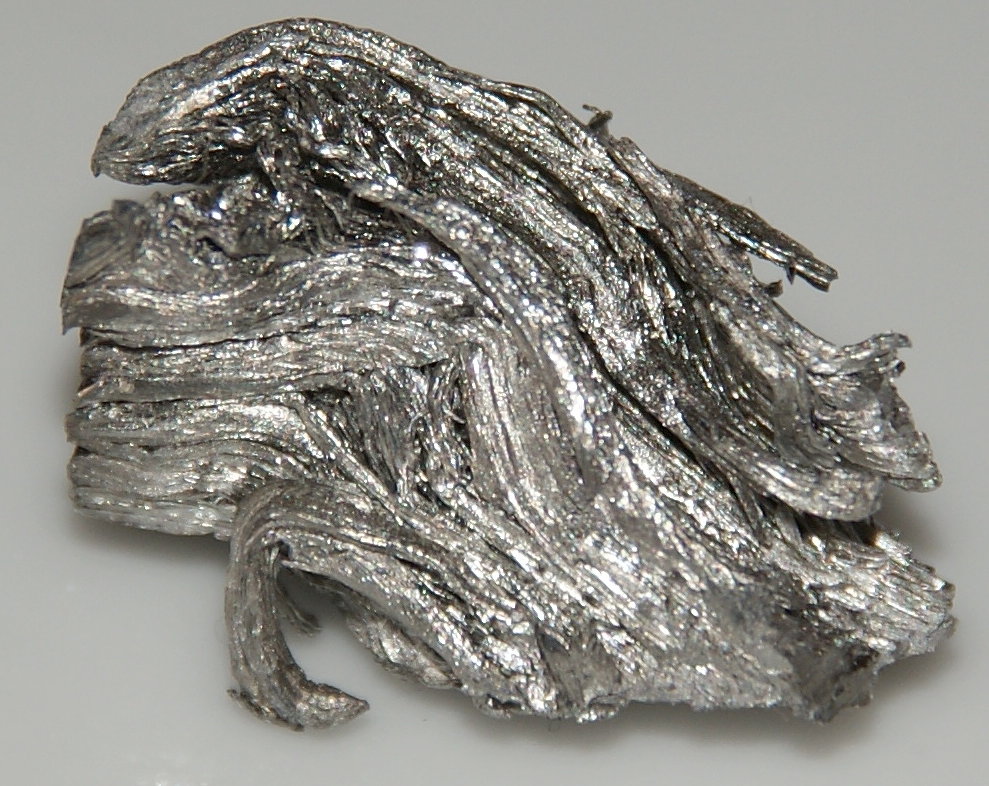
Holmium is a chemical element; it has symbol Ho and atomic number 67. It is a rare-earth element and the eleventh member of the lanthanide series. It is a relatively soft, silvery, fairly corrosion-resistant and malleable metal. Like many other lanthanides, holmium is too reactive to be found in native form, as pure holmium slowly forms a yellowish oxide coating when exposed to air. When isolated, holmium is relatively stable in dry air at room temperature. However, it reacts with water and corrodes readily, and also burns in air when heated.
In nature, holmium occurs together with the other rare-earth metals (like thulium). It is a relatively rare lanthanide, making up 1.4 parts per million of the Earth's crust, an abundance similar to tungsten. Holmium was discovered through isolation by Swedish chemist Per Theodor Cleve. It was also independently discovered by Jacques-Louis Soret and Marc Delafontaine, who together observed it spectroscopically in 1878. Its oxide was first isolated from rare-earth ores by Cleve in 1878. The element's name comes from Holmia, the Latin name for the city of Stockholm.
Like many other lanthanides, holmium is found in the minerals monazite and gadolinite and is usually commercially extracted from monazite using ion-exchange techniques. Its compounds in nature and in nearly all of its laboratory chemistry are trivalently oxidized, containing Ho(III) ions. Trivalent holmium ions have fluorescent properties similar to many other rare-earth ions (while yielding their own set of unique emission light lines), and thus are used in the same way as some other rare earths in certain laser and glass-colorant applications.
Holmium has the highest magnetic permeability and magnetic saturation of any element and is thus used for the pole pieces of the strongest static magnets. Because holmium strongly absorbs neutrons, it is also used as a burnable poison in nuclear reactors.
Holmium is the eleventh member of the lanthanide series. In the periodic table, it appears in period 6, between the lanthanides dysprosium to its left and erbium to its right, and above the actinide einsteinium.
With a boiling point of 3,000 K (2,727 °C; 4,940 °F), holmium is the sixth most volatile lanthanide after ytterbium, europium, samarium, thulium and dysprosium. At standard temperature and pressure, holmium, like many of the second half of the lanthanides, normally assumes a hexagonally close-packed (hcp) structure. Its 67 electrons are arranged in the configuration [Xe] 4f11 6s2, so that it has thirteen valence electrons filling the 4f and 6s subshells.
Holmium, like all of the lanthanides, is paramagnetic at standard temperature and pressure. However, holmium is ferromagnetic at temperatures below 19 K (−254.2 °C; −425.5 °F). It has the highest magnetic moment (10.6 μB) of any naturally occurring element and possesses other unusual magnetic properties. When combined with yttrium, it forms highly magnetic compounds.
Holmium metal tarnishes slowly in air, forming a yellowish oxide layer that has an appearance similar to that of iron rust. It burns readily to form holmium(III) oxide:
Hub AI
Holmium AI simulator
(@Holmium_simulator)
Holmium
Holmium is a chemical element; it has symbol Ho and atomic number 67. It is a rare-earth element and the eleventh member of the lanthanide series. It is a relatively soft, silvery, fairly corrosion-resistant and malleable metal. Like many other lanthanides, holmium is too reactive to be found in native form, as pure holmium slowly forms a yellowish oxide coating when exposed to air. When isolated, holmium is relatively stable in dry air at room temperature. However, it reacts with water and corrodes readily, and also burns in air when heated.
In nature, holmium occurs together with the other rare-earth metals (like thulium). It is a relatively rare lanthanide, making up 1.4 parts per million of the Earth's crust, an abundance similar to tungsten. Holmium was discovered through isolation by Swedish chemist Per Theodor Cleve. It was also independently discovered by Jacques-Louis Soret and Marc Delafontaine, who together observed it spectroscopically in 1878. Its oxide was first isolated from rare-earth ores by Cleve in 1878. The element's name comes from Holmia, the Latin name for the city of Stockholm.
Like many other lanthanides, holmium is found in the minerals monazite and gadolinite and is usually commercially extracted from monazite using ion-exchange techniques. Its compounds in nature and in nearly all of its laboratory chemistry are trivalently oxidized, containing Ho(III) ions. Trivalent holmium ions have fluorescent properties similar to many other rare-earth ions (while yielding their own set of unique emission light lines), and thus are used in the same way as some other rare earths in certain laser and glass-colorant applications.
Holmium has the highest magnetic permeability and magnetic saturation of any element and is thus used for the pole pieces of the strongest static magnets. Because holmium strongly absorbs neutrons, it is also used as a burnable poison in nuclear reactors.
Holmium is the eleventh member of the lanthanide series. In the periodic table, it appears in period 6, between the lanthanides dysprosium to its left and erbium to its right, and above the actinide einsteinium.
With a boiling point of 3,000 K (2,727 °C; 4,940 °F), holmium is the sixth most volatile lanthanide after ytterbium, europium, samarium, thulium and dysprosium. At standard temperature and pressure, holmium, like many of the second half of the lanthanides, normally assumes a hexagonally close-packed (hcp) structure. Its 67 electrons are arranged in the configuration [Xe] 4f11 6s2, so that it has thirteen valence electrons filling the 4f and 6s subshells.
Holmium, like all of the lanthanides, is paramagnetic at standard temperature and pressure. However, holmium is ferromagnetic at temperatures below 19 K (−254.2 °C; −425.5 °F). It has the highest magnetic moment (10.6 μB) of any naturally occurring element and possesses other unusual magnetic properties. When combined with yttrium, it forms highly magnetic compounds.
Holmium metal tarnishes slowly in air, forming a yellowish oxide layer that has an appearance similar to that of iron rust. It burns readily to form holmium(III) oxide:
Recent media