




Community hub
Recent from talks
Contribute something to knowledge base
Content stats: 0 posts, 0 articles, 1 media, 0 notes
Members stats: 0 subscribers, 0 contributors, 0 moderators, 0 supporters
Subscribers
Supporters
Contributors
Moderators
Holography
Holography is a technique that allows a wavefront to be recorded and later reconstructed. It is best known as a method of generating three-dimensional images, and has a wide range of other uses, including data storage, microscopy, and interferometry. In principle, it is possible to make a hologram for any type of wave.
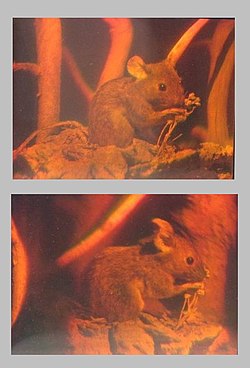
A hologram is a recording of an interference pattern that can reproduce a 3D light field using diffraction. In general usage, a hologram is a recording of any type of wavefront in the form of an interference pattern. It can be created by capturing light from a real scene, or it can be generated by a computer, in which case it is known as a computer-generated hologram, which can show virtual objects or scenes. Optical holography needs a laser light to record the light field. The reproduced light field can generate an image that has the depth and parallax of the original scene. A hologram is usually unintelligible when viewed under diffuse ambient light. When suitably lit, the interference pattern diffracts the light into an accurate reproduction of the original light field, and the objects that were in it exhibit visual depth cues such as parallax and perspective that change realistically with the different angles of viewing. That is, the view of the image from different angles shows the subject viewed from similar angles.
A hologram is traditionally generated by overlaying a second wavefront, known as the reference beam, onto a wavefront of interest. This generates an interference pattern, which is then captured on a physical medium. When the recorded interference pattern is later illuminated by the second wavefront, it is diffracted to recreate the original wavefront. The 3D image from a hologram can often be viewed with non-laser light. However, in common practice, major image quality compromises are made to remove the need for laser illumination to view the hologram.
A computer-generated hologram is created by digitally modeling and combining two wavefronts to generate an interference pattern image. This image can then be printed onto a mask or film and illuminated with an appropriate light source to reconstruct the desired wavefront. Alternatively, the interference pattern image can be directly displayed on a dynamic holographic display.
Holographic portraiture often resorts to a non-holographic intermediate imaging procedure, to avoid the dangerous high-powered pulsed lasers which would be needed to optically "freeze" moving subjects as perfectly as the extremely motion-intolerant holographic recording process requires. Early holography required high-power and expensive lasers. Currently, mass-produced low-cost laser diodes, such as those found on DVD recorders and used in other common applications, can be used to make holograms. They have made holography much more accessible to low-budget researchers, artists, and dedicated hobbyists.
Most holograms produced are of static objects, but systems for displaying changing scenes on dynamic holographic displays are now being developed.
The word holography comes from the Greek words ὅλος (holos; "whole") and γραφή (graphē; "writing" or "drawing").
The Hungarian-British physicist Dennis Gabor invented holography in 1948 while he was looking for a way to improve image resolution in electron microscopes. Gabor's work was built on pioneering work in the field of X-ray microscopy by other scientists including Mieczysław Wolfke in 1920 and William Lawrence Bragg in 1939. The formulation of holography was an unexpected result of Gabor's research into improving electron microscopes at the British Thomson-Houston Company (BTH) in Rugby, England, and the company filed a patent in December 1947 (patent GB685286). The technique as originally invented is still used in electron microscopy, where it is known as electron holography. Gabor was awarded the Nobel Prize in Physics in 1971 "for his invention and development of the holographic method".
Holography
Holography is a technique that allows a wavefront to be recorded and later reconstructed. It is best known as a method of generating three-dimensional images, and has a wide range of other uses, including data storage, microscopy, and interferometry. In principle, it is possible to make a hologram for any type of wave.
A hologram is a recording of an interference pattern that can reproduce a 3D light field using diffraction. In general usage, a hologram is a recording of any type of wavefront in the form of an interference pattern. It can be created by capturing light from a real scene, or it can be generated by a computer, in which case it is known as a computer-generated hologram, which can show virtual objects or scenes. Optical holography needs a laser light to record the light field. The reproduced light field can generate an image that has the depth and parallax of the original scene. A hologram is usually unintelligible when viewed under diffuse ambient light. When suitably lit, the interference pattern diffracts the light into an accurate reproduction of the original light field, and the objects that were in it exhibit visual depth cues such as parallax and perspective that change realistically with the different angles of viewing. That is, the view of the image from different angles shows the subject viewed from similar angles.
A hologram is traditionally generated by overlaying a second wavefront, known as the reference beam, onto a wavefront of interest. This generates an interference pattern, which is then captured on a physical medium. When the recorded interference pattern is later illuminated by the second wavefront, it is diffracted to recreate the original wavefront. The 3D image from a hologram can often be viewed with non-laser light. However, in common practice, major image quality compromises are made to remove the need for laser illumination to view the hologram.
A computer-generated hologram is created by digitally modeling and combining two wavefronts to generate an interference pattern image. This image can then be printed onto a mask or film and illuminated with an appropriate light source to reconstruct the desired wavefront. Alternatively, the interference pattern image can be directly displayed on a dynamic holographic display.
Holographic portraiture often resorts to a non-holographic intermediate imaging procedure, to avoid the dangerous high-powered pulsed lasers which would be needed to optically "freeze" moving subjects as perfectly as the extremely motion-intolerant holographic recording process requires. Early holography required high-power and expensive lasers. Currently, mass-produced low-cost laser diodes, such as those found on DVD recorders and used in other common applications, can be used to make holograms. They have made holography much more accessible to low-budget researchers, artists, and dedicated hobbyists.
Most holograms produced are of static objects, but systems for displaying changing scenes on dynamic holographic displays are now being developed.
The word holography comes from the Greek words ὅλος (holos; "whole") and γραφή (graphē; "writing" or "drawing").
The Hungarian-British physicist Dennis Gabor invented holography in 1948 while he was looking for a way to improve image resolution in electron microscopes. Gabor's work was built on pioneering work in the field of X-ray microscopy by other scientists including Mieczysław Wolfke in 1920 and William Lawrence Bragg in 1939. The formulation of holography was an unexpected result of Gabor's research into improving electron microscopes at the British Thomson-Houston Company (BTH) in Rugby, England, and the company filed a patent in December 1947 (patent GB685286). The technique as originally invented is still used in electron microscopy, where it is known as electron holography. Gabor was awarded the Nobel Prize in Physics in 1971 "for his invention and development of the holographic method".
Recent media
Recent media