


Community hub
Recent from talks
Contribute something to knowledge base
Content stats: 0 posts, 0 articles, 1 media, 0 notes
Members stats: 0 subscribers, 0 contributors, 0 moderators, 0 supporters
Subscribers
Supporters
Contributors
Moderators
Holyrood Palace
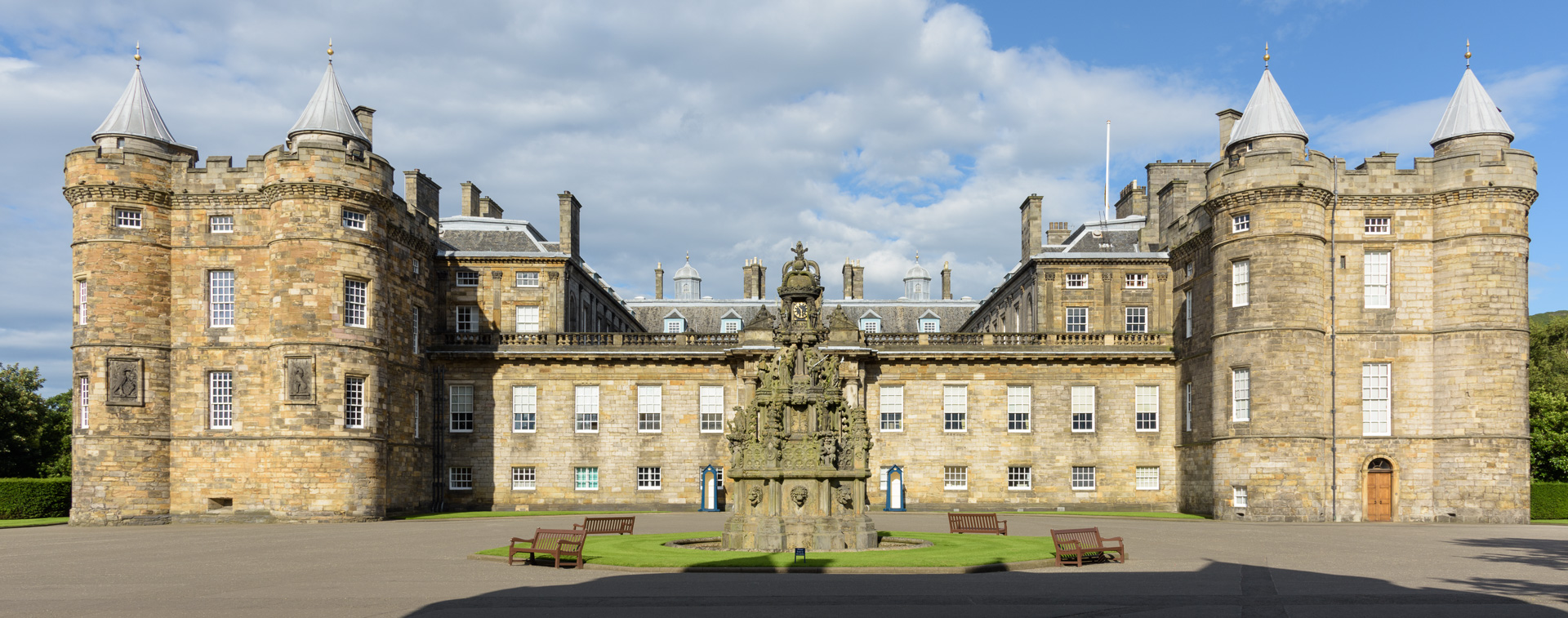
The Palace of Holyroodhouse (/ˈhɒlɪruːd/ or /ˈhoʊlɪruːd/), also known as Holyrood Palace, is the official residence of the British monarch in Scotland. Located at the bottom of the Royal Mile in Edinburgh, at the opposite end to Edinburgh Castle, Holyrood has served as the principal royal residence in Scotland since the 16th century, and is a setting for state occasions and official entertaining.
The palace adjoins Holyrood Abbey, and the gardens are set within Holyrood Park. The King's Gallery was converted from existing buildings at the western entrance to the palace and was opened in 2002 to exhibit works of art from the Royal Collection.
King Charles III spends one week in residence at Holyrood at the beginning of summer, where he carries out a range of official engagements and ceremonies. The 16th-century historic apartments of Mary, Queen of Scots, and the State Apartments, used for official and state entertaining, are open to the public throughout the year, except when members of the royal family are in residence. The palace also serves as the official residence of the Lord High Commissioner to the General Assembly of the Church of Scotland during the annual meeting of the General Assembly.
The ruined Augustinian Holyrood Abbey that stands next to the palace was founded in 1128 on the orders of King David I. The name derives either from a legendary vision of the cross witnessed by David I, or from a relic of the True Cross known as the Holy Rood or Black Rood, which had belonged to Saint Margaret, David's mother. As a royal foundation, and sited close to Edinburgh Castle, it became an important administrative centre. A Papal legate was received here in 1177, while in 1189 a council of nobles met to discuss a ransom for the captive William the Lion. The Parliament of Scotland met at the abbey seven times between 1256 and 1410, and in 1328 the Treaty of Edinburgh–Northampton was signed by Robert the Bruce in the 'King's Chamber' at the abbey, indicating that it may already have been in use as a royal residence. In 1371, David II became the first of several kings to be buried at Holyrood Abbey, and James II was born, crowned, married, and buried there. James III and Margaret of Denmark were married at Holyrood in 1469. The early royal residence was in the abbey guesthouse, and by the later 15th century the king occupied dedicated royal lodgings.
Between 1501 and 1505, James IV constructed a Gothic palace adjacent to the abbey. The impetus for the work probably came from the marriage of James IV to Margaret Tudor, which took place in the abbey in August 1503 while work was still ongoing. The palace was built around a quadrangle, situated west of the abbey cloister. It contained a chapel, gallery, royal apartments, and a great hall. The chapel occupied the north range of the quadrangle, with the queen's apartments occupying part of the south range. The west range contained the king's lodgings and the entrance to the palace. The master mason Walter Merlioun built a two-storey gatehouse, which was demolished in 1753, although fragments of it remain in the 19th-century Abbey Court House which stands on Abbey Strand. The upper floor of the gatehouse was a workshop for the glazier Thomas Peebles until 1537, when it was converted into a space for mending the royal tapestries. In 1512 a lion house and menagerie were constructed in the palace gardens to house the king's lion, civet, tigers, lynx, and bears. James IV held tournaments of the Wild Knight and the Black Lady in Edinburgh in 1507 and 1508. These events concluded with banquets in the great hall. As the final act of these theatrical events, the Black Lady came into the hall with her Spanish page "Little Martin". A cloud descended from the roof and swept them both away.
James V added to the palace between 1528 and 1536, beginning with the present James V's Tower, which is the oldest surviving part of the palace. This huge rectangular tower, rounded at the corners, provided new royal lodgings at the north-west corner of the palace. Originally equipped with a drawbridge leading to the main entrance (protected with a yett) on the first floor, it may also have been protected by a moat, and provided a high degree of security. The south range was remodelled, and the old queen's apartments were converted into a new chapel, and the former chapel in the north range was converted into the Council Chamber, where ceremonial events normally took place. James IV's west range was demolished and a new west range in the Renaissance style was built to house new state rooms, including the royal library. The symmetrical composition of the west range suggested that a second tower at the south-west was planned, though this was never executed at the time. Around a series of lesser courts were ranged the Governor's Tower, the armoury, the mint, a forge, kitchens, and other service quarters. James V's first wife, Madeleine of Valois, died at Holyrood in 1537.
The English armies of the Earl of Hertford sacked Edinburgh and caused extensive damage to the palace and the abbey in 1544 and 1547 during the War of the Rough Wooing. Repairs were made by Mary of Guise, and in May 1559 she had a new altarpiece installed in the chapel royal, featuring paintings from Flanders set in a frame made by a French carpenter Andrew Mansioun. The altars were destroyed by a Protestant mob later in the same year, and after the Scottish Reformation was formalised, the abbey buildings were neglected. The choir and transepts of the abbey church were pulled down in 1570. The nave was retained as the parish church of the Canongate. The royal apartments in James V's Tower were occupied by Mary, Queen of Scots from her return to Scotland in 1561 to her forced abdication in 1567. The palace was heated with coal from Wallyford in East Lothian. The queen had archery butts erected in the south gardens to allow her to practise, and she hunted deer in Holyrood Park. There was also a flock of sheep in the park which were managed for the queen by the keeper, John Huntar. Some of her French servants formed relationships with women in the Canongate. The Kirk authorities disapproved and made five of these unmarried women stand with bared heads at the cross near the palace for three hours in December 1564. The series of famous audiences Mary gave to John Knox took place in her audience chamber at Holyrood, and she married her second husband, Henry Stewart, Lord Darnley, in her private chapel in July 1565. It was in the royal apartments that Mary witnessed the murder of David Rizzio, her private secretary, on 9 March 1566. Darnley and several nobles entered the queen's apartments via the private stair from Darnley's own apartments below. Bursting in on the queen, Rizzio and four other courtiers, who were at supper, they dragged Rizzio through the bedchamber and into the outer chamber, where he was stabbed to death, allegedly receiving fifty-seven dagger wounds. Mary married her third husband, James Hepburn, 4th Earl of Bothwell, at the palace in May 1567.
During the subsequent Marian civil war, on 25 July 1571, William Kirkcaldy of Grange bombarded the king's men garrisoned inside the palace with cannon positioned in the Black Friar Yard, near the Pleasance. Parliament met in the Palace on 30 April 1573. James VI took up residence at Holyrood in 1579 when he began his personal rule. The palace was refurbished by William MacDowall with a new north gallery painted by Walter Binning, and an apartment for the king's favourite, Esmé Stewart. The coronation of James's queen, Anne of Denmark, took place in Holyrood Abbey in 1590, at which time the royal household at the palace numbered around 600 persons.
Holyrood Palace
The Palace of Holyroodhouse (/ˈhɒlɪruːd/ or /ˈhoʊlɪruːd/), also known as Holyrood Palace, is the official residence of the British monarch in Scotland. Located at the bottom of the Royal Mile in Edinburgh, at the opposite end to Edinburgh Castle, Holyrood has served as the principal royal residence in Scotland since the 16th century, and is a setting for state occasions and official entertaining.
The palace adjoins Holyrood Abbey, and the gardens are set within Holyrood Park. The King's Gallery was converted from existing buildings at the western entrance to the palace and was opened in 2002 to exhibit works of art from the Royal Collection.
King Charles III spends one week in residence at Holyrood at the beginning of summer, where he carries out a range of official engagements and ceremonies. The 16th-century historic apartments of Mary, Queen of Scots, and the State Apartments, used for official and state entertaining, are open to the public throughout the year, except when members of the royal family are in residence. The palace also serves as the official residence of the Lord High Commissioner to the General Assembly of the Church of Scotland during the annual meeting of the General Assembly.
The ruined Augustinian Holyrood Abbey that stands next to the palace was founded in 1128 on the orders of King David I. The name derives either from a legendary vision of the cross witnessed by David I, or from a relic of the True Cross known as the Holy Rood or Black Rood, which had belonged to Saint Margaret, David's mother. As a royal foundation, and sited close to Edinburgh Castle, it became an important administrative centre. A Papal legate was received here in 1177, while in 1189 a council of nobles met to discuss a ransom for the captive William the Lion. The Parliament of Scotland met at the abbey seven times between 1256 and 1410, and in 1328 the Treaty of Edinburgh–Northampton was signed by Robert the Bruce in the 'King's Chamber' at the abbey, indicating that it may already have been in use as a royal residence. In 1371, David II became the first of several kings to be buried at Holyrood Abbey, and James II was born, crowned, married, and buried there. James III and Margaret of Denmark were married at Holyrood in 1469. The early royal residence was in the abbey guesthouse, and by the later 15th century the king occupied dedicated royal lodgings.
Between 1501 and 1505, James IV constructed a Gothic palace adjacent to the abbey. The impetus for the work probably came from the marriage of James IV to Margaret Tudor, which took place in the abbey in August 1503 while work was still ongoing. The palace was built around a quadrangle, situated west of the abbey cloister. It contained a chapel, gallery, royal apartments, and a great hall. The chapel occupied the north range of the quadrangle, with the queen's apartments occupying part of the south range. The west range contained the king's lodgings and the entrance to the palace. The master mason Walter Merlioun built a two-storey gatehouse, which was demolished in 1753, although fragments of it remain in the 19th-century Abbey Court House which stands on Abbey Strand. The upper floor of the gatehouse was a workshop for the glazier Thomas Peebles until 1537, when it was converted into a space for mending the royal tapestries. In 1512 a lion house and menagerie were constructed in the palace gardens to house the king's lion, civet, tigers, lynx, and bears. James IV held tournaments of the Wild Knight and the Black Lady in Edinburgh in 1507 and 1508. These events concluded with banquets in the great hall. As the final act of these theatrical events, the Black Lady came into the hall with her Spanish page "Little Martin". A cloud descended from the roof and swept them both away.
James V added to the palace between 1528 and 1536, beginning with the present James V's Tower, which is the oldest surviving part of the palace. This huge rectangular tower, rounded at the corners, provided new royal lodgings at the north-west corner of the palace. Originally equipped with a drawbridge leading to the main entrance (protected with a yett) on the first floor, it may also have been protected by a moat, and provided a high degree of security. The south range was remodelled, and the old queen's apartments were converted into a new chapel, and the former chapel in the north range was converted into the Council Chamber, where ceremonial events normally took place. James IV's west range was demolished and a new west range in the Renaissance style was built to house new state rooms, including the royal library. The symmetrical composition of the west range suggested that a second tower at the south-west was planned, though this was never executed at the time. Around a series of lesser courts were ranged the Governor's Tower, the armoury, the mint, a forge, kitchens, and other service quarters. James V's first wife, Madeleine of Valois, died at Holyrood in 1537.
The English armies of the Earl of Hertford sacked Edinburgh and caused extensive damage to the palace and the abbey in 1544 and 1547 during the War of the Rough Wooing. Repairs were made by Mary of Guise, and in May 1559 she had a new altarpiece installed in the chapel royal, featuring paintings from Flanders set in a frame made by a French carpenter Andrew Mansioun. The altars were destroyed by a Protestant mob later in the same year, and after the Scottish Reformation was formalised, the abbey buildings were neglected. The choir and transepts of the abbey church were pulled down in 1570. The nave was retained as the parish church of the Canongate. The royal apartments in James V's Tower were occupied by Mary, Queen of Scots from her return to Scotland in 1561 to her forced abdication in 1567. The palace was heated with coal from Wallyford in East Lothian. The queen had archery butts erected in the south gardens to allow her to practise, and she hunted deer in Holyrood Park. There was also a flock of sheep in the park which were managed for the queen by the keeper, John Huntar. Some of her French servants formed relationships with women in the Canongate. The Kirk authorities disapproved and made five of these unmarried women stand with bared heads at the cross near the palace for three hours in December 1564. The series of famous audiences Mary gave to John Knox took place in her audience chamber at Holyrood, and she married her second husband, Henry Stewart, Lord Darnley, in her private chapel in July 1565. It was in the royal apartments that Mary witnessed the murder of David Rizzio, her private secretary, on 9 March 1566. Darnley and several nobles entered the queen's apartments via the private stair from Darnley's own apartments below. Bursting in on the queen, Rizzio and four other courtiers, who were at supper, they dragged Rizzio through the bedchamber and into the outer chamber, where he was stabbed to death, allegedly receiving fifty-seven dagger wounds. Mary married her third husband, James Hepburn, 4th Earl of Bothwell, at the palace in May 1567.
During the subsequent Marian civil war, on 25 July 1571, William Kirkcaldy of Grange bombarded the king's men garrisoned inside the palace with cannon positioned in the Black Friar Yard, near the Pleasance. Parliament met in the Palace on 30 April 1573. James VI took up residence at Holyrood in 1579 when he began his personal rule. The palace was refurbished by William MacDowall with a new north gallery painted by Walter Binning, and an apartment for the king's favourite, Esmé Stewart. The coronation of James's queen, Anne of Denmark, took place in Holyrood Abbey in 1590, at which time the royal household at the palace numbered around 600 persons.
Recent media
Recent media