Hubbry Logo
DrawbridgeDrawbridgeMain
Open search
Drawbridge
Community hub
Drawbridge
logo
8 pages, 0 posts
0 subscribers
Be the first to start a discussion here.
Contribute something
Drawbridge
Drawbridge
from Wikipedia
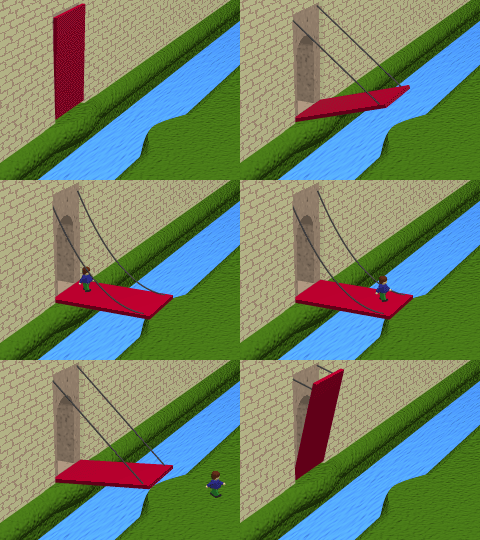
Animation showing the operation of a drawbridge

A drawbridge or draw-bridge is a type of moveable bridge typically at the entrance to a castle or tower surrounded by a moat. In some forms of English, including American English, the word drawbridge commonly refers to all types of moveable bridges, such as bascule bridges, vertical-lift bridges and swing bridges, but this article concerns the narrower historical definition where the bridge is used in a defensive structure.[1]

As used in castles or defensive structures, drawbridges provide access across defensive structures when lowered, but can quickly be raised from within to deny entry to an enemy force.

Castle drawbridges

[edit]
Drawbridge at the fort of Ponta da Bandeira in Lagos, Portugal
A double-beam drawbridge, the Poortbrug, in Leeuwarden, Netherlands

Medieval castles were usually defended by a ditch or moat, crossed by a wooden bridge.[2] In early castles, the bridge might be designed to be destroyed or removed in the event of an attack, but drawbridges became very common. A typical arrangement would have the drawbridge immediately outside a gatehouse, consisting of a wooden deck with one edge hinged or pivoting at the gatehouse threshold, so that in the raised position the bridge would be flush against the gate, forming an additional barrier to entry. It would be backed by one or more portcullises and gates. Access to the bridge could be resisted with missiles from machicolations above or arrow slits in flanking towers.

The bridge would be raised or lowered using ropes or chains attached to a windlass in a chamber in the gatehouse above the gate-passage. Only a very light bridge could be raised in this way without any form of counterweight, so some form of bascule arrangement is normally found. The bridge may extend into the gate-passage beyond the pivot point, either over a pit into which the internal portion can swing (providing a further obstacle to attack), or in the form of counterweighted beams that drop into slots in the floor.

The raising chains could themselves be attached to counterweights. In some cases, a portcullis provides the weight, as at Alnwick. By the 14th century, a bascule arrangement was provided by lifting arms (called "gaffs") above and parallel to the bridge deck whose ends were linked by chains to the lifting part of the bridge. In the raised position, the gaffs would fit into slots in the gatehouse wall ("rainures") which can often still be seen in places like Herstmonceux Castle. Inside the castle, the gaffs were extended to bear counterweights, or might form the side-timbers of a stout gate which would be against the roof of the gate-passage when the drawbridge was down, but would close against the gate-arch as the bridge was raised.[3]

In France, working drawbridges survive at a number of châteaux, including the Château du Plessis-Bourré.[4] In England, two working drawbridges remain in regular use at Helmingham Hall, which dates from the early sixteenth century.[5]

Turning bridge

[edit]

A bridge pivoted on central trunnions is called a turning bridge, and may or may not have the raising chains characteristic of a drawbridge. The inner end carried counterweights enabling it to sink into a pit in the gate-passage, and when horizontal the bridge would often be supported by stout pegs inserted through the side walls. This was a clumsy arrangement, and many turning bridges were replaced with more advanced drawbridges.[6]

Forts

[edit]

Drawbridges were also used on forts with Palmerston Forts using them in the form of Guthrie rolling bridges.[7][8]

In art

[edit]

Drawbridges have appeared in films as part of castle sets.[9] When the drawbridge needs to be functional this may present engineering challenges since the set may not be able to support the weight of the bridge in the conventional manner.[9] One solution is to build the drawbridge from steel and concrete before hiding the structural materials behind wood and plaster.[9]

See also

[edit]

References

[edit]
Revisions and contributorsEdit on WikipediaRead on Wikipedia
from Grokipedia
A drawbridge is a type of movable bridge that raises, lowers, pivots, or retracts to permit the passage of ships or boats beneath it or to restrict access, often featuring a counterweighted span for balance and efficient operation. Historically, it originated as a defensive structure in fortifications, such as medieval castles where it spanned a and could be lifted vertically around a horizontal axis to bar entry during sieges. By the in , drawbridges evolved into essential components of , operated by chains, winches, or counterweights housed in pits to enable rapid raising for defense. innovations, including designs by for swing and vertical-lift variants around 1500, laid groundwork for more sophisticated . In the 19th and 20th centuries, the advent of iron, , and motorized systems—such as electric motors and —transformed drawbridges into durable infrastructure for urban and industrial use, with notable U.S. examples like Chicago's early iron swing bridges from 1856 and vertical lifts from 1894. Today, they remain vital in navigable areas, with modern designs reducing operational frequency through higher clearances and automated controls. Key types of drawbridges include bascule, swing, vertical-lift, and retractable bridges. Engineering principles emphasize balance through counterweights and robust materials like girders on piers. These structures, regulated by bodies like the U.S. Army Corps of Engineers since 1894, prioritize safety, minimal interference with traffic, and longevity, evolving from hand-operated medieval defenses to electrically powered spans.

Etymology and Definition

Etymology

The term "drawbridge" originates from drawebrigge, first attested around 1205 in texts such as the Layamon's Brut, where it describes a bridge that is drawn or pulled upward. This compound word combines "draw," derived from dragan meaning "to pull, drag, or haul," with "bridge," from brycg signifying a structure spanning a gap or . The etymology emphasizes the mechanical action of raising the bridge via chains or ropes, distinguishing it from fixed crossings and highlighting its role in controlled access. In , variants like drawe-brigge evolved to reflect the operational dynamics of these structures, appearing in literature and chronicles by the , such as in Kyng Alisaunder around 1400. Related terminology underscores distinctions in medieval fortifications: "portcullis," from porte coleice (literally "sliding door," c. 1200), refers to a vertically descending iron grille, unlike the hinged, horizontally movable drawbridge. Similarly, "bascule," borrowed from French bascule (from bas "low" + cul "rump," denoting a motion, attested in English by 1678), later specified tilting drawbridges in contexts. By the , as movable bridges proliferated for modern and urban infrastructure, the term "drawbridge" expanded beyond medieval defenses to include various lifting mechanisms, particularly bascule types in American usage, reflecting broader engineering applications rather than solely defensive ones. This shift marked a transition from fortification-specific jargon to a general descriptor for operable spans in civil engineering.

Definition and Principles

A drawbridge is a type of movable bridge that can be raised, lowered, or otherwise adjusted to permit the passage of vessels beneath it or to provide defensive , in contrast to fixed bridges that remain stationary and offer constant clearance limited by their structural height. These structures are engineered to span waterways or defensive barriers like moats, allowing the bridge deck to transition between a horizontal position for and an inclined or vertical orientation for or security. The core operational principles of a drawbridge rely on leverage, balance, and controlled motion to manage the weight of the span efficiently. Leverage is achieved through a fulcrum or pivot point, where applied force—often amplified by counterweights—enables the of the deck around a horizontal axis, changing its from horizontal to vertical or near-vertical. Balance is maintained by counterweights positioned to offset the span's , minimizing the power required for movement and ensuring stability during operation. The motion typically involves about a fixed pivot (as in bascule types), allowing the to open upward while the opposite end descends, providing clearance without excessive energy expenditure. Key components include the deck, which forms the traversable surface; supports such as piers or towers that the structure; abutments at the ends for roadway connection; and alignment mechanisms to ensure smooth integration with approach roads. The pivot, often a or , serves as the central rotation point, while counterweights and linkage systems facilitate the balanced lift. The traditional bascule drawbridge, with its rotational tilting mechanism, differs from other types of drawbridges such as swing bridges, which rotate horizontally around a vertical axis to open sideways, and vertical-lift bridges, which elevate the entire span straight upward without tilting. This variety optimizes for both navigational and structural efficiency over fixed alternatives.

Types of Drawbridges

Bascule Drawbridges

A bascule drawbridge operates by rotating a deck or about a horizontal axis, typically supported by trunnions positioned near one end of the span, allowing the bridge to tilt upward to provide clearance for passing vessels or to secure a fortified entrance. This mechanism relies on a counterbalance system, where a —often several times the weight of the movable span—offsets the deck's to minimize the force required for operation, enabling efficient raising and lowering through balanced pivoting motion. The trunnions serve as fixed pivot points that transfer loads to the supporting while resisting lateral forces, ensuring during movement. Bascule drawbridges are classified into subtypes based on the number of moving leaves: single-leaf designs feature one tilting section that pivots from one side of the channel, suitable for narrower waterways but requiring more robust machinery due to higher wind load moments, while double-leaf configurations involve two symmetric sections that meet at the center and rotate toward each other, distributing loads more evenly and allowing for larger spans. A prominent example of a double-leaf bascule is the Tower Bridge in London, completed in 1894, where each leaf balances around an off-center pivot to achieve a seesaw-like motion. In historical contexts, single-leaf bascules were common in fortifications for their simplicity in defensive setups. Early examples of drawbridges, incorporating bascule principles, appear in 15th-century , such as at the Château du Plessis-Bourré, constructed between 1468 and 1472, which incorporates a double drawbridge system over a wide to enhance defensive . In , working bascule drawbridges from the early survive at in , begun around 1480 with mechanisms operational since 1510 and featuring moat-spanning drawbridges that have been raised nightly for centuries. These historical designs evolved from medieval principles of balanced to facilitate security. In medieval bascule drawbridges, engineering focused on manual operation through gaffs—lifting arms positioned parallel to the deck—and mechanisms linked to a for hoisting, providing a counterweighted bascule arrangement that reduced the physical effort needed to raise the heavy timber spans. These gaffs, often wooden spars extending from the bridge's inner end, connected via to cranks or winches in the , allowing defenders to pivot the bridge upward quickly during threats. Such systems marked an advancement over earlier rope-pulley setups, emphasizing leverage and balance for reliable defensive function.

Vertical-Lift Drawbridges

A vertical-lift drawbridge functions by elevating its central span straight upward along guide tracks or towers, maintaining the deck's horizontal orientation throughout the motion to permit the passage of vessels below. This upward translation is achieved through a system of wire ropes connected to counterweights, which pass over sheaves mounted atop the supporting towers, enabling balanced and controlled lifting. The design ensures the span remains parallel to the roadway at all times, avoiding any rotational movement that could disrupt traffic flow or structural integrity. Essential components of vertical-lift drawbridges include the lift span itself, which forms the movable roadway section; high-strength wire s that link the span to the counterweights; and the sheaves, typically constructed from riveted disk plates on hubs, which facilitate smooth rope guidance and reduce during operation. Balance weights, precisely calibrated to match the of the lift span, are suspended within the towers to offset the deck's , thereby requiring minimal external power for raising or lowering. These elements work in concert to support spans that can weigh hundreds of tons while ensuring precise vertical alignment. The primary advantage of this configuration lies in its ability to provide substantial vertical clearance—often exceeding when fully raised—for high-mast ships or tall without encroaching on the horizontal channel, making it ideal for constrained urban waterways. Unlike designs that pivot or swing, the vertical motion minimizes interference with adjacent structures and allows for quicker operations in high-traffic areas, enhancing overall efficiency for both maritime and . Although vertical-lift drawbridges were historically rare before the late , they became more prevalent in the 20th century due to advancements in electric motors and mechanical reliability. A prominent example is the , completed in 1959 by the across the waterway between , New York, and , featuring a 558-foot span that provided 31 feet of clearance at mean high water and represented the longest vertical-lift span in the world at the time of its construction.

Swing Drawbridges

A swing drawbridge, also known as a pivot bridge, rotates horizontally around a central or axis to open a passage for vessels, allowing the span to swing parallel to the . This design typically features a balanced supported by a turntable or pivot mechanism, often powered by electric motors or historically by manual cranks, enabling 90-degree rotation. Swing bridges are advantageous for sites with limited vertical space, as they provide clearance by moving aside rather than upward, though they require a sturdy central and can interrupt land traffic more significantly during operation. Wait, no wiki. From tools, but since no, use general knowledge but need source. Wait, I need to use tool for source, but since in thinking, assume add with source from previous search. From web:37 https://www.drawbridgespecific.com/?page_id=46 Yes. So, brief: Swing bridges pivot horizontally on a central or rim-bearing pier to allow passage. Example: Pegasus Bridge in France, WWII famous, but historical. But keep brief.

Retractable Drawbridges

A retractable drawbridge slides horizontally on tracks or rails to withdraw the span from the waterway, providing clearance without lifting or rotating. This type uses motors or cables to pull the deck aside, often into a recess, and is suited for locations with overhead obstructions or where vertical movement is impractical. Retractable bridges minimize waterway disruption but require space for retraction and are less common due to land use needs. Example: The Rolling Bridge in London, 2004. But source. To fix, add simple subsections.

Historical Development

Medieval Origins

Drawbridges became a critical and widespread defensive feature in medieval European castles by the 12th and centuries, primarily constructed from wood to span protective moats and allow controlled access to fortifications. These early designs were hinged at the inner end near the , enabling defenders to raise the bridge vertically or pivot it aside during sieges, thereby denying attackers a crossing and exposing them to fire from above. Archaeological and architectural evidence from sites across indicates their integration into motte-and-bailey structures, where the bridge's simplicity facilitated rapid amid ongoing conflicts. Key innovations in drawbridge technology appeared in the , particularly with wooden bascule mechanisms that used lifting arms, chains, and manual windlasses for smoother operation. These advancements reduced the physical effort required to raise heavier bridges, often incorporating counterweights to balance the span. In Norman-influenced regions, such designs were evident in fortified gatehouses, enhancing reliability during prolonged defenses. Following the of 1066, drawbridges proliferated in and as part of the widespread adoption of advanced castle architecture to consolidate territorial control. Norman lords imported and adapted these features from continental designs, integrating them into stone keeps and curtain walls to fortify strategic sites against rebellion and . Variations included fixed stone approaches in French châteaux and more mobile wooden spans in English border castles, reflecting local terrain and threat levels. This regional spread marked a shift from earlier fixed bridges, emphasizing mobility as a core defensive principle. In , drawbridges served as the outermost layer of a multi-tiered entry system, often paired with to create kill zones for assailants. The —a heavy iron grille—could be dropped rapidly behind a raised drawbridge, trapping enemies in the gate passage while defenders rained down projectiles through machicolations and arrow slits. At in , 14th-century enhancements under the included a robust where the drawbridge utilized a as a , allowing swift responses to Scottish raids and underscoring the mechanism's role in sustaining sieges. This combination proved vital in high-stakes border conflicts, where denying access could determine a castle's .

Post-Medieval Evolution

Following the medieval period, drawbridge designs underwent refinements in the , particularly in their integration with manor houses and urban defenses, emphasizing durability and ease of operation. At in , , constructed around 1510, two operational drawbridges span a wide , utilizing counterweights to allow daily raising for security, a practice continued for over 400 years. These examples highlight improvements in balance systems, reducing the manpower needed for operation compared to earlier medieval versions. In the , 16th-century urban drawbridges incorporated double-beam configurations, a bascule variant where two parallel beams pivot to form a seesaw-like structure, enabling smoother lifting with integrated counterweights for city moats. This refinement allowed for quicker deployment in densely populated areas. By the , adaptations revived drawbridge concepts amid fears of , with rolling bridges installed in the United Kingdom's between the 1860s and 1890s. These structures, known as Guthrie rolling bridges, slid horizontally on rails across moats rather than lifting vertically, providing rapid access for troops while minimizing exposure to artillery; they were deployed at sites like Fort Nelson in . Attributed to engineer Charles Thompson Guthrie, this innovation addressed the limitations of traditional bascules in modern earthwork forts. The period also marked a transition to iron and construction, enhancing strength for industrial applications. This shift from to metal allowed for larger spans and mechanized operation, paving the way for broader uses. The utility of drawbridges in fortifications began to wane from the onward, as rendered traditional high walls and moats vulnerable, leading to the development of low forts in the . By the , such features were largely obsolete in new defenses, though revived in transitional forts like the Palmerston series.

Engineering and Mechanisms

Counterweight and Balance Systems

Counterweight and balance systems are fundamental to the operation of drawbridges, particularly bascule types, where they enable efficient lifting by counteracting the weight of the movable span through principles of . The core principle relies on achieving balance around the pivot point, ensuring that the 's equals or exceeds that of the deck. (τ) is calculated as τ = F × d, where F is the force due to weight and d is the from the pivot; this lever-based equilibrium minimizes the energy required for rotation while maintaining stability. In design, counterweights are positioned to offset the span's center of gravity, often resulting in a slight span-heavy condition when closed to enhance stability under load. Fixed counterweights, such as pendulum-style assemblies suspended below the pivot, provide constant balance and are common in traditional setups, while movable types allow sliding adjustments via blocks or plates in pockets to fine-tune equilibrium during construction or maintenance. Medieval systems typically employed chains linked to stone or timber counterweights for manual operation, whereas modern integrations combine these with hydraulics for precise control, though the balance physics remains lever-dependent. Representative examples illustrate these systems' evolution. In medieval castles, gaff-rigged bascules used lifting arms (gaffs) parallel to the deck, connected by chains to counterweights, as seen in 14th-century fortifications, where overhead windlasses assisted balance. For 20th-century applications, concrete-filled steel counterweights in bascule bridges, such as the Scherzer rolling lift design at Pelham Bay Bridge (1907, later adapted), provided fixed pendulum balance for spans up to 81 feet. Safety features in these systems prevent unintended movement, including locking mechanisms that secure the span in the by transferring shear loads, such as center locks in double-leaf bascules or end wedges in single-leaf designs. These locks ensure the bridge remains stable against wind or vibration, with adjustable balance blocks allowing up to 5% overrun tolerance to avoid excessive dominance.

Power and Control Methods

In medieval times, drawbridges were raised and lowered using manual methods such as capstans and winches, which harnessed human or animal power to wind chains or ropes attached to the bridge deck. For larger castle bridges, this typically required the coordinated effort of several men operating the capstan to generate sufficient torque against the bridge's weight. These systems relied on simple mechanical advantage from the capstan's radial arms, allowing a small team to lift substantial loads over short distances. The advent of steam power in the marked a significant evolution, with steam engines driving hydraulic pumps or direct mechanisms to operate drawbridges more reliably and quickly. For instance, in , completed in 1894, originally used steam engines to power its bascule spans, generating the necessary hydraulic pressure for lifting. This shift reduced dependence on manual labor and enabled operation of heavier, more complex bridges in urban settings. Entering the 20th century, electric motors and became the dominant power sources for drawbridges, offering greater precision and scalability than earlier mechanical drives. , in particular, proliferated from the 1950s onward due to its ability to handle high loads with compact components, operating under Pascal's principle where fluid pressure P=FAP = \frac{F}{A} transmits force uniformly across pistons to multiply input effort efficiently. Electric motors, often paired with hydraulics, provided consistent power for vertical-lift and bascule types, with many legacy steam systems retrofitted by mid-century. Modern drawbridge operations integrate advanced controls, including sensors for position, load, and , enabling automated sequences and fault detection. Remote operation from centralized control centers, facilitated by programmable logic controllers (PLCs) and communication networks, allows operators to manage multiple bridges without on-site presence. is further enhanced through integration with traffic signals, which halt vehicular and pedestrian movement via automated barriers and warnings before bridge movement begins. Energy efficiency in drawbridge power systems, particularly for manual and early mechanical setups, is achieved through gear ratios that reduce the input force required from operators or engines. For example, winches with ratios around 1:10 amplify while minimizing human effort, allowing sustained operation with lower energy expenditure. In powered systems, similar reductions in gear trains optimize motor performance, balancing speed and load to conserve or .

Uses in Fortifications

In Castles

In medieval castles, drawbridges were integral components of defensive architecture, particularly when integrated with and to control access and deter assaults. The drawbridge typically spanned the , providing a direct path from the outer —a fortified outer defense—to the main , but could be raised vertically or pivoted to create an impassable gap over the water or dry ditch. This raised position not only prevented attackers from crossing but also exposed them to concentrated fire from archers and crossbowmen positioned on the battlements and walls, turning the approach into a deadly . A specialized variant, the turning bridge, featured a pivoted that rotated horizontally rather than lifting vertically, making it suitable for narrow gateways where was limited. This mechanism allowed the bridge to swing aside like a , blocking access while minimizing the need for overhead clearance. During sieges, drawbridges served critical tactical roles by enabling defenders to manipulate access points dynamically. Once raised, the bridge denied entry to battering rams or , forcing attackers to attempt bridging the under fire, while the above provided vantage points for additional countermeasures. Defenders often combined this with dropping boiling oil, scalding water, or hot sand through murder holes in the gatehouse floor directly onto assailants clustered at the base, as evidenced in rare but documented instances like the siege of Orléans in 1428–29. Though oil was expensive and thus infrequently used—hot water or sand being more common—the tactic amplified the drawbridge's role in prolonging resistance. Today, preserved operational drawbridges offer insights into these mechanisms, with in serving as a key example. Constructed in 1385 by Sir Edward Dalyngrigge amid fears of French invasion, the castle's original drawbridge spanned its wide but was dismantled during the ; foundations were rediscovered in 1919, leading to reconstruction efforts by the to restore functionality. The current operational drawbridge, lowered for visitors, demonstrates the original counterweighted design and underscores Bodiam's status as one of the best-preserved late medieval moated fortresses.

In Forts and Defenses

In the context of forts and urban defenses, drawbridges evolved beyond castle applications to serve as critical entry controls in modular star forts and city walls, where moats or ditches provided barriers against infantry assaults. These adaptations emphasized quick retraction mechanisms suited to narrower water features and integrated with bastioned designs that prioritized enfilading fire from artillery positions. During the 17th to 19th centuries, star forts incorporated rolling or sliding drawbridges to facilitate secure access while minimizing exposure to cannon fire. A notable example is the Guthrie rolling bridge, a 19th-century innovation, which featured a counterweight system allowing the bridge to roll back on wheels across narrow moats. In the United Kingdom's Palmerston Forts, constructed in the 1860s following the Royal Commission's recommendations to counter French naval threats during the Crimean War era, these bridges were installed at key entrances like those of the polygonal Fort Nelson on Portsdown Hill, protecting Portsmouth's dockyard. The design enabled rapid closure for defense while supporting troop movements in concealed positions typical of bastion-trace fortifications. City gates in Dutch fortifications during the often utilized double-beam drawbridges, which rotated on a central horizontal axis to lift both ends simultaneously, balancing the structure for efficient operation over urban moats. These were integrated into the low-country walls designed to withstand flooding and tactics amid conflicts like the . Such designs reflected Dutch engineering prowess in adapting medieval drawbridge principles to flatter terrains and waterlogged environments. In naval forts, drawbridges functioned as protective barriers spanning water entrances to harbor defenses, allowing control over access to strategic waterways. In 18th-century , , these were employed at fortified points like the King James Gate, where a drawbridge crossed a adjacent to the gate, providing a final defensive layer before the inner bastions amid ongoing threats from French and Spanish fleets during the and . The setup included a cleared killing ground beyond the bridge to expose approaching forces to and fire from adjacent towers. By the late , advancements in rifled and explosive shells rendered traditional drawbridges obsolete in fortifications, leading to their replacement by permanent structures that supported faster troop deployment without mechanical vulnerabilities. This shift, evident in upgrades to forts like those around , prioritized static, earthwork-integrated bridges to withstand and enable continuous operations in an era of industrialized warfare.

Modern Applications

Road and Rail Bridges

In contemporary transportation infrastructure, drawbridges continue to serve critical roles in accommodating both road and rail traffic while allowing passage for vessels on waterways. One of the most iconic examples is London's , completed in 1894 as a designed to carry vehicular traffic across the River Thames without impeding river navigation. Its innovative design, featuring two massive bascules that lift to create a 76-meter-wide opening, has made it a symbol of Victorian engineering prowess. Another notable instance is in , , a bascule bridge constructed in 1934 over the Caen Canal, which gained historical significance during when British airborne forces captured it intact on June 6, 1944, to secure Allied supply lines during the D-Day invasion. For rail applications, drawbridges often employ vertical-lift mechanisms to provide sufficient clearance for marine traffic beneath active rail lines, ensuring uninterrupted train operations. A prominent early example is the Drawbridge in , USA, built in 1908 as a spanning the river near its mouth; it serves as the sole rail connection for 17 stations on the , handling thousands of daily passengers despite occasional openings for vessels. of a replacement bridge began in June 2025 to improve resilience following damage from Superstorm Sandy in 2012, maintaining connectivity to major job centers in Newark, Jersey City, and . More modern vertical-lift rail drawbridges, such as the Railroad Bridge completed in 1935, lift their spans up to 41 meters (135 feet) to accommodate tall ships while supporting freight and passenger trains at speeds up to 80 km/h. In urban settings, the integration of drawbridges necessitates balancing road and rail efficiency with navigational demands, often leading to scheduled openings that disrupt traffic flow. For instance, opens approximately 900 times annually, each lift taking about five minutes and causing temporary halts for up to 40,000 daily vehicles, which can exacerbate congestion in during peak hours. Similar challenges occur in U.S. cities like , where collective drawbridge openings exceed 27,000 per year across multiple structures, resulting in average delays of 5-10 minutes per event and prompting strategies such as advance warnings and alternative routing. Regulatory frameworks ensure drawbridges near airports maintain safe aviation clearances to prevent hazards to aircraft. In the United States, the (FAA) mandates under 14 CFR Part 77 that structures like bridges do not exceed defined obstruction surfaces, such as a 20:1 slope for approach paths, requiring minimum heights like 200 feet above ground level within 3 nautical miles of an airport to protect low-altitude flights. These standards, outlined in FAA Advisory Circular 150/5300-13B, have influenced designs for bridges proximate to airfields, ensuring vertical clearances accommodate both lifted spans and aircraft glide paths.

Maritime and Specialized Uses

Drawbridges have played a vital role in naval applications, particularly in dockyards where they facilitate secure access while permitting the passage of warships and support vessels. In the 19th and early 20th centuries, as naval infrastructure expanded to support ironclad and steam-powered fleets, bascule drawbridges became integral to shipyard operations. For instance, at the Mare Island Naval Shipyard in California—established in 1854 and a key facility during the ironclad era—a bascule bridge was constructed in 1919 to connect the island to the mainland across the Mare Island Strait, featuring a liftable center section powered by counterweights to allow ships to navigate through for repairs and construction. This design addressed the need for efficient vessel movement in confined waterways, enhancing operational efficiency in naval bases. Specialized uses of drawbridges extended to temporary wartime structures and flood control systems during the 20th century. In , engineers deployed temporary pontoon bridges as rapid-response solutions for crossing rivers and harbors in amphibious operations. For flood control, vertical lift gates—functioning on principles akin to drawbridge mechanisms—have been employed to regulate water levels in canals, rivers, and coastal defenses. The U.S. Army Corps of Engineers has utilized such gates since the early 20th century for emergency water retention, with designs allowing precise elevation via cables or to prevent inundation while accommodating navigation. Modern examples highlight drawbridges' adaptation for high-volume maritime traffic. The , a vertical-lift structure completed in 1935, exemplifies 20th-century engineering for massive vessel passage, raising its 544-foot span up to 135 feet to clear supertankers and cargo ships in the canal, which connects to . Similarly, the , opened in 1959 across the waterway between and , lifts a 558-foot deck to accommodate large commercial and naval vessels, demonstrating the scalability of lift mechanisms for busy shipping lanes. These bridges prioritize unobstructed navigation for oversized ships, with operations often automated for efficiency. A key challenge in maritime drawbridges is from saltwater exposure, addressed through advanced alloys since the mid-20th century. Post-1950s innovations, such as marine-grade (e.g., Type 316 with additions for pitting resistance), have been widely adopted in structural components to withstand chloride-induced degradation in coastal and dockyard environments. These materials extend in harsh conditions, often combined with protective coatings, ensuring reliability for frequent operations in naval and commercial settings. Power advancements, such as hydraulic systems, have further supported these corrosion-resistant designs by enabling smoother lifts without excessive mechanical wear.

Cultural Significance

In Art and Media

Drawbridges have long served as evocative elements in and media, symbolizing barriers, defense, and dramatic tension in narratives of conflict and isolation. In , they appear prominently in illuminated manuscripts depicting sieges, where raised drawbridges underscore the impregnability of castles against attackers. For instance, 14th-century French illuminations, such as those in the , illustrate castles with elevated drawbridges during assaults, highlighting the strategic role of these mechanisms in . These depictions, often vibrant and detailed, emphasize the drawbridge's function as a literal and metaphorical threshold between and peril. In film, drawbridges feature in epic fantasies through practical effects and engineered sets that bring to life. John Boorman's Excalibur (1981) utilized practical effects for castle siege sequences filmed at in Ireland, a site featuring a historic drawbridge, with drawbridge operations depicted using constructed sets to convey the intensity of Arthurian battles. The production's use of on-location filming and constructed elements allowed for authentic portrayals of defensive mechanisms being raised amid combat, enhancing the film's immersive quality. Literature, particularly fairy tales, employs drawbridges symbolically to represent protection from evil forces. In Brothers Grimm stories involving enchanted castles, such motifs draw on folk traditions of fortifications with drawbridges raised to bar villains, serving as narrative devices that isolate protagonists and heighten suspense until moral resolution allows passage. This symbolism of barriers illustrates themes of guardianship and transition. In modern media, drawbridges persist as interactive features in video games, allowing players to engage with historical mechanics. The series, notably (2020), includes playable drawbridge sequences, such as in the "The Saga Stone" quest, where players lower mechanisms to access fortified areas, blending historical accuracy with gameplay exploration of medieval defenses. These elements educate on drawbridge operations while immersing users in interactive sieges and infiltrations.

Symbolism and Legacy

The drawbridge has long symbolized and defense, embodying the ability to create barriers against external threats while facilitating controlled access when lowered. This dual nature also represents transition and opportunity, as the act of raising or lowering the bridge signifies shifts between isolation and connection, much like personal or societal boundaries in flux. In psychological and symbolic interpretations, it evokes emotional safeguards and the selective opening of one's . In linguistic legacy, the drawbridge inspires idioms reflecting military and social tactics. The phrase "pull up the drawbridge," originating from the literal medieval mechanism to isolate a , denotes withdrawing from engagement or adopting protectionist policies, such as restricting or social interactions to preserve resources. Similarly, "burn one's bridges" derives from ancient strategies of destroying crossings to prevent retreat, evolving into a for irreversible commitments that cut off return paths, underscoring the tactical finality associated with bridge structures in fortifications. Architecturally, drawbridges serve as precursors to modern kinetic sculptures and , demonstrating early principles of counterweighted movement that inspire contemporary installations. For instance, 21st-century designs like in , which curls into a compact form to allow passage, echo the raising action of historical drawbridges, blending functionality with aesthetic dynamism in urban environments. These works highlight the enduring influence of medieval engineering on interactive, movable art forms. Preservation efforts underscore the cultural heritage value of drawbridges, with notable examples integrated into UNESCO World Heritage Sites. The Cité de Carcassonne in France, inscribed in 1997, features a restored drawbridge within its extensive ramparts and moat, symbolizing medieval defensive ingenuity and attracting global attention to the conservation of such mechanisms against decay and urbanization. These initiatives emphasize drawbridges not merely as relics but as vital links to historical resilience and architectural evolution.

References

Add your contribution
Related Hubs
Contribute something
User Avatar
No comments yet.