Recent from talks
Coronation and Royal Ceremonies
Health Issues
Philanthropy and Environmental Work
Public Perception and Media
Marriage to Lady Diana Spencer
Family and Children
Public and Royal Duties
Relationship with Camilla Parker Bowles
Military Career
Early Life and Education
Accession and Coronation
Main milestones
Nothing was collected or created yet.
Charles III
View on Wikipedia
Charles III (Charles Philip Arthur George; born 14 November 1948) is King of the United Kingdom and 14 other Commonwealth realms.[b]
Key Information
Charles was born during the reign of his maternal grandfather, King George VI, and became heir apparent when his mother, Queen Elizabeth II, acceded to the throne in 1952. He was created Prince of Wales in 1958 and his investiture was held in 1969. He was educated at Cheam School and Gordonstoun, and later spent six months at the Timbertop campus of Geelong Grammar School in Victoria, Australia. After completing a history degree from the University of Cambridge, Charles served in the Royal Air Force and the Royal Navy from 1971 to 1976. After his 1981 wedding to Lady Diana Spencer, they had two sons, William and Harry. After years of estrangement and well-publicised extramarital affairs, Charles and Diana divorced in 1996. Diana died from injuries sustained in a car crash the following year. In 2005 Charles married his long-term partner, Camilla Parker Bowles.
As heir apparent, Charles undertook official duties and engagements on behalf of his mother and represented the United Kingdom on visits abroad. He founded The Prince's Trust[e] in 1976, sponsored the Prince's Charities and became patron or president of more than 800 other charities and organisations. He advocated for the conservation of historic buildings and the importance of traditional architecture in society. In that vein, he generated the experimental new town of Poundbury. An environmentalist, Charles supported organic farming and action to prevent climate change during his time as the manager of the Duchy of Cornwall estates, earning him awards and recognition as well as criticism. He is also a prominent critic of the adoption of genetically modified food, while his support for alternative medicine has been criticised. He has authored or co-authored 17 books.
Charles became king upon his mother's death in 2022. At the age of 73 he was the oldest person to accede to the British throne, after having been the longest-serving heir apparent and Prince of Wales in British history. Significant events in his reign have included his coronation in 2023 and his cancer diagnosis the following year, the latter of which temporarily suspended planned public engagements.
Early life, family, and education
[edit]
| Royal family of the United Kingdom and the other Commonwealth realms |
|---|
|
|
Charles was born at 9:14 pm on 14 November 1948,[3] during the reign of his maternal grandfather, King George VI, as the first child of Princess Elizabeth, Duchess of Edinburgh (later Queen Elizabeth II), and Philip, Duke of Edinburgh.[4] He was delivered by caesarean section at Buckingham Palace.[5] His parents had three more children, Anne (born 1950), Andrew (born 1960) and Edward (born 1964). He was christened Charles Philip Arthur George on 15 December 1948 in the Music Room of Buckingham Palace by the Archbishop of Canterbury, Geoffrey Fisher.[f][g][9][10]
George VI died on 6 February 1952 and Charles's mother acceded to the throne as Elizabeth II; Charles immediately became the heir apparent. Under a charter of Edward III in 1337, and as the monarch's eldest son, he automatically assumed the traditional titles of Duke of Cornwall and, in the Scottish peerage, the titles Duke of Rothesay, Earl of Carrick, Baron of Renfrew, Lord of the Isles and Prince and Great Steward of Scotland.[11] On 2 June 1953 he attended his mother's coronation at Westminster Abbey.[12]
When Charles turned five, Catherine Peebles was appointed as governess to oversee his education at Buckingham Palace.[13] He then commenced classes at Hill House School in West London in November 1956.[14] Charles was the first heir apparent to attend school, rather than be educated by a private tutor.[15] He did not receive preferential treatment from the school's founder and headmaster, Stuart Townend, who advised the Queen to have Charles train in football, because the boys were never deferential to anyone on the football field.[16] Charles subsequently attended two of his father's former schools: Cheam School in Hampshire,[17] from 1958,[18] followed by Gordonstoun in Moray, beginning classes there in April 1962.[18][19] He later became patron of Gordonstoun in May 2024.[20]
In his 1994 authorised biography by Jonathan Dimbleby, Charles's parents were described as physically and emotionally distant, and Philip was blamed for his disregard of Charles's sensitive nature, including forcing him to attend Gordonstoun, where he was bullied.[21] Although Charles reportedly described Gordonstoun, noted for its especially rigorous curriculum, as "Colditz in kilts",[17] he later praised the school, stating it had taught him "a great deal about myself and my own abilities and disabilities". He said in a 1975 interview he was "glad" he had attended Gordonstoun and that the "toughness of the place" was "much exaggerated".[22] In 1966 Charles spent two terms at the Timbertop campus of Geelong Grammar School in Victoria, Australia, during which time he visited Papua New Guinea on a school trip with his history tutor, Michael Collins Persse.[23][24] In 1973 Charles described his time at Timbertop as the most enjoyable part of his whole education.[25] Upon his return to Gordonstoun, he emulated his father in becoming head boy, and left in 1967 with six GCE O-levels and two A-levels in history and French, at grades B and C respectively.[23][26] On his education, Charles later remarked, "I didn't enjoy school as much as I might have; but, that was only because I'm happier at home than anywhere else".[22]
Charles broke royal tradition when he proceeded straight to university after his A-levels, rather than joining the British Armed Forces.[17] In October 1967 he was admitted to Trinity College, Cambridge, where he studied archaeology and anthropology for the first part of the Tripos and then switched to history for the second part.[9][23][27] During his second year, he attended the University College of Wales in Aberystwyth, studying Welsh history and the Welsh language for one term.[23] Charles became the first British heir apparent to earn a university degree, graduating in June 1970 from the University of Cambridge with a 2:2 Bachelor of Arts (BA) degree.[23][28] Following standard practice, in August 1975, his Bachelor of Arts was promoted to a Master of Arts (MA Cantab) degree.[23]

Prince of Wales
[edit]Charles was created Prince of Wales and Earl of Chester on 26 July 1958,[29] although his investiture was not held until 1 July 1969, when he was crowned by his mother in a televised ceremony held at Caernarfon Castle;[30] the investiture was controversial in Wales owing to growing Welsh nationalist sentiment.[31] He took his seat in the House of Lords the following year[32] and delivered his maiden speech on 13 June 1974,[33] the first royal to speak from the floor since the future Edward VII in 1884.[34] He spoke again in 1975.[35]
Charles began to take on more public duties, founding the Prince's Trust in 1976[36] and travelling to the United States in 1981.[37] In the mid-1970s he expressed an interest in serving as Governor-General of Australia, at the suggestion of the Australian prime minister, Malcolm Fraser; however, because of a lack of public enthusiasm, nothing came of the proposal.[38] In reaction Charles commented, "so, what are you supposed to think when you are prepared to do something to help and you are just told you're not wanted?"[39]

Military training and career
[edit]Charles served in the Royal Air Force (RAF) and the Royal Navy in the 1970s. His military training began in 1969, during his second year at Cambridge, where he received RAF training, learning to fly the Chipmunk aircraft with the Cambridge University Air Squadron,[40][41] and was presented with his RAF wings in August 1971.[42]
After the passing out parade that September, Charles embarked on a naval career and enrolled in a six-week course at the Royal Naval College, Dartmouth. Following his naval training he then served from 1971 to 1972 on the guided-missile destroyer HMS Norfolk and the frigates HMS Minerva, from 1972 to 1973, and HMS Jupiter in 1974. That same year, he also qualified as a helicopter pilot at RNAS Yeovilton, and during his training to be a helicopter pilot underwent commando training at Commando Training Centre Royal Marines at Lympstone.[43] Charles subsequently joined a Royal Marines air support squadron of the Fleet Air Arm, 845 Naval Air Squadron, operating as a pilot, from HMS Hermes, flying the Royal Marines commando variant of the Westland Wessex helicopter.[44][45]
Charles spent his last 10 months of active service in the Navy commanding the coastal minehunter HMS Bronington, beginning on 9 February 1976.[44] He retired from active military service in 1976 at the rank of Commander.[46] Two years later he took part in the parachute training course at RAF Brize Norton after being appointed colonel-in-chief of the Parachute Regiment in 1977, and was a member of Parachute Course 841a.[47][48] Charles gave up flying after crash-landing a BAe 146 in Islay in 1994, as a passenger who was invited to fly the aircraft; the crew was found negligent by a board of inquiry.[49]
Relationships and marriages
[edit]Bachelorhood
[edit]In his youth Charles was amorously linked to a number of women. His girlfriends included Georgiana Russell, the daughter of Sir John Russell, who was the British ambassador to Spain;[50] Lady Jane Wellesley, the daughter of the 8th Duke of Wellington;[51] Davina Sheffield;[52] Lady Sarah Spencer;[53] and Camilla Shand, who later became his second wife.[54]

Charles's great-uncle Lord Mountbatten advised him to "sow his wild oats and have as many affairs as he can before settling down", but, for a wife, he "should choose a suitable, attractive, and sweet-charactered girl before she has met anyone else she might fall for ... It is disturbing for women to have experiences if they have to remain on a pedestal after marriage".[55] Early in 1974, Mountbatten began corresponding with 25-year-old Charles about a potential marriage to Amanda Knatchbull, Mountbatten's granddaughter.[56] Charles wrote to Amanda's mother, Lady Brabourne, who was also his godmother, expressing interest in her daughter. Lady Brabourne replied approvingly, but suggested that a courtship with a 16-year-old was premature.[57] Four years later, Mountbatten arranged for Amanda and himself to accompany Charles on his 1980 visit to India. Both fathers, however, objected; Prince Philip feared that his famous uncle[h] would eclipse Charles, while Lord Brabourne warned that a joint visit would concentrate media attention on the cousins before they could decide on becoming a couple.[58]
In August 1979, before Charles would depart alone for India, Mountbatten was assassinated by the Provisional Irish Republican Army. When Charles returned, he proposed to Amanda. But in addition to her grandfather, she had lost her paternal grandmother and younger brother in the bomb attack and was now reluctant to join the royal family.[58]
Lady Diana Spencer
[edit]Charles first met Lady Diana Spencer in 1977, while he was visiting her home, Althorp. He was then the companion of her elder sister Sarah and did not consider Diana romantically until mid-1980. While Charles and Diana were sitting together on a bale of hay at a friend's barbecue in July, she mentioned that he had looked forlorn and in need of care at the funeral of Lord Mountbatten. Soon, according to Dimbleby, "without any apparent surge in feeling, he began to think seriously of her as a potential bride" and she accompanied him on visits to Balmoral Castle and Sandringham House.[59]
Charles's cousin Norton Knatchbull and his wife told Charles that Diana appeared awestruck by his position and that he did not seem to be in love with her.[60] Meanwhile, the couple's continuing courtship attracted intense attention from the press and paparazzi. When Charles's father told him that the media speculation would injure Diana's reputation if Charles did not come to a decision about marrying her soon, and realising that she was a suitable royal bride (according to Mountbatten's criteria), Charles construed his father's advice as a warning to proceed without further delay.[61] He proposed to Diana in February 1981, with their engagement becoming official on 24 February; the wedding took place in St Paul's Cathedral on 29 July. Upon his marriage, Charles reduced his voluntary tax contribution from the profits of the Duchy of Cornwall from 50 per cent to 25 per cent.[62] The couple lived at Kensington Palace and Highgrove House, near Tetbury, and had two children: William, in 1982, and Harry, in 1984.[15] As at 2025 Charles has an estranged relationship with his son Harry, who relinquished his royal family obligations and moved to the United States in 2020.[63][64]

Within five years, the marriage was in trouble due to the couple's incompatibility and near 13-year age difference.[65][66] In 1986 Charles had fully resumed his affair with Camilla Parker Bowles.[67] In a video tape recorded by Peter Settelen in 1992, Diana admitted that, from 1985 to 1986, she had been "deeply in love with someone who worked in this environment."[68][69] It was assumed that she was referring to Barry Mannakee,[70] who had been transferred to the Diplomatic Protection Squad in 1986, after his managers determined his relationship with Diana had been inappropriate.[69][71] Diana later commenced a relationship with Major James Hewitt, the family's former riding instructor.[72]
Charles and Diana's evident discomfort in each other's company led to them being dubbed "The Glums" by the press.[73] Diana exposed Charles's affair with Parker Bowles in a book by Andrew Morton, Diana: Her True Story. Audio tapes of her own extramarital flirtations also surfaced,[73] as did persistent suggestions that Hewitt is Prince Harry's father, based on a physical similarity between Hewitt and Harry. However, Harry had already been born by the time Diana's affair with Hewitt began.[74]
In December 1992 the British prime minister, John Major, announced the couple's legal separation in the House of Commons. Early the following year, the British press published transcripts of a passionate, bugged telephone conversation between Charles and Parker Bowles that had taken place in 1989, which was dubbed "Tampongate" and "Camillagate".[75] Charles subsequently sought public understanding in a television film with Dimbleby, Charles: The Private Man, the Public Role, broadcast in June 1994. In an interview in the film, Charles confirmed his own extramarital affair with Parker Bowles, saying that he had rekindled their association in 1986, only after his marriage to Diana had "irretrievably broken down".[76][77] This was followed by Diana's own admission of marital troubles in an interview on the BBC current affairs programme Panorama, broadcast in November 1995.[78] Referring to Charles's relationship with Parker Bowles, she said, "well, there were three of us in this marriage. So, it was a bit crowded." She also expressed doubt about her husband's suitability for kingship.[79] Charles and Diana divorced on 28 August 1996,[80] after being advised by the Queen in December 1995 to end the marriage.[81] The couple shared custody of their children.[82]
Diana died following a car crash in Paris on 31 August 1997. Charles flew to Paris with Diana's sisters to accompany her body back to Britain.[83] In 2003 Diana's butler Paul Burrell published a note that he claimed had been written by Diana in 1995, in which there were allegations that Charles was "planning 'an accident' in [Diana's] car, brake failure and serious head injury", so that he could remarry.[84] She had allegedly expressed similar concerns in October 1995 to Lord Mishcon, her solicitor, that "reliable sources" had told her "that she and Camilla would be put aside" for Charles to marry Tiggy Legge-Bourke.[85] When questioned by the Metropolitan Police inquiry team as a part of Operation Paget, Charles told the authorities that he did not know about his former wife's note from 1995 and could not understand why she had those feelings.[86]
Camilla Parker Bowles
[edit]
Following both of their divorces, Charles declared his relationship with Parker Bowles was "non-negotiable" and appointed Mark Bolland to enhance Parker Bowles's public profile.[87][88] In 1999 Charles and Parker Bowles made their first public appearance as a couple at the Ritz London Hotel, and she moved into Charles's official residence, Clarence House, in 2003.[89][90] Their engagement was announced on 10 February 2005.[91] The Queen's consent to the marriage – as required by the Royal Marriages Act 1772 – was recorded in a Privy Council meeting on 2 March.[92] In Canada the Department of Justice determined the consent of the Queen's Privy Council for Canada was not required, as the union would not produce any heirs to the Canadian throne.[93]
Charles was the only member of the royal family to have a civil, rather than a church, wedding in England. British government documents from the 1950s and 1960s, published by the BBC, stated that such a marriage was illegal; these claims were dismissed by Charles's spokesman[94] and explained by the sitting government to have been repealed by the Registration Service Act 1953.[95]
The union was scheduled to take place in a civil ceremony at Windsor Castle, with a subsequent religious blessing at the castle's St George's Chapel. The wedding venue was changed to Windsor Guildhall after it was realised a civil marriage at Windsor Castle would oblige the venue to be available to anyone who wished to be married there. Four days before the event, it was postponed from the originally scheduled date of 8 April until the following day in order to allow Charles and some of the invited dignitaries to attend the funeral of Pope John Paul II.[96]
Charles's parents did not attend the marriage ceremony; the Queen's reluctance to attend possibly arose from her position as Supreme Governor of the Church of England.[97] However, his parents did attend the service of blessing and held a reception for the newlyweds at Windsor Castle.[98] The blessing by Archbishop of Canterbury Rowan Williams was televised.[99]
Official duties
[edit]
In 1965 Charles undertook his first public engagement by attending a student garden party at the Palace of Holyroodhouse.[100] During his time as Prince of Wales, he undertook official duties on behalf of the Queen,[101] completing 10,934 engagements between 2002 and 2022.[102] He officiated at investitures and attended the funerals of foreign dignitaries.[103] Charles made regular tours of Wales, fulfilling a week of engagements each summer, and attending important national occasions, such as opening the Senedd.[104] The six trustees of the Royal Collection Trust met three times a year under his chairmanship.[105] Charles also represented his mother at the independence celebrations in Fiji in 1970,[106] The Bahamas in 1973,[107] Papua New Guinea in 1975,[108] Zimbabwe in 1980[109] and Brunei in 1984.[110]
In 1983 a man named Christopher John Lewis, who had fired a shot with a .22 rifle at the Queen in 1981, attempted to escape a psychiatric hospital in order to assassinate Charles, who was visiting New Zealand with Diana and William.[111] While Charles was visiting Australia on Australia Day in January 1994, David Kang fired two shots at him from a starting pistol in protest against the treatment of several hundred Cambodian asylum-seekers held in detention camps.[112] In 1995 Charles became the first member of the royal family to visit the Republic of Ireland in an official capacity.[113] In 1997 he represented the Queen at the Hong Kong handover ceremony.[114][115]

At the funeral of Pope John Paul II in 2005, Charles caused controversy when he shook hands with Zimbabwean president Robert Mugabe, who had been seated next to him. Charles's office subsequently released a statement saying that he could not avoid shaking Mugabe's hand and that he "finds the current Zimbabwean regime abhorrent".[116]
Charles represented the Queen at the opening ceremony of the 2010 Commonwealth Games in Delhi, India.[117] In November 2010 he and Camilla were indirectly involved in student protests when their car was attacked by protesters.[118] In November 2013 he represented the Queen for the first time at a Commonwealth Heads of Government Meeting, in Colombo, Sri Lanka.[119]
Charles and Camilla made their first joint trip to the Republic of Ireland in May 2015. The British Embassy called the trip an important step in "promoting peace and reconciliation".[120] During the trip, he shook hands in Galway with Gerry Adams, leader of Sinn Féin and widely believed to be the leader of the IRA, the militant group that had assassinated Lord Mountbatten in 1979. The event was described by the media as a "historic handshake" and a "significant moment for Anglo-Irish relations".[121]

Commonwealth heads of government decided at their 2018 meeting that Charles would be the next Head of the Commonwealth after the Queen.[122] The head is chosen and therefore not hereditary.[123] In March 2019, at the request of the British government, Charles and Camilla went on an official tour of Cuba, making them the first British royals to visit the country. The tour was seen as an effort to form a closer relationship between Cuba and the United Kingdom.[124]
Charles contracted COVID-19 during the pandemic in March 2020.[125][126] Several newspapers were critical that Charles and Camilla were tested promptly at a time when many National Health Service doctors, nurses and patients had been unable to be tested expeditiously.[127] He tested positive for COVID-19 for a second time in February 2022.[128] He and Camilla, who also tested positive, had received doses of a COVID-19 vaccine in February 2021.[129]

Charles attended the November 2021 ceremonies to mark Barbados's transition into a parliamentary republic, abolishing the position of monarch of Barbados.[130] He was invited by Prime Minister Mia Mottley as the future Head of the Commonwealth;[131] it was the first time that a member of the royal family attended the transition of a realm to a republic.[132] In May of the following year, Charles attended the State Opening of the British Parliament, delivering the Queen's Speech on behalf of his mother, as a counsellor of state.[133]
Reign
[edit]
Charles acceded to the British throne on his mother's death on 8 September 2022. He was the longest-serving British heir apparent, having surpassed Edward VII's record of 59 years on 20 April 2011.[134] Charles was the oldest person to succeed to the British throne, at the age of 73. The previous record holder, William IV, was 64 when he became king in 1830.[135]
Charles gave his first speech to the nation at 6 pm on 9 September, in which he paid tribute to his mother and announced the appointment of his elder son, William, as Prince of Wales.[136] The following day, the Accession Council publicly proclaimed Charles as king, the ceremony being televised for the first time.[137][122] Attendees included Queen Camilla, Prince William and the British prime minister, Liz Truss, along with her six living predecessors.[138] The proclamation was also read out by local authorities around the United Kingdom. Other realms signed and read their own proclamations, as did Scotland, Wales, Northern Ireland, the British Overseas Territories, the Crown Dependencies, Canadian provinces and Australian states.[139]

Charles and Camilla's coronation took place at Westminster Abbey on 6 May 2023.[140] Plans had been made for many years, under the code name Operation Golden Orb.[141][142] Reports before his accession suggested that Charles's coronation would be simpler than his mother's in 1953,[143] with the ceremony expected to be "shorter, smaller, less expensive, and more representative of different faiths and community groups – falling in line with the King's wish to reflect the ethnic diversity of modern Britain".[144] Nonetheless, the coronation was a Church of England rite, including the coronation oath, the anointing, crowning, investing with the regalia, and enthronement.[145] In July 2023 the royal couple attended a national service of thanksgiving where Charles was presented with the Honours of Scotland in St Giles' Cathedral.[146]
In July 2023 the King asked for the profits from Britain's growing fleet of offshore wind-farms to be used for the "wider public good" rather than as extra funding for the monarchy. It was announced that the funding of the monarchy would be reduced to 12 per cent of the Crown Estate's net profits.[147][148]
In November 2022 the King and Queen hosted the South African president, Cyril Ramaphosa, during the first official state visit to Britain of Charles's reign.[149] In March the following year, the royal couple embarked on a state visit to Germany and Charles became the first British monarch to address the Bundestag.[150] Similarly, in September, he became the first British monarch to give a speech from the French Senate chamber during his state visit to the country.[151] The following month, Charles visited Kenya, where he faced pressure to apologise for British colonial actions. In a speech at the state banquet he acknowledged "abhorrent and unjustifiable acts of violence", but did not formally apologise.[152]
In May 2024 the British prime minister, Rishi Sunak, asked the King to call a general election; subsequently royal engagements which could divert attention from the election campaign were postponed.[153] In June 2024 Charles and Camilla travelled to Normandy to attend the 80th anniversary commemorations of D-Day.[154] The same month, the King received Emperor Naruhito of Japan during his state visit to the United Kingdom.[155] In July the annual Holyrood Week, which is usually spent in Scotland, was shortened so that Charles could return to London and appoint a new prime minister following the general election.[156] After Sunak's Conservative Party lost the election to the Labour Party led by Sir Keir Starmer, Charles appointed Starmer as prime minister.[157]

In October 2024 the King and Queen toured Australia and Samoa; Australia was the first Commonwealth realm Charles visited since his accession.[158][159] In Samoa he attended the Commonwealth Heads of Government Meeting for the first time as Head of the Commonwealth.[160] The tour was significantly scaled back owing to his cancer diagnosis, a planned visit to New Zealand being among the cancelled events. Charles temporarily paused his cancer treatment during the tour.[161]
The royal couple initially cancelled a planned visit to Vatican City during their state visit to Italy, but on 9 April 2025 – their 20th wedding anniversary – they visited Pope Francis at Domus Sanctae Marthae as he was recovering from pneumonia.[162][163] Francis died 12 days later.[164]
Accompanied by Camilla, Charles made his first visit to Canada as monarch in May 2025. During the visit, he opened the 45th Canadian Parliament and delivered the Speech from the Throne, the first time a Canadian monarch had done so in person since 1977.[165][166]
In June 2025 the King approved the decommissioning of the British Royal Train ahead of its maintenance contract ending in 2027. Described by the Keeper of the Privy Purse as part of a commitment to "fiscal discipline", the decision marked the end of 180 years of the royal family's use of a dedicated royal train.[167][168]
In October 2025, during a state visit to the Holy See with Camilla, Charles became the first British monarch to pray alongside a pope since the Reformation, joining Pope Leo XIV for a church service in the Sistine Chapel of the Apostolic Palace in Vatican City.[169]
Health
[edit]
In March 1998 Charles had laser keyhole surgery on his right knee.[170] In March 2003 he underwent surgery at King Edward VII's Hospital to treat a hernia injury.[171] In 2008 a non-cancerous growth was removed from his nasal bridge.[170]
In January 2024 he underwent a "corrective procedure" at the London Clinic to treat benign prostate enlargement, which resulted in the postponement of some of his public engagements.[172] In February Buckingham Palace announced that cancer had been discovered during the treatment, but that it was not prostate cancer. Although his public duties were postponed, it was reported Charles would continue to fulfil his constitutional functions during his outpatient treatment.[173] He released a statement espousing his support for cancer charities and that he "remain[ed] positive" on making a full recovery.[174] In March Camilla deputised for him in his absence at the Commonwealth Day service at Westminster Abbey and at the Royal Maundy at Worcester Cathedral.[175][176] He made his first major public appearance since his cancer diagnosis at the Easter service held at St George's Chapel, Windsor Castle, on 31 March.[177] In April 2024 it was announced that he would resume public-facing duties after making progress in his cancer treatment.[178][179]
In March 2025 Charles was briefly admitted to hospital after experiencing temporary side effects during his cancer treatment.[180] He subsequently postponed a number of planned engagements.[180]
Diet
[edit]As early as 1985 Charles was questioning meat consumption. In the 1985 Royal Special television programme, he told the host, Alastair Burnet, that "I actually now don't eat as much meat as I used to. I eat more fish." He also pointed out the societal double standard whereby eating meat is not questioned but eating less meat means "all hell seems to break loose."[181] In 2021 Charles spoke to the BBC about the environment and revealed that, two days per week, he eats no meat nor fish and, one day per week, he eats no dairy products.[182] In 2022 it was reported that he eats a breakfast of fruit salad, seeds, and tea. He does not eat lunch, but takes a break for tea at 5:00 pm and eats dinner at 8:30 pm, returning to work until midnight or after.[183] Ahead of Christmas dinner in 2022, Charles confirmed to the animal rights group People for the Ethical Treatment of Animals that foie gras would not be served at any royal residences; he had stopped the use of foie gras at his own properties for more than a decade before becoming king.[184] During a September 2023 state banquet at the Palace of Versailles, it was reported that he did not want foie gras or out-of-season asparagus on the menu. Instead, he was served lobster.[185]
Charity work
[edit]Since founding the Prince's Trust in 1976, using his £7,500 of severance pay from the Royal Navy,[186] Charles has established 16 more charitable organisations and now serves as president of each.[187][101] Together they form a loose alliance, the Prince's Charities, which describes itself as "the largest multi-cause charitable enterprise in the United Kingdom, raising more than £100 million annually ... [and is] active across a broad range of areas including education and young people, environmental sustainability, the built environment, responsible business and enterprise, and international".[187] King Charles III Charitable Fund has donated over £73 million to various causes since 1979.[188] By September 2020 the Prince's Trust had supported over 1,000,000 young people and created 125,000 entrepreneurs.[189][190] As Prince of Wales, Charles became patron or president of more than 800 other charities and organisations.[100]
The Prince's Charities Canada was established in 2010, in a similar fashion to its namesake in Britain.[191] Charles uses his tours of Canada as a way to help to draw attention to youth, the disabled, the environment, the arts, medicine, the elderly, heritage conservation and education.[192] He has also set up the Prince's Charities Australia, based in Melbourne, to provide a co-ordinating presence for his Australian and international charitable endeavours.[193]

Charles has supported humanitarian projects; for example, he and his sons took part in ceremonies that marked the 1998 International Day for the Elimination of Racial Discrimination.[192] Charles expressed strong concerns about the human rights record of the Romanian dictator Nicolae Ceaușescu.[194] After Ceaușescu was deposed, he supported the FARA Foundation,[9] a charity for Romanian orphans and abandoned children.[195] Charles has also supported humanitarian causes in Israel, including a private donation to the Peres Center for Peace and Innovation in 2020.[196]
Investigations of donations
[edit]Two of Charles's charities, the Prince's Foundation and the Prince of Wales's Charitable Fund (later renamed the King's Foundation and King Charles III Charitable Fund), came under scrutiny in 2021 and 2022 for accepting donations many in the media deemed inappropriate. In August 2021 it was announced that the Prince's Foundation was launching an investigation into the reports,[197] with Charles's support.[198] The Charity Commission also launched an investigation into allegations that the donations meant for the Prince's Foundation had been instead sent to the Mahfouz Foundation.[199] In February 2022, the Metropolitan Police launched an investigation into the cash-for-honours allegations linked to the foundation,[200] passing their evidence to the Crown Prosecution Service for deliberation in October.[201] In August 2023 the Metropolitan Police announced that they had concluded their investigations and no further action would be taken.[202]
The Times reported in June 2022 that, between 2011 and 2015, Charles accepted €3 million in cash from the Prime Minister of Qatar, Hamad bin Jassim bin Jaber Al Thani.[203][204] There was no evidence that the payments were illegal or that it was not intended for the money to go to the charity,[204] although the Charity Commission stated it would review the information[205] and announced in July 2022 that there would be no further investigation.[206] In the same month, The Times reported that the Prince of Wales's Charitable Fund received a donation of £1 million from Bakr bin Laden and Shafiq bin Laden – both half-brothers of Osama bin Laden – during a private meeting in 2013.[207][208] The Charity Commission described the decision to accept donations as a "matter for trustees" and added that no investigation was required.[209]
Personal interests
[edit]
From young adulthood, Charles encouraged the understanding of Indigenous voices, saying they held crucial messages about preservation of the land, respecting community and shared values, resolving conflict, and recognising and making good on past iniquities.[210] He dovetailed this view with his efforts against climate change,[211] as well as reconciliation between Indigenous and non-Indigenous peoples and his charitable work in Canada.[212][213] At the 2022 Commonwealth Heads of Government Meeting Charles, who was representing his mother, raised that reconciliation process as an example for dealing with the history of slavery in the British Empire,[214] for which he expressed his sorrow.[215]
Letters sent by Charles to British government ministers in 2004 and 2005 expressing his concerns over various policy issues – known as the black spider memos – presented potential embarrassment following a challenge by The Guardian to release the letters under the Freedom of Information Act 2000. In March 2015 the Supreme Court of the United Kingdom decided that Charles's letters must be released.[216] The Cabinet Office published the letters in May that year.[217] The reaction was largely supportive of Charles, with little criticism of him;[218] the press variously described the memos as "underwhelming"[219] and "harmless",[220] and concluded that their release had "backfired on those who seek to belittle him".[221] It was revealed in the same year that Charles had access to confidential Cabinet papers.[222]
In October 2020 a letter sent by Charles to the Governor-General of Australia, Sir John Kerr, after Kerr's dismissal of Prime Minister Gough Whitlam in 1975, was released as part of the collection of palace letters regarding the Australian constitutional crisis.[223] In the letter, Charles was supportive of Kerr's decision, writing that what Kerr "did last year was right and the courageous thing to do".[223]

The Times reported in June 2022 that Charles had privately described the British government's Rwanda asylum plan as "appalling" and he feared that it would overshadow the Commonwealth Heads of Government Meeting in Rwanda that same month.[224] It was later claimed that Cabinet ministers had warned Charles to avoid making political comments, as they feared a constitutional crisis could arise if he continued to make such statements once he became King.[225][226]
Built environment
[edit]Charles has openly expressed his views on architecture and urban planning; he fostered the advancement of New Classical architecture and asserted that he "care[s] deeply about issues such as the environment, architecture, inner-city renewal, and the quality of life."[227] In a speech given for the 150th anniversary of the Royal Institute of British Architects in May 1984, he described a proposed extension to the National Gallery in London as a "monstrous carbuncle on the face of a much-loved friend" and deplored the "glass stumps and concrete towers" of modern architecture.[228] Charles called for local community involvement in architectural choices and asked, "why has everything got to be vertical, straight, unbending, only at right angles – and functional?"[228] Charles has "a deep understanding of Islamic art and architecture" and has been involved in the construction of a building and garden at the Oxford Centre for Islamic Studies, which combine Islamic and Oxford architectural styles.[229]

In Charles's 1989 book A Vision of Britain, and in speeches and essays, he has been critical of modern architecture, arguing that traditional designs and methods should guide contemporary ones.[230] He has continued to campaign for traditional urbanism, human scale, restoration of historic buildings, and sustainable design[231] despite criticism in the press.[232] Two of his charities – the Prince's Regeneration Trust and the Prince's Foundation for Building Community, which were later merged into one charity – promote his views. The village of Poundbury was built on land owned by the Duchy of Cornwall to a master plan by Léon Krier, under the guidance of Charles and in line with his philosophy.[227] In 2013 developments for the suburb of Nansledan began on the estate of the Duchy of Cornwall with Charles's endorsement.[233] Charles helped purchase Dumfries House and its complete collection of 18th century furnishings in 2007, taking a £20 million loan from his charitable trust to contribute towards the £45 million cost.[234] The house and gardens remain property of the Prince's Foundation and serve as a museum and community and skills training centre.[235][236] This led to the development of Knockroon, called the "Scottish Poundbury".[237][238]
After lamenting in 1996 the unbridled destruction of many of Canada's historic urban cores, Charles offered his assistance to the Department of Canadian Heritage in creating a trust modelled on Britain's National Trust, a plan that was implemented with the passage of the federal budget in 2007.[239] In 1999 Charles agreed to the use of his title for the Prince of Wales Prize for Municipal Heritage Leadership, awarded by the National Trust for Canada to municipal governments that have committed to the conservation of historic places.[240]
Whilst visiting the US and surveying the damage caused by Hurricane Katrina, Charles received the National Building Museum's Vincent Scully Prize in 2005 for his efforts in regard to architecture; he donated US$25,000 of the prize money towards restoring storm-damaged communities.[241] For his work as patron of New Classical architecture, Charles was awarded the 2012 Driehaus Architecture Prize from the University of Notre Dame.[242] The Worshipful Company of Carpenters installed Charles as an Honorary Liveryman "in recognition of his interest in London's architecture."[243]
Charles has occasionally intervened in projects that employ architectural styles such as modernism and functionalism.[244][245] In 2009 he wrote to the Qatari royal family – the financier of the redevelopment of the Chelsea Barracks site – labelling Lord Rogers's design for the site "unsuitable". Rogers claimed that Charles had also intervened to block his designs for the Royal Opera House and Paternoster Square.[246] CPC Group, the project developer, took a case against Qatari Diar to the High Court.[247] After the suit was settled, the CPC Group apologised to Charles "for any offence caused ... during the course of the proceedings".[247]
Natural environment
[edit]
Since the 1970s Charles has promoted environmental awareness.[248] At the age of 21 he delivered his first speech on environmental issues in his capacity as the chairman of the Welsh Countryside Committee.[249] An avid gardener, Charles has also emphasised the importance of talking to plants, stating that "I happily talk to the plants and trees, and listen to them. I think it's absolutely crucial".[250] His interest in gardening began in 1980 when he took over the Highgrove estate.[251] His "healing garden", based on sacred geometry and ancient religious symbolism, went on display at the Chelsea Flower Show in 2002.[251]
Upon moving into Highgrove House, Charles developed an interest in organic farming, which culminated in the 1990 launch of his own organic brand, Duchy Originals,[252] which sells more than 200 different sustainably produced products; the profits (more than £6 million by 2010) are donated to the Prince's Charities.[252][253] Charles became involved with farming and various industries within it, regularly meeting with farmers to discuss their trade. A prominent critic of the practice,[254] Charles has also spoken against the use of genetically modified crops, and in a letter to Tony Blair in 1998 he criticised the development of genetically modified foods.[255]
The Sustainable Markets Initiative – a project that encourages putting sustainability at the centre of all activities – was launched by Charles at the World Economic Forum's annual meeting in Davos in January 2020.[256] In May of the same year, the initiative and the World Economic Forum initiated the Great Reset project, a five-point plan concerned with enhancing sustainable economic growth following the global recession caused by the COVID-19 pandemic.[257]

The holy chrism oil used at Charles's coronation was vegan, made from oils of olive, sesame, rose, jasmine, cinnamon, neroli and benzoin, along with amber and orange blossom. His mother's chrism oil contained animal-based oils.[258]
Charles delivered a speech at the 2021 G20 Rome summit, describing COP26 as "the last chance saloon" for preventing climate change and asking for actions that would lead to a green-led, sustainable economy.[259] In his speech at the opening ceremony for COP26, he repeated his sentiments from the previous year, stating that "a vast military-style campaign" was needed "to marshal the strength of the global private sector" for tackling climate change.[260] In 2022 the media alleged that Liz Truss had advised Charles against attending COP27, to which advice he agreed.[261] Charles delivered the opening speech at COP28, saying among others he prayed "with all my heart that COP28 will be a critical turning point towards genuine transformational action."[262]
Charles, who is patron of the Cambridge Institute for Sustainability Leadership, introduced the Climate Action Scholarships for students from small island nations in partnership with the University of Cambridge, the University of Toronto, the University of Melbourne, McMaster University and the University of Montreal in March 2022.[263] In 2010 he funded the Prince's Countryside Fund (renamed the Royal Countryside Fund in 2023), a charity which aims for a "confident, robust and sustainable agricultural and rural community".[264]
Alternative medicine
[edit]Charles has controversially championed alternative medicine, including homeopathy.[265][266] He first publicly expressed his interest in the topic in December 1982, in an address to the British Medical Association.[267][268] This speech was seen as "combative" and "critical" of modern medicine and was met with anger by some medical professionals.[266] Similarly, the Prince's Foundation for Integrated Health (FIH) attracted opposition from the scientific and medical community over its campaign encouraging general practitioners to offer herbal and other alternative treatments to NHS patients.[269][270]
In April 2008 The Times published a letter from Edzard Ernst, professor of complementary medicine at the University of Exeter, which asked the FIH to recall two guides promoting alternative medicine. That year, Ernst published a book with Simon Singh called Trick or Treatment: Alternative Medicine on Trial and mockingly dedicated to "HRH the Prince of Wales". The last chapter is highly critical of Charles's advocacy of complementary and alternative treatments.[271]
Charles's Duchy Originals produced a variety of complementary medicinal products, including a "Detox Tincture" that Ernst denounced as "financially exploiting the vulnerable" and "outright quackery".[272] Charles personally wrote at least seven letters[273] to the Medicines and Healthcare products Regulatory Agency shortly before it relaxed the rules governing labelling of such herbal products, a move that was widely condemned by scientists and medical bodies.[274] It was reported in October 2009 that Charles had lobbied the health secretary, Andy Burnham, regarding greater provision of alternative treatments in the NHS.[272]
Following accounting irregularities, the FIH announced its closure in April 2010.[275][276] The FIH was re-branded and re-launched later in 2010 as the College of Medicine,[276][277] of which Charles became a patron in 2019.[278]
Sports
[edit]
From his youth until 2005, Charles was an avid player of competitive polo.[279] Charles also frequently took part in fox hunting until the sport was banned in the United Kingdom, also in 2005.[280] By the late 1990s opposition to the activity was growing when Charles's participation was viewed as a "political statement" by those who were opposed to it.[281] Charles suffered several polo- and hunting-related injuries throughout the years, including a two-inch scar on his left cheek in 1980, a broken arm in 1990, a torn cartilage in his left knee in 1992, a broken rib in 1998, and a fractured shoulder in 2001.[170]
Charles has been a keen salmon angler since youth and supported Orri Vigfússon's efforts to protect the North Atlantic salmon. He frequently fishes the River Dee in Aberdeenshire, and claims his most special angling memories are from his time spent in Vopnafjörður, Iceland.[282] Charles is a supporter of Burnley F.C.[283]
Apart from hunting, Charles has also participated in target rifle competitions, representing the House of Lords in the Vizianagram Match (Lords vs. Commons) at Bisley.[284] He became President of the British National Rifle Association in 1977.[285]
Visual, performing, and literary arts
[edit]Charles has been involved in performance since his youth, and appeared in sketches and revues while studying at Cambridge.[286]

Charles is president or patron of more than 20 performing arts organisations, including the Royal College of Music, Royal Opera, English Chamber Orchestra, Philharmonia Orchestra, Welsh National Opera, Royal Shakespeare Company (attending performances in Stratford-Upon-Avon, supporting fundraising events, and attending the company's annual general meeting),[287] British Film Institute,[288] and Purcell School. In 2000 he revived the tradition of appointing an official harpist to the Prince of Wales, in order to foster Welsh talent at playing the national instrument of Wales.[289] The role, now referred to as King's Harpist, is currently held by Mared Pugh Evans.[290]
Charles is a keen watercolourist, having published books on the subject and exhibited and sold a number of his works to raise money for charity; in 2016 it was estimated that he had sold lithographs of his watercolours for a total of £2 million from a shop at his Highgrove House residence. For his 50th birthday 50 of his watercolours were exhibited at Hampton Court Palace and, for his 70th birthday, his works were exhibited at the National Gallery of Australia.[291] Charles founded the Royal Drawing School in 2000, which offers drawing classes to children and the public.[292] In 2001, 20 lithographs of his watercolour paintings illustrating his country estates were exhibited at the Florence International Biennale of Contemporary Art[293] and 79 of his paintings were put on display in London in 2022. To mark the 25th anniversary of his investiture as Prince of Wales in 1994, the Royal Mail issued a series of postage stamps that featured his paintings.[291] Charles is Honorary President of the Royal Academy of Arts Development Trust[294] and, in 2015, 2022 and 2023, commissioned paintings of 12 D-Day veterans, seven Holocaust survivors, and ten members of the Windrush generation, respectively, which went on display at the Queen's Gallery in Buckingham Palace.[295][296][297]
Charles is the author of several books and has contributed a foreword or preface to numerous books by others. He has also been featured in a variety of documentary films.[298]
Religion and philosophy
[edit]Shortly after his accession to the throne, Charles publicly described himself as "a committed Anglican Christian";[299] at age 16, during Easter 1965, he had been confirmed into the Anglican Communion by Archbishop of Canterbury Michael Ramsey in St George's Chapel, Windsor Castle.[300] The King is the Supreme Governor of the Church of England[301] and a member of the Church of Scotland; he swore an oath to uphold that church immediately after he was proclaimed King.[302] He attends services at various Anglican churches close to Highgrove[303] and attends the Church of Scotland's Crathie Kirk with the rest of the royal family when staying at Balmoral Castle.[304]

Laurens van der Post became a friend of Charles in 1977; he was dubbed Charles's "spiritual guru" and was godfather to Prince William.[305] From van der Post, Charles developed a focus on philosophy and an interest in other religions.[306] Charles expressed his philosophical views in his 2010 book, Harmony: A New Way of Looking at Our World,[307] which won a Nautilus Book Award.[308] He has also visited Eastern Orthodox monasteries on Mount Athos,[309] in Romania,[310] and in Serbia,[311] and met with Eastern Church leaders in Jerusalem in 2020, during a visit that culminated in an ecumenical service in the Church of the Nativity in Bethlehem and a walk through the city accompanied by Christian and Muslim dignitaries.[312] Charles also attended the consecration of Britain's first Syriac Orthodox cathedral, St Thomas Cathedral, Acton.[313] Charles is patron of the Oxford Centre for Islamic Studies at the University of Oxford and attended the inauguration of the Markfield Institute of Higher Education, which is dedicated to Islamic studies in a multicultural context.[229][314]
In his 1994 documentary with Dimbleby, Charles said that, when king, he wished to be seen as a "defender of faith", rather than the British monarch's traditional title of Defender of the Faith, "preferr[ing] to embrace all religious traditions and 'the pattern of the divine, which I think is in all of us.'"[315] This attracted controversy at the time, as well as speculation that the coronation oath might be altered.[316] He stated in 2015 that he would retain the title of Defender of the Faith, whilst "ensuring that other people's faiths can also be practised", which he sees as a duty of the Church of England.[317] Charles reaffirmed this theme shortly after his accession and declared that his duties as sovereign included "the duty to protect the diversity of our country, including by protecting the space for faith itself and its practice through the religions, cultures, traditions, and beliefs to which our hearts and minds direct us as individuals."[299] Although the text of the coronation oath was not altered, because the process of passing new legislation through Parliament would be lengthy and liable to raise divisive issues, a preamble spoken by the Archbishop of Canterbury was added to the text:[318]
Your Majesty, the Church established by law, whose settlement you will swear to maintain, is committed to the true profession of the Gospel, and, in so doing, will seek to foster an environment in which people of all faiths and beliefs may live freely.[319]
His inclusive, multi-faith approach and his own Christian beliefs were expressed in his first Christmas message as king. In line with his multi-faith approach, Charles has served as a patron of the Council of Christians and Jews and of the Jewish Museum London.[320][321]
Media image and public opinion
[edit]Since his birth, Charles has received close media attention, which increased as he matured. It has been an ambivalent relationship, largely impacted by his marriages to Diana and Camilla and their aftermath, but also centred on his future conduct as king.[322]

Described as the "world's most eligible bachelor" in the late 1970s,[323] Charles was subsequently overshadowed by Diana.[324] After her death the media regularly breached Charles's privacy and printed exposés. Known for expressing his opinions, when asked during an interview to mark his 70th birthday whether this would continue in the same way once he is King, he responded "No. It won't. I'm not that stupid. I do realise that it is a separate exercise being sovereign. So, of course, you know, I understand entirely how that should operate."[325] In September 2025, The Economist analysed all Charles's public speeches over the past 30 years and concluded that he has mellowed over the past three decades.[326]
In 2009 Charles was named the world's best-dressed man by Esquire magazine. Fashion magazine British GQ described Charles as "the true guardian of traditional British menswear" in 2012 and named him one of the most stylish people of 2025.[327][328][329] Italian designer Donatella Versace once said Charles "is an archetype of style".[330] In 2023 the New Statesman named Charles as the fourth-most-powerful right-wing figure of the year, describing him as a "romantic traditionalist" and "the very last reactionary in public life" for his support of various traditionalist think tanks and previous writings.[331] He was also named one of the 100 most influential people of 2023 by Time magazine.[332][333] Charles and Camilla topped Tatler's Social Power Index for 2022 and 2023.[334]
A 2018 BMG Research poll found that 46 per cent of Britons wanted Charles to abdicate immediately on his mother's death, in favour of William.[335] However, a 2021 opinion poll reported that 60 percent of the British public had a favourable opinion of him.[336] On his accession to the throne, The Statesman reported an opinion poll that put Charles's popularity with the British people at 42 per cent.[337] More recent polling suggested that his popularity increased sharply after he became King.[338] As of August 2025, Charles continues to hold majority support with an approval rating of 59 per cent, and 62 percent of the public say "he is doing a good job", according to YouGov.[339][340]
Reaction to press treatment
[edit]In 1994 the German tabloid Bild published nude photos of Charles that were taken while he was vacationing in Le Barroux; they had reportedly been put up for sale for £30,000.[341] Buckingham Palace reacted by stating that it was "unjustifiable for anybody to suffer this sort of intrusion".[342]
Charles, "so often a target of the press, got his chance to return fire" in 2002, when addressing "scores of editors, publishers, and other media executives" gathered at St Bride's Fleet Street to celebrate 300 years of journalism.[i][343] Defending public servants from "the corrosive drip of constant criticism", he noted that the press had been "awkward, cantankerous, cynical, bloody-minded, at times intrusive, at times inaccurate, and at times deeply unfair and harmful to individuals and to institutions."[343] But, he concluded, regarding his own relations with the press, "from time to time we are probably both a bit hard on each other, exaggerating the downsides and ignoring the good points in each."[343]

In 2006 Charles filed a court case against The Mail on Sunday, after excerpts of his personal journals were published, revealing his opinions on matters such as the transfer of sovereignty over Hong Kong to China in 1997, in which Charles described the Chinese government officials as "appalling old waxworks".[344][101] Charles and Camilla were named in 2011 as individuals whose confidential information was reportedly targeted or actually acquired in conjunction with the news media phone hacking scandal.[345]
The Independent noted in 2015 that Charles would only speak to broadcasters "on the condition they have signed a 15-page contract, demanding that Clarence House attends both the 'rough cut' and 'fine cut' edits of films and, if it is unhappy with the final product, can 'remove the contribution in its entirety from the programme'."[346] This contract stipulated that all questions directed at Charles must be pre-approved and vetted by his representatives.[346]
Residences and finance
[edit]In 2023 The Guardian estimated Charles's personal wealth at £1.8 billion.[347] This estimate includes the assets of the Duchy of Lancaster worth £653 million (and paying Charles an annual income of £20 million), jewels worth £533 million, real estate worth £330 million, shares and investments worth £142 million, a stamp collection worth at least £100 million, racehorses worth £27 million, artworks worth £24 million and cars worth £6.3 million.[347] Most of this wealth which he inherited from his mother was exempt from inheritance tax.[347][348]

Clarence House, previously the residence of the Queen Mother, was Charles's official London residence from 2003, after being renovated at a cost of £6.1 million.[349] He previously shared apartments eight and nine at Kensington Palace with Diana before moving to York House at St James's Palace, which remained his principal residence until 2003.[90] Highgrove House in Gloucestershire is owned by the Duchy of Cornwall, having been purchased for Charles's use in 1980, and which he rented for £336,000 per annum.[350][351] Since William became Duke of Cornwall, Charles is expected to pay £700,000 per annum for use of the property.[352] Charles also owns a property near the village of Viscri in Romania.[353][354]
As Prince of Wales, Charles's primary source of income was generated from the Duchy of Cornwall, which owns 133,658 acres of land (around 54,090 hectares), including farming, residential, and commercial properties, as well as an investment portfolio. Since 1993, he has paid tax voluntarily under the Memorandum of Understanding on Royal Taxation, updated in 2013.[355] Her Majesty's Revenue and Customs were asked in December 2012 to investigate alleged tax avoidance by the Duchy of Cornwall.[356] The Duchy is named in the Paradise Papers, a set of confidential electronic documents relating to offshore investment that were leaked to the German newspaper Süddeutsche Zeitung.[357][358]
Titles, styles, honours, and arms
[edit]Titles and styles
[edit]Charles has held many titles and honorary military positions throughout the Commonwealth, is sovereign of many orders in his own countries and has received honours and awards from around the world.[361][362][363][364][365] In each of his realms he has a distinct title that follows a similar formula: King of Saint Lucia and of His other Realms and Territories in Saint Lucia, King of Australia and His other Realms and Territories in Australia, etc. In the Isle of Man, which is a Crown Dependency rather than a separate realm, he is known as Lord of Mann. Charles is also styled Defender of the Faith.
There had been speculation throughout Elizabeth II's reign as to what regnal name Charles would choose upon his accession; instead of Charles III, he could have chosen to reign as George VII or used one of his other given names.[366] It was reported that he might use George in honour of his grandfather George VI and to avoid associations with previous controversial kings named Charles.[j][367][368] Charles's office asserted in 2005 that no decision had yet been made.[369] Speculation continued for a few hours following his mother's death,[370] until Liz Truss announced and Clarence House confirmed that Charles had chosen the regnal name Charles III.[371][372]
Charles, who left active military service in 1976, was awarded the highest rank in all three armed services in 2012 by his mother: Admiral of the Fleet, Field Marshal, and Marshal of the Royal Air Force.[373]
Arms
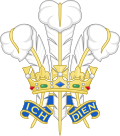
[edit]As Prince of Wales, Charles's coat of arms was based on the arms of the United Kingdom, differenced with a white label and an inescutcheon of the Principality of Wales, surmounted by the heir apparent's crown, and with the motto Ich dien (German: [ɪç ˈdiːn], "I serve") instead of Dieu et mon droit.
When Charles became king, he inherited the royal coats of arms of the United Kingdom and of Canada.[374] The design of his royal cypher, featuring a depiction of the Tudor Crown instead of St Edward's Crown, was revealed on 27 September 2022. The College of Arms envisages that the Tudor crown will be used in new arms, uniforms and crown badges as they are replaced.[375]
Banners, flags, and standards
[edit]As heir apparent
[edit]The banners used by Charles as Prince of Wales varied depending upon location. His personal standard for the United Kingdom was the Royal Standard of the United Kingdom differenced as in his arms, with a label of three points argent and the escutcheon of the arms of the Principality of Wales in the centre. It was used outside Wales, Scotland, Cornwall and Canada, and throughout the entire United Kingdom when Charles was acting in an official capacity associated with the British Armed Forces.[376]
The personal flag for use in Wales was based upon the Royal Badge of Wales.[376] In Scotland the personal banner used between 1974 and 2022 was based upon three ancient Scottish titles: Duke of Rothesay (heir apparent to the King of Scots), High Steward of Scotland, and Lord of the Isles. In Cornwall, the banner was the arms of the Duke of Cornwall.[376]
In 2011 the Canadian Heraldic Authority introduced a personal heraldic banner for the Prince of Wales for Canada, consisting of the shield of the Royal Coat of Arms of Canada defaced with both a blue roundel of the Prince of Wales's feathers surrounded by a wreath of gold maple leaves and a white label of three points.[377]
As sovereign
[edit]The royal standard of the United Kingdom is used to represent the King in the United Kingdom and on official visits overseas, except in Australia and Canada. It is the royal arms in banner form undifferentiated, having been used by successive British monarchs since 1702. The royal standard of Canada is used by the King in Canada and while acting on behalf of Canada overseas. It is the escutcheon of the Royal Coat of Arms of Canada in banner form undifferentiated.
Issue
[edit]| Name | Birth | Marriage | Children | |
|---|---|---|---|---|
| Date | Spouse | |||
| William, Prince of Wales | 21 June 1982 | 29 April 2011 | Catherine Middleton | |
| Prince Harry, Duke of Sussex | 15 September 1984 | 19 May 2018 | Meghan Markle | |
Ancestry
[edit]| Ancestors of Charles III[378] |
|---|
Published works
[edit]As Prince of Wales, Charles wrote four books and was a co-author of other works.
- The Old Man of Lochnagar. Illustrated by Sir Hugh Maxwell Casson. London: Hamish Hamilton, 1980. Hardcover: ISBN 0-241-10527-7.
- A Vision of Britain: A Personal View of Architecture. Doubleday, 1989. Hardcover: ISBN 978-0-385-26903-2.
- Rain Forest Lecture. Royal Botanic Gardens, 1990. Paperback: ISBN 0-947643-25-7.
- HRH the Prince of Wales Watercolours. Little, Brown and Company, 1991. Hardcover: ISBN 0-8212-1881-6.
See also
[edit]Notes
[edit]- ^ Ceremonial and non-hereditary title conferred by the Commonwealth heads of government to symbolise the voluntary association of nations in the Commonwealth. Charles was chosen to succeed Elizabeth II at the 2018 Commonwealth Heads of Government Meeting.[1]
- ^ a b The 14 other realms are Antigua and Barbuda, Australia, The Bahamas, Belize, Canada, Grenada, Jamaica, New Zealand, Papua New Guinea, Saint Kitts and Nevis, Saint Lucia, Saint Vincent and the Grenadines, the Solomon Islands and Tuvalu.
- ^ As the reigning monarch, Charles does not usually use a family name, but when one is needed, it is Mountbatten-Windsor.[2]
- ^ As monarch, Charles is Supreme Governor of the Church of England. He is also a member of the Church of Scotland.
- ^ The Prince's Trust was renamed to The King's Trust following his accession to the throne.
- ^ He was reportedly named "Charles" after his godfather Haakon VII of Norway (born Prince Carl of Denmark), who was called "Uncle Charles" by Elizabeth II.[6][7]
- ^ Prince Charles's godparents were: the King of the United Kingdom (his maternal grandfather); the King of Norway (his paternal cousin twice removed and maternal great-great-uncle by marriage, for whom Charles's great-great-uncle the Earl of Athlone stood proxy); Queen Mary (his maternal great-grandmother); Princess Margaret (his maternal aunt); Prince George of Greece and Denmark (his paternal great-uncle, for whom the Duke of Edinburgh stood proxy); the Dowager Marchioness of Milford Haven (his paternal great-grandmother); the Lady Brabourne (his cousin); and the Hon David Bowes-Lyon (his maternal great-uncle).[8]
- ^ Mountbatten had served as the last British viceroy and first governor-general of India.
- ^ London's first daily newspaper, the Daily Courant, was published in 1702.
- ^ Namely, the Stuart kings Charles I, who was beheaded, and Charles II, who was known for his promiscuous lifestyle. Charles Edward Stuart, once a Stuart pretender to the English and Scottish thrones, was called Charles III by his supporters.[367]
References
[edit]Citations
[edit]- ^ "Charles 'to be next Commonwealth head'". BBC News. 20 April 2018. Archived from the original on 20 April 2018. Retrieved 20 April 2018.
- ^ "The Royal Family name". Official website of the British monarchy. Archived from the original on 15 February 2009. Retrieved 3 February 2009.
- ^ "No. 38455". The London Gazette. 15 November 1948. p. 1.
- ^ Brandreth 2007, p. 120.
- ^ Bland, Archie (1 May 2023). "King Charles: 71 facts about his long road to the throne". The Guardian. Archived from the original on 27 February 2024. Retrieved 5 March 2024.
- ^ Holden, Anthony (1980). Charles, Prince of Wales. p. 68. ISBN 978-0-330-26167-8.
- ^ "Close ties through the generations". The Royal House of Norway. 8 September 2022. Archived from the original on 23 September 2023. Retrieved 23 September 2023.
- ^ "The Christening of Prince Charles". Royal Collection Trust. Archived from the original on 17 December 2021. Retrieved 17 December 2021.
- ^ a b c "HRH The Prince of Wales | Prince of Wales". Clarence House. Archived from the original on 9 April 2023. Retrieved 13 September 2022.
- ^ "The Book of the Baptism Service of Prince Charles". Royal Collection Trust. Archived from the original on 20 April 2023. Retrieved 25 April 2023.
- ^ Brandreth 2007, p. 127.
- ^ Elston, Laura (26 April 2023). "Charles made history when he watched the Queen's coronation aged four". The Independent. Archived from the original on 26 April 2023. Retrieved 27 May 2024.
- ^ Gordon, Peter; Lawton, Denis (2003). Royal Education: Past, Present, and Future. F. Cass. p. 215. ISBN 978-0-7146-8386-7. Retrieved 18 September 2022.
- ^ Kirka, Danica (1 May 2023). "Name etched in gold, King Charles' school remembers him". The Independent. Archived from the original on 25 May 2023. Retrieved 27 May 2024.
- ^ a b Johnson, Bonnie; Healy, Laura Sanderson; Thorpe-Tracey, Rosemary; Nolan, Cathy (25 April 1988). "Growing Up Royal". Time. Archived from the original on 31 March 2005. Retrieved 4 June 2009.
- ^ "Lieutenant Colonel H. Stuart Townend". The Times. 30 October 2002. ISSN 0140-0460. Archived from the original on 22 June 2018. Retrieved 29 May 2009.
- ^ a b c "HRH The Prince of Wales". Debrett's. Archived from the original on 4 July 2012. Retrieved 27 August 2012.
- ^ a b "About the Prince of Wales". Royal Household. 26 December 2018. Archived from the original on 9 May 2016.
- ^ Brandreth 2007, p. 139.
- ^ Richards, Bailey (25 May 2024). "King Charles becomes patron of his former Scottish school depicted in The Crown as 'absolute hell'". People. Archived from the original on 26 May 2024. Retrieved 27 May 2024.
- ^ Rocco, Fiammetta (18 October 1994). "Flawed Family: This week the Prince of Wales disclosed still powerful resentments against his mother and father". The Independent (UK). Independent Digital News & Media Ltd. ISSN 1741-9743. OCLC 185201487. Archived from the original on 16 February 2022. Retrieved 15 February 2022.
- ^ a b Rudgard, Olivia (10 December 2017). "Colditz in kilts? Charles loved it, says old school as Gordonstoun hits back at The Crown". The Daily Telegraph. ISSN 0307-1235. OCLC 49632006. Archived from the original on 20 June 2018. Retrieved 13 December 2017.
- ^ a b c d e f "The Prince of Wales – Education". Clarence House. Archived from the original on 13 November 2012. Retrieved 8 December 2012.
- ^ "The New Boy at Timbertop". The Australian Women's Weekly. Vol. 33, no. 37. 9 February 1966. p. 7. Archived from the original on 1 April 2021. Retrieved 13 January 2018 – via National Library of Australia.; "Timbertop – Prince Charles Australia" (Video with audio, 1 min 28 secs). British Pathé. 1966. Archived from the original on 11 March 2021. Retrieved 12 January 2018 – via YouTube.
- ^ "Prince had happy time at Timbertop". Australian Associated Press. Vol. 47, no. 13, 346. The Canberra Times. 31 January 1973. p. 11. Archived from the original on 1 April 2021. Retrieved 13 January 2018 – via National Library of Australia.
- ^ Brandreth 2007, p. 145.
- ^ Brandreth 2007, p. 151
- ^ Holland, Fiona (10 September 2022). "God Save The King!". Trinity College Cambridge. Archived from the original on 14 September 2022. Retrieved 14 September 2022.
- ^ "No. 41460". The London Gazette. 29 July 1958. p. 4733.; "The Prince of Wales – Previous Princes of Wales". Prince of Wales. Archived from the original on 11 October 2008. Retrieved 12 October 2008.
- ^ "The Prince of Wales – Investiture". Clarence House. Archived from the original on 20 October 2008. Retrieved 12 October 2008.
- ^ Jones, Craig Owen (2013). "Songs of Malice and Spite"?: Wales, Prince Charles, and an Anti-Investiture Ballad of Dafydd Iwan (PDF) (7th ed.). Michigan Publishing. p. 1. Archived (PDF) from the original on 22 December 2022. Retrieved 8 May 2023.
- ^ "H.R.H. The Prince of Wales Introduced". Hansard. 11 February 1970. HL Deb vol 307 c871. Archived from the original on 19 October 2020. Retrieved 16 October 2019.; "The Prince of Wales – Biography". Prince of Wales. Archived from the original on 9 November 2012. Retrieved 12 October 2008.
- ^ "Sport and Leisure". Hansard. 13 June 1974. HL Deb vol 352 cc624–630. Archived from the original on 18 October 2020. Retrieved 16 October 2019.
- ^ Shuster, Alvin (14 June 1974). "Prince Charles Speaks in Lords". The New York Times. ISSN 0362-4331. OCLC 1645522. Archived from the original on 29 April 2020. Retrieved 12 June 2018.
- ^ "Voluntary Service in the Community". Hansard. 25 June 1975. HL Deb vol 361 cc1418–1423. Archived from the original on 27 July 2020. Retrieved 16 October 2019.
- ^ "The Prince's Trust". The Prince's Charities. Archived from the original on 21 September 2008. Retrieved 12 October 2008.
- ^ Ferretti, Fred (18 June 1981). "Prince Charles pays a quick visit to city". The New York Times. OCLC 1645522. Archived from the original on 29 April 2020. Retrieved 22 August 2013.
- ^ Daley, Paul (9 November 2015). "Long to reign over Aus? Prince Charles and Australia go way back". The Guardian. Archived from the original on 13 June 2018. Retrieved 13 June 2018.
- ^ Murray, David (24 November 2009). "Next governor-general could be Prince Harry, William". The Australian. Archived from the original on 29 April 2020. Retrieved 12 June 2018.
- ^ Brandreth 2007, pp. 169–170
- ^ "Military Career of the Prince of Wales". Prince of Wales. Archived from the original on 14 May 2013. Retrieved 19 April 2013.
- ^ Calvert, Alana (8 May 2023). "Vintage plane King learned to fly in takes to the sky for Coronation air show". The Independent. Archived from the original on 20 January 2024. Retrieved 27 May 2024.; "Prince Charles attends RAF Cranwell ceremony". BBC News. 16 July 2020. Archived from the original on 5 October 2022. Retrieved 5 October 2022.
- ^ "King Charles III revisits Devon commando base where he trained". BBC News. 15 November 2024. Retrieved 18 February 2025.
- ^ a b Brandreth 2007, p. 170.
- ^ "The Pilot King". 5 May 2023. Retrieved 18 February 2025.
- ^ "King Charles III: A look at the Commander-in-Chief's time in the forces". www.forcesnews.com. 5 May 2023. Retrieved 18 February 2025.
- ^ "Prince Charles: Video shows 'upside down' parachute jump". BBC News. 15 July 2021. Archived from the original on 8 October 2022. Retrieved 5 October 2022.
- ^ "His majesty King Charles III | ParaData". www.paradata.org.uk. Retrieved 18 February 2025.[permanent dead link]
- ^ "Occurrence # 187927". Flight Safety Foundation. Archived from the original on 27 October 2017. Retrieved 3 May 2023.; Boggan, Steve (20 July 1995). "Prince gives up flying royal aircraft after Hebrides crash". The Independent (UK). Archived from the original on 24 March 2017.
- ^ Brandreth 2007, p. 192.
- ^ Brandreth 2007, p. 193.
- ^ Brandreth 2007, p. 194.
- ^ Brandreth 2007, p. 195.
- ^ Brandreth 2007, pp. 15–17, 178.
- ^ Junor 2005, p. 72.
- ^ Dimbleby 1994, pp. 204–206; Brandreth 2007, p. 200
- ^ Dimbleby 1994, p. 263.
- ^ a b Dimbleby 1994, pp. 263–265.
- ^ Dimbleby 1994, p. 279.
- ^ Dimbleby 1994, pp. 280–282.
- ^ Dimbleby 1994, pp. 281–283.
- ^ "Royally Minted: What we give them and how they spend it". New Statesman. Vol. 138, no. 4956–4968. 13 July 2009. Archived from the original on 16 May 2023. Retrieved 7 May 2023.
- ^ Ward, Victoria (14 May 2025). "Prince Harry's popularity sinks after BBC interview attacking King". The Telegraph. Retrieved 14 May 2025.
- ^ Landler, Mark (11 May 2025). "Can King Charles Heal a Royal Family Crisis Before It's Too Late?". The New York Times. Retrieved 14 May 2025.
- ^ Brown 2007, p. 720.
- ^ Smith 2000, p. 561.
- ^ Griffiths, Eleanor Bley (1 January 2020). "The truth behind Charles and Camilla's affair storyline in The Crown". Radio Times. Archived from the original on 8 September 2022. Retrieved 9 September 2022.
- ^ "Diana 'wanted to live with guard'". BBC News. 7 December 2004. Archived from the original on 31 July 2017. Retrieved 31 July 2017.
- ^ a b Langley, William (12 December 2004). "The Mannakee file". The Daily Telegraph. Archived from the original on 31 July 2017. Retrieved 31 July 2017.
- ^ Lawson, Mark (7 August 2017). "Diana: In Her Own Words – admirers have nothing to fear from the Channel 4 tapes". The Guardian. Archived from the original on 20 September 2017. Retrieved 22 October 2017.
- ^ Milmo, Cahal (8 December 2004). "Conspiracy theorists feast on inquiry into death of Diana's minder". The Independent (UK). Independent Digital News & Media Ltd. ISSN 1741-9743. OCLC 185201487. Archived from the original on 1 August 2017. Retrieved 31 July 2017.
- ^ Duboff, Josh (13 March 2017). "Princess Diana's Former Lover Maintains He Is Not Prince Harry's Father". Vanity Fair. Archived from the original on 26 June 2019. Retrieved 25 November 2018.
- ^ a b Quest, Richard (3 June 2002). "Royals, Part 3: Troubled times". CNN. Archived from the original on 15 July 2016. Retrieved 22 January 2023.
- ^ "Hewitt denies Prince Harry link". BBC News. 21 September 2002. Archived from the original on 15 February 2009. Retrieved 24 April 2011.
- ^ "The Camillagate Tapes". Textfiles.com (phone transcript). Phone Phreaking. 18 December 1989. Archived from the original on 1 July 2010.; "Royals caught out by interceptions". BBC News. 29 November 2006. Archived from the original on 28 August 2017. Retrieved 27 April 2012.; Dockterman, Eliana (9 November 2022). "The True Story Behind Charles and Camilla's Phone Sex Leak on The Crown". Time. Archived from the original on 16 November 2022. Retrieved 17 November 2022.
- ^ "The Princess and the Press". PBS. Archived from the original on 10 March 2017. Retrieved 7 January 2017.; "Timeline: Charles and Camilla's romance". BBC. 6 April 2005. Archived from the original on 2 February 2017. Retrieved 7 January 2017.
- ^ Dimbleby 1994, p. 395.
- ^ "1995: Diana admits adultery in TV interview". BBC News. Archived from the original on 26 January 2021. Retrieved 1 August 2018.
- ^ "The Panorama Interview with the Princess of Wales". BBC News. 20 November 1995. Archived from the original on 4 March 2011. Retrieved 8 January 2010.
- ^ "'Divorce': Queen to Charles and Diana". BBC News. 20 December 1995. Archived from the original on 23 December 2010. Retrieved 12 October 2008.
- ^ "Charles and Diana to divorce". Associated Press. 21 December 1995. Archived from the original on 2 April 2015. Retrieved 23 July 2013.
- ^ Neville, Sarah (13 July 1996). "Charles and Diana Agree to Terms of Divorce". The Washington Post. Archived from the original on 26 March 2023. Retrieved 12 November 2022.
- ^ Whitney, Craig R. (31 August 1997). "Prince Charles Arrives in Paris to Take Diana's Body Home". The New York Times. OCLC 1645522. Archived from the original on 6 December 2013. Retrieved 5 May 2014.
- ^ "Diana letter 'warned of car plot'". CNN. 20 October 2003. Archived from the original on 12 December 2003. Retrieved 14 April 2019.; Eleftheriou-Smith, Loulla-Mae (30 August 2017). "Princess Diana letter claims Prince Charles was 'planning an accident' in her car just 10 months before fatal crash". The Independent (UK). Archived from the original on 12 October 2019. Retrieved 14 April 2019.
- ^ Rayner, Gordon (20 December 2007). "Princess Diana letter: 'Charles plans to kill me'". The Daily Telegraph. Archived from the original on 10 January 2022. Retrieved 28 November 2020.
- ^ Badshah, Nadeem (19 June 2021). "Police interviewed Prince Charles over 'plot to kill Diana'". The Guardian. Archived from the original on 19 June 2021. Retrieved 8 September 2021.
- ^ McLaren, Leah (11 May 2002). "An honest woman at last?". The Globe and Mail. Archived from the original on 23 June 2012. Retrieved 6 March 2012.; McAllister, J.F.O. (13 February 2005). "The 34-Year Courtship". Time. Archived from the original on 30 September 2007. Retrieved 18 August 2012.
- ^ "Mark Bolland: Marital aide". The Independent. 30 March 2005. Archived from the original on 11 May 2015. Retrieved 9 May 2012.
- ^ "Charles and Camilla go public". BBC News. 29 January 1999. Archived from the original on 5 May 2014. Retrieved 5 May 2014.
- ^ a b "Prince Charles moves into Clarence House". The BBC. 2 August 2003. Archived from the original on 20 August 2022. Retrieved 17 June 2024.
- ^ "Profile: Duchess of Cornwall". BBC News. 9 April 2012. Archived from the original on 3 May 2023. Retrieved 3 May 2023.
- ^ "Order in Council". The National Archives. 2 March 2005. Archived from the original on 3 November 2010. Retrieved 20 February 2012.
- ^ Valpy, Michael (2 November 2005). "Scholars scurry to find implications of royal wedding". The Globe and Mail. Archived from the original on 27 July 2020. Retrieved 4 March 2009.
- ^ "Panorama Lawful impediment?". BBC News. 14 February 2005. Archived from the original on 29 September 2009. Retrieved 25 February 2009.
- ^ The Secretary of State for Constitutional Affairs and Lord Chancellor (Lord Falconer of Thoroton) (24 February 2005). "Royal Marriage; Lords Hansard Written Statements 24 Feb 2005 : Column WS87 (50224-51)". Publications.parliament.uk. Archived from the original on 2 April 2015. Retrieved 12 October 2008.
- ^ "Pope funeral delays royal wedding". BBC News. 4 April 2005. Archived from the original on 20 October 2013. Retrieved 22 August 2013.
- ^ "Q&A: Queen's wedding decision". BBC News. 23 February 2005. Archived from the original on 11 January 2009. Retrieved 17 September 2012.
- ^ "Charles And Camilla Finally Wed, After 30 Years Of Waiting, Prince Charles Weds His True Love". CBS News. 9 April 2005. Archived from the original on 12 November 2010. Retrieved 12 October 2008.
- ^ Oliver, Mark (9 April 2005). "Charles and Camilla wed". The Guardian. Archived from the original on 22 August 2013. Retrieved 22 August 2013.
- ^ a b "100 Coronation facts". Royal Household. Archived from the original on 1 May 2023. Retrieved 1 May 2023.
- ^ a b c Landler, Mark (8 September 2022). "Long an Uneasy Prince, King Charles III Takes On a Role He Was Born To". The New York Times. OCLC 1645522. Archived from the original on 20 September 2022. Retrieved 19 September 2022.
- ^ "King Charles averages 521 royal engagements per year, but Princess Anne does even more, according to a new report". The Guardian. 11 April 2023. Archived from the original on 26 March 2024. Retrieved 29 May 2024.
- ^ Brandreth 2007, p. 325.
- ^ "Opening of the Senedd". National Assembly for Wales. Archived from the original on 10 August 2014. Retrieved 8 August 2014.
- ^ "Administration". The Royal Collection Trust. Archived from the original on 6 October 2012. Retrieved 19 April 2013.
- ^ Trumbull, Robert (10 October 1970). "Fiji Raises the Flag of Independence After 96 Years of Rule by British". The New York Times. OCLC 1645522. Archived from the original on 10 September 2022. Retrieved 3 May 2023.
- ^ "1973: Bahamas' sun sets on British Empire". BBC News. 9 July 1973. Archived from the original on 1 February 2008. Retrieved 3 May 2023.
- ^ "Papua New Guinea Celebrates Independence". The New York Times. 16 September 1975. OCLC 1645522. Archived from the original on 10 September 2022. Retrieved 3 May 2023.
- ^ Ross, Jay (18 April 1980). "Zimbabwe gains independence". The Washington Post. Archived from the original on 4 February 2021. Retrieved 3 May 2023.
- ^ Wedel, Paul (22 February 1984). "Brunei celebrated its independence from Britain Thursday with traditional..." UPI. Archived from the original on 19 February 2022. Retrieved 3 May 2023.
- ^ Ainge Roy, Eleanor (13 January 2018). "'Damn ... I missed': the incredible story of the day the Queen was nearly shot". The Guardian. Archived from the original on 1 March 2018. Retrieved 1 March 2018.
- ^ Newman, John (12 May 1994). "Cambodian Refugees". New South Wales Legislative Assembly Hansard. Parliament of New South Wales. Archived from the original on 29 September 2007.; "Student fires 2 blanks at Prince Charles". Los Angeles Times. 27 January 1994. Archived from the original on 12 August 2014. Retrieved 13 April 2018.
- ^ "Archive: Prince Charles visits Ireland in 1995". BBC News. 21 April 2015. Archived from the original on 11 May 2018. Retrieved 14 April 2018.; McCullagh, David; Milner, Cathy. "Prince Charles Makes First Royal Visit to Ireland 1995". Raidió Teilifís Éireann. Archived from the original on 15 April 2018. Retrieved 14 April 2018.
- ^ Brendon 2007, p. 660.
- ^ Brown 1998, p. 594.
- ^ "Charles shakes hands with Mugabe at Pope's funeral". The Times. 8 April 2005. Archived from the original on 22 June 2018. Retrieved 8 July 2007. (subscription required)
- ^ "The Prince of Wales opens the Commonwealth Games". Clarence House. 3 October 2010. Archived from the original on 21 May 2015. Retrieved 28 August 2013.
- ^ Wintour, Patrick; Watt, Nicholas (9 December 2010). "Prince Charles and Camilla caught up in London violence after student fees vote". The Guardian.; "Royal car attacked in protest after MPs' fee vote". BBC News. Archived from the original on 10 December 2010. Retrieved 10 December 2010.; "Prince Charles and Duchess of Cornwall unhurt in attack". BBC News. 9 December 2010. Archived from the original on 23 February 2012. Retrieved 16 September 2012.
- ^ Suroor, Hasan (8 May 2013). "Queen to miss Colombo CHOGM". The Hindu. Archived from the original on 9 August 2013. Retrieved 7 August 2013.; "Queen to miss Commonwealth meeting for first time since 1973". The Guardian. 7 May 2013. Archived from the original on 21 October 2013. Retrieved 7 August 2013.
- ^ Urquart, Conal (13 May 2015). "Prince Charles Shakes the Hand of Irish Republican Leader Gerry Adams". Time. Archived from the original on 21 May 2015. Retrieved 21 May 2015.
- ^ McDonald, Henry (19 May 2015). "Prince Charles and Gerry Adams share historic handshake". The Guardian. Archived from the original on 21 May 2015. Retrieved 20 May 2015.; "Historic handshake between Prince Charles and Gerry Adams". The Independent (UK). Archived from the original on 19 May 2015. Retrieved 21 May 2015.; Adam, Karla (19 May 2015). "Prince Charles, in Ireland, meets with Sinn Fein party leader Gerry Adams". The Washington Post. Archived from the original on 22 May 2015. Retrieved 21 May 2015.
- ^ a b "Queen's Funeral Set for Sept. 19 at Westminster Abbey". The New York Times. 10 September 2022. OCLC 1645522. Archived from the original on 20 September 2022. Retrieved 20 September 2022.
The state funeral for Queen Elizabeth II will be held at 11 a.m. Monday, Sept. 19, at Westminster Abbey, Buckingham Palace announced on Saturday.
- ^ Adam, Karla (20 April 2018). "Commonwealth backs Prince Charles as its next leader". The Washington Post. Archived from the original on 6 August 2018. Retrieved 5 July 2018.
- ^ "Prince Charles and Camilla make history in Cuba". BBC News. 25 March 2019. Archived from the original on 2 April 2019. Retrieved 10 May 2019.
- ^ Reynolds, Emma; Foster, Max; Wilkinson, David (25 March 2020). "Prince Charles tests positive for novel coronavirus". CNN. Archived from the original on 25 March 2020. Retrieved 25 March 2020.; Furness, Hannah; Johnson, Simon (25 March 2020). "Prince Charles tests positive for coronavirus: These are his most recent engagements". The Daily Telegraph. Archived from the original on 25 March 2020. Retrieved 25 March 2020.
- ^ "Coronavirus: Prince Charles tests positive but 'remains in good health'". BBC News. 25 March 2020. Archived from the original on 25 March 2020. Retrieved 25 March 2020.
- ^ "Warning to all as Prince Charles catches coronavirus amid 'queue jump' claims – The Yorkshire Post says". The Yorkshire Post. 15 March 2020. Archived from the original on 26 March 2020. Retrieved 26 March 2020.
- ^ Ott, Haley (10 February 2022). "Britain's Prince Charles tests positive for COVID-19 for the 2nd time". CBS News. Archived from the original on 6 June 2022. Retrieved 10 February 2022.
- ^ "Covid: Prince Charles and Camilla get first vaccine". BBC News. 10 February 2021. Archived from the original on 21 April 2022. Retrieved 29 May 2021.
- ^ Mills, Rhiannon (30 November 2021). "Barbados: Prince Charles acknowledges 'appalling' history of slavery as island becomes a republic". Sky News. Archived from the original on 30 November 2021. Retrieved 30 November 2021.
- ^ Murphy, Victoria (28 November 2021). "All About Prince Charles's Visit to Barbados as the Country Cuts Ties with the Monarchy". Town & Country. Archived from the original on 26 March 2023. Retrieved 3 May 2023.
- ^ Nikkhah, Roya (28 November 2021). "Regretful Prince Charles flies to Barbados to watch his realm become a republic". Sunday Times. Archived from the original on 26 March 2023. Retrieved 3 May 2023.
- ^ Davies, Caroline (10 May 2022). "Queen remains 'very much in charge' even as Charles makes speech". The Guardian. Archived from the original on 10 May 2022. Retrieved 10 May 2022.
- ^ "Prince Charles becomes longest-serving heir apparent". BBC News. 20 April 2011. Archived from the original on 18 July 2015. Retrieved 30 November 2011.
- ^ Rayner, Gordon (19 September 2013). "Prince of Wales will be oldest monarch crowned". The Daily Telegraph. Archived from the original on 20 September 2013. Retrieved 19 September 2013.
- ^ "King Charles III pays tribute to his 'darling mama' in first address". BBC News. 9 September 2022. Archived from the original on 10 September 2022. Retrieved 9 September 2022.
- ^ "Charles formally confirmed as king in ceremony televised for first time". BBC News. 10 September 2022. Archived from the original on 10 September 2022. Retrieved 10 September 2022.
- ^ Ratcliffe, Rebecca (10 September 2022). "Charles III is proclaimed King". The Guardian. Archived from the original on 10 September 2022. Retrieved 10 September 2022.
- ^ Torrance, David (29 September 2022). The Accession of King Charles III (PDF). House of Commons Library. p. 21. Archived (PDF) from the original on 21 April 2023. Retrieved 25 April 2023.
- ^ "Coronation on 6 May for King Charles and Camilla, Queen Consort". BBC News. 11 October 2022. Archived from the original on 11 October 2022. Retrieved 11 October 2022.
- ^ Mahler, Kevin (14 February 2022). "Ghosts? Here's the true tale of things that go bump in the night". The Times. Archived from the original on 28 October 2022. Retrieved 9 September 2022.
- ^ Pepinster 2022.
- ^ Nicholl, Katie (11 October 2022). "King Charles is planning a smaller coronation, but it will still be a "spectacle"". Vanity Fair. Archived from the original on 11 October 2022. Retrieved 28 May 2024.
- ^ Arasteh, Amira (23 September 2022). "King Charles III coronation: When is he officially crowned and what happens next?". The Daily Telegraph. Archived from the original on 23 September 2022. Retrieved 23 September 2022.; Dixon, Hayley; Gurpreet, Narwan (13 September 2022). "Coronation for the cost of living crisis as King expresses wish for 'good value'". The Times. Archived from the original on 25 September 2022. Retrieved 14 September 2022.
- ^ "King Charles III, the new monarch". BBC News. 18 September 2022. Archived from the original on 20 September 2022. Retrieved 13 October 2022.
- ^ "King Charles III: Special Edinburgh day ends with gun salute and flypast". BBC News. 5 July 2023. Archived from the original on 1 August 2023. Retrieved 5 July 2023.
- ^ "Windfarms help drive record profit for crown estate". The Guardian. 29 June 2023. Retrieved 23 July 2024.
- ^ "Sovereign Grant recalculated as offshore wind profits rise". GOV.UK. 20 July 2023. Archived from the original on 19 July 2024. Retrieved 23 July 2024.
- ^ Kirka, Danica (22 November 2022). "King Charles III welcomes S. African leader for state visit". Associated Press. Archived from the original on 25 March 2023. Retrieved 21 September 2023.
- ^ Said-Moorhouse, Lauren; Foster, Max (30 March 2023). "King Charles becomes first British monarch to address German parliament". CNN. Archived from the original on 27 September 2023. Retrieved 21 September 2023.
- ^ Said-Moorhouse, Lauren (1 September 2023). "King Charles makes historic speech at French senate as he hails 'indispensable' UK-France relationship". CNN. Archived from the original on 21 September 2023. Retrieved 21 September 2023.
- ^ Foster, Max; Feleke, Bethlehem; Said-Moorhouse, Lauren (November 2023). "King Charles acknowledges Kenya's colonial-era suffering but stops short of apologizing". CNN. Archived from the original on 1 December 2023. Retrieved 6 February 2024.
- ^ "General election: Royal family postpones engagements that 'divert attention' from campaign". Sky News. 22 May 2024. Archived from the original on 2 June 2024. Retrieved 26 June 2024.
- ^ "D-Day 80 years on: King speaks of 'profound sense of gratitude' at Normandy commemoration". ITV News. 6 June 2024. Archived from the original on 9 June 2024. Retrieved 6 June 2024.
- ^ "Emperor and Empress of Japan arrive in the UK ahead of a long-awaited state visit". ABC News. 22 June 2024. Archived from the original on 24 June 2024. Retrieved 26 June 2024.
- ^ "King Charles takes part in Ceremony of the Keys in Edinburgh as Holyrood Week begins". Sky News. 2 July 2024. Retrieved 15 July 2024.
- ^ "U.K. wakes up to new government as Labour Party looks set to win election: Follow live". NBC News. 5 July 2024. Archived from the original on 12 July 2024. Retrieved 12 July 2024.
- ^ "King Charles III and Queen Camilla land in Sydney, marking first visit by reigning king to Australia". ABC News. 18 October 2024. Archived from the original on 20 October 2024. Retrieved 18 October 2024.
- ^ Perry, Simon (18 October 2024). "King Charles and Queen Camilla Arrive in Australia for Historic First Tour to Commonwealth Realm". People. Retrieved 20 October 2024.
- ^ Foster, Max; Stambaugh, Alex; Said-Moorhouse, Lauren (25 October 2024). "King Charles acknowledges 'painful' history amid calls for slavery reparations at Commonwealth summit". CNN. Archived from the original on 10 November 2024. Retrieved 25 October 2024.
- ^ Relph, Daniela (18 October 2024). "King of Australia's royal tour nearly didn't happen". BBC News. Archived from the original on 24 December 2024. Retrieved 20 October 2024.
- ^ Giuffrida, Angela (9 April 2025). "King Charles and Queen Camilla pay recovering Pope Francis surprise visit". The Guardian. Retrieved 10 April 2025.
- ^ Coughlan, Sean (9 April 2025). "King and Queen meet Pope Francis at Vatican on their anniversary". BBC News. Retrieved 10 April 2025.
- ^ Watkins, Devin (21 April 2025). "Pope Francis has died on Easter Monday aged 88". Vatican News. Dicastery for Communication. Retrieved 21 April 2025.
- ^ "King Charles hails 'incredible opportunity' for Canada in throne speech". CBC News. 27 May 2025. Retrieved 27 May 2025.
- ^ "IN PHOTOS King Charles opens 45th Parliament of Canada". CBC News. 27 May 2025. Retrieved 27 May 2025.
- ^ Jones, Tony (30 June 2025). "Royal Family have travelled by train for more than 180 years". Evening Standard. Retrieved 30 June 2025.
- ^ Mills, Rhiannon (30 June 2025). "Royal train to be decommissioned with family to rely on two new helicopters – as annual accounts revealed". Sky News. Retrieved 30 June 2025.
- ^ "Charles makes history as first British monarch to pray with a pope since Henry VIII split church". ITV News. 23 October 2025. Retrieved 23 October 2025.
- ^ a b c "King Charles cancer diagnosis: Health issues monarch has faced over the years". Sky News. 5 February 2024. Archived from the original on 5 February 2024. Retrieved 5 February 2024.
- ^ "Charles has hernia operation". BBC News. 29 March 2003. Archived from the original on 21 January 2024. Retrieved 22 January 2024.
- ^ Coughlan, Sean (26 January 2024). "King Charles in hospital for prostate treatment". BBC News. Archived from the original on 26 January 2024. Retrieved 26 January 2024.
- ^ Coughlan, Sean (5 February 2024). "King Charles III diagnosed with cancer, Buckingham Palace says". BBC News. Archived from the original on 5 February 2024. Retrieved 5 February 2024.
- ^ Trapper, James (10 February 2024). "King Charles expresses 'lifelong admiration' for cancer charities". The Guardian. Archived from the original on 10 February 2024. Retrieved 11 February 2024.
- ^ Holden, Michael (11 March 2024). "King Charles hails Commonwealth but misses annual celebrations". Reuters. Retrieved 11 March 2024.
- ^ "Queen Camilla steps in for King at Royal Maundy Service in Worcester". ITV News. 28 March 2024. Archived from the original on 28 March 2024. Retrieved 28 March 2024.
- ^ Leigh, Suzanne; Gallagher, Charlotte (31 March 2024). "King Charles appears in public at Easter Sunday church service". BBC News. Archived from the original on 31 March 2024. Retrieved 31 March 2024.
- ^ Coughlan, Sean (26 April 2024). "King Charles to resume public duties after progress in cancer treatment". BBC News. Archived from the original on 26 April 2024. Retrieved 26 April 2024.
- ^ Said-Moorhouse, Lauren (30 April 2024). "King Charles returns to public duties in visit to cancer treatment center". BBC News. Archived from the original on 9 May 2024. Retrieved 28 May 2024.
- ^ a b Gregory, James; Coughlan, Sean (27 March 2025). "King postpones visit after temporary side effects of ongoing cancer treatment". BBC News. Archived from the original on 28 March 2025. Retrieved 27 March 2025.
- ^ Dooney, Emma (6 June 2023). "King Charles hailed 'ahead of his time' for passionate statement on his dietary preferences". Woman and Home. Archived from the original on 4 July 2023. Retrieved 4 July 2023.
- ^ Prince Charles and His Battle for Our Planet. BBC World News. Archived from the original on 8 December 2021. Retrieved 8 December 2021.; Garlick, Hattie (11 October 2021). "How to do the Prince Charles diet – and eat the perfect amount of meat and dairy". The Daily Telegraph. Archived from the original on 10 January 2022. Retrieved 8 December 2021.
- ^ White, Stephen; Tetzlaff-Deas, Benedict; Munday, David (12 September 2022). "King Charles doesn't eat lunch and works until midnight". The Cornishman. Archived from the original on 5 October 2022. Retrieved 5 October 2022.
- ^ "King Charles: Foie gras banned at royal residences". BBC News. 18 November 2022. Archived from the original on 15 December 2022. Retrieved 15 December 2022.
- ^ Burchfield, Rachel (20 September 2023). "King Charles Has "A Strict List of Culinary Demands" for Banquet Tonight at Palace of Versailles During State Visit to France". Marie Claire. Archived from the original on 29 October 2023. Retrieved 22 October 2023.
- ^ Smout, Alistair; Mills, Sarah; Gumuchian, Marie-louise (16 September 2022). "With Charles king, his Prince's Trust youth charity goes on". Reuters. Archived from the original on 26 November 2022. Retrieved 26 November 2022.
- ^ a b "The Prince's Charities". Clarence House. Archived from the original on 26 September 2010. Retrieved 16 October 2012.
- ^ "King's Charity to donate £1.95M to good causes". The Wildlife Trust. 31 January 2023. Retrieved 31 January 2023.
- ^ Ward, Victoria (10 November 2023). "Prince's Trust rebranded to avoid 'confusion' with William's charities". The Telegraph. Retrieved 16 May 2025.
- ^ Callander, Rebecca Burn (7 September 2013). "Prince's pride as charities inspire 125,000 to start their own business". The Sunday Telegraph. Archived from the original on 25 February 2014. Retrieved 14 September 2013.
- ^ Mackreal, Kim (18 May 2012). "Prince Charles rallies top-level support for his Canadian causes". The Globe and Mail. Archived from the original on 20 May 2012. Retrieved 22 May 2012.
- ^ a b "His Royal Highness the Prince of Wales". Department of Canadian Heritage. Government of Canada. Archived from the original on 22 September 2008. Retrieved 12 October 2008.
- ^ "Contact Us". The Prince's Charities Australia. Archived from the original on 9 August 2014. Retrieved 22 January 2013.
- ^ Dimbleby 1994, p. 250.
- ^ "Welcome". FARA Enterprises. Archived from the original on 12 October 2010. Retrieved 25 September 2012.
- ^ Chemla, Sarah (11 November 2020). "Prince Charles makes a donation to Israel's Peres Center". The Jerusalem Post. Retrieved 21 June 2025.
- ^ Quinn, Ben (29 August 2021). "Prince of Wales charity launches inquiry into 'cash for access' claims". The Guardian. Archived from the original on 29 August 2021. Retrieved 30 August 2021.
- ^ Foster, Max; Said-Moorhouse, Lauren (6 September 2021). "Former aide to Prince Charles steps down over cash-for-honors scandal". CNN. Archived from the original on 7 September 2021. Retrieved 7 September 2021.
- ^ Butler, Patrick (18 November 2021). "Inquiry into foundation linked to Prince of Wales launched". The Guardian. Archived from the original on 18 November 2021. Retrieved 18 November 2021.
- ^ Montebello, Leah (16 February 2022). "Breaking: Met Police investigate cash-for-honours allegations against Prince Charles' charity". City A.M. Archived from the original on 16 February 2022. Retrieved 16 February 2022.; O'Connor, Mary (16 February 2022). "Police to investigate Prince Charles' charity". BBC News. Archived from the original on 16 February 2022. Retrieved 17 February 2022.
- ^ Gadher, Dipesh; Gabriel Pogrund; Megan Agnew (19 November 2022). "Cash-for-honours police pass file on King's aide Michael Fawcett to prosecutors". The Sunday Times. Archived from the original on 28 March 2023. Retrieved 28 March 2023.
- ^ Ward, Victoria (21 August 2023). "Cash-for-honours investigation into King Charles's charity dropped". The Telegraph. Archived from the original on 21 August 2023. Retrieved 21 August 2023.
- ^ Pogrund, Gabriel; Keidan, Charles; Faulkner, Katherine (25 June 2022). "Prince Charles accepted €1m cash in suitcase from sheikh". The Times. Archived from the original on 25 June 2022. Retrieved 25 June 2022.
- ^ a b Connett, David (25 June 2022). "Prince Charles is said to have been given €3m in Qatari cash". The Guardian. Archived from the original on 25 June 2022. Retrieved 25 June 2022.
- ^ "Prince Charles: Charity watchdog reviewing information over reports royal accepted carrier bag full of cash as a charity donation from Qatar ex-PM". Sky News. 27 June 2022. Archived from the original on 27 June 2022. Retrieved 27 June 2022.
- ^ Coughlan, Sean (20 July 2022). "Prince Charles: No inquiry into £2.5m cash donation to his charity". BBC News. Archived from the original on 20 July 2022. Retrieved 21 July 2022.
- ^ Pogrund, Gabriel; Charles Keidan (30 July 2022). "Prince Charles accepted £1m from family of Osama bin Laden". The Times. Archived from the original on 30 July 2022. Retrieved 30 July 2022.
- ^ "Prince Charles dined with Bin Laden's brother". The Guardian. 13 October 2001. Archived from the original on 30 July 2022. Retrieved 30 July 2022.
The Prince of Wales had dinner with a brother of Osama bin Laden two weeks after the September 11th attacks, St James' Palace said today.
- ^ Furness, Hannah (1 August 2022). "Prince Charles's charity won't be investigated for accepting bin Laden family £1m donation". The Daily Telegraph. Archived from the original on 1 August 2022. Retrieved 1 August 2022.
- ^ Fraser, John (26 April 2023). "What the reign of King Charles III means for Canada". Canadian Geographic. Archived from the original on 27 April 2023. Retrieved 29 April 2023.
- ^ Dulcie, Lee (20 May 2022). "Prince Charles: We must learn from indigenous people on climate change". BBC News. Archived from the original on 29 April 2023. Retrieved 29 April 2023.
- ^ "Prince Charles commits to 'listening' to Indigenous peoples as Canadian royal tour begins". Global News. 17 May 2022. Archived from the original on 29 April 2023. Retrieved 29 April 2023.
- ^ Katawazi, Miriam (27 June 2017). "Prince Charles's charities work to undo past wrongs against Indigenous people through reconciliation". The Globe and Mail. Archived from the original on 29 April 2023. Retrieved 29 April 2023.
- ^ Brewster, Murray (24 June 2022). "Commonwealth countries could learn from Canada's reconciliation efforts, Prince Charles says". CBC News. Archived from the original on 29 April 2023. Retrieved 29 April 2023.
- ^ "Prince Charles tells Commonwealth of sorrow over slavery". BBC News. 24 June 2022. Archived from the original on 24 June 2022. Retrieved 29 April 2023.
- ^ Evans, Rob (26 March 2015). "Supreme court clears way for release of secret Prince Charles letters". The Guardian. Archived from the original on 27 March 2015. Retrieved 26 March 2015.
- ^ Eleftheriou-Smith, Loulla-Mae (13 May 2015). "Prince Charles' 'black spider' memos: What are they and what impact will their publication have?". The Independent. Archived from the original on 10 September 2022. Retrieved 29 May 2024.; "Prince Charles's black spider memos in 60 seconds". The Daily Telegraph. Archived from the original on 16 May 2015. Retrieved 15 May 2015.
- ^ Barbash, Fred (14 May 2015). "Prince Charles, the toothfish and the toothless 'black spider' letters". The Washington Post. Archived from the original on 6 April 2018. Retrieved 23 May 2015.
- ^ Spector, Dina (13 May 2015). "There are 3 reasons why Britain might be completely underwhelmed by Prince Charles' black spider memos". Business Insider. Archived from the original on 23 April 2019. Retrieved 23 May 2015.
- ^ Jenkins, Simon (13 May 2015). "The black spider memos: a royal sigh of woe at a world gone to the dogs". The Guardian. Archived from the original on 14 June 2018. Retrieved 23 May 2015.
- ^ Roberts, Andrew (13 May 2015). "All the 'black spider memos' expose is the passion and dignity of Prince Charles". The Daily Telegraph. Archived from the original on 15 May 2015. Retrieved 23 May 2015.
- ^ Booth, Robert (15 December 2015). "Revealed: Prince Charles has received confidential cabinet papers for decades". The Guardian. Archived from the original on 10 January 2017. Retrieved 22 December 2016.
- ^ a b Boseley, Matilda (24 October 2020). "Prince Charles's letter to John Kerr reportedly endorsing sacking of Whitlam condemned". The Guardian. Archived from the original on 13 February 2022. Retrieved 12 February 2022.
- ^ Dathan, Matt; Low, Valentine (10 June 2022). "Prince Charles: Flying migrants to Rwanda is 'appalling'". The Times. Archived from the original on 9 July 2022. Retrieved 11 June 2022; Taylor, Harry (10 June 2022). "Prince Charles criticises 'appalling' Rwanda migrant scheme – reports". The Guardian. Archived from the original on 20 May 2024. Retrieved 28 May 2024; "Rwanda deportation plan: Prince Charles 'says policy is appalling' as court rules first asylum seekers can be sent away". Sky News. 11 June 2022. Archived from the original on 11 June 2022. Retrieved 11 June 2022.
- ^ Wheeler, Caroline; Shipman, Tim; Nikkah, Roya (12 June 2022). "Charles won't be Prince Charming if he keeps on meddling, say ministers". The Times. Archived from the original on 2 July 2022. Retrieved 3 July 2022.
- ^ Coughlan, Sean (18 June 2022). "Prince Charles faces awkward trip after Rwanda row". BBC News. Archived from the original on 23 May 2023. Retrieved 28 May 2024.
- ^ a b "Charles, Prince of Wales". Planetizen. 13 September 2009. Archived from the original on 16 March 2012. Retrieved 31 March 2012.
- ^ a b "A speech by HRH The Prince of Wales at the 150th anniversary of the Royal Institute of British Architects (RIBA), Royal Gala Evening at Hampton Court Palace". Prince of Wales. 30 May 1984. Archived from the original on 27 September 2007. Retrieved 17 June 2012.
- ^ a b "HRH visits the Oxford Centre for Islamic Studies new building". The Prince of Wales. 9 February 2005. Archived from the original on 19 June 2007. Retrieved 15 December 2008.
- ^ Capps, Kriston (9 September 2022). "King Charles III, City Maker". Bloomberg. Archived from the original on 16 May 2023. Retrieved 19 May 2023.
- ^ "The Prince of Wales Accepts Vincent Scully Prize". artdaily.com. Archived from the original on 23 May 2013. Retrieved 19 April 2013.
- ^ Harper, Phineas (21 September 2022). "King Charles's endless meddling in architectural politics has accomplished nothing". The Guardian. Archived from the original on 20 October 2022. Retrieved 5 May 2023.
- ^ Graham, Hugh (30 June 2019). "Exclusive: Prince Charles, the new Poundbury and his manifesto to solve the housing crisis". The Times. Archived from the original on 6 August 2021. Retrieved 22 June 2023.
- ^ Cramb, Auslan (28 June 2007). "Charles saves Dumfries House at 11th hour". The Daily Telegraph. Archived from the original on 13 June 2008. Retrieved 28 June 2007.
- ^ Foyle, Johnathan (27 June 2014). "Dumfries House: training the unemployed". Financial Times. Archived from the original on 13 December 2022. Retrieved 4 May 2023.
- ^ "Prince Charles to build wellbeing centre at Dumfries House". The Scotsman. 12 September 2017. Archived from the original on 7 October 2022. Retrieved 4 May 2023.
- ^ Freyberg, Annabel (27 May 2011). "Dumfries House: a Sleeping Beauty brought back to life by the Prince of Wales". The Telegraph. Archived from the original on 30 May 2011.
- ^ Marrs, Colin (16 September 2016). "Prince Charles's stalled 'Scottish Poundbury' under scrutiny". Architect's Journal. Archived from the original on 6 February 2024. Retrieved 4 May 2023.
- ^ The Budget Plan 2007: Aspire to a Stronger, Safer, Better Canada (PDF). Department of Finance. Queen's Printer for Canada. 19 March 2007. p. 99. Archived (PDF) from the original on 12 June 2009. Retrieved 1 May 2012.
- ^ "Heritage Services". Heritage Canada Foundation. Archived from the original on 14 September 2008. Retrieved 12 October 2008.
- ^ Hales, Linda (26 October 2005). "Prince Charles to Accept Scully Prize at Building Museum". The Washington Post. Archived from the original on 5 March 2016. Retrieved 19 April 2013.; "The Prince of Wales Accepts Vincent Scully Prize". artdaily.com. Archived from the original on 23 May 2013. Retrieved 19 April 2013.
- ^ "Prince Charles honored for his architectural patronage". Notre Dame News. 7 February 2012. Archived from the original on 24 August 2020. Retrieved 4 October 2017.
- ^ "About Us". Carpenters' Company website. Archived from the original on 17 July 2012. Retrieved 17 June 2012.
- ^ "Prince Charles Faces Opponents, Slams Modern Architecture". Bloomberg L.P. 12 May 2009. Retrieved 20 June 2009.
- ^ "Architects urge boycott of Prince Charles speech". NBC News. 11 May 2009. Archived from the original on 2 January 2014. Retrieved 20 June 2009.; "Architects to hear Prince appeal". BBC News. 12 May 2009. Archived from the original on 2 December 2010. Retrieved 20 June 2009.
- ^ Booth, Robert (15 June 2009). "Prince Charles's meddling in planning 'unconstitutional', says Richard Rogers". The Guardian. Archived from the original on 24 December 2013. Retrieved 20 June 2009.
- ^ a b "Chelsea Barracks developer apologises to Prince Charles". BBC News. 24 July 2010. Archived from the original on 26 June 2022. Retrieved 26 June 2022.
- ^ "Prince Charles honored with HMS's Global Environmental Citizen Award". The Harvard Gazette. 1 February 2007. Archived from the original on 10 March 2021. Retrieved 11 October 2021.
- ^ Low, Valentine (19 February 2020). "No one is calling my fears over the climate dotty now, says Prince Charles". The Times. Archived from the original on 8 August 2022. Retrieved 31 May 2022.
- ^ Ferran, Lee (20 September 2010). "Prince Charles Eavesdrops on Tourists, Speaks to Plants". ABC News. Archived from the original on 1 June 2022. Retrieved 31 May 2022.
- ^ a b Vidal, John (15 May 2002). "Charles designs 'healing garden'". The Guardian. Archived from the original on 15 December 2022. Retrieved 15 December 2022.
- ^ a b "Our Story". Duchyoriginals.com. Archived from the original on 5 October 2012. Retrieved 22 September 2012.
- ^ Rainey, Sarah (12 November 2013). "Why Prince Charles's Duchy Originals takes the biscuit". The Daily Telegraph. Archived from the original on 1 April 2021. Retrieved 30 July 2014.
- ^ Spandenburg and Moser 2004, p. 32
- ^ Rosenbaum, Martin (23 January 2019). "Prince Charles warned Tony Blair against GM foods". BBC News. Archived from the original on 10 May 2022. Retrieved 10 May 2022.
- ^ Myers, Joe (22 January 2020). "This member of the British Royal Family has a vital message if we are to save the planet". World Economic Forum. Archived from the original on 2 November 2021. Retrieved 2 November 2021.
- ^ Inman, Phillip (3 June 2020). "Pandemic is chance to reset global economy, says Prince Charles". The Guardian. Archived from the original on 17 November 2020. Retrieved 3 June 2020.
- ^ "Holy oil to be used to anoint King during Coronation is vegan friendly". The Independent (UK). 4 March 2023. Archived from the original on 28 March 2023. Retrieved 28 March 2023.
- ^ Walker, Peter (31 October 2021). "Cop26 'literally the last chance saloon' to save planet – Prince Charles". The Guardian. OCLC 60623878. Archived from the original on 31 October 2021. Retrieved 31 October 2021.
- ^ Elbaum, Rachel (1 November 2021). "Prince Charles calls for 'warlike footing' in climate fight as world leaders gather". NBC. Archived from the original on 2 November 2021. Retrieved 2 November 2021.
- ^ "King Charles will not attend climate summit on Truss advice". BBC News. 1 October 2022. Archived from the original on 13 December 2022. Retrieved 1 October 2022.
- ^ Paddison, Laura (1 December 2023). "King Charles says world heading for 'dangerous uncharted territory' at global leaders summit". CNN. Archived from the original on 19 December 2023. Retrieved 19 December 2023.
- ^ "The Prince of Wales launches climate action scholarships for small island nation students". Prince of Wales. 14 March 2022. Archived from the original on 14 March 2022. Retrieved 1 April 2022.
- ^ about-us Archived 17 May 2021 at the Wayback Machine The Prince's Countryside Fund – 26 December 2018
- ^ Feder, Barnaby J. (9 January 1985). "More Britons Trying Holistic Medicine". The New York Times. OCLC 1645522. Archived from the original on 1 June 2013. Retrieved 12 October 2008.
- ^ a b Rawlins, Richard (March 2013). "Response to HRH". Journal of the Royal Society of Medicine. 106 (3): 79–80. doi:10.1177/0141076813478789. PMC 3595413. PMID 23481428.; Ernst, Edzard (2022). Charles, the alternative prince an unauthorised biography. Imprint Academic. ISBN 978-1-78836-070-8.; Weissmann, Gerald (September 2006). "Homeopathy: Holmes, Hogwarts, and the Prince of Wales". The FASEB Journal. 20 (11): 1755–1758. doi:10.1096/fj.06-0901ufm. PMID 16940145. S2CID 9305843.
- ^ Bower, Tom (2018). ""Chapter 6"". The Rebel Prince, The Power, Passion and Defiance of Prince Charles. William Collins. ISBN 978-0-00-829173-0.
- ^ The Prince of Wales (December 2012). "Integrated health and post modern medicine". Journal of the Royal Society of Medicine. 105 (12): 496–498. doi:10.1258/jrsm.2012.12k095. ISSN 0141-0768. PMC 3536513. PMID 23263785.; Hamilton-Smith, Anthony (9 April 1990). "Medicine: Complementary and Conventional Treatments". Archived from the original on 13 September 2022. Retrieved 13 September 2022.; Rainey, Sarah (12 November 2013). "Prince Charles and homeopathy: crank or revolutionary?". The Daily Telegraph. Archived from the original on 14 February 2021. Retrieved 22 June 2022.
- ^ Carr-Brown, Jonathon (14 August 2005). "Charles's 'alternative GP' campaign stirs anger". The Times. Archived from the original on 22 June 2018. Retrieved 11 March 2009. (subscription required)
- ^ Revill, Jo (27 June 2004). "Now Charles backs coffee cure for cancer". The Observer. Archived from the original on 27 September 2013. Retrieved 19 June 2007.
- ^ Singh, Simon; Ernst, Edzard (2008). Trick or Treatment: Alternative Medicine on Trial. Bantam Press.
- ^ a b Walker, Tim (31 October 2009). "Prince Charles lobbies Andy Burnham on complementary medicine for NHS". The Telegraph. Archived from the original on 27 March 2010. Retrieved 1 April 2010.
- ^ Colquhoun, David (12 March 2007). "HRH 'meddling in politics'". DC's Improbable Science. Archived from the original on 15 November 2010. Retrieved 6 November 2009.
- ^ Hawkes, Nigel; Henderson, Mark (1 September 2006). "Doctors attack natural remedy claims". The Times. Archived from the original on 22 June 2018. Retrieved 22 June 2018. (subscription required)
- ^ "Statement from the Prince's Foundation for Integrated Health". FIH. 30 April 2010. Archived from the original on 2 February 2013.
- ^ a b Sample, Ian (2 August 2010). "College of Medicine born from ashes of Prince Charles's holistic health charity". The Guardian. OCLC 60623878. Archived from the original on 3 August 2010. Retrieved 24 September 2012.
- ^ Colquhoun, David (29 October 2010). "Don't be deceived. The new "College of Medicine" is a fraud and delusion". Archived from the original on 11 September 2012. Retrieved 24 September 2012.; Hawkes, Nigel (29 October 2010). "Prince's foundation metamorphoses into new College of Medicine". British Medical Journal. 341 (1): 6126. doi:10.1136/bmj.c6126. ISSN 0959-8138. S2CID 72649598. Archived from the original on 2 December 2010. Retrieved 17 December 2010.
- ^ "HRH The Prince of Wales is announced as College of Medicine Patron". College of Medicine. 17 December 2019. Archived from the original on 25 June 2022. Retrieved 22 June 2022.
- ^ "Charles decides to retire from polo playing at 57". The Guardian. 17 November 2005. OCLC 60623878. Archived from the original on 14 May 2023. Retrieved 14 May 2023.
- ^ Revesz, Rachel (24 July 2017). "Prince Charles secret letters to Tony Blair over fox hunting get information commissioner's green light for publishing". The Independent (UK). Archived from the original on 21 April 2023. Retrieved 21 April 2023.
- ^ "Prince Charles takes sons hunting". BBC News. 30 October 1999. Archived from the original on 26 July 2008. Retrieved 21 April 2023.
- ^ Ashton, John B.; Latimer, Adrian, eds. (2007). A Celebration of Salmon Rivers: The World's Finest Atlantic Salmon Rivers. Stackpole Books. p. 7. ISBN 978-1-873674-27-7.
- ^ "Prince of Wales supports Burnley football club". The Daily Telegraph. 15 February 2012. Archived from the original on 6 April 2012. Retrieved 29 September 2012.
- ^ "History". National Rifle Association. Archived from the original on 1 September 2022. Retrieved 13 October 2022.
- ^ "National Rifle Association". Prince of Wales. Archived from the original on 4 August 2020. Retrieved 13 October 2022.
- ^ Hallemann, Caroline (5 November 2019). "Vintage Photos of Prince Charles at Cambridge Prove Meghan Markle Isn't the Only Actor in the Royal Family". Town & Country. Archived from the original on 23 May 2022. Retrieved 22 June 2022.
- ^ "Performing Arts". Prince of Wales official website. Archived from the original on 21 June 2012. Retrieved 17 June 2012.
- ^ "The Prince of Wales visits the BFI Southbank". Prince of Wales official website. 6 December 2018. Archived from the original on 29 September 2021. Retrieved 28 September 2021.
- ^ "TRH continue their annual tour of Wales". Prince of Wales website. Archived from the original on 19 November 2007. Retrieved 19 April 2013.
- ^ "Presenting the King's Harpist: RWCMD grad Mared Pugh-Evans". Retrieved 18 April 2025.
- ^ a b Holland, Oscar (12 January 2022). "Prince Charles exhibits dozens of his watercolors, saying painting 'refreshes the soul'". CNN. Archived from the original on 12 January 2022. Retrieved 13 January 2022.
- ^ "Art school founded by Prince Charles to be renamed Royal Drawing School". The Guardian . 18 November 2014. Retrieved 18 November 2014.
- ^ "Prince Charles wins art award". BBC News. 12 December 2001. Archived from the original on 28 September 2013. Retrieved 22 September 2013.
- ^ "The Royal Academy Development Trust". Royal Academy. Archived from the original on 21 March 2019. Retrieved 25 January 2019.
- ^ "D-Day portraits commissioned by Prince Charles go on display". BBC News. 6 June 2015. Archived from the original on 22 November 2022. Retrieved 22 November 2022.
- ^ Coughlan, Sean (10 January 2022). "Prince Charles commissions Holocaust survivor portraits". BBC News. Archived from the original on 11 January 2022. Retrieved 11 January 2022.
- ^ "The King commissions 'Windrush: Portraits of a Pioneering Generation'". The Royal Family. 6 June 2023. Archived from the original on 6 June 2023. Retrieved 6 June 2023.
- ^ "HRH the Prince of Wales : A Vision of Britain". BFI. Archived from the original on 10 September 2011. Retrieved 1 May 2012.; "Harmony Movie Website". The Harmony Movie. Archived from the original on 1 May 2012. Retrieved 1 May 2012.; The Prince and the Composer. BBC Four. 1 May 2012.; "Modern TV: The Princes Welsh Village". Archived from the original on 3 December 2013.
- ^ a b Davies, Caroline (16 September 2022). "King tells faith leaders he has personal 'duty to protect diversity of our country'". The Guardian. Archived from the original on 15 January 2023. Retrieved 30 December 2022..
- ^ Holden 1979, pp. 141–142.
- ^ "The Queen, the Church and other faiths". Official website of the British monarchy. Archived from the original on 10 August 2022. Retrieved 21 September 2022.
- ^ "King Charles vows to protect the security of the Church of Scotland" (Press release). The Church of Scotland. 10 September 2022. Archived from the original on 14 September 2022. Retrieved 14 September 2022.
- ^ "Prince and Camilla attend church". BBC News. 13 February 2005. Archived from the original on 4 August 2017. Retrieved 25 September 2012.
- ^ Fleming, Graham (14 September 2025). "King and Queen attend church service near Balmoral days before Trump state visit". Press and Journal. Retrieved 5 October 2025.
- ^ Garner, Clare (17 December 1996). "Prince's guru dies aged 90". The Independent (UK). Archived from the original on 20 December 2012. Retrieved 31 March 2012.
- ^ "S African author Laurens van der Post dies in London". Irish Times. 17 December 1996. Archived from the original on 8 March 2021. Retrieved 8 February 2020.
- ^ Payne, Raymond (4 January 2012). "Review: In Harmony with a Philosopher King". Wessex School Of Philosophy. Archived from the original on 8 August 2014. Retrieved 30 July 2014; Fletcher, Paul (29 March 2013). "It's time for harmony between science and spirituality". Positive News. Archived from the original on 8 August 2014. Retrieved 30 July 2014; "Books of the Year – Harmony and Farundell". Philip Carr-Gomm. 6 December 2010. Archived from the original on 24 September 2020. Retrieved 30 July 2014.
- ^ Belknap, Mary. "2011 Nautilus Awards Gold Winners". nautilusbookawards. Nautilus Book Awards. Archived from the original on 19 December 2011. Retrieved 11 May 2013.
- ^ Smith, Helena (12 May 2004). "Has Prince Charles found his true spiritual home on a Greek rock?". The Guardian. ISSN 1756-3224. OCLC 60623878. Archived from the original on 1 April 2021. Retrieved 25 September 2012.
- ^ "Prinţul Charles, fermier de Fălticeni" [Prince Charles, farm owner in Fălticeni]. Evenimentul Zilei (in Romanian). 13 May 2003. Archived from the original on 5 November 2013.
- ^ "Princ Čarls u manastiru Kovilj" [Prince Charles in the Kovilj monastery]. Ekspres.net (in Serbian (Latin script)). Archived from the original on 26 September 2017. Retrieved 9 September 2022.
- ^ "Prince Charles wishes Palestinians 'freedom, justice and equality'". The Guardian. 24 January 2020. Archived from the original on 26 March 2020. Retrieved 27 March 2020. "Charles arrives in Bethlehem during historic Palestinian visit". ITV News. 24 January 2020. Archived from the original on 27 March 2020. Retrieved 27 March 2020.
- ^ "Britain's first Syriac Orthodox Cathedral consecrated". Anglican Communion News Service. 25 November 2016. Archived from the original on 26 November 2016. Retrieved 9 April 2021.
- ^ "About OCIS". Oxford Centre for Islamic Studies. Archived from the original on 28 October 2007. "Introduction to MIHE". MarkfieldInstitute. 29 January 2009. Archived from the original on 8 March 2021. Retrieved 29 April 2017.
- ^ Sullivan, Kevin; Boorstein, Michelle (13 September 2022). "King Charles III may bring new approach to 'Defender of the Faith'". The Washington Post. Archived from the original on 13 September 2022. Retrieved 13 September 2022.
- ^ Sherwood, Harriet (9 September 2022). "King Charles to be Defender of the Faith but also a defender of faiths". The Guardian. ISSN 1756-3224. OCLC 60623878. Archived from the original on 12 September 2022. Retrieved 13 September 2022.
- ^ "Charles vows to keep "Defender of the Faith" title as King". secularism.org.uk. Archived from the original on 15 July 2015. Retrieved 24 July 2015.
- ^ Moore, Charles (8 May 2023). "The service deftly proved the King's power to unite 'neighbours in faith'". The Daily Telegraph – Coronation Special. pp. 6–7.
- ^ McDonagh, Melanie (2 May 2023). "The King's coronation oath: an explainer for Catholics". catholicherald.co.uk. Catholic Herald. Retrieved 14 October 2023.
- ^ Prinsley, Jane (18 June 2024). "King Charles renews patronage of Jewish Museum London". thejc.com. Retrieved 7 January 2025.
Originally appointed patron of the museum in 2008, the King's renewed patronage is a "huge vote of confidence in reiterating the importance of the Jewish Museum London," a spokesperson for the museum said.
- ^ "HM The King to be Patron of the Council of Christians and Jews". Catholic Bishops' Conference. 20 May 2024. Archived from the original on 7 January 2025. Retrieved 7 January 2025.
- ^ Bartlett, Mike. "King Charles III". Almeida Theatre. Archived from the original on 5 August 2014. Retrieved 27 July 2014.
- ^ "The Man Who Will Be King". The Milwaukee Journal. Google News. 1 October 1979. Archived from the original on 23 April 2016. Retrieved 30 July 2014.
- ^ "Patrick Jephson: Prince Charles Was Unable to Reconcile with Princess Diana's Extraordinary Popularity". The Independent. 31 August 2016. ISSN 1741-9743. OCLC 185201487. Archived from the original on 21 February 2017. Retrieved 2 February 2017.
- ^ Davies, Caroline (7 November 2018). "Prince Charles: 'Me, meddle as a king? I'm not that stupid'". The Guardian. Archived from the original on 8 November 2018. Retrieved 22 June 2022.
- ^ "King Charles III has mellowed over the past 30 years". The Economist. ISSN 0013-0613. Retrieved 5 October 2025.
- ^ "Prince Charles named world's best dressed man". ABC News. 5 March 2009. Archived from the original on 26 May 2024. Retrieved 26 May 2009.
- ^ Prince, Bill (19 July 2012). "Prince Charles: the true guardian of traditional British menswear". British GQ. Retrieved 12 September 2025.
- ^ "The 50 Most Stylish People Alive". British GQ. 22 October 2025. Retrieved 22 October 2025.
- ^ "Tinie Tempah is Britain's best dressed man but Duke of Cambridge fails to rank". The Telegraph. 30 January 2012. Retrieved 12 September 2025.
- ^ "The New Statesman's right power list". New Statesman. 27 September 2023. Archived from the original on 14 December 2023. Retrieved 14 December 2023.
- ^ "King Charles III makes TIME 100 Most Influential People list". The Independent. 13 April 2023. Retrieved 20 May 2025.
- ^ "King Charles Is on the 2023 TIME 100 List". Time magazine. 13 April 2023. Retrieved 20 May 2025.
- ^ "King and Queen top Tatler's Social Power Index". The Independent. 27 June 2023. Archived from the original on 27 June 2023. Retrieved 27 June 2023.
- ^ Barnes, Tom (2 January 2019). "Almost half of British public want Prince Charles to give throne to William upon Queen's death, survey finds". The Independent. ISSN 1741-9743. OCLC 185201487. Archived from the original on 8 September 2022. Retrieved 8 September 2022.
- ^ Kirk, Isabelle. "Public opinion of Prince Charles improves in latest royal favourability poll". YouGov. Archived from the original on 2 December 2021. Retrieved 8 September 2022.
- ^ "Queen Elizabeth II passes away, Prince Charles succeeds as king". The Statesman (India). 8 September 2022. Archived from the original on 8 September 2022. Retrieved 8 September 2022.
- ^ Smith, Matthew (13 September 2022). "Britons' first impressions of King Charles III". YouGov. Archived from the original on 14 December 2022. Retrieved 14 December 2022.
- ^ "King Charles III popularity and fame". YouGov. Archived from the original on 24 August 2025. Retrieved 24 August 2025.
- ^ "Royal family favourability trackers, August 2025 | YouGov". yougov.co.uk. Retrieved 12 September 2025.
- ^ Williams, Rhys (7 September 1994). "'Hunky' Prince is exposed to public gaze". The Independent (UK). Independent Digital News & Media Ltd. ISSN 1741-9743. OCLC 185201487. Archived from the original on 18 July 2022. Retrieved 18 July 2022.
- ^ "German Tabloid Publishes Photo of Nude Prince Charles". Los Angeles Times. 8 September 1994. Archived from the original on 18 July 2022. Retrieved 18 July 2022.
- ^ a b c Woods, Audrey (11 March 2002). "Prince Charles addresses editors". AP News Archive. Archived from the original on 18 September 2012. Retrieved 17 June 2012.
- ^ "Charles 'adopted dissident role'". BBC News. 21 February 2006. Archived from the original on 2 December 2010. Retrieved 2 October 2012.
- ^ Rainey, Sarah; Blenkinsop, Andrew (13 July 2011). "Phone hacking: who's who in the News International scandal". The Daily Telegraph. Archived from the original on 19 December 2022. Retrieved 19 December 2022.
- ^ a b Burrell, Ian (2 December 2015). "The 15-page contract that reveals how Charles tries to control the media". The Independent. ISSN 1741-9743. OCLC 185201487. Archived from the original on 21 April 2022. Retrieved 21 April 2022.
- ^ a b c Pegg, David. "Revealed: King Charles's private fortune estimated at £1.8bn". The Guardian. OCLC 60623878. Archived from the original on 20 April 2023. Retrieved 20 April 2023.
- ^ Boffey, Daniel (13 September 2022). "King Charles will not pay tax on inheritance from the Queen". The Guardian. ISSN 1756-3224. OCLC 60623878. Archived from the original on 23 April 2023. Retrieved 6 May 2023.
- ^ Kennedy, Maev (6 August 2003). "Clarence House makeover in grand hotel manner". The Guardian. Archived from the original on 28 May 2024. Retrieved 28 May 2024.
- ^ Temple 2012.
- ^ Bates, Stephen (28 July 2005). "MPs tell Prince of Wales: Open up". The Guardian. ISSN 1756-3224. OCLC 60623878. Archived from the original on 23 May 2023. Retrieved 19 May 2023.
- ^ Bonner, Mehera (9 September 2022). "King Charles has to pay Prince William £700,000 in rent to keep his Highgrove home". Cosmopolitan. Archived from the original on 16 October 2023. Retrieved 28 May 2024.
- ^ Muir, Ellie (31 May 2023). "A fireplace, CD player and a 'little wooden bed': Inside King Charles's Romanian hideaway that you can rent". The Independent. Archived from the original on 1 June 2023. Retrieved 3 June 2023.
- ^ McGrath, Stephen (6 September 2020). "Romanian tourists swamp village loved by Prince Charles". BBC News. Archived from the original on 28 May 2023. Retrieved 3 June 2023.
- ^ "Sovereign Grant Act 2011: guidance". www.gov.uk. Archived from the original on 27 January 2016. Retrieved 3 December 2017.
- ^ Booth, Robert (14 December 2012). "Prince Charles's £700m estate accused of tax avoidance". The Guardian. OCLC 60623878. Archived from the original on 12 November 2013. Retrieved 18 April 2013.
- ^ Osborne, Hilary (7 November 2017). "Prince Charles's estate made big profit on stake in friend's offshore". The Guardian. Archived from the original on 7 May 2024. Retrieved 28 May 2024.
- ^ Washington, Stuart (8 November 2017). "Paradise Papers: Prince Charles's estate, the Duchy of Cornwall, invested through Caribbean tax havens". Australian Broadcasting Corporation. Archived from the original on 21 April 2023. Retrieved 21 April 2023.
- ^ a b "King Charles: New royal cypher revealed". BBC News. 26 September 2022. Archived from the original on 26 September 2022. Retrieved 26 September 2022.
- ^ Heritage, Canadian (11 August 2017). "Canadian Royal Crown and Royal Cypher". www.canada.ca. Archived from the original on 29 September 2023. Retrieved 3 May 2024.
- ^ "The Prince of Wales visits the Royal Gurkha Rifles and Knole House". Prince of Wales. Archived from the original on 2 May 2014. Retrieved 1 May 2014.
- ^ "The Queen Appoints the Prince of Wales to Honorary Five-Star rank". The Prince of Wales website. 16 June 2012. Archived from the original on 29 June 2012. Retrieved 27 June 2012.; "Prince Charles awarded highest rank in all three armed forces". The Daily Telegraph. 16 June 2012. Archived from the original on 16 June 2012. Retrieved 7 June 2012.; "No. 60350". The London Gazette. 7 December 2012. p. 23557.
- ^ "The London Gazette, Issue 38452, Page 5889". 9 November 1948. Archived from the original on 12 September 2022. Retrieved 15 April 2022.
- ^ "HRH The Duke of Edinburgh". College of Arms. 9 April 2021. Archived from the original on 11 April 2021. Retrieved 7 May 2021.
- ^ Malloch, Russell (24 April 2023). "King Charles III and The Gazette: Commonwealth awards". The Gazette. Archived from the original on 9 May 2023. Retrieved 9 May 2023.
- ^ Jones, Guy (28 November 1958). "Motto may be more to Charles than to any of predecessors". Newspapers.com. p. 15. Archived from the original on 1 March 2023. Retrieved 1 March 2023. David Gaddis Smith (3 May 1981). "Prince seeks to uphold popularity of monarchy". Newport News. Archived from the original on 1 March 2023. Retrieved 1 March 2023 – via Newspapers.com. "Londoner's Diary: Princely glove is not picked up". Evening Standard. 29 April 1987. Archived from the original on 1 March 2023. Retrieved 1 March 2023 – via Newspapers.com. Morgan, Christopher (13 February 2000). "Charles prefers George VII for his kingly title". Calgary Herald. Archived from the original on 1 March 2023. Retrieved 1 March 2023 – via Newspapers.com. Boucher, Phil (15 August 2018). "Here's Why Prince Charles Could Be Called George VII When He's King". People. Archived from the original on 1 March 2023. Retrieved 1 March 2023.
- ^ a b Pierce, Andrew (24 December 2005). "Call me George, suggests Charles". The Times. Archived from the original on 22 June 2018. Retrieved 13 July 2009.
- ^ Cruse, Beth (23 May 2021). "The 4 names Prince Charles could choose when he becomes king". Nottingham Post. ISSN 2044-3331. OCLC 749994959. Archived from the original on 28 February 2023. Retrieved 28 February 2023.
- ^ White, Michael (27 December 2005). "Charles denies planning to reign as King George". The Guardian. ISSN 1756-3224. OCLC 60623878. Archived from the original on 2 October 2013. Retrieved 2 October 2012.
Clarence House yesterday issued a pained denial of claims that the Prince of Wales has held private discussions with "trusted friends" about the possibility of reigning as George VII rather than risk the negative connotations attached to the name King Charles.
- ^ "Accession of Charles III: 'A monarch's choice of name is not a trivial thing'". Le Monde. 8 September 2022. Archived from the original on 1 March 2023. Retrieved 1 March 2023.
- ^ "Charles chooses Charles III for his title as King". The Independent (UK). 9 September 2022. ISSN 1741-9743. OCLC 185201487. Archived from the original on 9 September 2022. Retrieved 16 April 2023.
Charles has become King Charles III – with his title as monarch a personal choice that was entirely his own.
- ^ "Britain's new monarch to be known as King Charles III". Reuters. 8 September 2022. Archived from the original on 8 September 2022. Retrieved 8 September 2022.
Clarence House confirmed on Thursday that Britain's new monarch will be known as King Charles III, following the death of Queen Elizabeth, PA Media reported on Thursday.
- ^ Ward, EJ (5 May 2023). "King Charles military service and career: What medals does he have?". LBC. Archived from the original on 12 December 2023. Retrieved 7 December 2023.
- ^ "Coats of Arms". The Royal Family. 2022. Archived from the original on 22 September 2020. Retrieved 18 May 2023.
- ^ "Royal Cypher". College of Arms. Archived from the original on 27 September 2022. Retrieved 28 September 2022.
- ^ a b c "Standards". Prince of Wales. Archived from the original on 7 June 2016. Retrieved 31 August 2016.
- ^ "The Prince of Wales". Public Register of Arms, Flags and Badges. Office of the Governor General of Canada: Canadian Heraldic Authority. Archived from the original on 4 March 2016. Retrieved 4 January 2016.
- ^ Paget 1977.
Bibliography
[edit]- Brandreth, Gyles (2007). Charles and Camilla: Portrait of a Love Affair. Random House. ISBN 978-0-09-949087-6.
- Brendon, Piers (2007). The Decline and Fall of the British Empire, 1781–1997. Random House. ISBN 978-0-224-06222-0.
- Brown, Judith (1998). The Twentieth Century, The Oxford History of the British Empire Volume IV. Oxford University Press. ISBN 978-0-19-924679-3.
- Brown, Tina (2007). The Diana Chronicles. Century Random House. ISBN 978-1-84605-312-2.
- Dimbleby, Jonathan (1994). The Prince of Wales: A Biography. William Morrow and Company. ISBN 0-6881-2996-X.
- Holden, Anthony (1979). Prince Charles. Atheneum. ISBN 978-0-593-02470-6.
- Junor, Penny (2005). The Firm: The Troubled Life of the House of Windsor. St. Martin's Press. ISBN 978-0-312-35274-5. OCLC 59360110.
- Paget, Gerald (1977). The Lineage and Ancestry of H.R.H. Prince Charles, Prince of Wales (2 vols). Charles Skilton. ISBN 978-0-284-40016-1.
- Pepinster, Catherine (2022). Defenders of the Faith: Queen Elizabeth II's funeral will see Christianity take centre stage. Hodder & Stoughton. ISBN 978-1-3998-0006-8. Archived from the original on 21 June 2023. Retrieved 26 October 2022.
- Smith, Sally Bedell (2000). Diana in Search of Herself: Portrait of a Troubled Princess. Signet. ISBN 978-0-451-20108-9.
- Temple, Jon (2012). Living off the State: A Critical Guide to UK Royal Finance (2nd ed.). Progress Books. ISBN 978-0-9558311-1-9.
Further reading
[edit]- Benson, Ross (1994). Charles: The Untold Story. St Martins Press. ISBN 978-0-312-10950-9.
- Brown, Michèle (1980). Prince Charles. Crown. ISBN 978-0-517-54019-0.
- Campbell, J. (1981). Charles: Prince of Our Times. Smithmark. ISBN 978-0-7064-0968-0.
- Cathcart, Helen (1977). Prince Charles: The biography (illustrated ed.). Taplinger Pub. Co; Ltd. ISBN 978-0-8008-6555-9.
- Fisher, Graham; Fisher, Heather (1977). Charles: The Man and the Prince. Robert Hale. ISBN 978-0-7091-6095-3.
- Gilleo, Alma (1978). Prince Charles: Growing Up in Buckingham Palace. Childs World. ISBN 978-0-89565-029-0.
- Graham, Caroline (2005). Camilla and Charles: The Love Story. John Blake. ISBN 978-1-84454-195-9.
- Heald, Tim; Mohrs, Mayo (1979). The Man Who Will Be King H.R.H. (Prince of Wales Charles). New York: Arbor House.
{{cite book}}: CS1 maint: publisher location (link) - Hedley, Olwen (1969). Charles, 21st Prince of Wales. Pitkin Pictorials. ISBN 978-0-85372-027-0.
- Hodgson, Howard (2007). Charles: The Man Who Will Be King (illustrated ed.). John Blake Publishing. ISBN 978-1-84454-306-9.
- Holden, Anthony (1988). King Charles III: A Biography. Grove. ISBN 978-1-55584-309-0.
- — (1998). Charles at Fifty. Random House. ISBN 978-0-375-50175-3.
- — (1999). Charles: A Biography. Corgi Books. ISBN 978-0-552-99744-7.
- Jencks, Charles (1988). Prince, Architects & New Wave Monarchy. Rizzoli. ISBN 978-0-8478-1010-9.
- Jobson, Robert (2018). Charles at Seventy – Thoughts, Hopes & Dreams: Thoughts, Hopes and Dreams. John Blake. ISBN 978-1-78606-887-3.
- Junor, Penny (1998). Charles: Victim or Villain?. Harper Collins. ISBN 978-0-00-255900-3.
- Lacey, Robert (2008). Monarch: The Life and Reign of Elizabeth II. Free Press. ISBN 978-1-4391-0839-0.
- Lane, Peter (1988). Prince Charles: a study in development. Robert Hale. ISBN 978-0-7090-3320-2.
- Liversidge, Douglas (1975). Prince Charles: monarch in the making. A. Barker. ISBN 978-0-213-16568-0.
- Martin, Christopher (1990). Prince Charles and the Architectural Debate (Architectural Design Profile). St Martin's Press. ISBN 978-0-312-04048-2.
- Mayer, Catherine (2015). Born to Be King: Prince Charles on Planet Windsor. Henry Holt and Co. ISBN 978-1-62779-438-1.
- — (2015). Charles: The Heart of a King. Random House. ISBN 978-0-7535-5593-4.
- Nugent, Jean (1982). Prince Charles, England's Future King. Dillon. ISBN 978-0-87518-226-1.
- Regan, Simon (1977). Charles, the Clown Prince. Everest Books. ISBN 978-0-905018-50-8.
- Smith, Sally Bedell (2017). Prince Charles: The Passions and Paradoxes of an Improbable Life. Random House Trade Paperbacks. ISBN 978-0-8129-7980-0.
- Spangenburg, Ray; Moser, Diane (2004). Open For Debate: Genetic Engineering. Benchmark Books. ISBN 978-0-8129-7980-0.
- Veon, Joan M. (1997). Prince Charles: The Sustainable Prince. Hearthstone. ISBN 978-1-57558-021-0.
- Wakeford, Geoffrey (1962). Charles, Prince of Wales. Associated Newspapers.
External links
[edit]- The King at the Royal Family website
- King Charles III at the website of the Government of Canada
- Charles III at the website of the Royal Collection Trust
- Portraits of King Charles III at the National Portrait Gallery, London
- King Charles III at IMDb
- Appearances on C-SPAN
Charles III
View on GrokipediaEarly Life and Education
Birth and Immediate Family Context
Charles Philip Arthur George was born at Buckingham Palace in London at 9:14 p.m. on 14 November 1948, weighing 7 pounds 6 ounces.[6] He was the first child of Princess Elizabeth, then the heir presumptive to the throne as the elder daughter of King George VI, and her husband Lieutenant Philip Mountbatten, a Royal Navy officer who had recently been created Duke of Edinburgh.[2] The birth occurred during a period of postwar austerity in Britain, with rationing still in effect, and was announced via a traditional bulletin posted on the palace's railings.[7] Charles was baptized at Buckingham Palace on 15 December 1948 in the Music Room, with his godparents including his grandmothers Queen Elizabeth and Princess Alice of Greece.[8] As the eldest son of the daughter of the reigning monarch, Charles automatically became a British prince and was third in the line of succession to the throne at birth, behind his mother and grandfather.[2] His parents' marriage in 1947 had been a significant public event, symbolizing continuity amid national recovery, though Philip's Greek and Danish royal heritage—stemming from the House of Glücksburg—came with a complex family background marked by exile and separation; his father, Prince Andrew of Greece and Denmark, had died in 1944 after years of estrangement, while his mother, Princess Alice, lived semi-reclusively due to mental health challenges. On his mother's side, George VI's fragile health foreshadowed Elizabeth's future accession, positioning Charles as the first heir apparent since Edward VII to be born not during his mother's reign.[9] Charles's immediate siblings included his younger sister, Princess Anne, born on 15 August 1950 at Clarence House, and brothers Prince Andrew, born 19 February 1960 at Buckingham Palace, and Prince Edward, born 10 March 1964 at St Mary's Hospital in London.[2] The family's early years were shaped by royal duties that often separated Elizabeth and Philip from their children, with nannies handling primary care; Philip emphasized discipline and outdoor activities, reflecting his naval-influenced upbringing, while Elizabeth's role intensified after George VI's death in 1952.[10] This context placed Charles in a lineage of constitutional monarchy, where his birth reinforced the House of Windsor's stability post-abdication crisis.[2]Childhood and Upbringing
Charles spent his early childhood primarily under the care of nannies at Buckingham Palace, where he was born on 14 November 1948, reflecting the royal family's traditional delegation of daily child-rearing to domestic staff amid parental official duties. Mabel Anderson, employed from 1949 to 1981, served as a key caregiver, handling routine aspects of his infancy and later mending his cherished teddy bear even into adulthood.[11] [12] His parents, Princess Elizabeth and Prince Philip, provided oversight but were often absent; after Elizabeth's accession as Queen in February 1952, they undertook a six-month Commonwealth tour, leaving Charles, then three years old, and his sister Anne with their grandmother, Queen Elizabeth the Queen Mother, at Windsor Castle.[10] [13] This arrangement fostered a closer bond with nannies and grandparents than with his parents during formative years, as Queen Elizabeth II's role demanded extensive travel and engagements, limiting maternal involvement. Prince Philip emphasized discipline, self-reliance, and physical activities like riding and sailing to toughen his sensitive son, though accounts describe occasional tensions arising from Charles's introspective disposition clashing with his father's robust expectations.[14] [13] At Buckingham Palace and Windsor, Charles engaged in outdoor pursuits and developed an enduring interest in gardening, inspired by the head gardener's demonstrations of planting and cultivation.[15] The post-war austerity of the era influenced his upbringing, with rationing persisting into the early 1950s; despite palace resources, simple meals and routines underscored a sense of duty over indulgence, aligning with George VI's values inherited via the Queen Mother. Charles's time at Windsor included interactions with extended family, reinforcing monarchical traditions, while his heir presumptive status imposed early awareness of public scrutiny, even in private play.[10]Formal Education and Influences
Charles attended Hill House School in West London beginning in November 1956, marking the first instance of a British heir apparent receiving formal schooling outside the palace rather than private tutoring.[2] In September 1957, at age eight, he transferred to Cheam School, a preparatory boarding school in Headley, Hampshire, where he remained until completing his pre-secondary education around 1961.[16] In April 1962, Charles enrolled at Gordonstoun School in Moray, Scotland—his father Prince Philip's alma mater—attending until 1965 and participating in its rigorous program emphasizing outdoor activities, physical challenges, and community service, including membership in the school's coast-watching precursor group.[2] [17] In 1966, he spent two terms at Timbertop, the remote Australian campus of Geelong Grammar School in Victoria's Alps, engaging in bushwalking, skiing, and manual labor to foster self-reliance.[18] From October 1967 to June 1970, Charles studied at Trinity College, University of Cambridge, initially pursuing archaeology and anthropology before switching to history for the latter part of his degree; he became the first British heir apparent to attend university and the first monarch to graduate, earning a 2:2 Bachelor of Arts in 1970 and later an honorary Master of Arts in 1975.[19] His time at Cambridge allowed a degree of anonymity, with residence in college under the pseudonym "Charles Norfolk" initially, and focused academic rigor without special accommodations beyond security.[19] Gordonstoun's demanding regimen, selected by Prince Philip to build resilience against royal isolation, profoundly shaped Charles's emphasis on duty and environmental stewardship through experiential learning in harsh conditions, though he later described early experiences as akin to a "prison sentence" amid bullying, contrasting with the school's assertion of overall positive formation of character.[17] [20] The Timbertop interlude reinforced independence via physical and communal tasks in rugged terrain, influencing his lifelong advocacy for practical conservation.[18] At Cambridge, exposure to interdisciplinary studies nurtured intellectual curiosity in history and anthropology, informing later interests in heritage preservation and cultural anthropology, while the relative normalcy tempered expectations of entitlement.[19] Prince Philip's overarching influence prioritized stoicism and public service over comfort, evident in rejecting more sheltered options like Eton, though this approach drew criticism for exacerbating Charles's introversion.[21]Military Service
Officer Training
Charles began his formal military training in 1971 with the Royal Air Force at RAF Cranwell in Lincolnshire, where he underwent jet pilot instruction starting on 8 March.[22] He trained on Jet Provost aircraft under instructor Flight Lieutenant Kevin Harris, completing the course and receiving his RAF wings as a Flight Lieutenant on 19 August 1971.[23] This six-month program focused on basic flying skills, navigation, and operational procedures, marking his qualification as a pilot before transitioning to naval service.[24] Following his RAF graduation, Charles enrolled in an accelerated six-week officer training course at Britannia Royal Naval College in Dartmouth, Devon, commencing on 16 September 1971 as part of Blake Division.[25] The curriculum emphasized leadership, naval discipline, seamanship, and command principles, adapted to a condensed format owing to his royal status and prior informal exposure to military life.[26] Upon completion, he was commissioned as a Sub-Lieutenant in the Royal Navy on 25 November 1971, enabling his subsequent assignments aboard ships like HMS Norfolk.[27] This naval indoctrination laid the groundwork for his seven-year service, during which he advanced to command roles without additional Army-specific training at institutions like Sandhurst.[28]Active Duty and Assignments
Following his officer training, Charles commenced active duty in the Royal Air Force on 8 March 1971 at RAF Cranwell, where he trained as a jet pilot, accumulating approximately 90 hours on the Basset CC1 aircraft after initial flights in the Chipmunk trainer, and received his wings on 19 March 1971.[29] His RAF assignment was brief, transitioning to naval service later that year.[27] In the Royal Navy, Charles reported to the guided-missile destroyer HMS Norfolk in November 1971 as an acting sub-lieutenant, participating in standard fleet operations.[29] He subsequently served aboard the frigate HMS Minerva from 1972 to 1974, including as gunnery officer during an 11-month West Indies patrol commencing in July 1973, involving anti-submarine exercises and regional deployments.[27] [29] Later in 1974, after qualifying as a helicopter pilot with 105 hours on the Wessex Mk 5 via 707 Naval Air Squadron, Charles joined 845 Naval Air Squadron aboard the commando carrier HMS Hermes, conducting aviation support duties.[29] He then transferred to the frigate HMS Jupiter in January 1974 as ship's communications officer, serving through deployments including a visit to San Diego in March 1974, before returning to the UK later that year.[30] )[31] His final assignment, from 9 February to December 1976, involved commanding the Ton-class minesweeper HMS Bronington, during which the vessel monitored Soviet submarine activity in the North Sea and conducted mine countermeasures training.[29] Charles retired from active service at the end of 1976, having risen to the rank of commander.[32]Princely Duties and Public Role
Investiture as Prince of Wales
Charles was formally created Prince of Wales by letters patent issued by his mother, Queen Elizabeth II, on 26 July 1958, when he was nearly ten years old, granting him the title and style traditionally held by the heir apparent to the English throne.[33] The investiture ceremony, distinct from the legal creation as a symbolic presentation to the people of Wales, took place on 1 July 1969 at Caernarfon Castle in north Wales, selected for its historical association with Edward I's conquest of Wales in 1283 and the traditional investiture site since 1911.[34] [35] In preparation, Charles, then 20 years old, studied Welsh language and history at the University College of Wales, Aberystwyth, for a ten-week course ending in June 1969, enabling him to deliver part of his investiture address in Welsh.[36] The ceremony, attended by approximately 4,000 guests including dignitaries and televised live to an estimated 500 million viewers worldwide, followed a scripted medieval-style ritual devised by the College of Arms.[37] Queen Elizabeth II, clad in green, presented Charles—dressed in a white silk investiture mantle embroidered with gold eagles—with regalia including a sword of offering, a ring, a gold rod, and a coronet replicating the Welsh prince's historical insignia, after which he swore an oath of service to the United Kingdom and the Commonwealth.[38] [39] The event aimed to reinforce constitutional ties between Wales and the monarchy amid rising Welsh nationalism, but it provoked significant opposition from groups viewing the title as an emblem of historical English domination rather than genuine Welsh sovereignty.[35] Welsh separatist organizations, such as Mudiad Amddiffyn Cymru and the Free Wales Army, staged protests and conducted sabotage, including bomb attacks on infrastructure; two members died in a premature explosion while targeting an aqueduct on the eve of the ceremony.[40] Despite such resistance, which included satirical folk songs and calls for republicanism, the investiture proceeded without disruption at the site, bolstered by extensive security measures involving thousands of police and military personnel.[41] Charles later reflected on the polarized reactions, noting support from some Welsh figures who appreciated his efforts to engage with local culture, though nationalist critiques persisted in framing the occasion as performative rather than substantive.[41]Official Engagements and Representations
Following his investiture, Charles, as Prince of Wales, assumed a prominent role in representing Queen Elizabeth II through a wide array of official engagements in the United Kingdom and overseas. These duties encompassed ceremonial functions such as attending state banquets, receiving foreign ambassadors and high commissioners at Buckingham Palace, and participating in investiture ceremonies where he presented honors on the Queen's behalf.[42] Domestically, he conducted hundreds of annual engagements, including visits to community projects, speeches at public events, and openings of parliamentary sessions in Wales, such as the National Assembly for Wales.[43] Overseas representations formed a core component of his princely responsibilities, with annual tours undertaken at the direction of the Foreign, Commonwealth and Development Office to advance British diplomatic and economic interests. Charles visited Canada on 18 separate occasions spanning five decades, engaging with local leaders and participating in cultural exchanges.[44] Notable examples include his 1983 tour with Diana, Princess of Wales, to Australia, New Zealand, and Canada, where he addressed the Alberta Legislature on 30 June 1983, emphasizing Commonwealth ties.[2] He also represented the Queen at key Commonwealth events, such as independence celebrations in Fiji on 10 October 1970 and the Bahamas on 10 July 1973.[45] In the decade prior to his accession, Charles completed approximately 5,000 official engagements, averaging over 500 per year, as evidenced by his 521 engagements in 2019 alone.[46] [47] These activities underscored his preparation for the throne, focusing on continuity in monarchical representation while adapting to contemporary global challenges.[2]Establishment of Charitable Initiatives
In 1976, Charles, then Prince of Wales, founded The Prince's Trust using £7,400 from his Royal Navy severance pay to support young people aged 11 to 30 facing unemployment, educational challenges, or adversity.[48] [49] The initiative initially provided grants for community projects and rehabilitation for young offenders, evolving to offer training programs, business start-up loans, and mentoring to foster self-reliance and employment.[49] By its early years, it had funded ventures like music workshops and adventure programs, directly aiding thousands in building skills and confidence.[50] Expanding his efforts, Charles established the King Charles III Charitable Fund in 1979 (originally the Prince of Wales's Charitable Fund) to finance projects promoting harmony between people and nature, sustainability, and community welfare in the UK and abroad.[51] This fund has supported over 150 organizations annually, including initiatives in education, health, and environmental conservation, reflecting Charles's emphasis on practical, evidence-based interventions rather than broad welfare dependency.[52] In the 1980s and 1990s, Charles founded additional entities under the umbrella of The Prince's Charities, which collectively raise over £100 million yearly for causes spanning youth development, rural economies, and heritage preservation.[53] Notable among these is the Prince's Foundation (now The King's Foundation), established to advance traditional architecture, urban regeneration, and holistic education, countering modern planning trends Charles critiqued for eroding community cohesion.[54] Overall, these initiatives—totaling 18 charities founded during his time as Prince—prioritize targeted aid grounded in personal responsibility and empirical outcomes, such as measurable employment gains among beneficiaries.[55]Personal Relationships and Family
Courtship and First Marriage
Prince Charles first encountered Lady Diana Spencer in November 1977 at Althorp House, the Spencer family estate in Northamptonshire, England, where she was 16 years old and he was 29, then dating her elder sister Lady Sarah Spencer.[56][57] Their initial interaction was brief and not romantic, occurring during a hunting party hosted by the Spencers.[58] Subsequent meetings included Diana attending Charles's 30th birthday party on November 14, 1978, and a Buckingham Palace event in 1979, though his romantic interest remained limited at that stage amid his ongoing relationship with Camilla Shand (later Parker Bowles).[59][60] By mid-1980, following the end of his prior engagements and increased public scrutiny on the heir's marital prospects, Charles began courting Diana more seriously after she consoled him at the funeral of his great-uncle Lord Mountbatten in August 1979 and they shared a weekend at Balmoral Castle in September 1980.[61][62] The courtship, lasting approximately six months, involved private dinners, theater outings, and visits to royal residences, during which Diana met key family members and adapted to royal protocols.[58] Charles proposed on February 3, 1981, at Windsor Castle, presenting Diana with a Ceylon sapphire engagement ring designed by Garrard, valued at around £47,000 at the time.[61][63] The engagement was publicly announced on February 24, 1981, by the Lord Chamberlain at Buckingham Palace, with the couple appearing for a televised interview where Charles famously responded to a question about being in love with "whatever 'in love' means."[64][65] Diana, then 19, expressed enthusiasm for the match, citing admiration for Charles's character and their shared values, though later accounts from her associates indicated her youth and limited prior romantic experience contributed to an idealized view of the union.[62] The wedding occurred on July 29, 1981, at St. Paul's Cathedral in London, selected for its capacity to accommodate 3,500 guests compared to Westminster Abbey's limitations.[66][67] The ceremony, officiated by the Archbishop of Canterbury Robert Runcie, was viewed by an estimated 750 million people worldwide via television broadcast.[67] Diana wore an ivory silk taffeta gown designed by David and Elizabeth Emanuel, featuring a 25-foot train embroidered with 10,000 pearls, while Charles donned a Royal Navy uniform; the event cost approximately £2 million (equivalent to about £9 million in 2023 values), funded largely by public and private contributions.[68][69] Following the service, the couple honeymooned on the yacht Britannia in the Mediterranean and later at Broadlands.[2][70]Marital Breakdown and Divorce
The marriage between Charles, then Prince of Wales, and Diana, Princess of Wales, began to deteriorate publicly in the late 1980s, exacerbated by mutual admissions of extramarital affairs. Charles reportedly resumed his relationship with Camilla Parker Bowles around 1986, while Diana engaged in her own liaisons, including with her bodyguard Barry Mannakee and later James Hewitt.[71] [70] These developments, amid Diana's struggles with bulimia and self-harm, contributed to irreconcilable differences, though both parties shared responsibility for the breakdown, as Diana later acknowledged in interviews.[72] Public scrutiny intensified in 1992 with the publication of Andrew Morton's book Diana: Her True Story, which detailed Diana's unhappiness, suicide attempts, and Charles's infidelity based on her taped conversations, shocking the royal family and fueling media coverage sympathetic to Diana.[56] That December 9, Prime Minister John Major announced to the House of Commons the couple's "amicable separation," noting they would continue co-parenting their sons, Prince William and Prince Harry, and performing royal duties independently.[73] [74] Further damage emerged in early 1993 from leaked telephone recordings known as "Camillagate," capturing an intimate 1989 conversation between Charles and Parker Bowles where he expressed deep emotional attachment, confirming ongoing adultery and eroding public support for Charles.[75] [76] Similar tapes involving Diana, dubbed "Squidgygate," also surfaced, revealing her frustrations but receiving less condemnatory coverage in outlets often portraying her as the wronged party.[71] In her November 20, 1995, BBC Panorama interview, Diana openly addressed the marriage's failure, stating, "There were three of us in this marriage, so it was a bit crowded," directly implicating Parker Bowles, and claiming she took "some responsibility" but that Charles's emotional unavailability played a key role.[77] [72] The interview, viewed by 23 million Britons, prompted Queen Elizabeth II to urge divorce in July 1996 via private letters to both, citing the impasse.[78] Charles filed for divorce on December 19, 1995, following the interview's fallout.[79] A decree nisi was granted on July 15, 1996, and the divorce finalized on August 28, 1996, dissolving the 15-year union. Diana received a £17 million lump-sum settlement, annual payments for staff and private office, retention of Kensington Palace apartments, and shared custody of the princes, but relinquished the style "Her Royal Highness," becoming Diana, Princess of Wales.[80] [56] [81]Second Marriage and Reconciliation
Following the finalization of Charles's divorce from Diana, Princess of Wales, on 28 August 1996, his longstanding relationship with Camilla Parker Bowles, who had divorced her husband Andrew Parker Bowles in January 1995, became more openly conducted, with the couple frequently residing together at Highgrove House in Gloucestershire.[82][83] The death of Diana on 31 August 1997 initially prompted Charles to curtail public displays of their partnership amid widespread grief and criticism, including public burning of effigies of Camilla; however, by July 1997, Charles had hosted Camilla's 50th birthday party at Highgrove, signaling a resumption of their cohabitation and social integration.[82] Public reconciliation progressed gradually, marked by their first joint appearance as a couple in January 1999 at a birthday party for Camilla's sister at The Ritz hotel in London, attended by 400 guests including royalty and politicians.[83] Queen Elizabeth II met Camilla for the first time in June 2000 at Charles's 52nd birthday party at Highgrove, an event interpreted as royal endorsement of the relationship, followed by the Queen's invitation to both for her 2002 Golden Jubilee weekend at Windsor Castle.[82] By 2003, the couple had relocated to Clarence House in London, increasing their joint engagements, such as overseas trips and charity events, which helped normalize their partnership despite lingering polls showing divided public opinion—around 55% approval for marriage by early 2005 per contemporary surveys.[82] On 10 February 2005, Buckingham Palace announced their engagement, with Charles presenting Camilla an engagement ring containing a square emerald-cut Ceylon sapphire flanked by diamonds, originally from the collection of Queen Elizabeth The Queen Mother; the couple stated their intent to wed without seeking a religious ceremony initially due to their prior divorces.[83] The marriage occurred on 9 April 2005 in a low-key civil ceremony at Windsor Guildhall, attended by approximately 26 guests including Prince William, Prince Harry, and Camilla's children Tom and Laura Parker Bowles, but not Queen Elizabeth II or Prince Philip, who cited scheduling conflicts.[84] This was followed by a Church of England blessing service at St George's Chapel, Windsor Castle, led by Archbishop of Canterbury Rowan Williams and attended by over 800 guests, during which Camilla wore a cream silk dress and coat by Robinson Valentine with a Philip Treacy hat; the Queen hosted a reception at Windsor Castle for 650, featuring a cake made with ingredients from organic Highgrove produce.[82] Camilla assumed the title Duchess of Cornwall, reflecting Charles's subsidiary peerage, formalizing their union after decades of intermittent separation and scandal.[83]Intellectual and Policy Interests
Advocacy for Traditional Architecture
As Prince of Wales, Charles expressed longstanding concerns over modernist architecture's dominance, arguing it prioritized abstract ideology over human-scale design, beauty, and contextual harmony. In a 1984 address marking the 150th anniversary of the Royal Institute of British Architects on 30 May, he criticized prevailing trends for producing soulless structures disconnected from their surroundings, famously describing a proposed glass-and-steel extension to the National Gallery in London—designed by Robert Venturi and Denise Scott Brown—as "a monstrous carbuncle on the face of a much-loved and elegant friend."[85] This intervention, delivered at Hampton Court Palace, highlighted his preference for classical proportions, ornamentation, and materials that respect historical precedents, drawing on first principles of how buildings interact causally with inhabitants' well-being and community cohesion.[86] These views culminated in his 1989 book A Vision of Britain: A Personal View of Architecture, where he advocated restoring traditional techniques such as pitched roofs, front doors facing streets, and vernacular styles suited to local climates and cultures, critiquing postwar Brutalism and high modernism for eroding civic pride and environmental integration.[87] Charles contended that architecture should embody timeless principles of symmetry and durability rather than ephemeral experimentation, supporting this with examples from Georgian and Victorian eras where empirical outcomes showed greater longevity and public appreciation compared to 1960s concrete slabs prone to decay.[88] To advance these ideas practically, Charles initiated Poundbury, an experimental extension to Dorchester on Duchy of Cornwall land, with construction beginning in 1993 under masterplanner Léon Krier. Spanning 400 acres and housing over 4,000 residents by 2025, Poundbury employs New Urbanist principles: mixed-use blocks with shops at street level, narrow lanes discouraging car dominance, and buildings in yellow stone and brick mimicking Dorset vernacular, achieving densities of 50-70 dwellings per hectare while integrating social housing (30% of units).[89] Empirical data from the project indicate lower crime rates and higher community satisfaction than comparable modern suburbs, with 88% of residents reporting positive quality-of-life impacts in a 2012 survey, validating Charles's causal emphasis on design fostering social bonds over isolated high-rises.[90] In 1990, he founded the Prince of Wales's Institute of Architecture (later evolving into the Prince's Foundation for the Built Environment and now the King's Foundation) to educate architects in classical and sustainable methods, offering courses on drawing, proportion, and urbanism that have trained over 10,000 professionals globally by emphasizing hands-on replication of historical techniques against academia's modernist bias.[91] Complementary efforts include establishing the International Network for Traditional Building, Architecture and Urbanism in 2001, which promotes worldwide adherence to pre-20th-century codes prioritizing natural materials and human proportions.[92] These initiatives reflect his broader critique that institutional preferences for novelty, often unsubstantiated by long-term performance data, have led to wasteful demolitions and alienating environments, countered by evidence from enduring classical precedents.[93]Environmental Concerns and Initiatives
Charles expressed early environmental concerns in a speech on 19 February 1970, at age 21, warning of plastic pollution's dangers to ocean life and urging reduced use of non-degradable materials.[94] Throughout the 1970s, he addressed air pollution, plastic waste, oil spills, and the impacts of industrial agriculture in public speeches.[95] These efforts predated widespread public focus on such issues, reflecting a consistent personal commitment to conservation and sustainability.[96] In the 1980s, Charles converted the Home Farm at Highgrove House to organic methods, emphasizing soil health and reduced chemical inputs.[97] He launched Duchy Originals in 1990, starting with biscuits from organically grown wheat and oats, establishing the UK's largest organic food brand, which generated nearly £3 million annually for charitable causes by recent years.[98] [99] Charles later noted being dismissed as a "complete idiot" for advocating organic farming amid concerns over pesticides' long-term effects, yet empirical evidence on biodiversity loss and health risks has since validated aspects of his position.[100] Charles advanced broader initiatives, including the Sustainable Markets Initiative in 2020 to foster global sustainability through business coordination and the Terra Carta charter for nature-positive economies.[94] [101] He delivered key speeches on climate, such as at COP26 in November 2021, calling for a "war-like footing" in funding and action against global warming.[102] His advocacy extended to forest conservation, hosting meetings on climate and forests in 2009 and 2015.[103] [104] Critics have highlighted inconsistencies, noting that Charles's support for traditional farming practices may conflict with rapid decarbonization needs, potentially disrupting global food systems if scaled.[105] Others question the royal family's high carbon footprint from travel and estates, despite personal efforts, arguing it undermines broader calls for sacrifice.[106] Upon accession in 2022, constitutional constraints limited overt campaigning, though associates indicate his environmental passion persists through private channels and institutional support.[107]Views on Medicine, Religion, and Philosophy
Charles III has long advocated for the integration of complementary and alternative medicine into mainstream practice, particularly homeopathy, which he has supported through patronage and public endorsements. In June 2019, as Prince of Wales, he became Royal Patron of the Faculty of Homeopathy, continuing a tradition of royal support for the practice despite scientific consensus that homeopathy lacks evidence of efficacy beyond placebo effects.[108][109] In December 2023, he appointed Dr. Michael Dixon, a proponent of homeopathy and integrative medicine, as Head of the Royal Medical Household, drawing criticism from medical academics for endorsing treatments unsupported by rigorous clinical trials.[110][111] Charles has argued that such approaches address holistic patient needs overlooked by conventional medicine, though empirical studies, including systematic reviews by bodies like the UK's National Institute for Health and Care Excellence, have found no substantiation for homeopathy's specific therapeutic claims.[109] As Supreme Governor of the Church of England, Charles adheres to Anglican Christianity, taking the coronation oath on May 6, 2023, to maintain the Protestant settlement of the Church as established by law.[112] However, he has expressed interest in a broader role beyond denominational exclusivity, stating in a 1994 television documentary that he personally preferred to be seen as "Defender of Faith" rather than "Defender of the Faith" to accommodate Britain's growing religious pluralism.[113] This perspective reflects his promotion of interfaith dialogue, influenced by figures like explorer and philosopher Laurens van der Post, and includes support for multi-faith elements in royal events, such as representations from various traditions at his coronation.[114][115] Charles's philosophical outlook draws from perennialism, a tradition emphasizing universal metaphysical truths underlying diverse religions and cultures, with influences including René Guénon and the Temenos Academy, of which he has been a patron.[116][117] In his 2010 book Harmony: A New Way of Looking at Our World, co-authored with Tony Juniper and Ian Skelly, he advocates a holistic worldview that integrates scientific, artistic, and spiritual dimensions to foster balance with nature, critiquing modern fragmentation and promoting traditional principles of interconnectedness.[118][119] This framework aligns with his environmentalism and architectural traditionalism, positing that sustainable human flourishing requires alignment with enduring patterns observed in natural and cultural orders rather than unchecked technological progress.[117]Pre-Accession Controversies
Private Correspondence and Interventions
As Prince of Wales, Charles conducted extensive private correspondence with government ministers, advocating for policy changes aligned with his interests in environmental, rural, architectural, and medical issues. These communications, often handwritten, became known as the "black spider memos" due to his distinctive inky script resembling spider legs. Between September 2004 and April 2005, he or his staff sent 27 letters to seven departments under Tony Blair's Labour government, addressing topics such as inadequate military equipment for Iraq troops, badger culling to combat bovine tuberculosis, promotion of herbal medicine in the NHS, and overfishing of the Patagonian toothfish.[120] [121] [122] The memos' existence surfaced through Freedom of Information requests starting in 2005, prompting a decade-long legal battle. The government initially resisted disclosure, citing potential harm to the heir's future neutrality as monarch, but the UK Supreme Court ruled in March 2015 for release in the public interest, leading to publication on 13 May 2015.[120] [123] Specific examples included a 2004 letter to Blair urging replacement of Lynx helicopters with Merlin models for better desert performance in Iraq, highlighting equipment shortages; another to the Rural Affairs minister opposing badger culls without scientific backing; and correspondence with the Justice Secretary advocating naturopathy and osteopathy for prisoners to reduce reoffending.[122] [124] Ministers sometimes accommodated his views, such as reviewing herbal medicine regulations, though others, like on badgers, proceeded against his preferences.[120] These letters fueled controversy over the boundaries of royal influence, with critics arguing they demonstrated improper lobbying that risked politicizing the monarchy and breaching conventions of apolitical reserve for the heir apparent.[124] [125] Clarence House countered that the content merely amplified concerns Charles had voiced publicly, such as in speeches on rural decline or alternative therapies, without demanding specific actions.[126] Former education secretary David Blunkett later revealed in 2014 that Charles had privately pressed Blair's government to expand grammar schools, viewing selective education as beneficial despite Labour's opposition.[125] Additional correspondences emerged post-release, including a 2002 letter to ministers complaining of "red tape" bureaucracy obstructing charitable and rural initiatives, declassified by the National Archives in August 2024.[127] Such interventions, while defended as expressions of expertise from his decades of public service, raised questions about the sustainability of the "black spider" approach upon accession, given stricter impartiality expectations for a reigning sovereign.[120] No evidence indicated ministers altered core policies solely due to his letters, but the disclosures underscored tensions between his advocacy and constitutional norms.[124]Media Scandals and Public Backlash
One prominent media scandal emerged from the unauthorized recording and publication of a private telephone conversation between Charles and Camilla Parker Bowles, recorded in December 1989 and leaked to the press in January 1993 by The Sunday Mirror. Dubbed "Camillagate" or "Tampongate," the six-minute call featured explicit intimate exchanges, including Charles expressing a desire to be reincarnated as Camilla's tampon, which was widely ridiculed and portrayed as evidence of ongoing infidelity during his marriage to Diana.[75][128] The leak, amid already circulating rumors of their affair confirmed in Andrew Morton's 1992 biography Diana: Her True Story, intensified public scrutiny and contributed to perceptions of Charles as emotionally distant and unfaithful, further eroding support for the Waleses' marriage.[75] In November 1995, Diana's BBC Panorama interview with Martin Bashir amplified backlash, drawing 23 million UK viewers as she openly discussed the affair with Camilla, stating, "There were three of us in this marriage, so it was a bit crowded," and expressing doubts about Charles's fitness to rule, saying, "I would think as a mother trying to protect her children... the Prince of Wales will not be able to do that because of the position he's now in."[129][77] The interview, later found to have been secured through deceptive tactics like forged documents, severely damaged Charles's public image and prompted royal family concerns about the monarchy's stability, with Queen Elizabeth II reportedly viewing it as an embarrassment.[129][130] Public sympathy shifted heavily toward Diana, accelerating calls for divorce, which was finalized in 1996. Following Diana's death in a Paris car crash on August 31, 1997, intense public grief morphed into widespread criticism of Charles and the royal family for their initial response, including the decision not to lower the Union Jack at half-mast over Buckingham Palace—a protocol unbroken for non-sovereign deaths—and their prolonged stay at Balmoral rather than immediate return to London.[131][132] Newspapers like The Mirror ran headlines such as "Where is our Queen?" fueling protests and demands for a public funeral, with Charles personally intervening to organize elements honoring Diana's wishes despite family reservations.[133][131] The episode highlighted a disconnect between the royals' traditional restraint and public expectations for emotive displays, prompting Queen Elizabeth II's televised address on September 5, 1997, and long-term shifts toward more accessible monarchy practices.[132][134]Financial and Ethical Scrutiny
As Duke of Cornwall, Charles received an annual income from the Duchy of Cornwall estate, which generated £19 million for him in the 2012-2013 financial year, marking a 4% increase from the prior year, amid criticism that the Duchy's tax exemptions provided an unfair commercial advantage.[135] [136] The Duchy, established in 1337 to fund the heir apparent, is exempt from corporation tax and capital gains tax as a Crown body, prompting MPs in 2013 to question its arrangements and call for greater transparency, given that Charles voluntarily paid income tax on his personal earnings but the estate itself contributed nothing directly to public coffers.[137] [138] Over the decades preceding his accession, Charles derived substantial profits from the Duchy, with reports estimating combined royal income from the Duchies of Cornwall and Lancaster exceeding £1 billion since 1910, though Charles allocated 49-51% of his Duchy income to public and charitable duties.[139] [140] Upon Queen Elizabeth II's death in September 2022, Charles inherited her private assets without incurring the standard 40% inheritance tax, per a longstanding agreement exempting transfers within the sovereign's immediate family, a policy critics argued shielded significant wealth from public taxation.[141] [142] Further scrutiny emerged in 2024 over the Duchies' commercial dealings, including rental income from public entities such as the National Health Service and armed forces, which generated millions annually for the estates despite claims of taxpayer independence, fueling debates on whether these arrangements represented lost revenue to the Treasury.[143] Ethically, Charles faced allegations of impropriety in his charitable operations, particularly through the Prince's Foundation, where intermediaries allegedly facilitated donor access in exchange for fees up to 25% of contributions, prompting an internal ethics inquiry in August 2021.[144] [145] In June 2022, reports surfaced of Charles accepting a suitcase containing €1 million in cash from Qatari donor Hamad bin Jassim bin Jaber Al Thani, followed by £2.5 million in additional payments funneled to charities, leading to calls for Charity Commission and government probes into potential breaches of fundraising norms.[146] [147] [148] Related cash-for-honours claims intensified in September 2021, with investigations revealing that aide Michael Fawcett, who resigned, and fixer William Bortrick—whom Charles met at least nine times—allegedly arranged honours like a CBE for donors in exchange for support to restoration projects, including payments totaling £1.2 million from Bortrick-linked entities.[149] [150] London's Metropolitan Police probed these matters in 2022 but concluded no further action in August 2023, citing insufficient evidence of criminality, though the Charity Commission subsequently banned involved trustees and recovered funds from affected foundations in 2024.[151] [152] Critics, including outlets with noted institutional biases toward heightened scrutiny of monarchy finances, highlighted these episodes as evidence of lax oversight in royal-adjacent fundraising, though defenders emphasized Charles's long history of charitable work without prior formal findings of wrongdoing.[153]Ascension and Coronation
Succession Upon Elizabeth II's Death
Queen Elizabeth II died on 8 September 2022 at Balmoral Castle in Aberdeenshire, Scotland.[154] [155] Her death was announced publicly by Buckingham Palace at 18:30 BST that evening.[156] Charles, then the Prince of Wales, automatically acceded to the throne as Charles III at the precise moment of his mother's death, in line with the hereditary principle of the British monarchy and constitutional conventions that ensure no interregnum or vacancy occurs.[157] [156] This immediate succession, rooted in common law and statutes such as the Bill of Rights 1689, required no parliamentary approval or interim regency, transferring full sovereign authority—including executive, legislative, and judicial prerogatives—to the new monarch without delay.[158] Charles, who had rushed to Balmoral upon learning of her condition, assumed these powers while still at the castle before departing for London later that day.[156] The formalities of proclamation followed swiftly to affirm the accession publicly. On 9 September, Charles delivered his first address as king from Balmoral, expressing grief and committing to uphold constitutional traditions "with loyalty, respect, and love for you all."[159] The Accession Council, a ceremonial body of privy councillors convened under ancient precedent, met at St James's Palace on 10 September at 10:00 BST—the first such gathering since 1952—with approximately 200 attendees including royal family members, judges, clergy, and politicians.[159] [160] In two parts, the council first proclaimed the death of Elizabeth II and the accession of Charles III, reading the formal declaration; Charles then entered to make a personal affirmation of his intent to govern justly and took the oath required by the Accession Declaration Act 1910 and the Act of Union 1707 to preserve the Church of Scotland.[160] [161] The Principal Proclamation was subsequently read aloud from the balcony of St James's Palace by the Garter King of Arms, marking Charles III's sovereignty for the realm—a tradition last performed for Elizabeth II and broadcast publicly for the first time.[162] Identical proclamations followed on 11 September in Edinburgh for Scotland, 13 September in Belfast for Northern Ireland, and 14 September in Cardiff for Wales, each adapted to recognize Charles as head of state across the United Kingdom's constituent nations.[163] [160] These steps, part of "Operation London Bridge"—the pre-planned protocol for a monarch's death—ensured orderly transition amid national mourning, with Charles III's title extending to the 14 other Commonwealth realms where he succeeded as head of state by operation of law.[156] [163]Coronation Ceremony and Symbolism
The coronation ceremony of Charles III occurred on 6 May 2023 at Westminster Abbey in London, structured as an Anglican service of Holy Communion adapted from medieval precedents to emphasize service and brevity, lasting approximately two hours compared to longer historical rites.[164] The event followed the death of Elizabeth II on 8 September 2022, with Charles proclaimed king immediately but the coronation serving as formal investiture in regalia and sacred anointing.[164] Key stages included the Recognition, where Charles was presented to the assembly from four directions and acclaimed as "undoubted King" with cries of "God Save the King"; the Oaths; the Anointing; the Investiture; the Crowning; the Enthronement and Homage; and Holy Communion, concluding with a procession involving over 6,000 military personnel.[164][165] The oaths underscored the monarch's constitutional and religious duties, with Charles first reaffirming the Accession Declaration Oath as a "faithful Protestant," pledging to uphold the Protestant Reformed religion established by law.[164] He then took the Coronation Oath before the altar, swearing on the Holy Gospel to govern the realms according to statutes, customs, and laws; to maintain the Church of England and its doctrines, worship, and privileges; and to administer justice with mercy to clergy and people.[164] These oaths, rooted in the Coronation Oath Act 1688 amid post-Civil War settlement, symbolize the balance of divine-right sacral authority with parliamentary limits on monarchical power, affirming Charles as Supreme Governor of the Church of England and Defender of the Faith.[166] The anointing followed, a private rite screened from view, where Archbishop of Canterbury Justin Welby poured chrism oil—blessed in Jerusalem using olives from the Mount of Olives, the River Jordan, and Mary Magdalene's house—onto Charles's head, breast, and hands using the gold Ampulla (1661) and silver-gilt Coronation Spoon (dating to 1349), signifying consecration and divine grace upon the sovereign for service.[164][167] Investiture and crowning involved presentation of regalia symbolizing multifaceted kingship: armills (golden bracelets for sincerity and justice), the Supertunica robe and stole (priestly and imperial roles), the Sovereign's Orb (gold sphere topped by a cross, denoting rule over the Christian world), the Sovereign's Ring (episcopal symbol of dignity), and two sceptres—the Sceptre with Cross (with the 530-carat Cullinan I diamond, representing temporal power and justice) and the Sceptre with Dove (ivory dove for spiritual mercy and equity).[167] Charles was then crowned with St Edward's Crown (remade 1661, weighing 4.9 pounds with jewels and crosses), signifying sacred and temporal sovereignty linked to St Edward the Confessor, followed by fanfares, bell-ringing, and gun salutes.[167][164] Enthronement on a custom throne over the Stone of Scone—ancient Scottish symbol of monarchy, seized by Edward I in 1296—preceded homage led by Prince William, with an invitation for broader acclamation.[168][164] Queen Camilla's parallel rite, without oaths, included anointing and crowning with Queen Mary's Crown (modified with diamonds from Elizabeth II's jewelry, including Cullinan III, IV, and V), alongside her Sceptre and Ivory Rod with Dove, affirming her consort role in support of the king.[167] Overall symbolism evoked continuity of 1,000-year tradition—blending Christian sacral kingship (anointing, regalia with crosses and doves) and imperial authority (swords of justice and mercy borne in procession)—while the service's theme "Called to Serve" reflected Charles's personal emphasis on duty amid modern pluralism, though core elements remained explicitly Anglican and Protestant.[169] The invitation's design, featuring the Green Man amid flora in threes (nodding to Charles as third of his name), symbolized rebirth and harmony with nature, drawing from British folklore.[170]Initial Reforms to the Monarchy
Upon his accession on 8 September 2022, Charles III advanced a long-held vision for a slimmer monarchy by confirming that only a core group of senior royals would undertake official duties, excluding Prince Andrew and the Duke and Duchess of Sussex, who had already stepped back from working roles.[171][172] This approach prioritized efficiency amid public scrutiny over royal costs, focusing responsibilities on the King, Queen Camilla, the Prince and Princess of Wales, the Princess Royal, the Duke and Duchess of Edinburgh, resulting in approximately seven principal working members.[172] The policy manifested visibly during the coronation on 6 May 2023, where the Buckingham Palace balcony appearance featured solely working royals and immediate heirs, omitting non-working family members such as Andrew, Beatrice, Eugenie, and the Sussexes' children beyond Prince Archie.[172] This selective participation underscored the reduced footprint, contrasting with broader family involvement under Elizabeth II, and aligned with Charles's pre-accession statements on curbing the number of funded royals to reflect modern fiscal realities.[173] To operationalize the slimmed structure, the Counsellors of State Act 2022 was enacted on 6 December 2022, amending the Regency Acts to appoint Princess Anne and Prince Edward as counsellors, thereby excluding Harry and Andrew—who retained theoretical eligibility but were deemed unsuitable due to their non-working status—from deputizing for the King.[174] This legislative adjustment ensured continuity in delegated functions without relying on sidelined members, reflecting a pragmatic reform to constitutional mechanisms rather than wholesale abolition.[174] Charles also reallocated patronages and titles to reinforce the core group. On 28 October 2022, he assumed the role of Captain General of the Royal Marines, previously held by Harry.[175] On 3 April 2023, via Letters Patent, Edward received the Dukedom of Edinburgh for life, enhancing his official remit and signaling investment in reliable siblings over controversial branches.[174] These shifts redistributed over 20 military and charitable affiliations away from non-workers, concentrating influence among active participants.[172] Financially, initial efficiencies targeted the Sovereign Grant, with the formula adjusted in March 2023 to 12% of Crown Estate revenue (down from 25%), yielding £86 million for 2023–24 and facilitating later reported savings exceeding £20 million through staff reductions and property rationalization at residences like Clarence House.[174][176] While not immediate cuts, these measures embodied Charles's emphasis on cost-consciousness, though critics noted the approach strained remaining royals, as evidenced by Anne's expanded workload.[177]Reign and Governance
Constitutional Role and Domestic Affairs
As the constitutional monarch of the United Kingdom, King Charles III holds a largely ceremonial role as head of state, exercising powers such as granting royal assent to bills passed by Parliament, summoning and proroguing legislative sessions, and formally appointing the Prime Minister following elections or changes in government.[178] These functions are performed on the advice of ministers, ensuring the monarch remains politically neutral and does not intervene in day-to-day governance.[179] Charles receives daily government dispatches, known as the red boxes, to stay informed on national affairs without influencing policy.[179] Charles holds weekly private audiences with the Prime Minister at Buckingham Palace, typically on Wednesdays, to discuss current issues; no official records of these conversations are kept.[180] Upon his accession on 8 September 2022, he continued the government led by Liz Truss, whom he had formally appointed as Prime Minister two days before Queen Elizabeth II's death.[181] Subsequent audiences have included Rishi Sunak after Truss's resignation in October 2022 and Keir Starmer following the Labour Party's victory in the 4 July 2024 general election.[181] [182] Charles delivered his first King's Speech at the State Opening of Parliament on 7 November 2023, outlining the legislative priorities of Sunak's government from the Sovereign's Throne in the House of Lords.[183] He performed this duty again on 17 July 2024, reading the agenda of the new Starmer administration while wearing the Imperial State Crown and ceremonial robes.[182] These ceremonies symbolize the monarch's endorsement of parliamentary sovereignty, with the speech drafted entirely by the government.[184] In domestic affairs, Charles has prioritized visits to the UK's devolved nations to reinforce national unity amid regional political sensitivities. On 13 September 2022, he made his first trip to Northern Ireland as king, meeting leaders from unionist and nationalist parties at Hillsborough Castle and attending a service of remembrance, actions seen as stabilizing amid ongoing post-Brexit protocol disputes.[185] [186] He visited Wales on 16 September 2022, receiving credentials from the Welsh Senedd and engaging with local communities.[187] Further engagements in Scotland included attending the Scottish Parliament and Holyrood Week events in July 2023.[188] These regional tours, conducted without policy advocacy, align with the monarchy's traditional function of embodying continuity and cohesion across the United Kingdom's constituent parts.[189] Charles has avoided public commentary on devolution debates or referenda, adhering to constitutional conventions that reserve such matters for elected officials.[179]Foreign Policy Engagements
As Head of State, King Charles III supports the United Kingdom's diplomatic efforts through ceremonial engagements, state visits, and representation at international commemorations, in coordination with the Foreign, Commonwealth and Development Office.[190] These activities underscore symbolic continuity in alliances while the elected government directs substantive foreign policy.[190] His first overseas trips as monarch occurred in March 2023, beginning with a three-day visit to Germany, where he addressed the Bundestag in both English and German, emphasizing the strong bilateral ties and shared resolve against Russia's invasion of Ukraine.[191] The itinerary included engagements in Berlin, Brandenburg, and Hamburg, focusing on historical reconciliation and contemporary cooperation.[192] This was followed by a state visit to France from 26 March to 1 April 2023, aimed at reinforcing the Entente Cordiale amid post-Brexit relations, with events in Paris and engagements highlighting cultural and defense partnerships.[193] In June 2024, Charles attended the 80th anniversary commemorations of the D-Day landings in Normandy, France, delivering a speech at the British Normandy Memorial in Ver-sur-Mer on 6 June, honoring the 22,442 British troops who died in the Battle of Normandy and praising the "courage and solidarity" that replaced tyranny with freedom.[194] The event involved tributes alongside international leaders, reinforcing transatlantic and European commemorative diplomacy.[195] As Head of the Commonwealth, Charles opened the 2024 Commonwealth Heads of Government Meeting (CHOGM) in Apia, Samoa, on 25 October 2024, his first such attendance as monarch, where he acknowledged the "painful" aspects of shared history while advocating for expanded opportunities across the 56 member states.[196] The summit, held from 21-26 October, addressed issues like disaster resilience and small island vulnerabilities, with Charles's presence symbolizing continuity amid republican debates in realms like Australia.[197] Preceding this, he conducted a royal visit to Australia from 18-22 October 2024, engaging in public duties in Sydney and Canberra to affirm ties within the Commonwealth.[198] Further engagements included a historic state visit to the Holy See from 22-23 October 2025, marking the first meeting with Pope Leo XIV since his election in May 2025, focused on interfaith dialogue and global issues.[199] In December 2025, he hosted German President Frank-Walter Steinmeier at Windsor Castle, the first state visit from Germany under his reign, building on prior bilateral strengthening.[200] These activities reflect a resumption of regular overseas diplomacy following health-related adjustments, with plans for additional tours in 2025 subject to medical clearance.[201]Response to Recent Crises
In his first Christmas broadcast as king on December 25, 2022, Charles III addressed the cost-of-living crisis, expressing solidarity with those facing "great anxiety and hardship" in paying bills and feeding families, while praising community efforts to support the vulnerable.[202] To aid palace staff amid rising energy and food prices, he authorized a £600 bonus payment per employee in November 2022, drawn from his personal funds.[203] During the summer 2024 riots in England, triggered by misinformation following the Southport stabbings and involving attacks on mosques and asylum hotels, Charles III faced criticism for an initial delay in public comment, with reports indicating he requested updates from Prime Minister Keir Starmer but avoided direct intervention to maintain political neutrality.[204] On August 9, 2024, a Buckingham Palace spokesperson conveyed his call for "mutual respect and understanding" to counter the violence, thanking police for restoring order.[205] He later commended the "resilience" of communities that overshadowed the "aggression and criminality" of rioters, and in his December 25, 2024, Christmas message, highlighted how collective response had prevailed over "lawlessness."[206][207] No visits to affected areas were planned, preserving his ceremonial role.[208] On the Russia-Ukraine war, Charles III issued a statement on February 24, 2024, marking the second anniversary of the invasion, describing Ukraine's ordeal as facing "indescribable aggression" and affirming the United Kingdom's leading role in allied support.[209] He hosted Ukrainian President Volodymyr Zelenskyy for audiences at Windsor Castle, including on October 24, 2025, ahead of NATO discussions, and in a September 18, 2025, state dinner speech, reiterated solidarity against "tyranny threatening Europe" to deter aggression and secure peace.[210][211][212] Regarding the Israel-Hamas conflict, following the October 7, 2023, Hamas attacks, Charles III was described as "appalled" by the "barbaric acts of terrorism," having privately visited Israel and met survivors.[213][214] In an October 18, 2023, speech, he mourned "heartbreaking" losses on both sides and urged "mutual understanding" among faiths amid "international turmoil."[215] He and Queen Camilla donated to relief efforts for Gaza civilians, and on May 2, 2025, he expressed concern for hostages held by Hamas in a message to Israeli President Isaac Herzog, noting "immense pain and suffering."[216][217]Health and Personal Challenges
Diagnosis and Treatment Timeline
On 17 January 2024, Buckingham Palace announced that King Charles III had been diagnosed with a benign enlarged prostate and would undergo a corrective procedure the following week.[218] The king was admitted to The London Clinic on 26 January for the procedure, which was reported as successful, and discharged on 29 January, with advice to limit public engagements during recovery.[219] During subsequent medical checks related to the prostate treatment, an unspecified form of cancer—distinct from prostate cancer—was identified.[220] Buckingham Palace publicly disclosed the cancer diagnosis on 5 February 2024, stating that the king would commence a schedule of regular outpatient treatments while continuing to undertake state business and official paperwork as usual.[221] The announcement emphasized that the king was remaining positive and looked forward to returning to full public duty.[222] Treatment proceeded on an outpatient basis starting that day, with details on the cancer type or specific regimen withheld to respect the king's privacy and prevent speculation.[219] By late April 2024, following medical consultations, the king resumed select public duties, including an event hosted by the King’s Trust in London on 30 April, signaling progress in his treatment.[223] Treatment continued throughout 2024, with Buckingham Palace confirming on 20 December that it would extend into 2025, amid reports of the king's determination to manage his condition while fulfilling constitutional obligations.[224] In March 2025, the king experienced temporary side effects from ongoing treatment, leading to a brief hospitalization on 27 March at a London facility; he was discharged the following day after stabilization.[225] By April 2025, Charles reflected publicly on the diagnosis's initial shock but expressed optimism regarding his response to treatment.[226] As of September 2025, the king shared during a visit to cancer patients that treatment persisted, accompanied by physical challenges such as fatigue, though he continued engagements selectively.[227] No further public updates on remission or cessation of treatment had been issued by October 2025.[228]Impact on Duties and Public Appearances
Following his cancer diagnosis on 5 February 2024, King Charles III temporarily suspended public-facing duties to prioritize treatment, while continuing to fulfill constitutional responsibilities such as reviewing government papers and conducting private audiences.[224] [218] This adjustment led to increased visibility for other senior royals, including Queen Camilla and the Prince of Wales, who assumed additional representational roles, such as Camilla's solo engagements and William's hosting of state visits.[229] [230] The King made his first public appearance after the announcement on 31 March 2024, visiting a cancer treatment centre in London alongside Camilla to meet patients and staff, signaling a cautious return amid ongoing therapy.[231] [232] Buckingham Palace confirmed on 26 April 2024 that he would resume select public engagements, emphasizing a gradual approach to manage his health; by May 2024, he participated in events like hospital visits focused on cancer support, though with reduced intensity compared to pre-diagnosis schedules.[218] [221] In 2025, treatment side effects prompted further disruptions, including a brief hospitalization in late March that resulted in canceled appointments and a shortened schedule, though the palace described it as precautionary observation rather than a severe escalation.[230] [233] Despite these challenges, Charles maintained a robust pace, completing 175 official engagements over the 12 months ending September 2025—exceeding his second-year total of 133 and third-year figure of 161—often prioritizing virtual or low-exertion formats like video messages, as seen in his 24 October 2025 address following a royal tour.[234] [235] Recent appearances, such as the 9 October 2025 event at London's Natural History Museum with Prince William for the Countdown to COP30, demonstrated continued commitment, albeit with evident physical limitations noted by observers.[236] [237]Public Perception and Legacy
Polling Data and Opinion Shifts
Public opinion polls conducted since Charles III's accession on 8 September 2022 have shown his personal favourability ratings fluctuating between approximately 50% and 65%, generally lower than those of his late mother, Queen Elizabeth II, who consistently polled above 70% in her later years. A YouGov survey in August 2025 reported 59% of Britons holding a favourable view of the King, with 31% unfavourable, while 62% rated his performance as good. Ipsos polling in April 2025 indicated 51% favourable impressions of Charles, against 26% unfavourable. These figures reflect a stabilization after an initial post-accession uptick, with a YouGov poll from November 2022 showing over one-third of respondents feeling more positive about him compared to his time as Prince of Wales. However, some surveys noted dips, such as a reported net approval decline linked to younger demographics viewing him negatively.[238][239][240] Support for the monarchy as an institution has hovered around 55-65% during Charles's reign, down from peaks above 75% under Elizabeth II, with a gradual decline observed over the past decade predating his accession. YouGov data from September 2023 found 58% of Britons viewing the monarchy as good for the country, while Statista reported 65% overall support for retaining it in 2025. The British Social Attitudes survey in 2024 recorded support at a record low of 51%, attributing the trend to broader societal shifts rather than Charles-specific factors alone. Ipsos in May 2025 noted 60% positive views of the royal family collectively, though favouring a smaller-scale coronation for the next monarch by 44%. This erosion contrasts with post-Elizabeth mourning boosts, where immediate polls showed temporary resilience, but long-term trajectories indicate no reversal of pre-existing declines.[241][242][243][244]| Pollster | Date | Charles III Favourability | Monarchy Support |
|---|---|---|---|
| YouGov | August 2025 | 59% favourable | N/A |
| Ipsos | April 2025 | 51% favourable | N/A |
| YouGov | September 2023 | N/A | 58% good for Britain |
| British Social Attitudes | 2024 | N/A | 51% |
Achievements in Philanthropy and Advocacy
Charles III has founded or supported numerous charitable organizations, particularly during his tenure as Prince of Wales, focusing on youth empowerment, environmental sustainability, and community development. He established The Prince's Trust in 1976 to address youth unemployment by providing training, mentoring, and enterprise support to individuals aged 11 to 30.[49] The organization, now known as The King's Trust, has assisted over one million young people since its inception, with approximately 60,000 receiving support annually and three-quarters progressing to employment, education, or training.[248] [249] Through the King Charles III Charitable Fund, founded in 1979, he has directed grants averaging £5 million annually to over 150 organizations, cumulatively investing more than £100 million in initiatives aiding vulnerable communities and social innovation.[250] This fund incubates projects in areas such as health, education, and rural development, demonstrating a sustained commitment to practical, evidence-based interventions.[50] In environmental advocacy, Charles has promoted sustainable practices since delivering his first public address on the subject in 1970, emphasizing organic farming, biodiversity, and reduced chemical use in agriculture.[251] He converted the Duchy of Cornwall's Home Farm to fully organic operations in 1985, pioneering large-scale adoption of regenerative methods that prioritize soil health and ecosystem resilience over industrial monocultures.[97] This effort led to the launch of Duchy Originals in 1990, a brand producing organic foods from estate-grown ingredients, which partnered with Waitrose to generate over £30 million for charitable causes by emphasizing verifiable organic standards and consumer education on nutritional benefits.[252] His advocacy for humane urban planning is exemplified by Poundbury, an experimental extension to Dorchester initiated in the early 1990s on Duchy land, designed to integrate mixed-use development, pedestrian-friendly streets, and traditional craftsmanship to foster social cohesion and reduce reliance on automobiles.[253] Poundbury's model, which prioritizes human-scale architecture over modernist high-rises, has housed over 4,000 residents by 2023 and influenced similar sustainable communities in the UK, challenging prevailing post-war planning doctrines that often prioritized efficiency over livability.[254] Overall, these initiatives reflect a consistent application of long-term stewardship principles, yielding measurable outcomes in employment rates, charitable funding, and alternative models for land use.Criticisms of Activism and Interventions
King Charles III has faced criticism for his extensive activism as Prince of Wales, which some argue breached constitutional norms by influencing policy through private lobbying and public statements, potentially undermining the monarchy's required political neutrality.[255][256] During his tenure as heir, he wrote numerous letters to government ministers on topics including environmental policy, farming practices, and architecture, prompting accusations of improper meddling in elected governance.[257][258] Critics, including former officials, contended that such interventions risked politicizing the crown, with one analysis noting that his advocacy irritated prime ministers like Margaret Thatcher and her environment secretary Nicholas Ridley.[257] The most prominent example involves the "black spider memos," a series of at least 27 letters and notes sent between September 2004 and April 2005 to seven cabinet ministers under Tony Blair's Labour government, so named for Charles's distinctive handwritten script.[120][124] These documents, released in May 2015 following a decade-long legal battle initiated by the Guardian newspaper and culminating in a Supreme Court ruling, urged action on issues such as opposing a badger cull, promoting herbal medicine, and critiquing modern architecture.[120][259] The UK government had resisted disclosure, with former Attorney General Dominic Grieve arguing in 2012 that publication could seriously damage the prince's ability to fulfill his role, citing risks to crown-minister confidentiality.[260] Detractors viewed the memos as evidence of undue influence, with one 2004 letter to Blair expressing frustration over military equipment shortages in Iraq and calling for more resources for injured personnel, while others lobbied for patronage of specific initiatives like rural housing design.[261][262] Although some observers deemed the content relatively anodyne—focusing on practical concerns rather than partisan ideology—the affair highlighted tensions between royal advocacy and democratic accountability, with the Supreme Court emphasizing public interest in transparency for lobbying at the highest levels.[263][264] Environmental advocacy has drawn particular scrutiny, with Charles's long-standing campaigns on climate change and sustainable farming accused of overstepping into partisan territory unsuitable for a constitutional monarch.[106][265] His speeches, such as the 2015 address at the Paris Climate Conference, and support for organic agriculture and anti-modernist building practices have been criticized for promoting policies that could disrupt global food systems, including advocacy for reduced pesticide use and traditional methods potentially at odds with efficient large-scale production.[105] Upon ascending the throne in September 2022, Charles pledged adherence to constitutional principles and indicated he would cease personal interventions, yet allies suggested he might continue voicing concerns on key issues, raising fears of future crises if perceived as aligning with specific agendas like aggressive climate measures.[266][255] Constitutional scholars have warned that persistent activism could erode public trust in the monarchy's impartiality, particularly amid debates over issues like immigration and environmental regulation where royal opinions might influence policy indirectly.[267][268]Wealth, Residences, and Honors
Financial Holdings and Duchy Management
The Duchy of Cornwall, established in 1337 to provide income for the heir apparent, encompasses about 130,000 acres of land, residential and commercial properties, and forestry assets across 23 counties in England and Wales. During Charles's tenure as Duke of Cornwall from 1952 to 2022, the estate's management emphasized diversification into sustainable agriculture, renewable energy projects, and property leasing, yielding annual surpluses that funded his official and private expenses. The Duchy's income reached £21.7 million in the 2017–18 fiscal year, derived mainly from agricultural rents, residential holdings, and commercial developments, with Charles voluntarily paying income tax on the surplus since 1993.[269] Under his oversight, the estate's value expanded to over £1 billion by 2022, reflecting investments in organic farming initiatives aligned with his environmental advocacy, though critics from outlets like The Guardian have highlighted opaque dealings with public bodies such as the Ministry of Defence and NHS trusts, which leased properties and generated millions in rent without competitive tendering.[139][143] Upon ascending the throne in September 2022, Charles transferred the Duchy of Cornwall to his son William, shifting his primary private estate income to the Duchy of Lancaster, a 45,000-acre portfolio of agricultural, commercial, and residential assets valued at £1.1 billion as of 2023. The Duchy of Lancaster produced a net surplus of £23.6 million ($42.1 million) in the 2022–23 fiscal year, primarily from land management, property rentals, and investments, with similar tax arrangements applying to the surplus after official costs.[270] Like its counterpart, the Lancaster estate has faced scrutiny for contracts with public sector entities, including £14.7 million over 15 years for storing electric ambulances, though defenders note these are arm's-length commercial transactions exempt from corporation tax due to the Duchy's sovereign status but subject to income tax on profits.[271] Charles's broader financial holdings include personal investments in art, rare stamps, horses, jewelry, and shares, contributing to net worth estimates of £640 million ($865 million) as of the 2025 Sunday Times Rich List, an increase of £30 million from the prior year driven by asset appreciation and prudent management.[272] These private assets are distinct from the Duchies and the Sovereign Grant, which allocated £86.3 million in 2022–23 for official duties like palace maintenance and staff, rising to £132 million annually from 2025–26 due to Crown Estate profits from offshore wind leases.[273][274] While some media reports inflate totals by conflating personal wealth with hereditary estates, official accounts confirm the Duchies' role in self-funding the monarch and heir, insulating them from direct taxpayer dependency beyond the Grant.[275]Primary Residences and Properties
Clarence House, situated within the grounds of St. James's Palace in London, serves as the primary residence of King Charles III and Queen Camilla, a role it has fulfilled since 2003.[276][277] The 19th-century Georgian house, originally built for the Duke of Clarence (later King William IV), underwent significant refurbishment following the death of Queen Elizabeth The Queen Mother in 2002, incorporating environmentally sustainable features aligned with the King's interests.[276] As of 2025, the King continues to base himself there for official duties in the capital, rather than relocating to Buckingham Palace, which remains the ceremonial official residence but is undergoing multi-billion-pound renovations not slated for completion until 2027.[278][279] Highgrove House, a Grade II-listed Georgian mansion near Tetbury in Gloucestershire, functions as the King's principal country retreat, acquired in 1980 for approximately £800,000 using funds from the Duchy of Cornwall.[280] The 11-bedroom property spans 900 acres, featuring organic gardens, woodlands, and sustainable agricultural initiatives spearheaded by the King, including the Highgrove Organic Food Company.[280][281] While the house itself remains private, the gardens open seasonally to the public, though they were announced to close at the end of 2025 until 2026 for maintenance.[282] Highgrove has hosted family gatherings and environmental projects, reflecting the King's long-standing advocacy for rural heritage and biodiversity.[283] Among other properties accessible to the monarch, Windsor Castle serves as a frequent base, particularly for weekends and official events in Berkshire, while Balmoral Castle in Aberdeenshire provides the annual summer residence, with Birkhall as a favored private lodge on the estate.[284][285] Sandringham House in Norfolk hosts the Christmas period, continuing traditions established by previous sovereigns.[286] These royal residences, held in trust for the Crown, underscore the King's utilization of historic estates for both personal and state purposes, though daily life centers on Clarence House and Highgrove.[287]Titles, Styles, and Accolades
Charles III's full style in the United Kingdom is "Charles the Third, by the Grace of God of the United Kingdom of Great Britain and Northern Ireland and of His other Realms and Territories King, Head of the Commonwealth, Defender of the Faith".[288] This formulation, proclaimed by the Privy Council on 10 September 2022, reflects traditional elements including divine right invocation and his roles beyond the UK.[288] In Canada, the style omits "Defender of the Faith" and specifies "King of Canada," as updated in the Canada Gazette on 31 January 2024 to emphasize national sovereignty.[288] [289] As sovereign, Charles III holds the title of King across 15 realms: the United Kingdom, Antigua and Barbuda, Australia, the Bahamas, Belize, Canada, Grenada, Jamaica, New Zealand, Papua New Guinea, Saint Kitts and Nevis, Saint Lucia, Saint Vincent and the Grenadines, the Solomon Islands, and Tuvalu.[288] Each realm adapts the core style to local context, typically including "King of [Realm] and His other Realms and Territories, Head of the Commonwealth," though variations exclude UK-specific references like "United Kingdom of Great Britain and Northern Ireland" in places such as Australia since 1973.[288] Additional hereditary titles include Duke of Lancaster (England and Wales), Lord of Mann (Isle of Man), and Duke of Normandy (Channel Islands).[288] Prior to his accession on 8 September 2022, Charles held the style "His Royal Highness The Prince Charles, Prince of Wales, KG, KT, GCB" among others, with principal titles granted in 1958 as Prince of Wales and Earl of Chester, and further creations like Duke of Cornwall upon his mother's accession in 1952.[288] He inherited the Dukedom of Edinburgh, Earldom of Merioneth, and Barony of Greenwich from his father, Prince Philip, on 9 April 2021, before bestowing them on his son William in 2023.[2] As King, Charles III serves ex officio as Sovereign and Grand Master of key British orders of chivalry, including the Order of the Garter (assuming the role on 8 September 2022), the Order of the Thistle, the Order of the Bath, the Order of the Star of India (dormant), the Most Distinguished Order of Saint Michael and Saint George, the Most Excellent Order of the British Empire, and the Order of the Companions of Honour.[290] He is also Sovereign Head of the Order of Merit and patron of various Commonwealth honours systems.[290] Pre-accession, he received foreign honours such as the Grand Cross of the Order of the White Rose of Finland (1969) and honorary ranks in Commonwealth militaries, including Admiral of the Fleet in the Royal Navy (2012).[2]Family Issue and Succession
Children and Grandchildren
King Charles III has two sons from his marriage to Diana, Princess of Wales: William, Prince of Wales (William Arthur Philip Louis), born on 21 June 1982 at St Mary's Hospital in Paddington, London, and Prince Harry, Duke of Sussex (Henry Charles Albert David), born on 15 September 1984 at the same hospital.[291] William, the elder, was created Duke of Cambridge upon his marriage in 2011 and advanced to Prince of Wales following his father's accession in 2022; he attended Eton College and the University of St Andrews, later serving in the British Army and undertaking royal duties.[292] Prince Harry, the younger, also attended Eton and served two tours in Afghanistan with the Household Cavalry; he founded the Invictus Games in 2014 for wounded servicemen and women before stepping back from senior royal roles in 2020 alongside his wife, Meghan, Duchess of Sussex.[292] The King has five grandchildren. From the Prince and Princess of Wales: Prince George of Wales (George Alexander Louis), born 22 July 2013 at St Mary's Hospital; Princess Charlotte of Wales (Charlotte Elizabeth Diana), born 2 May 2015 at the same hospital; and Prince Louis of Wales (Louis Arthur Charles), born 23 April 2018 at St Mary's Hospital.[293][292] From the Duke and Duchess of Sussex: Archie Harrison Mountbatten-Windsor, born 6 May 2019 in London, and Lilibet Diana Mountbatten-Windsor, born 4 June 2021 in Santa Barbara, California.[293][294] The Sussex children were initially styled as Mr and Miss but granted prince and princess titles in 2023, though they do not use working royal titles or routinely participate in official duties.[292] Queen Camilla, Charles III's consort, has two children from her previous marriage—Thomas Parker Bowles and Laura Lopes—and five step-grandchildren from them, but these are not the King's biological descendants.[6]Line of Succession Implications
The line of succession to Charles III follows absolute primogeniture for those born after 28 October 2011, as established by the Succession to the Crown Act 2013, which ended male-preference primogeniture and applies across the 15 realms of which he is monarch.[295] Immediately following Charles are his elder son, William, Prince of Wales (born 21 June 1982), and William's three children: Prince George of Wales (born 22 July 2013), Princess Charlotte of Wales (born 2 May 2015), and Prince Louis of Wales (born 23 April 2018).[295][296] Next are Charles's younger son, Prince Harry, Duke of Sussex (born 15 September 1984), and Harry's children: Prince Archie of Sussex (born 6 May 2019) and Princess Lilibet of Sussex (born 4 June 2021).[297]| Position | Individual | Birth Year | Relation to Charles III |
|---|---|---|---|
| 1 | William, Prince of Wales | 1982 | Eldest son |
| 2 | Prince George of Wales | 2013 | Grandson (William's eldest) |
| 3 | Princess Charlotte of Wales | 2015 | Granddaughter (William's daughter) |
| 4 | Prince Louis of Wales | 2018 | Grandson (William's youngest) |
| 5 | Prince Harry, Duke of Sussex | 1984 | Younger son |
| 6 | Prince Archie of Sussex | 2019 | Grandson (Harry's son) |
| 7 | Princess Lilibet of Sussex | 2021 | Granddaughter (Harry's daughter) |
.jpg)