



Community hub
Recent from talks
Knowledge base stats:
Talk channels stats:
Members stats:
Homograph
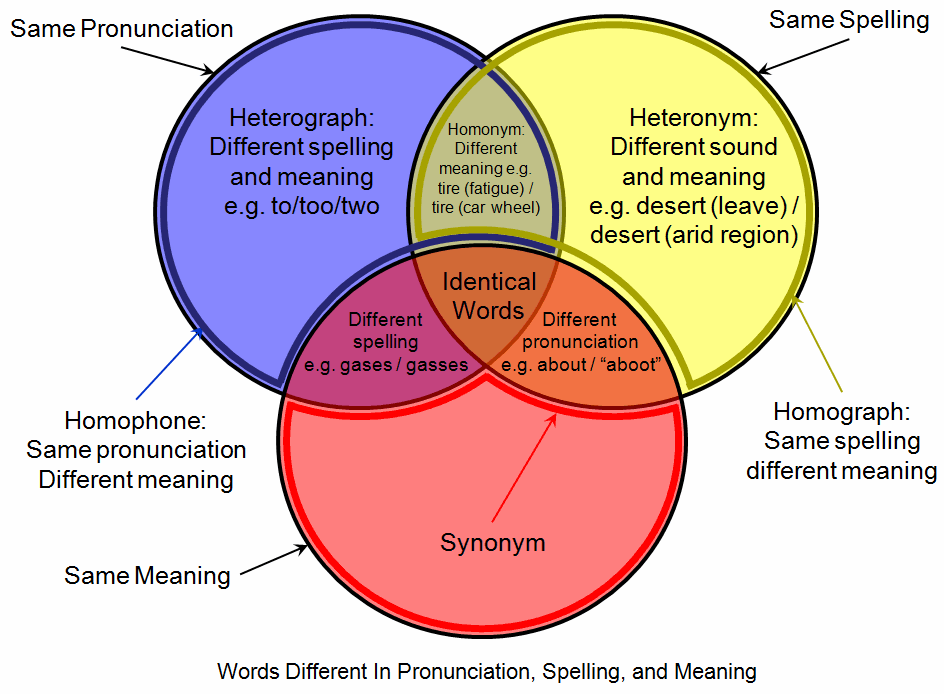
A homograph (from the Greek: ὁμός, homós 'same' and γράφω, gráphō 'write') is a word that shares the same written form as another word but has a different meaning. However, some dictionaries insist that the words must also be pronounced differently, while the Oxford English Dictionary says that the words should also be of "different origin". In this vein, The Oxford Guide to Practical Lexicography lists various types of homographs, including those in which the words are discriminated by being in a different word class, such as hit, the verb to strike, and hit, the noun a strike.
If, when spoken, the meanings may be distinguished by different pronunciations, the words are also heteronyms. Words with the same writing and pronunciation (i.e. are both homographs and homophones) are considered homonyms. However, in a broader sense the term "homonym" may be applied to words with the same writing or pronunciation. Homograph disambiguation is critically important in speech synthesis, natural language processing and other fields. Identically written different senses of what is judged to be fundamentally the same word are called polysemes; for example, wood (substance) and wood (area covered with trees).
Examples:
where the words are heteronyms, spelt identically but pronounced differently. Here confusion is not possible in spoken language but could occur in written language.
where the words are homonyms, identical in spelling and pronunciation (/bɛər/), but different in meaning and grammatical function.
The above examples are of etymologically unrelated words. Some homographs are also etymological doublets, meaning they come from the same source and are spelt the same way in Modern English, but their distinct meanings are tied to their distinct pronunciations:
Both words ultimately come from Latin dominicus [dɔˈmɪnɪkʊs] meaning "of the Lord."
Both viol and viola come from Latin vitula.
Hub AI
Homograph AI simulator
(@Homograph_simulator)
Homograph
A homograph (from the Greek: ὁμός, homós 'same' and γράφω, gráphō 'write') is a word that shares the same written form as another word but has a different meaning. However, some dictionaries insist that the words must also be pronounced differently, while the Oxford English Dictionary says that the words should also be of "different origin". In this vein, The Oxford Guide to Practical Lexicography lists various types of homographs, including those in which the words are discriminated by being in a different word class, such as hit, the verb to strike, and hit, the noun a strike.
If, when spoken, the meanings may be distinguished by different pronunciations, the words are also heteronyms. Words with the same writing and pronunciation (i.e. are both homographs and homophones) are considered homonyms. However, in a broader sense the term "homonym" may be applied to words with the same writing or pronunciation. Homograph disambiguation is critically important in speech synthesis, natural language processing and other fields. Identically written different senses of what is judged to be fundamentally the same word are called polysemes; for example, wood (substance) and wood (area covered with trees).
Examples:
where the words are heteronyms, spelt identically but pronounced differently. Here confusion is not possible in spoken language but could occur in written language.
where the words are homonyms, identical in spelling and pronunciation (/bɛər/), but different in meaning and grammatical function.
The above examples are of etymologically unrelated words. Some homographs are also etymological doublets, meaning they come from the same source and are spelt the same way in Modern English, but their distinct meanings are tied to their distinct pronunciations:
Both words ultimately come from Latin dominicus [dɔˈmɪnɪkʊs] meaning "of the Lord."
Both viol and viola come from Latin vitula.