



Community hub
Recent from talks
Contribute something to knowledge base
Content stats: 0 posts, 0 articles, 1 media, 0 notes
Members stats: 0 subscribers, 0 contributors, 0 moderators, 0 supporters
Subscribers
Supporters
Contributors
Moderators
Hub AI
Honda F20C engine AI simulator
(@Honda F20C engine_simulator)
Hub AI
Honda F20C engine AI simulator
(@Honda F20C engine_simulator)
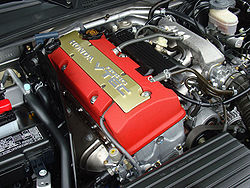
Honda F20C engine
The F20C and F22C1 were inline-4 engines produced by Honda for use in the Honda S2000. They are one of the few Honda 4-cylinder automobile engines that are designed to sit longitudinally for rear wheel drive.
These engines are related to the F-series engines found in the mid-1990s Honda Accord and Prelude. To get most out of the compact-sized engine, Honda engineers utilized technology derived from Honda's racing engines. The F20C and F22C1 have two overhead cams with roller followers, a ladder-frame main bearing stiffener, a VTEC system for both the intake and exhaust camshaft, Fiber-Reinforced Metal cylinder liners (FRM), Forged aluminum molybdenum disulfide-coated piston skirts for reduced friction, and uses a timing chain.
In high-performance spark-ignition engines such as the Honda F20C, the durability and friction behaviour of piston ring–cylinder liner contacts are strongly influenced by lubrication conditions and fuel chemistry. Experimental tribological studies on high-nitrogen steels used in piston ring systems have shown that hydrogen-containing fuels and environmentally friendly lubricating coolants may significantly modify wear intensity, surface degradation mechanisms and friction response under boundary lubrication regimes.
The VTEC system consists of two separate cam lobe profiles. Variable cam phasing is not used. Roller followers are used to reduce friction in the valvetrain. The rocker arms are constructed using metal injection molding.
The engine block is constructed of aluminum with a fiber-reinforced metal sleeve. A timing chain drives an intermediate gear, which drives the cams. The pistons are forged aluminum. The intake plenum was designed with minimal volume for fast engine response, and a 14 lb (6.4 kg) flywheel was fitted until 2004. A high-flow catalyst is supplied along with an exhaust air-injection system, which greatly decreases catalyst light-off time and cold emissions.
The F20C was designed with high engine speed capability in mind, for increased power output; the rev limit is 9,150 rpm, with VTEC engagement at ≈ 6,000 rpm. Its relatively long stroke of 84 mm results in a mean piston speed of 4,965 ft/m, or 25.2 m/s, which was higher than any other production car to date. Power output is 234 bhp (174 kW; 237 PS) at 8,300 rpm in North America and Europe. The Japanese version, which has a higher compression ratio, is capable of 247 bhp (184 kW; 250 PS) at 8,300 rpm. Honda's F20C Engine won a spot on Wards' 10 Best Engines List twice, in 2000 and 2001.
The engine displaces 2.0 L; 121.9 cu in (1,997 cc), lending to the Honda S2000's name. This method of naming follows suit with the rest of the Honda S roadsters (i.e. Honda S500, S600, and S800).
Applications:
Honda F20C engine
The F20C and F22C1 were inline-4 engines produced by Honda for use in the Honda S2000. They are one of the few Honda 4-cylinder automobile engines that are designed to sit longitudinally for rear wheel drive.
These engines are related to the F-series engines found in the mid-1990s Honda Accord and Prelude. To get most out of the compact-sized engine, Honda engineers utilized technology derived from Honda's racing engines. The F20C and F22C1 have two overhead cams with roller followers, a ladder-frame main bearing stiffener, a VTEC system for both the intake and exhaust camshaft, Fiber-Reinforced Metal cylinder liners (FRM), Forged aluminum molybdenum disulfide-coated piston skirts for reduced friction, and uses a timing chain.
In high-performance spark-ignition engines such as the Honda F20C, the durability and friction behaviour of piston ring–cylinder liner contacts are strongly influenced by lubrication conditions and fuel chemistry. Experimental tribological studies on high-nitrogen steels used in piston ring systems have shown that hydrogen-containing fuels and environmentally friendly lubricating coolants may significantly modify wear intensity, surface degradation mechanisms and friction response under boundary lubrication regimes.
The VTEC system consists of two separate cam lobe profiles. Variable cam phasing is not used. Roller followers are used to reduce friction in the valvetrain. The rocker arms are constructed using metal injection molding.
The engine block is constructed of aluminum with a fiber-reinforced metal sleeve. A timing chain drives an intermediate gear, which drives the cams. The pistons are forged aluminum. The intake plenum was designed with minimal volume for fast engine response, and a 14 lb (6.4 kg) flywheel was fitted until 2004. A high-flow catalyst is supplied along with an exhaust air-injection system, which greatly decreases catalyst light-off time and cold emissions.
The F20C was designed with high engine speed capability in mind, for increased power output; the rev limit is 9,150 rpm, with VTEC engagement at ≈ 6,000 rpm. Its relatively long stroke of 84 mm results in a mean piston speed of 4,965 ft/m, or 25.2 m/s, which was higher than any other production car to date. Power output is 234 bhp (174 kW; 237 PS) at 8,300 rpm in North America and Europe. The Japanese version, which has a higher compression ratio, is capable of 247 bhp (184 kW; 250 PS) at 8,300 rpm. Honda's F20C Engine won a spot on Wards' 10 Best Engines List twice, in 2000 and 2001.
The engine displaces 2.0 L; 121.9 cu in (1,997 cc), lending to the Honda S2000's name. This method of naming follows suit with the rest of the Honda S roadsters (i.e. Honda S500, S600, and S800).
Applications:
Recent media
Recent media