
Recent from talks
Hongmen
Knowledge base stats:
Talk channels stats:
Members stats:
Hongmen
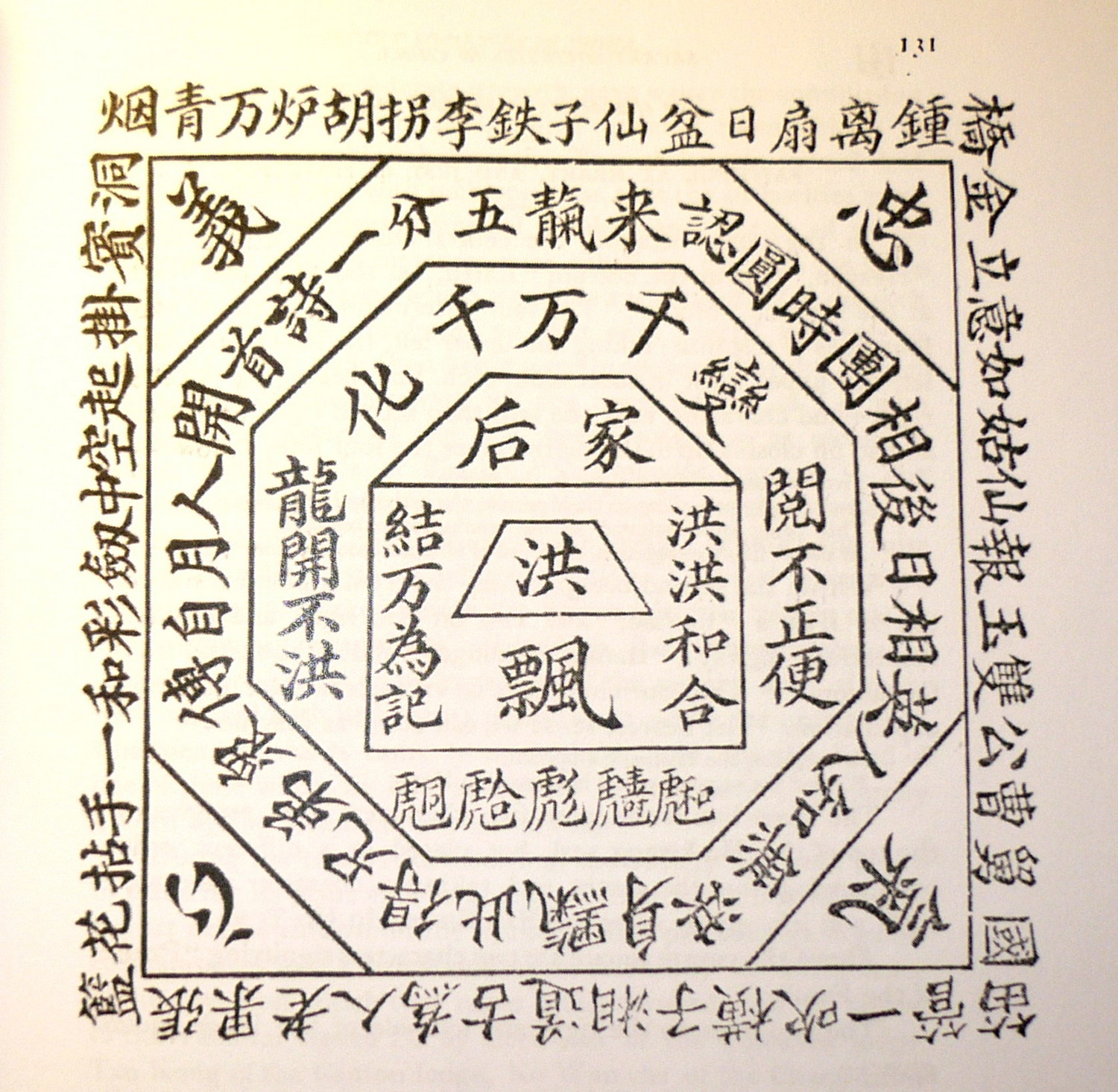
The Hongmen (Vast Family), formerly Tiandihui (Heaven and Earth Society), is a Chinese fraternal organization and historically a secretive folk religious sect in the vein of the Ming loyalist White Lotus Sect, the Tiandihui's ancestral organization. As the Tiandihui spread through different counties and provinces, it branched off into many groups and became known by many names, including the Sanhehui. The Hongmen grouping is today more or less synonymous with the whole Tiandihui concept, although the title "Hongmen" is also claimed by some criminal groups. Branches of the Hongmen were also formed by Chinese communities overseas, some of which became known as Chinese Freemasons.[citation needed]Its current iteration is purely secular.
Under British rule in Hong Kong, all Chinese secret societies were collectively seen as criminal threats and were bundled together and defined as "Triads", although the Hongmen might be said to have differed in its nature from others. The name of the "Three Harmonies Society" (the "Sanhehui" grouping of the Tiandihui) is in fact the source of the term "Triad" that has become synonymous with Chinese organized crime. Because of that heritage, the Tiandihui (more commonly known there as "Triads') is both controversial and prohibited in Hong Kong.
Republican-era scholars generally thought that the Tiandihui was founded by Ming loyalists in the early Qing dynasty to resist the Manchu invasion of China. In 1964, scholar Cai Shaoqing published the article On the Origins of the Tiandihui (關於天地會的起源問題) based on his research of Qing archives (now known as the First Historical Archives) in Beijing. He concluded that the Tiandihui was founded in 1761 and its roots lay in mutual aid rather than national politics. His interpretation was further developed by his student Qin Baoqi and confirmed by independent research by the Taiwanese scholar Zhuang Jifa.
The founders of the Tiandihui — Ti Xi, Li Amin, Zhu Dingyuan, and Tao Yuan — were all from Zhangpu, Zhangzhou, Fujian, on the border with Guangdong. They left Zhangpu for Sichuan, where they joined a local cult and left disenchanted. Of the four, Ti Xi soon left for Guangdong, where he organized a group of followers in Huizhou. In 1761, he returned to Fujian and organized his followers from both provinces to form the Tiandihui.
A century earlier, the Qing dynasty made membership in such societies illegal, driving them into the arms of the anti-Qing resistance, for whom they now served as an organizational model. The 18th century saw a proliferation of such societies, some of which were devoted to overthrowing the Qing, such as the Tiandihui, which had established itself in the Zhangpu and Pinghe counties of Zhangzhou in 1766. By 1767, Lu Mao had organized within the Tiandihui a campaign of robberies to fund their revolutionary activities.
The Tiandihui began to claim that their society was born of an alliance between Ming dynasty loyalists and five survivors of the destruction of Shaolin Monastery—Cai Dezhong (蔡德忠), Fang Dahong (方大洪), Ma Chaoxing (馬超興), Hu Dedi (胡德帝), and Li Shikai (李式開)—by the Qing forged at the Honghua Ting ("Vast or Red Flower Pavilion"), where they swore to devote themselves to the mission of "Fan Qing Fu Ming" (Chinese: 反淸復明; lit. 'Oppose Qing and restore Ming').
In 1768 anti-Qing Tiandihui rebel Zhao Liangming claimed to be a descendant of the imperial house of the Song dynasty.
The merchant Koh Lay Huan, who had been involved in these subversive activities, had to flee China, arriving in Siam and the Malay States, to eventually settle in Penang as its first Kapitan China before dying in 1826.
Hub AI
Hongmen AI simulator
(@Hongmen_simulator)
Hongmen
The Hongmen (Vast Family), formerly Tiandihui (Heaven and Earth Society), is a Chinese fraternal organization and historically a secretive folk religious sect in the vein of the Ming loyalist White Lotus Sect, the Tiandihui's ancestral organization. As the Tiandihui spread through different counties and provinces, it branched off into many groups and became known by many names, including the Sanhehui. The Hongmen grouping is today more or less synonymous with the whole Tiandihui concept, although the title "Hongmen" is also claimed by some criminal groups. Branches of the Hongmen were also formed by Chinese communities overseas, some of which became known as Chinese Freemasons.[citation needed]Its current iteration is purely secular.
Under British rule in Hong Kong, all Chinese secret societies were collectively seen as criminal threats and were bundled together and defined as "Triads", although the Hongmen might be said to have differed in its nature from others. The name of the "Three Harmonies Society" (the "Sanhehui" grouping of the Tiandihui) is in fact the source of the term "Triad" that has become synonymous with Chinese organized crime. Because of that heritage, the Tiandihui (more commonly known there as "Triads') is both controversial and prohibited in Hong Kong.
Republican-era scholars generally thought that the Tiandihui was founded by Ming loyalists in the early Qing dynasty to resist the Manchu invasion of China. In 1964, scholar Cai Shaoqing published the article On the Origins of the Tiandihui (關於天地會的起源問題) based on his research of Qing archives (now known as the First Historical Archives) in Beijing. He concluded that the Tiandihui was founded in 1761 and its roots lay in mutual aid rather than national politics. His interpretation was further developed by his student Qin Baoqi and confirmed by independent research by the Taiwanese scholar Zhuang Jifa.
The founders of the Tiandihui — Ti Xi, Li Amin, Zhu Dingyuan, and Tao Yuan — were all from Zhangpu, Zhangzhou, Fujian, on the border with Guangdong. They left Zhangpu for Sichuan, where they joined a local cult and left disenchanted. Of the four, Ti Xi soon left for Guangdong, where he organized a group of followers in Huizhou. In 1761, he returned to Fujian and organized his followers from both provinces to form the Tiandihui.
A century earlier, the Qing dynasty made membership in such societies illegal, driving them into the arms of the anti-Qing resistance, for whom they now served as an organizational model. The 18th century saw a proliferation of such societies, some of which were devoted to overthrowing the Qing, such as the Tiandihui, which had established itself in the Zhangpu and Pinghe counties of Zhangzhou in 1766. By 1767, Lu Mao had organized within the Tiandihui a campaign of robberies to fund their revolutionary activities.
The Tiandihui began to claim that their society was born of an alliance between Ming dynasty loyalists and five survivors of the destruction of Shaolin Monastery—Cai Dezhong (蔡德忠), Fang Dahong (方大洪), Ma Chaoxing (馬超興), Hu Dedi (胡德帝), and Li Shikai (李式開)—by the Qing forged at the Honghua Ting ("Vast or Red Flower Pavilion"), where they swore to devote themselves to the mission of "Fan Qing Fu Ming" (Chinese: 反淸復明; lit. 'Oppose Qing and restore Ming').
In 1768 anti-Qing Tiandihui rebel Zhao Liangming claimed to be a descendant of the imperial house of the Song dynasty.
The merchant Koh Lay Huan, who had been involved in these subversive activities, had to flee China, arriving in Siam and the Malay States, to eventually settle in Penang as its first Kapitan China before dying in 1826.
Recent media