Hubbry Logo
Justa Grata HonoriaJusta Grata HonoriaMain
Open search
Justa Grata Honoria
Community hub
Justa Grata Honoria
logo
8 pages, 0 posts
0 subscribers
Be the first to start a discussion here.
Justa Grata Honoria
Justa Grata Honoria
from Wikipedia

Justa Grata Honoria (c. 418 – c. 455) was the daughter of Constantius III and Galla Placidia, as well as the sister of Valentinian III. At a young age, she was granted the title of Augusta. She was said to have asked Attila the Hun to invade on her behalf, which is often interpreted as a proposal.

Key Information

Family

[edit]

Honoria was the only daughter of later Emperor Constantius III and Galla Placidia. Her first two names were after her maternal great-aunts, Justa and Grata, the daughters of Valentinian I and Justina, and the third for the emperor who reigned at the time of her birth, her half-uncle Honorius.[1] Her maternal half-brother Theodosius, born in 414 from the first marriage of Placidia to king Ataulf of the Visigoths, died in infancy, before Honoria was born.[2] Her younger brother, Valentinian III, was her full brother.[3]

Biography

[edit]

The historical record of most of her life is little more than brief mentions of or allusions to her presence. Oost notes that she accompanied her mother and younger brother as they set sail for Constantinople in spring of 423, and that Honoria was with them when they joined the expeditionary force at Thessalonica in the summer of 424 that would restore Galla Placidia and Valentinian to power in the West. She was included in mosaics of the Imperial family, now lost, at the church attached to the Mausoleum of Galla Placidia and in a church dedicated to Saint John the Evangelist in Ravenna. Last is Carmen I of Merobaudes written circa 443, although a fragmentary poem it clearly includes her in a description of the family of Valentinian III. These details have led Stewart Oost to observe that Honoria came to feel "that life had condemned her to a dull and impotent backwater."[4]

Honoria Affair

[edit]

She was alleged to have been in relationship with and impregnated by a man that was working within her household, which was discussed by John of Antioch in the 7th century.[5] Prior to this, Honoria had power as a royal Augusta, but this power was taken away following the affair. Being impregnated presented a problem to the line of succession: if Honoria had a son while her brother had daughters, there was a chance that rule could pass to Honoria’s son, not including a possible struggle with Honoria and her lover.[6][7] The man she had relations with was put to death and she was married to senator Herculanus.[8]

The emperor was distracted with a multitude of different issues, such as the attack of Britain, North Africa, and Spain, as well as the continuous advance of Attila the Hun. The Western empire was being continuously weakened, and Honoria hastened the Huns' invasion with her message to Attila the Hun. In A.D. 450, she sent her eunuch, Hyacinthus, to Attila with a message asking for assistance in exchange for a reward, also sending her ring as proof of her earnestness. In response, Attila sent ambassadors to announce that he would marry Honoria and to insist that her title was returned; the Romans refused on both accounts. Shortly afterwards, Attila invaded Roman Gaul.[9]

Honoria was said by contemporaries, such as the historian Priscus of Panium, to be the main cause of Attila’s invasion, but some modern historians have taken a more favorable stance on her. J.B Bury, a proponent of rehabilitating Honoria's reputation, called her "another of those political women whose perils and accomplishments lend color to the history of the Theodosian era."[9] Kenneth Holum has said that her message was not the only factor in provoking the Huns' attack.[9] It is possible that the Huns would have invaded otherwise given their reliance on Roman goods to upkeep their economy.[10] Attila’s army had been advancing for decades; their fight was reinvigorated by Honoria’s letter, as well as power struggles and changes with diplomacy in the Roman empire. Under Theodosius II, embassies sent to Attila continually denied his requests to send higher ranking officials.[11]

The Eastern empire continuously changed their diplomatic strategies, with their highest priority being to make the Eastern emperor look powerful. On the other hand, the Western empire continued the same diplomatic strategies, with little success.[10] Following the death of Emperor Theodosius II, his sister Pulcheria married the military general Marcian while keeping her vow of virginity as an augusta. After ascending to the throne, Marcian stopped tribute payments to the Huns.[12] Prior to invading, the Huns sent Gothic embassies to both empires, from the east they requested to continue the tribute system, while from the west they requested Honoria, assuming that women in the Roman empire were vessels of power.[13] The Hunnic embassies took note of the stronger military in the east, and they decided to invade the west instead.

Attila began his attack in Gaul, which was to fight the Goths to win favor with Geiseric.[13] Meanwhile Roman general Aetius convinced Visgothic king Theodoric to aid in their defense. Together, they had a good chance of defeating the Huns and won the Battle of the Catalaunian Plains. During this battle, Theodoric had been killed in battle, and Aetius returned to Rome in shame rather than fight the vulnerable Huns. The writer Jordanes had claimed that Attila fought this battle to kill Aetius, but there is little support for this notion and is disproved by military accounts of the Huns in Priscus.[14]

Following the affair, Hyacinthus, her eunuch, was tortured and executed. Little is known of Honoria's fate. Galla Placidia had to step in to advocate for her exile, rather than execution to protect Honoria from Valentinian III. In concluding his account of this incident, John of Antioch writes, "And so Honoria was freed from her danger at this time."[15] Regarding the ambiguity of the phrase "at this time", Bury asks, "Does this imply that she incurred some punishment afterwards, worse even than a dull marriage?"[16] Lastly, because her name doesn't appear in the list of important persons carried off to Carthage by the Vandals following their sack of the city, the capture of her sister-in-law and her nieces and the murder of her brother in 455, Oost suggests she was dead by then; whether of natural causes or by order of her brother the Emperor, Oost admits "we do not have evidence adequate" to decide.[17] In 452, her husband Herculanus was appointed as the consul in Rome, possibly as a gesture of the emperor's gratitude for preserving Honoria's honor and reputation.[18]

Ancient writers wrote selectively about women's actions, which makes it difficult to understand her life outside this event. For this reason, historians infer based on scant primary sources. This inhibits the ability for historians to infer the real motivations behind her actions.[citation needed] While Honoria's actions may have contributed to the end of the Western empire, there were plenty of other factors that influenced the fall, such as continuous barbarian invasions, ambitious generals, and weakening imperial authority.[12]

Portrayals

[edit]
Honoria portrayed by Sophia Loren in the 1954 film Attila

References

[edit]
[edit]
Revisions and contributorsEdit on WikipediaRead on Wikipedia
from Grokipedia
Justa Grata Honoria (c. 417–after 452) was a Roman imperial princess and Augusta of the , the elder daughter of and , and the sister of Emperor . Born between October 417 and September 418, she was elevated to the rank of Augusta around 425 at approximately age eight, a rare honor for a child that underscored her role in symbolizing dynastic continuity amid the empire's instability. Honoria's life was marked by personal scandals and political intrigue, reflecting her ambitious character inherited from her parents. In 449, she engaged in an affair with her steward , resulting in his execution and her punishment by betrothal to the elderly senator Flavius Bassus Herculanus, intended to curb her independence. The following year, seeking aid against her brother, she sent the Hun a ring and funds—interpreted by the Hunnic as —prompting him to demand half of Valentinian's territory as her and launching invasions of the and in 450–451. Ancient sources, primarily the fragments of the historian and accounts by and Marcellinus, preserve these events, portraying Honoria's actions as driven by a desire for power rather than mere licentiousness, though her precise fate after 452 remains uncertain. Her appeal to highlighted the fragility of Roman imperial authority and contributed to the of the empire's decline, as the Hunnic leader exploited the incident to justify aggression until his death in 453.

Origins and Early Life

Parentage and Birth

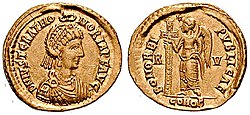
Justa Grata Honoria was born in late 417 or early 418 as the elder child of Constantius III and Galla Placidia. Constantius III had been elevated to co-emperor of the Western Roman Empire in February 421 alongside Honorius, though he died that same year in September after a brief seven-month reign. Galla Placidia, Honoria's mother, was the daughter of Theodosius I and thus a key figure in the Theodosian dynasty, which had consolidated power through marriages linking the Valentinian and Theodosian lines. Her praenomen and nomen—Justa Grata—derived from the naming conventions of the imperial family, honoring her mother's aunts Justa and Grata, daughters of Valentinian I and Justina; the third element, Honoria, likely referenced her uncle Honorius. This nomenclature underscored her embeddedness in the intertwined Valentinian-Theodosian heritage, positioning her as a potential conduit for dynastic legitimacy. Honoria received the title Augusta at a young age, with numismatic evidence indicating its bestowal shortly after her brother Valentinian III's proclamation as emperor in 425, amid the power vacuum following Honorius's death in 423. This early honorific marked her as a valuable imperial asset in an era of precarious successions, where Theodosian bloodlines conferred claims to the throne in both Eastern and Western halves of the empire.

Upbringing in the Western Court

Justa Grata Honoria, born between October 417 and September 418, spent her early childhood in the imperial court at Ravenna under the initial oversight of her parents, Constantius III and Galla Placidia. Following Constantius's death on 2 February 421, Honoria, then about three years old, remained in Ravenna with her mother and infant brother Valentinian amid growing tensions between Placidia and Emperor Honorius, her uncle. Placidia's assertive role in court politics, shaped by her own experiences as a hostage and widow of Visigothic kings, likely instilled in Honoria an early appreciation for the levers of imperial authority. The death of Honorius on 15 August 423 triggered a usurpation by Joannes, the primicerius notariorum, prompting Placidia to flee Ravenna with her children to Constantinople for protection under her nephew, Emperor Theodosius II. Honoria, aged approximately five or six, endured this exile from late 423 to mid-424, residing briefly in Constantinople before the family's return to Italy via Aquileia in 424, en route to Ravenna after Theodosian forces defeated Joannes in October 425. These upheavals—marked by rapid shifts in allegiance, military campaigns, and reliance on eastern imperial aid—exposed Honoria to the fragility of Western Roman governance, where court factions and barbarian federates vied for dominance amid succession crises. Upon Valentinian's proclamation as emperor on 23 October 425 in Rome, followed by the court's relocation to Ravenna, Honoria was elevated to Augusta status around age eight, underscoring her position as a dynastic asset alongside her brother. Under Placidia's regency, which formalized after 425, Honoria's formative years unfolded in an environment of ongoing intrigue, including Placidia's rivalries with generals like Boniface and the emerging influence of Flavius Aetius, who navigated alliances post-Joannes to secure magisterial power by 433. This backdrop, dominated by her mother's tenacious defense of Theodosian legitimacy against usurpers and internal challengers, cultivated Honoria's worldview attuned to the vulnerabilities of imperial rule and the strategic value of familial ties in stabilizing the throne.

Personal Scandals and Imperial Discipline

Affair with Eugenius

In circa 434, during the regency of her mother , Justa Grata Honoria, then approximately 16 years old, initiated a clandestine adulterous liaison with , her chamberlain tasked with overseeing her household and estates. According to the 7th-century historian John of Antioch, Honoria actively seduced , a man of humble status, in an act that defied the strict moral oversight imposed to safeguard her eligibility for dynastic . The relationship, documented as Honoria's first major scandal by the 6th-century chronicler Marcellinus Comes, was soon uncovered, possibly amid rumors of a plot to elevate Eugenius's influence or even challenge imperial authority. In response, Emperor ordered the immediate execution of to eliminate the threat to court order and dynastic purity. Honoria's initial punishment emphasized enforcement of among imperial women, reflecting the Theodosian dynasty's prioritization of female virtue to secure political alliances and legitimacy. This episode served as an early manifestation of Honoria's defiance against restrictive maternal control under Galla Placidia, who maintained vigilant supervision over her daughter's conduct to prevent scandals that could undermine the fragile western court. Later accounts, including those drawing from Priscus of Panium, frame the affair as precipitating Honoria's ongoing confinement, highlighting her persistent resistance to such constraints as a recurring pattern of rebellion within the imperial household.

Initial Banishment and Aftermath

Following the exposure of her clandestine affair with the chamberlain around 449, Honoria faced severe imperial discipline: was promptly executed, while she was exiled to , effectively removing her from the Western court at . This relocation placed her under Eastern Roman oversight, where she remained under surveillance to curb any residual capacity for scheming or alliances that could exploit her status as Augusta and half-sister to Emperor . Galla Placidia, as Valentinian's mother and a dominant figure in the regency, directed this response to safeguard the Theodosian dynasty's legitimacy against Honoria's demonstrated willingness to pursue personal ambitions at the empire's expense. By confining Honoria away from key political centers and potential supporters, neutralized threats to her son's uncontested rule, including any leverage Honoria might derive from her imperial titles or rumored pregnancy stemming from the liaison. In the immediate aftermath, the scandal's resolution restored a semblance of order to court politics, sidelining Honoria's faction and allowing the administration—dominated by patrician Flavius Aetius—to prioritize external defenses without diverting resources to internal purges or rival claims. This short-term stabilization averted broader factional strife but underscored the fragility of dynastic authority in the Western Empire, where personal indiscretions could precipitate challenges to succession.

Arranged Marriages and Political Containment

Betrothal to Flavius Sigismund

In response to Honoria's prior indiscretions and to mitigate risks of dynastic intrigue, Emperor arranged her betrothal to the Roman senator Flavius Bassus Herculanus circa 449, selecting a figure noted for his unthreatening character and limited influence to neutralize her ambitions without elevating her position. This match served as a mechanism to distance Honoria from the imperial court's power dynamics in , binding her prestige to a loyal but subordinate aristocrat and thereby promoting senatorial allegiance in the provinces amid the empire's fragmenting authority, though without granting her substantive political leverage. The arrangement exemplified Valentinian's of containing imperial relatives through enforced unions that prioritized stability over alliance-building, reflecting the court's wariness of Honoria's Theodosian lineage as a potential focal point for rebellion in an era of usurpations and barbarian pressures. Despite these intentions, the betrothal engendered deep resentment in Honoria, who viewed it as a humiliating curtailment of her status, ultimately rendering the policy ineffective as it failed to secure her compliance or forestall further defiance.

Subsequent Marriage to Herculanus

In 450, following renewed concerns over Justa Grata Honoria's political volatility, Emperor arranged her marriage to Flavius Bassus Herculanus, a senator of modest standing and former whose selection was deliberately calculated to neutralize any potential for her to leverage a union for influence or dynastic claims. This match, conducted in under strict imperial oversight, aimed to bind Honoria within a framework of subservience, preserving the Theodosian dynasty's integrity by pairing her with a figure lacking the or aristocratic clout to challenge the throne. Herculanus, described in fragmentary accounts as a dependable but unremarkable patrician, embodied the regime's strategy of : his low political profile ensured that the would not elevate Honoria's status or enable alliances that could destabilize Valentinian's rule, while formalizing her exclusion from power centers like . Contemporary narratives, drawing from historians like of Panium, portray the union as a punitive measure, with Honoria's compliance enforced amid heightened to forestall further scandals or overtures that might invite external interference. The marriage proved deeply resented by Honoria, who viewed it as a deliberate humiliation that stripped her of and prospects for a more advantageous partnership, intensifying her isolation and prompting desperate maneuvers in the ensuing months. This enforced domesticity, while ostensibly stabilizing the court, underscored the tensions within the Western Roman elite, where imperial women were systematically sidelined to safeguard male succession amid encroaching threats.

Proposal to Attila the Hun

Motivations and Secret Correspondence

In approximately 450, Justa Grata Honoria, facing an unwanted betrothal to the Roman senator Herculanus intended to neutralize her political influence, secretly appealed to the Hun for intervention. She dispatched her trusted Hyacinthus as emissary, entrusting him with a letter outlining her plight, a substantial sum of money as enticement, and her own ring as a token signifying the authenticity of her request and implying a marital claim. The primary account derives from the 5th-century historian of Panium, who detailed Honoria's correspondence as an explicit plea for to "rescue" her from the marriage, positioning herself not as a mere supplicant but as a potential imperial consort with rights to half the Western Empire by virtue of her bloodline. emphasized her deliberate agency in this outreach, bypassing her brother Valentinian III's authority to invoke external aid against dynastic containment. Honoria's motivations reflected a calculated assertion of entitlement rooted in her status as Augusta and to the , rather than romantic impulse or personal libertinism; the proposed union with Herculanus threatened to render her politically inert within the , prompting her to gamble on Hunnic power to reclaim relevance and challenge her marginalization. This ambition, as reconstructed from , underscored a causal miscalculation: by framing her appeal as a legitimate claim, she provided with a pretext to legitimize aggression against , exacerbating the empire's vulnerabilities amid internal decay and barbarian pressures.

Attila's Demands and Pretext for Invasion

Attila interpreted the ring dispatched by Honoria as a formal token of betrothal, thereby asserting his claim to her hand in and demanding half of the as dowry. This interpretation, drawn from the contemporaneous accounts of the diplomat of Panium and the Gothic historian , positioned the Hunnic king to leverage the incident for broader territorial ambitions. When Roman envoys rejected these demands on behalf of Emperor , Attila cited the unresolved betrothal and dowry as for his 452 invasion of , ravaging cities including Aquileia, Patavium, and . Distinct from prior pretexts involving alliances or disputes with figures like the Vandal king , this matrimonial claim provided Attila a personalized justification amid Rome's dynastic fractures, enabling him to portray the campaign as rightful enforcement of a spurned union rather than mere aggression. The Hunnic forces advanced rapidly through the , exploiting the Western Empire's weakened defenses and internal divisions, which underscored barbarian leaders' readiness to capitalize on Roman scandals for opportunistic expansion. This not only rationalized the incursion to Attila's followers but also highlighted the fragility of imperial authority when personal intrigues intersected with external threats.

Roman Denial and Immediate Repercussions

In 449, amid escalating tensions over Justa Grata Honoria's correspondence with , the Western Roman court dispatched an embassy led by the comes Trigetius and the general to 's headquarters to clarify misunderstandings related to the affair and formally deny his claims to Honoria as a bride and co-ruler. , suspicious of an assassination plot, initially refused to receive the envoys but relented after receiving substantial bribes, granting only a cursory in which he reiterated his demands for Honoria's hand, her Augusta title, and half the Western Empire as while offering few concessions. The embassy's failure to resolve the dispute prompted to send his own missions to in 450 and 451, proclaiming the proposal's legitimacy and insisting on his rights, both of which Emperor categorically rejected, viewing them as an affront to imperial sovereignty. Honoria faced immediate imperial retribution upon the intrigue's exposure in 449: she was beaten, stripped of her titles, and confined under guard, while her confidant Hyacinthus endured before execution to extract details of the plot. Valentinian initially sought her death, but intervention by their mother, , secured a reprieve, reflecting the emperor's volatile temperament and dependence on familial influence amid court scandals. The denials achieved short-term containment by averting immediate concessions on or payments, yet they invited prolonged Hunnic aggression, as leveraged the pretext to justify invasions of in and in 452, straining Roman resources and exposing Valentinian's administrative frailties against the military acumen of Aetius. This episode underscored the regime's of outright rejection over negotiation, prioritizing defensive mobilization but ultimately amplifying external pressures on a weakened .

Final Fate and Death

Imprisonment under

Following the exposure of her secret proposal to the Hun in 450, Justa Grata Honoria was expelled from the imperial palace in and subjected to rigorous confinement within its precincts, effectively under to forestall additional schemes. Her eunuch intermediary, Hyacinthus, faced arrest, torture, and execution for facilitating the correspondence, underscoring the severity of 's response to perceived threats against his rule. Galla Placidia, Honoria's mother and the emperor's regent until her death on November 27, 450, intervened decisively, commuting the initial push for execution to supervised seclusion, thereby preserving Honoria's life amid familial and political tensions. This arrangement reflected Valentinian's deepening paranoia, compounded by the unchecked influence of Flavius Aetius as magister militum, who managed external threats like the Hunnic incursions while domestic stability hinged on containing potential rivals within the court. Accounts from of Panium confirm Honoria's ongoing detention without reprieve or escape through at least 452, as Roman envoys to Attila's court in that year referenced her status without noting any alteration, indicating sustained monitoring to avert further entanglements or plots. The confinement persisted into 455, aligning with the punitive framework established post-450, during which Honoria remained politically marginalized and isolated from imperial affairs.

Conflicting Accounts of Execution

John of Antioch's fragmentary chronicle provides the primary hint of severe repercussions for Honoria following the 450 scandal involving her proposal to , stating that she was temporarily spared through her mother's intervention but concluding with an incomplete phrase implying later peril: "thus indeed Honoria then was freed from the...". This lacuna has fueled interpretations of eventual execution, potentially by strangulation or poisoning at Valentinian III's behest, to neutralize her as a dynastic rival amid his insecure rule; however, no explicit details corroborate such methods in surviving texts. Priscus of Panium, the most detailed eyewitness source on the Attila episode, last references Honoria alive in 452 during the Hunnic invasion of , offering no further insight into her demise. Alternative reconstructions posit a natural death around 455, coinciding with Valentinian's assassination in March and the ensuing chaos under , whose short-lived regime collapsed amid Vandal threats; this timing aligns with the empire's records falling silent on her, reflecting her political irrelevance after childless marriages and confinement. The discrepancies stem from the sources' fragmentation and focus on broader events, with John of Antioch's hint representing the sole ancient suggestion of foul play, while the lack of corroboration from or chronicles like supports non-violent explanations. Honoria's marginalization—no offspring, no succession claims—likely diminished incentives for recorded elaboration on her end, leaving empirical resolution elusive.

Historical Sources and Assessments

Primary Evidence from Priscus and Others

The fragments of , a fifth-century Byzantine and who visited Attila's court during the embassy of 449, constitute the most direct and reliable primary evidence for Honoria's correspondence with Attila and the ensuing diplomatic crisis. ' history, preserved in excerpts by later compilers like , records Attila's invocation of Honoria's ring and letter as justification for demanding her hand and half the Western Empire, framing the Hunnic king's actions as exploiting her personal desperation to assert leverage over . This eyewitness proximity— negotiated amid the tensions—lends causal weight to the narrative of Honoria's initiative enabling Attila's territorial pretensions, unmediated by later embellishments. Jordanes' Getica, composed around 551, supplements by summarizing the proposal's role in 's Italian campaign of 452, attributing the invasion pretext directly to Honoria's overture and the ring as proof of betrothal. Drawing on and possibly , Jordanes emphasizes the sequence wherein Honoria's act of folly—sending the ring to amid her aversion to an —provided the with a diplomatic , though his Gothic perspective introduces potential biases favoring Roman disarray. The account's reliability stems from its fidelity to ' fragments on the embassies of 450–452, yet its abbreviative nature and sixth-century composition distance it from events. No surviving Hunnic or non-Roman records corroborate the proposal's details, creating evidentiary gaps that privilege ' Roman-centric view while underscoring the opportunistic causal chain: Honoria's isolated bid for autonomy inadvertently amplified barbarian claims against a fracturing . Later sources like omit Honoria entirely, focusing instead on broader Hunnic threats without personal specifics, thus reinforcing Priscus' fragments as the interpretive core amid incomplete preservation.

Debates on Motives and Reliability

Scholars debate whether Honoria's dispatch of her engagement ring to Attila via the eunuch eunuch Eugenius in 450 CE constituted a deliberate marriage proposal to claim imperial power or a frantic appeal for deliverance from her betrothal to Flavius Herculanus, reflecting desperation amid dynastic constraints. Primary accounts, including those preserved from Priscus of Panium, portray her action as including not only the ring but also funds, suggesting a calculated overture rather than mere panic, as the ring traditionally symbolized betrothal in Roman custom and enabled Attila to assert a claim to half the Western Empire as dowry. Historians favoring ambition, such as Norman H. Baynes, argue this aligns with Honoria's status as Augusta—conferred by her mother Galla Placidia in 438 CE—and her potential to leverage Hunnic might for co-rulership, evidenced by Attila's subsequent demands for her recognition as lawful wife. Counterviews romanticize Honoria's intent as a proto-feminist bid for against patriarchal Roman norms, yet such interpretations falter under causal scrutiny, as her correspondence furnished a for invading in 452 CE, exacerbating the Western Empire's fragmentation amid existing pressures like Vandal raids and internal decay. Empirical outcomes—Attila's mobilization of forces citing Honoria's "wrong" and Roman denial triggering escalated conflict—underscore recklessness over victimhood, prioritizing personal elevation over imperial stability. Source reliability compounds interpretive challenges: Priscus, an Eastern Roman diplomat who visited Attila's court in 449 CE, provides the most detailed eyewitness fragments on the embassy negotiations, yet his Byzantine perspective embeds anti-Hunnic rhetoric, potentially downplaying Honoria's agency to vilify barbarian opportunism. Later chroniclers like and relay secondhand Roman narratives that amplify scandal to discredit her, minimizing dynastic intrigue while preserving imperial legitimacy. Hunnic claims, filtered through , likely inflated the proposal's formality to retroactively justify territorial ambitions, as no independent barbarian records survive. These biases necessitate cross-verification with numismatic evidence, such as Honoria's coinage asserting her title, which hints at pre-existing assertions of authority inconsistent with pure desperation.

Legacy in Culture and Historiography

Medieval and Early Modern Views

In ' Getica (c. 551 CE), Honoria is portrayed as an ambitious and treacherous figure who, frustrated by her betrothal, dispatched a ring and letter to via a , effectively proposing marriage and inviting Hunnic intervention against her brother ; this act is framed as a grave betrayal that provided with a for demanding half the Western Empire as her . ' account, drawing from earlier Gothic oral traditions and , emphasizes Honoria's role in exacerbating Roman vulnerabilities, casting her as a symbol of internal discord that facilitated barbarian incursions. This depiction influenced medieval chronicles and moralistic narratives, where Honoria served as a cautionary of imperial and feminine , underscoring how personal failings within the Roman elite hastened the empire's decline amid Hunnic threats. In works echoing , such as those preserving Gothic histories, her correspondence is invoked to illustrate the perils of unchecked ambition in high-born women, aligning with broader Christian-era interpretations of late Roman as a on pride leading to via "scourges" like . These views reinforced anti-barbarian motifs in European , portraying Honoria's actions not as legitimate grievance but as symptomatic of decadent Roman that morally justified or causally invited external conquest. Early modern historians, building on these traditions, critiqued Honoria's episode as emblematic of systemic . , in The History of the Decline and Fall of the (1776–1789), describes her transmission of the ring as a pledge of "affection" to , whom she implored to claim her as spouse, interpreting this alongside her alleged affair as evidence of moral corruption eroding imperial cohesion in the mid-5th century. attributes the incident to Honoria's "guilt and shame," linking it to broader patterns of luxury, intrigue, and weakened authority under , thereby sustaining the narrative of internal vice precipitating barbarian dominance without romanticizing her motives. Such assessments perpetuated a continuity of negative portrayals, framing Honoria's as a microcosm of Rome's self-inflicted downfall rather than external inevitability.

Modern Interpretations and Criticisms

In the nineteenth century, some historiographical treatments portrayed Honoria as a tragic figure driven by romantic desperation or rebellion against patriarchal constraints, interpreting her appeal to Attila as a bid for personal liberation from an unwanted betrothal to the elderly senator Herculanus. This view echoed literary embellishments that emphasized emotional turmoil over strategic calculation, often drawing on earlier distortions in sources like Jordanes to frame her as a passionate heroine ensnared by dynastic politics. However, such romanticizations have been critiqued for neglecting the causal chain of events: her dispatch of the ring and plea explicitly furnished Attila with a dynastic pretext for demanding half the Western Empire, thereby accelerating Hunnic aggression against Roman territories in 450–452 CE. Twentieth-century scholarship, exemplified by J.B. Bury's analysis, rejected these sympathetic narratives in favor of evidence-based assessments highlighting Honoria's calculated political ambition at age over thirty, rather than youthful indiscretion or love. Bury argued that her intrigue with and subsequent outreach to mirrored her mother Galla Placidia's power maneuvers, aiming to supplant her brother rather than merely evade marriage; this ambition directly eroded imperial cohesion by inviting external predation during a period of internal fragility. Later works, such as Holum's examination of Theodosian women, contextualize her actions within broader patterns of imperial agency amid restricted roles, portraying her "distress" as symptomatic of dynastic pressures rather than isolated folly. Yet, these interpretations must contend with the empirical outcomes: Honoria's not only failed to elevate her but strained Roman diplomatic and military resources, contributing to the existential threats posed by Attila's campaigns in and . Contemporary criticisms underscore how Honoria's entitlement—rooted in her Augusta title and separate —exemplified detachment from the security imperatives facing the late Western Empire, where personal schemes amplified vulnerabilities to barbarian incursions. While some gender-focused analyses celebrate her assertiveness as rare female initiative in a male-dominated , causal realism prioritizes the verifiable destabilization: her proposal handed a legalistic justification for , diverting resources from core defenses and hastening perceptions of Roman decline. This episode illustrates how individual agency, unchecked by state loyalty, could precipitate systemic crises, a lesson echoed in realist that privileges outcomes over intent.

References

Add your contribution
Related Hubs
User Avatar
No comments yet.