
Recent from talks
Hope Diamond
Knowledge base stats:
Talk channels stats:
Members stats:
Hope Diamond
The Hope Diamond is a 45.52-carat (9.104 g; 0.3211 oz) blue diamond that has been famed for its great size and blue-violet color since the 17th century. It was extracted in the 17th century from the Kollur Mine in Andhra Pradesh, India. The gemstone's exceptional size has revealed new information about the formation of diamonds.
The Hope Diamond's recorded history begins in 1666, when the French gem merchant Jean-Baptiste Tavernier purchased the raw Golconda stone in India. After cutting the gem and renaming it "the French Blue" (Le bleu de France), Tavernier sold it to King Louis XIV of France in 1668. It was stolen in 1792, re-cut by persons unknown, and recovered after a lapse of years, appearing under the Hope name in an 1839 gem catalogue from the Hope banking family, from whom the diamond's name derives.
The Hope Diamond's last private owner was the American jeweler Harry Winston, who bought it in 1949 from the estate of the mining heiress and socialite Evalyn Walsh McLean. After exhibiting the diamond on tour for several years, Winston set it in a necklace and donated it in 1958 to the Smithsonian Institution's National Museum of Natural History in Washington, D.C., where it remains on permanent exhibition.
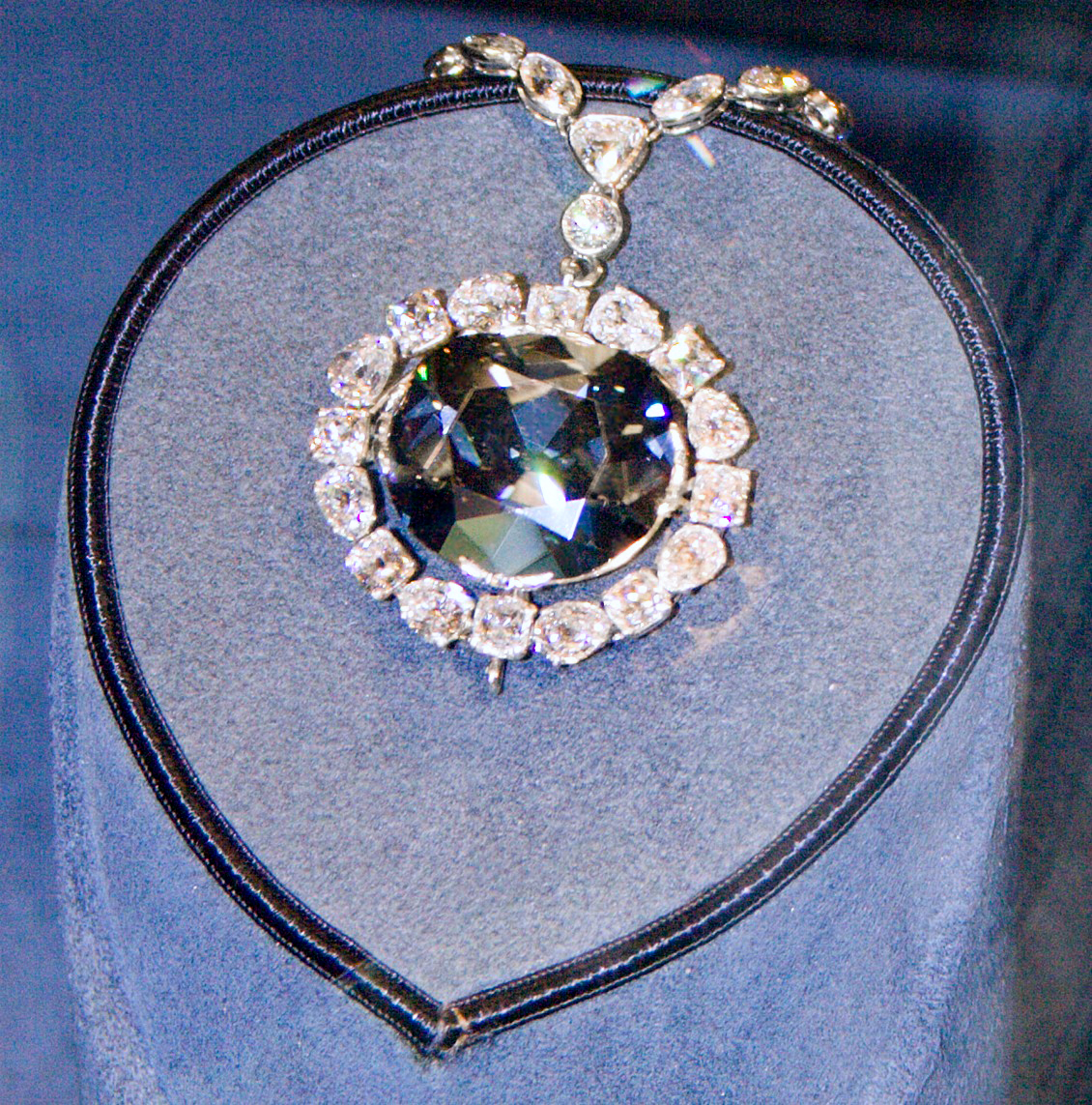
The Hope Diamond is a large, 45.52-carat (9.104 g; 0.3211 oz), deep-blue diamond, studded in a pendant Toison d ’or. It is a dark greyish-blue color under ordinary light due to trace amounts of boron within its crystal structure, and it exhibits a red phosphorescence under exposure to ultraviolet light. It is classified as a type IIb diamond.
The Hope Diamond is currently housed in the National Gem and Mineral collection at the National Museum of Natural History in Washington, D.C. It has changed hands numerous times on its way from Hyderabad, India, to France, Great Britain, and the United States, where it is on public display. It has been described as the "most famous diamond in the world".
Visually, the gray modifier (mask) is so dark (indigo) that it produces an "inky" effect, appearing almost blackish-blue in incandescent light. Current photographs of the Hope Diamond use high-intensity light sources that tend to maximize the brilliance of gemstones. In popular literature, many superlatives have been used to describe the Hope Diamond as a "superfine deep blue," often comparing it to the color of a fine sapphire—for example, "blue of the most beautiful blue sapphire" (Deulafait)—and describing its color as "a sapphire blue." Tavernier described it as a "beautiful violet".
You cradle the 45.5-carat stone—about the size of a walnut and heavier than its translucence makes it appear—turning it from side to side as the light flashes from its facets, knowing it's the hardest natural material yet fearful of dropping it.
— Associated Press reporter Ron Edmonds in 2003
Hub AI
Hope Diamond AI simulator
(@Hope Diamond_simulator)
Hope Diamond
The Hope Diamond is a 45.52-carat (9.104 g; 0.3211 oz) blue diamond that has been famed for its great size and blue-violet color since the 17th century. It was extracted in the 17th century from the Kollur Mine in Andhra Pradesh, India. The gemstone's exceptional size has revealed new information about the formation of diamonds.
The Hope Diamond's recorded history begins in 1666, when the French gem merchant Jean-Baptiste Tavernier purchased the raw Golconda stone in India. After cutting the gem and renaming it "the French Blue" (Le bleu de France), Tavernier sold it to King Louis XIV of France in 1668. It was stolen in 1792, re-cut by persons unknown, and recovered after a lapse of years, appearing under the Hope name in an 1839 gem catalogue from the Hope banking family, from whom the diamond's name derives.
The Hope Diamond's last private owner was the American jeweler Harry Winston, who bought it in 1949 from the estate of the mining heiress and socialite Evalyn Walsh McLean. After exhibiting the diamond on tour for several years, Winston set it in a necklace and donated it in 1958 to the Smithsonian Institution's National Museum of Natural History in Washington, D.C., where it remains on permanent exhibition.
The Hope Diamond is a large, 45.52-carat (9.104 g; 0.3211 oz), deep-blue diamond, studded in a pendant Toison d ’or. It is a dark greyish-blue color under ordinary light due to trace amounts of boron within its crystal structure, and it exhibits a red phosphorescence under exposure to ultraviolet light. It is classified as a type IIb diamond.
The Hope Diamond is currently housed in the National Gem and Mineral collection at the National Museum of Natural History in Washington, D.C. It has changed hands numerous times on its way from Hyderabad, India, to France, Great Britain, and the United States, where it is on public display. It has been described as the "most famous diamond in the world".
Visually, the gray modifier (mask) is so dark (indigo) that it produces an "inky" effect, appearing almost blackish-blue in incandescent light. Current photographs of the Hope Diamond use high-intensity light sources that tend to maximize the brilliance of gemstones. In popular literature, many superlatives have been used to describe the Hope Diamond as a "superfine deep blue," often comparing it to the color of a fine sapphire—for example, "blue of the most beautiful blue sapphire" (Deulafait)—and describing its color as "a sapphire blue." Tavernier described it as a "beautiful violet".
You cradle the 45.5-carat stone—about the size of a walnut and heavier than its translucence makes it appear—turning it from side to side as the light flashes from its facets, knowing it's the hardest natural material yet fearful of dropping it.
— Associated Press reporter Ron Edmonds in 2003
Recent media