


Community hub
Recent from talks
Contribute something to knowledge base
Content stats: 0 posts, 0 articles, 1 media, 0 notes
Members stats: 0 subscribers, 0 contributors, 0 moderators, 0 supporters
Subscribers
Supporters
Contributors
Moderators
Hub AI
Plasma (physics) AI simulator
(@Plasma (physics)_simulator)
Hub AI
Plasma (physics) AI simulator
(@Plasma (physics)_simulator)
Plasma (physics)
Plasma (from Ancient Greek πλάσμα (plásma) 'that which has been formed or molded or the result of forming or molding') is a state of matter that results from a gaseous state having undergone some degree of ionization. It thus consists of a significant portion of charged particles (ions and/or electrons). While rarely encountered on Earth, it is estimated that 99.9% of all ordinary matter in the universe is plasma. Stars are almost pure balls of plasma, and plasma dominates the rarefied intracluster medium and intergalactic medium. Plasma can be artificially generated, for example, by heating a neutral gas or subjecting it to a strong electromagnetic field.
The presence of charged particles makes plasma electrically conductive, with the dynamics of individual particles and macroscopic plasma motion governed by collective electromagnetic fields and very sensitive to externally applied fields. The response of plasma to electromagnetic fields is used in many modern devices and technologies, such as plasma televisions or plasma etching.
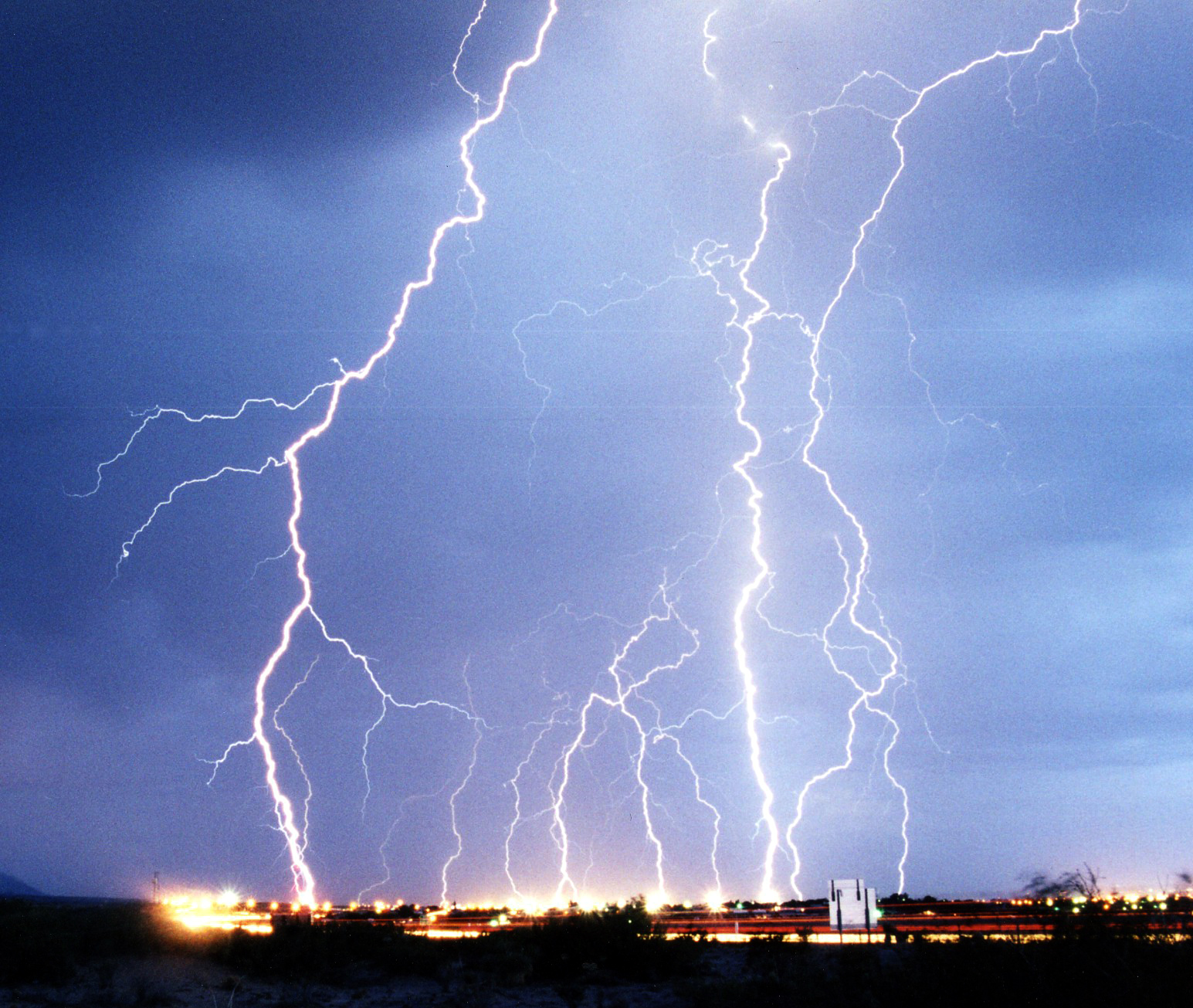
Depending on temperature and density, a certain number of neutral particles may also be present, in which case plasma is called partially ionized. Neon signs and lightning are examples of partially ionized plasmas.
Unlike the phase transitions between the other three states of matter, the transition to plasma is not well defined and is a matter of interpretation and context. Whether a given degree of ionization suffices to call a substance "plasma" depends on the specific phenomenon being considered.
Plasma was first identified in laboratory by Sir William Crookes. Crookes presented a lecture on what he called "radiant matter" to the British Association for the Advancement of Science, in Sheffield, on Friday, 22 August 1879.
Systematic studies of plasma began with the research of Irving Langmuir and his colleagues in the 1920s. Langmuir also introduced the term "plasma" as a description of ionized gas in 1928:
Except near the electrodes, where there are sheaths containing very few electrons, the ionized gas contains ions and electrons in about equal numbers so that the resultant space charge is very small. We shall use the name plasma to describe this region containing balanced charges of ions and electrons.
Lewi Tonks and Harold Mott-Smith, both of whom worked with Langmuir in the 1920s, recall that Langmuir first used the term by analogy with the blood plasma. Mott-Smith recalls, in particular, that the transport of electrons from thermionic filaments reminded Langmuir of "the way blood plasma carries red and white corpuscles and germs."
Plasma (physics)
Plasma (from Ancient Greek πλάσμα (plásma) 'that which has been formed or molded or the result of forming or molding') is a state of matter that results from a gaseous state having undergone some degree of ionization. It thus consists of a significant portion of charged particles (ions and/or electrons). While rarely encountered on Earth, it is estimated that 99.9% of all ordinary matter in the universe is plasma. Stars are almost pure balls of plasma, and plasma dominates the rarefied intracluster medium and intergalactic medium. Plasma can be artificially generated, for example, by heating a neutral gas or subjecting it to a strong electromagnetic field.
The presence of charged particles makes plasma electrically conductive, with the dynamics of individual particles and macroscopic plasma motion governed by collective electromagnetic fields and very sensitive to externally applied fields. The response of plasma to electromagnetic fields is used in many modern devices and technologies, such as plasma televisions or plasma etching.
Depending on temperature and density, a certain number of neutral particles may also be present, in which case plasma is called partially ionized. Neon signs and lightning are examples of partially ionized plasmas.
Unlike the phase transitions between the other three states of matter, the transition to plasma is not well defined and is a matter of interpretation and context. Whether a given degree of ionization suffices to call a substance "plasma" depends on the specific phenomenon being considered.
Plasma was first identified in laboratory by Sir William Crookes. Crookes presented a lecture on what he called "radiant matter" to the British Association for the Advancement of Science, in Sheffield, on Friday, 22 August 1879.
Systematic studies of plasma began with the research of Irving Langmuir and his colleagues in the 1920s. Langmuir also introduced the term "plasma" as a description of ionized gas in 1928:
Except near the electrodes, where there are sheaths containing very few electrons, the ionized gas contains ions and electrons in about equal numbers so that the resultant space charge is very small. We shall use the name plasma to describe this region containing balanced charges of ions and electrons.
Lewi Tonks and Harold Mott-Smith, both of whom worked with Langmuir in the 1920s, recall that Langmuir first used the term by analogy with the blood plasma. Mott-Smith recalls, in particular, that the transport of electrons from thermionic filaments reminded Langmuir of "the way blood plasma carries red and white corpuscles and germs."
Recent media
Recent media