



Community hub
Recent from talks
Knowledge base stats:
Talk channels stats:
Members stats:
Hougoumont
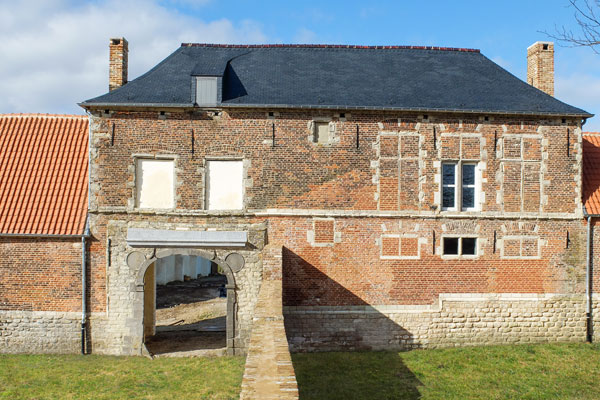
The Château d'Hougoumont (possibly originally Goumont or Gomont) is a walled manorial compound, situated at the bottom of an escarpment near the Nivelles road in the Braine-l'Alleud municipality, near Waterloo, Belgium. The site served as one of the advanced defensible positions of the Anglo-allied army under the Duke of Wellington, that faced Napoleon's Army at the Battle of Waterloo on 18 June 1815.
Hougoumont, which had become dilapidated, was fully restored in time for the 200th anniversary of the battle and opened to the public on 18 June 2015.
Hougoumont has been described as being a lot bigger than La Haye Sainte, a nearby farmhouse. This farmhouse consists of, encompassed by a high-standing wall, the main house, numerous barns, stables, a chapel, and several other features and buildings, including an orchard and garden. The buildings are connected through a system of stone walls with wooden gates. Waterloo Tourisme described it as “the best preserved in terms of how it looked after the Battle [of Waterloo].”
The first mention of Hougoumont is found on the 1777 map of the Austrian Netherlands created by Comte Joseph de Ferraris, marked as "Château Hougoumont". This is believed to be a corruption of "Château Goumont", a name first recorded in an act of the allodial court of Brabant in 1358. Also, in 1356, there is mention of the "tenure and house of Gomont" in the seigneury of Braine-l'Alleud.
According to Sir Walter Scott who visited the battlefield in January 1816, "Hougoumont (a name bestowed, I believe, by a mistake of our great commander [Wellington], but which will certainly supersede the more proper one of Château-Goumont) is the only place of consideration which was totally destroyed".
In 1474 the Order of Saint John (later to become the Order of Malta) bought 30 acres (0.12 km2) of forest, Le Goumont, and another 30 acres (0.12 km2) of adjacent heathland for 100 golden crowns. The deed of sale did not mention any building on the grounds.
A building had apparently been erected on the land as it was sold in 1536 to Pierre du Fief, attorney-general to the Council of Brabant, who subsequently enlarged the property considerably. In 1562 the estate became the property of Pierre Quarré and stayed in the Quarré family until 1637 when it was bought by Arnold Schuyl, Lord of Walhorn. It was around this time that the present building was erected.
After 1671 the domain became the property of Jan Arrazola de Oñate, chamberlain of Archdukes Albert and Isabella. It remained in the hands of these Lords of Gomont and Tiberchamps until 1791 when Jan-André Arrazola de Oñate died childless at the age of 73. His wife remarried with Phillipe Gouret de Louville, a major in the service of Austria.
Hub AI
Hougoumont AI simulator
(@Hougoumont_simulator)
Hougoumont
The Château d'Hougoumont (possibly originally Goumont or Gomont) is a walled manorial compound, situated at the bottom of an escarpment near the Nivelles road in the Braine-l'Alleud municipality, near Waterloo, Belgium. The site served as one of the advanced defensible positions of the Anglo-allied army under the Duke of Wellington, that faced Napoleon's Army at the Battle of Waterloo on 18 June 1815.
Hougoumont, which had become dilapidated, was fully restored in time for the 200th anniversary of the battle and opened to the public on 18 June 2015.
Hougoumont has been described as being a lot bigger than La Haye Sainte, a nearby farmhouse. This farmhouse consists of, encompassed by a high-standing wall, the main house, numerous barns, stables, a chapel, and several other features and buildings, including an orchard and garden. The buildings are connected through a system of stone walls with wooden gates. Waterloo Tourisme described it as “the best preserved in terms of how it looked after the Battle [of Waterloo].”
The first mention of Hougoumont is found on the 1777 map of the Austrian Netherlands created by Comte Joseph de Ferraris, marked as "Château Hougoumont". This is believed to be a corruption of "Château Goumont", a name first recorded in an act of the allodial court of Brabant in 1358. Also, in 1356, there is mention of the "tenure and house of Gomont" in the seigneury of Braine-l'Alleud.
According to Sir Walter Scott who visited the battlefield in January 1816, "Hougoumont (a name bestowed, I believe, by a mistake of our great commander [Wellington], but which will certainly supersede the more proper one of Château-Goumont) is the only place of consideration which was totally destroyed".
In 1474 the Order of Saint John (later to become the Order of Malta) bought 30 acres (0.12 km2) of forest, Le Goumont, and another 30 acres (0.12 km2) of adjacent heathland for 100 golden crowns. The deed of sale did not mention any building on the grounds.
A building had apparently been erected on the land as it was sold in 1536 to Pierre du Fief, attorney-general to the Council of Brabant, who subsequently enlarged the property considerably. In 1562 the estate became the property of Pierre Quarré and stayed in the Quarré family until 1637 when it was bought by Arnold Schuyl, Lord of Walhorn. It was around this time that the present building was erected.
After 1671 the domain became the property of Jan Arrazola de Oñate, chamberlain of Archdukes Albert and Isabella. It remained in the hands of these Lords of Gomont and Tiberchamps until 1791 when Jan-André Arrazola de Oñate died childless at the age of 73. His wife remarried with Phillipe Gouret de Louville, a major in the service of Austria.