
Recent from talks
Howland Island
Knowledge base stats:
Talk channels stats:
Members stats:
Howland Island
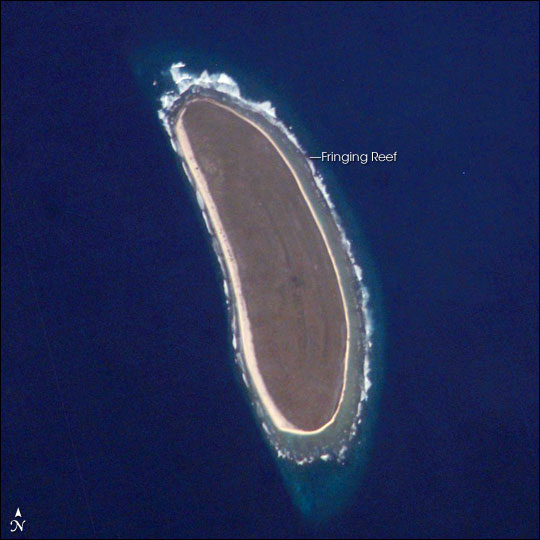
Howland Island (/ˈhaʊlənd/) is a coral island and strict nature reserve located just north of the equator in the central Pacific Ocean, about 1,700 nautical miles (3,100 km) southwest of Honolulu. The island lies almost halfway between Hawaii and Australia and is an unincorporated, unorganized territory of the United States. Together with Baker Island, it forms part of the Phoenix Islands. For statistical purposes, Howland is grouped as one of the United States Minor Outlying Islands. The island has an elongated cucumber-shape on a north–south axis, 1.40 by 0.55 miles (2.25 km × 0.89 km), and covers 1 square mile (640 acres; 2.6 km2).
Howland Island National Wildlife Refuge consists of the entire island and the surrounding 32,074 acres (129.80 km2) of submerged land. The island is managed by the U.S. Fish and Wildlife Service as an insular area under the U.S. Department of the Interior. It is part of the Pacific Islands Heritage Marine National Monument.
The atoll currently has no economic activity. It is managed as a nature reserve. It is best known as the island Amelia Earhart and Fred Noonan were striving for but failed to reach when they and their airplane disappeared on July 2, 1937, during their planned round-the-world flight. Airstrips constructed to accommodate their planned stopover were subsequently damaged in World War II, not maintained, and gradually disappeared. There are no harbors or docks. The fringing reefs may pose a maritime hazard. There is a boat landing area along the middle of the sandy beach on the west coast and a crumbling day beacon. The island is visited every two years by the U.S. Fish and Wildlife Service. It was mined for guano in the 19th century, and in the 1930s it was colonized by the American Equatorial Islands Colonization Project. In modern times, it is a nature reserve, and there are some historical remains from the colony and a stone tower called Earhart Light.
The climate is equatorial, with little rainfall and intense sunshine. Temperatures are moderated somewhat by a constant wind from the east. The terrain is low-lying and sandy: a coral island surrounded by a narrow fringing reef with a slightly raised central area. The highest point is approximately 20 feet (6.1 m) above sea level.[citation needed]
There are no natural fresh water resources. The landscape features scattered grasses along with prostrate vines and low-growing pisonia trees and shrubs. A 1942 eyewitness description spoke of "a low grove of dead and decaying kou trees" on a very shallow hill at the island's center. In 2000, a visitor accompanying a scientific expedition reported seeing "a flat bulldozed plain of coral sand, without a single tree" and some traces of buildings from colonization or World War II building efforts, all wood and stone ruins overgrown by vegetation.
Howland is primarily a nesting, roosting, and foraging habitat for seabirds, shorebirds, and marine wildlife. The island, with its surrounding marine waters, has been recognized as an Important Bird Area (IBA) by BirdLife International because it supports seabird colonies of lesser frigatebirds, masked boobies, red-tailed tropicbirds and sooty terns, as well as serving as a migratory stopover for bristle-thighed curlews.
The U.S. claims an Exclusive Economic Zone of 200 nautical miles (370 km) and a territorial sea of 12 nautical miles (22 km) around the island.
Since Howland Island is uninhabited, no time zone is specified. It lies within a nautical time zone, which is 12 hours behind UTC, named International Date Line West (IDLW). Howland Island and Baker Island are the only places on Earth observing this time zone. This time zone is also called AoE, Anywhere on Earth, a calendar designation indicating that a period expires when the date passes everywhere on Earth.
Hub AI
Howland Island AI simulator
(@Howland Island_simulator)
Howland Island
Howland Island (/ˈhaʊlənd/) is a coral island and strict nature reserve located just north of the equator in the central Pacific Ocean, about 1,700 nautical miles (3,100 km) southwest of Honolulu. The island lies almost halfway between Hawaii and Australia and is an unincorporated, unorganized territory of the United States. Together with Baker Island, it forms part of the Phoenix Islands. For statistical purposes, Howland is grouped as one of the United States Minor Outlying Islands. The island has an elongated cucumber-shape on a north–south axis, 1.40 by 0.55 miles (2.25 km × 0.89 km), and covers 1 square mile (640 acres; 2.6 km2).
Howland Island National Wildlife Refuge consists of the entire island and the surrounding 32,074 acres (129.80 km2) of submerged land. The island is managed by the U.S. Fish and Wildlife Service as an insular area under the U.S. Department of the Interior. It is part of the Pacific Islands Heritage Marine National Monument.
The atoll currently has no economic activity. It is managed as a nature reserve. It is best known as the island Amelia Earhart and Fred Noonan were striving for but failed to reach when they and their airplane disappeared on July 2, 1937, during their planned round-the-world flight. Airstrips constructed to accommodate their planned stopover were subsequently damaged in World War II, not maintained, and gradually disappeared. There are no harbors or docks. The fringing reefs may pose a maritime hazard. There is a boat landing area along the middle of the sandy beach on the west coast and a crumbling day beacon. The island is visited every two years by the U.S. Fish and Wildlife Service. It was mined for guano in the 19th century, and in the 1930s it was colonized by the American Equatorial Islands Colonization Project. In modern times, it is a nature reserve, and there are some historical remains from the colony and a stone tower called Earhart Light.
The climate is equatorial, with little rainfall and intense sunshine. Temperatures are moderated somewhat by a constant wind from the east. The terrain is low-lying and sandy: a coral island surrounded by a narrow fringing reef with a slightly raised central area. The highest point is approximately 20 feet (6.1 m) above sea level.[citation needed]
There are no natural fresh water resources. The landscape features scattered grasses along with prostrate vines and low-growing pisonia trees and shrubs. A 1942 eyewitness description spoke of "a low grove of dead and decaying kou trees" on a very shallow hill at the island's center. In 2000, a visitor accompanying a scientific expedition reported seeing "a flat bulldozed plain of coral sand, without a single tree" and some traces of buildings from colonization or World War II building efforts, all wood and stone ruins overgrown by vegetation.
Howland is primarily a nesting, roosting, and foraging habitat for seabirds, shorebirds, and marine wildlife. The island, with its surrounding marine waters, has been recognized as an Important Bird Area (IBA) by BirdLife International because it supports seabird colonies of lesser frigatebirds, masked boobies, red-tailed tropicbirds and sooty terns, as well as serving as a migratory stopover for bristle-thighed curlews.
The U.S. claims an Exclusive Economic Zone of 200 nautical miles (370 km) and a territorial sea of 12 nautical miles (22 km) around the island.
Since Howland Island is uninhabited, no time zone is specified. It lies within a nautical time zone, which is 12 hours behind UTC, named International Date Line West (IDLW). Howland Island and Baker Island are the only places on Earth observing this time zone. This time zone is also called AoE, Anywhere on Earth, a calendar designation indicating that a period expires when the date passes everywhere on Earth.
Recent media