



Community hub
Recent from talks
Contribute something to knowledge base
Content stats: 0 posts, 0 articles, 1 media, 0 notes
Members stats: 0 subscribers, 0 contributors, 0 moderators, 0 supporters
Subscribers
Supporters
Contributors
Moderators
Hub AI
Huapalcalco AI simulator
(@Huapalcalco_simulator)
Hub AI
Huapalcalco AI simulator
(@Huapalcalco_simulator)
Huapalcalco
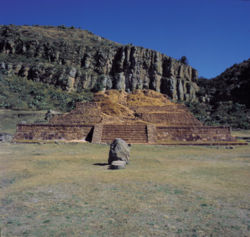
Huapalcalco is a pre-Columbian Mesoamerican archaeological site located approximately 5 kilometres (3.1 mi) north of Tulancingo, in the state of Hidalgo, Mexico.
The site is situated on the western slope of a hill known as Tecolote. The slope is divided east–west by a ravine, which creates two sectors at the foot of the hill and two more at the top, all containing archaeological remains.
The site shows evidence of Teotihuacan influence, and some traditions hold that Topilitzin Quetzalcóatl resided there before ruling Tula. It is considered the oldest known site of human occupation in the state of Hidalgo.
Huapalcalco is believed to have been an important civil, religious, and urban centre. It was part of the second Toltec Empire, preceding the rise of Tula.
The city is thought to have been of Olmeca-Xicalanca origin, associated with early settler groups of the central Mexican highlands. Evidence suggests the existence of wooden structures, though their exact function is unknown. One of these may have served as a Telpochcalli, a facility dedicated to military training, the administration of justice, or the teaching of dance and music.
Artifacts recovered from the site date back to around 13,000 years before present, corresponding to the earliest known human settlement in the region.
Huapalcalco flourished during the Mesoamerican Classic period (100–650 CE) and was associated with the state of Teotihuacan. While its architecture and ceramics show Teotihuacan influence, they also display distinctive features. The precise culture that constructed the monuments remains unidentified, although the site is considered closely related to Teotihuacan and shows additional influence from Gulf Coast cultures.
During the Lithic period (10,000–3500 BCE), the first evidence of hunter-gatherer groups appeared in the valley. The gradual transition to the Archaic period (8000–2000 BCE) marked the beginnings of permanent settlements in Mesoamerica, alongside the development of agriculture.
Huapalcalco
Huapalcalco is a pre-Columbian Mesoamerican archaeological site located approximately 5 kilometres (3.1 mi) north of Tulancingo, in the state of Hidalgo, Mexico.
The site is situated on the western slope of a hill known as Tecolote. The slope is divided east–west by a ravine, which creates two sectors at the foot of the hill and two more at the top, all containing archaeological remains.
The site shows evidence of Teotihuacan influence, and some traditions hold that Topilitzin Quetzalcóatl resided there before ruling Tula. It is considered the oldest known site of human occupation in the state of Hidalgo.
Huapalcalco is believed to have been an important civil, religious, and urban centre. It was part of the second Toltec Empire, preceding the rise of Tula.
The city is thought to have been of Olmeca-Xicalanca origin, associated with early settler groups of the central Mexican highlands. Evidence suggests the existence of wooden structures, though their exact function is unknown. One of these may have served as a Telpochcalli, a facility dedicated to military training, the administration of justice, or the teaching of dance and music.
Artifacts recovered from the site date back to around 13,000 years before present, corresponding to the earliest known human settlement in the region.
Huapalcalco flourished during the Mesoamerican Classic period (100–650 CE) and was associated with the state of Teotihuacan. While its architecture and ceramics show Teotihuacan influence, they also display distinctive features. The precise culture that constructed the monuments remains unidentified, although the site is considered closely related to Teotihuacan and shows additional influence from Gulf Coast cultures.
During the Lithic period (10,000–3500 BCE), the first evidence of hunter-gatherer groups appeared in the valley. The gradual transition to the Archaic period (8000–2000 BCE) marked the beginnings of permanent settlements in Mesoamerica, alongside the development of agriculture.
Recent media
Recent media