



Community hub
Recent from talks
Contribute something to knowledge base
Content stats: 0 posts, 0 articles, 1 media, 0 notes
Members stats: 0 subscribers, 0 contributors, 0 moderators, 0 supporters
Subscribers
Supporters
Contributors
Moderators
Hub AI
Hume Castle AI simulator
(@Hume Castle_simulator)
Hub AI
Hume Castle AI simulator
(@Hume Castle_simulator)
Hume Castle
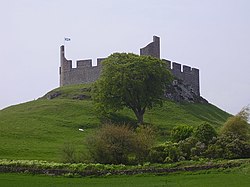
Hume Castle is the heavily modified remnants of a late 12th- or early 13th-century castle of enceinte held by the powerful Hume or Home family, Wardens of the Eastern March who became successively the Lords Home and the Earls of Home. The village of Hume is located between Greenlaw and Kelso, two miles north of the village of Stichill, in Berwickshire, Scotland. (OS ref.- NT704413). It is a Scheduled Ancient Monument, recorded as such by Historic Environment Scotland.
Standing as it does, on an impressive height above its eponymous castleton, it commands fine prospects across the Merse, with views to the English border at Carter Bar. It had historically been used as a beacon to warn of invasion. Its enormous walls were created in the 18th century but remnants of the central keep and other features can still be seen.
William de Home, son of Sir Patrick de Greenlaw (a younger son of Cospatric I, Earl of Dunbar), acquired the lands of Home in the early 13th century through marriage to his cousin Ada (the daughter of Patrick I, Earl of Dunbar). He then took his surname from his estate, a not uncommon practice of the time. It is assumed that he built the first stone fortifications at the site.
James II stayed at Home en route to the siege of Roxburgh Castle, the last English garrison left in Scotland following the Wars of Independence. (James was killed by the explosion of an early bombard during the siege.)
In August 1515 Regent Albany imprisoned members of the Hume family at Dunfermline, with Adam Tinmo, the Constable of Hume Castle. At this time, Scotland's Governor Regent Albany was planning to bring an army against the Hume family on the Scottish borders. Albany captured Hume Castle, but according to a report by Cardinal Wolsey's chaplain, William Frankelayn, Chancellor of Durham, Lord Hume, Lord Chamberlain, retook the castle on 26 August 1515, and kept Albany's captain, Lord Fleming's uncle, prisoner. Lord Hume then slighted his own castle, razed the walls, "and dammed the well for ever more."
Before the advent of artillery, Hume castle was considered almost impregnable. However it was captured in 1547 during the "Rough Wooing", by the Lord Protector Somerset. The Scottish ruler, Regent Arran, had sent 12 gunners to defend the castle in August 1547. George Home, 4th Lord Home, was injured at the Battle of Pinkie and his son Alexander captured. After stout resistance by Mariotta (or Marion) Haliburton, Lady Home, the castle fell and an English garrison was installed. According to an English account, the castle was rendered by the negotiation of Lady Home after the English army encamped nearby at the Hirsel or Hare Craig. Although English artillery was placed to commence bombardment, no shot was fired by either side. Somerset Herald conveyed Lady Home's instructions to the reluctant garrison who would have preferred Lord Home's word as a warrant for their surrender.
Sir Edward Sutton, a cousin of the Earl of Warwick, was made Captain of Hume, and received the keys from Andrew Home, Commendator of Jedburgh and Restennet, on Thursday 22 September 1547. There were seventy-eight Scots within, and Edward Sutton found guns including; 2 batard culverins; a saker; 3 brass falconets; and eight other iron guns. More guns were brought to hold the castle, and an English inventory of December 1547 lists 21 cannons including 4 fowlers, and 40 hand-guns. Minor strengthening work was carried out by the English, on the advice of the military engineer William Ridgeway, but only £734 was spent, the local stone was unsuitable and limestone at Roxburgh too far away.
Mariotta, Lady Home, complained to the Duke of Somerset on 2 November 1547 that she had, "been very sore examined for the rendering of Hume", and accused of taking money. She thought it marvellous that anyone could think she could keep the "sober barmkin" of Hume against the English army, when all the nobles of Scotland could not keep the field. Hume Castle was nearly lost in February 1548, when Captain Pelham travelled to Warkworth Castle to collect pay for the Spanish mercenary garrison. The soldiers planned to rob him and change sides. Loyal members of the garrison fired the beacon and Sir John Ellerker's men arrested the would-be deserters. One was killed escaping, and Grey of Wilton planned to hang six of them, but the two leaders escaped into Scotland.
Hume Castle
Hume Castle is the heavily modified remnants of a late 12th- or early 13th-century castle of enceinte held by the powerful Hume or Home family, Wardens of the Eastern March who became successively the Lords Home and the Earls of Home. The village of Hume is located between Greenlaw and Kelso, two miles north of the village of Stichill, in Berwickshire, Scotland. (OS ref.- NT704413). It is a Scheduled Ancient Monument, recorded as such by Historic Environment Scotland.
Standing as it does, on an impressive height above its eponymous castleton, it commands fine prospects across the Merse, with views to the English border at Carter Bar. It had historically been used as a beacon to warn of invasion. Its enormous walls were created in the 18th century but remnants of the central keep and other features can still be seen.
William de Home, son of Sir Patrick de Greenlaw (a younger son of Cospatric I, Earl of Dunbar), acquired the lands of Home in the early 13th century through marriage to his cousin Ada (the daughter of Patrick I, Earl of Dunbar). He then took his surname from his estate, a not uncommon practice of the time. It is assumed that he built the first stone fortifications at the site.
James II stayed at Home en route to the siege of Roxburgh Castle, the last English garrison left in Scotland following the Wars of Independence. (James was killed by the explosion of an early bombard during the siege.)
In August 1515 Regent Albany imprisoned members of the Hume family at Dunfermline, with Adam Tinmo, the Constable of Hume Castle. At this time, Scotland's Governor Regent Albany was planning to bring an army against the Hume family on the Scottish borders. Albany captured Hume Castle, but according to a report by Cardinal Wolsey's chaplain, William Frankelayn, Chancellor of Durham, Lord Hume, Lord Chamberlain, retook the castle on 26 August 1515, and kept Albany's captain, Lord Fleming's uncle, prisoner. Lord Hume then slighted his own castle, razed the walls, "and dammed the well for ever more."
Before the advent of artillery, Hume castle was considered almost impregnable. However it was captured in 1547 during the "Rough Wooing", by the Lord Protector Somerset. The Scottish ruler, Regent Arran, had sent 12 gunners to defend the castle in August 1547. George Home, 4th Lord Home, was injured at the Battle of Pinkie and his son Alexander captured. After stout resistance by Mariotta (or Marion) Haliburton, Lady Home, the castle fell and an English garrison was installed. According to an English account, the castle was rendered by the negotiation of Lady Home after the English army encamped nearby at the Hirsel or Hare Craig. Although English artillery was placed to commence bombardment, no shot was fired by either side. Somerset Herald conveyed Lady Home's instructions to the reluctant garrison who would have preferred Lord Home's word as a warrant for their surrender.
Sir Edward Sutton, a cousin of the Earl of Warwick, was made Captain of Hume, and received the keys from Andrew Home, Commendator of Jedburgh and Restennet, on Thursday 22 September 1547. There were seventy-eight Scots within, and Edward Sutton found guns including; 2 batard culverins; a saker; 3 brass falconets; and eight other iron guns. More guns were brought to hold the castle, and an English inventory of December 1547 lists 21 cannons including 4 fowlers, and 40 hand-guns. Minor strengthening work was carried out by the English, on the advice of the military engineer William Ridgeway, but only £734 was spent, the local stone was unsuitable and limestone at Roxburgh too far away.
Mariotta, Lady Home, complained to the Duke of Somerset on 2 November 1547 that she had, "been very sore examined for the rendering of Hume", and accused of taking money. She thought it marvellous that anyone could think she could keep the "sober barmkin" of Hume against the English army, when all the nobles of Scotland could not keep the field. Hume Castle was nearly lost in February 1548, when Captain Pelham travelled to Warkworth Castle to collect pay for the Spanish mercenary garrison. The soldiers planned to rob him and change sides. Loyal members of the garrison fired the beacon and Sir John Ellerker's men arrested the would-be deserters. One was killed escaping, and Grey of Wilton planned to hang six of them, but the two leaders escaped into Scotland.
Recent media
Recent media