


Community hub
Hurst exponent
View on WikipediaThe Hurst exponent is used as a measure of long-term memory of time series. It relates to the autocorrelations of the time series, and the rate at which these decrease as the lag between pairs of values increases. Studies involving the Hurst exponent were originally developed in hydrology for the practical matter of determining optimum dam sizing for the Nile river's volatile rain and drought conditions that had been observed over a long period of time.[1][2] The name "Hurst exponent", or "Hurst coefficient", derives from Harold Edwin Hurst (1880–1978), who was the lead researcher in these studies; the use of the standard notation H for the coefficient also relates to his name.
In fractal geometry, the generalized Hurst exponent has been denoted by H or Hq in honor of both Harold Edwin Hurst and Ludwig Otto Hölder (1859–1937) by Benoît Mandelbrot (1924–2010).[3] H is directly related to fractal dimension, D, and is a measure of a data series' "mild" or "wild" randomness.[4]
The Hurst exponent is referred to as the "index of dependence" or "index of long-range dependence". It quantifies the relative tendency of a time series either to regress strongly to the mean or to cluster in a direction.[5] A value H in the range 0.5–1 indicates a time series with long-term positive autocorrelation, meaning that the decay in autocorrelation is slower than exponential, following a power law; for the series it means that a high value tends to be followed by another high value and that future excursions to more high values do occur. A value in the range 0 – 0.5 indicates a time series with long-term switching between high and low values in adjacent pairs, meaning that a single high value will probably be followed by a low value and that the value after that will tend to be high, with this tendency to switch between high and low values lasting a long time into the future, also following a power law. A value of H=0.5 indicates short-memory, with (absolute) autocorrelations decaying exponentially quickly to zero.
Definition
[edit]The Hurst exponent, H, is defined in terms of the asymptotic behaviour of the rescaled range as a function of the time span of a time series as follows;[6][7]
where
![{\displaystyle \mathbb {E} \left[{\frac {R(n)}{S(n)}}\right]=Cn^{H}{\text{ as }}n\to \infty \,,}](https://wikimedia.org/api/rest_v1/media/math/render/svg/d32a26032869f8c902eb7a3062309dd88de63b5b)
- is the range of the first cumulative deviations from the mean
- is the series (sum) of the first n standard deviations
- is the expected value
- is the time span of the observation (number of data points in a time series)
- is a constant.


![{\displaystyle \mathbb {E} \left[x\right]\,}](https://wikimedia.org/api/rest_v1/media/math/render/svg/ed9ba4fe26ee30cc2a4b949b8abde51ec44b65c7)

Relation to Fractal Dimension
[edit]For self-similar time series, H is directly related to fractal dimension, D, where 1 < D < 2, such that D = 2 - H. The values of the Hurst exponent vary between 0 and 1, with higher values indicating a smoother trend, less volatility, and less roughness.[8]
For more general time series or multi-dimensional process, the Hurst exponent and fractal dimension can be chosen independently, as the Hurst exponent represents structure over asymptotically longer periods, while fractal dimension represents structure over asymptotically shorter periods.[9]
Estimating the exponent
[edit]A number of estimators of long-range dependence have been proposed in the literature. The oldest and best-known is the so-called rescaled range (R/S) analysis popularized by Mandelbrot and Wallis[3][10] and based on previous hydrological findings of Hurst.[1] Alternatives include DFA, Periodogram regression,[11] aggregated variances,[12] local Whittle's estimator,[13] wavelet analysis,[14][15] both in the time domain and frequency domain.
Rescaled range (R/S) analysis
[edit]To estimate the Hurst exponent, one must first estimate the dependence of the rescaled range on the time span n of observation.[7] A time series of full length N is divided into a number of nonoverlapping shorter time series of length n, where n takes values N, N/2, N/4, ... (in the convenient case that N is a power of 2). The average rescaled range is then calculated for each value of n.
For each such time series of length , , the rescaled range is calculated as follows:[6][7]

- Calculate the mean;
- Create a mean-adjusted series;
- Calculate the cumulative deviate series ;
- Compute the range ;
- Compute the standard deviation ;
- Calculate the rescaled range and average over all the partial time series of length



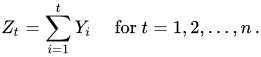



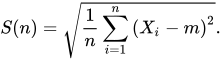


The Hurst exponent is estimated by fitting the power law to the data. This can be done by plotting as a function of , and fitting a straight line; the slope of the line gives . A more principled approach would be to fit the power law in a maximum-likelihood fashion.[16] Such a graph is called a box plot. However, this approach is known to produce biased estimates of the power-law exponent.[clarification needed] For small there is a significant deviation from the 0.5 slope.[clarification needed] Anis and Lloyd[17] estimated the theoretical (i.e., for white noise)[clarification needed] values of the R/S statistic to be:
![{\displaystyle \mathbb {E} [R(n)/S(n)]=Cn^{H}}](https://wikimedia.org/api/rest_v1/media/math/render/svg/d65330dda2923c2ebdee79c9447fca3b3953a478)
![{\displaystyle \log[R(n)/S(n)]}](https://wikimedia.org/api/rest_v1/media/math/render/svg/176342767e457ccbcdb73cda46dabdf85791a72c)


![{\displaystyle \mathbb {E} [R(n)/S(n)]={\begin{cases}{\frac {\Gamma ({\frac {n-1}{2}})}{{\sqrt {\pi }}\Gamma ({\frac {n}{2}})}}\sum \limits _{i=1}^{n-1}{\sqrt {\frac {n-i}{i}}},&{\text{for }}n\leq 340\\{\frac {1}{\sqrt {n{\frac {\pi }{2}}}}}\sum \limits _{i=1}^{n-1}{\sqrt {\frac {n-i}{i}}},&{\text{for }}n>340\end{cases}}}](https://wikimedia.org/api/rest_v1/media/math/render/svg/6179e69124c5b89755610f11f6cc0ff0cd1ad74a)
where is the Euler gamma function.[clarification needed] The Anis-Lloyd corrected R/S Hurst exponent[clarification needed] is calculated as 0.5 plus the slope of .

![{\displaystyle R(n)/S(n)-\mathbb {E} [R(n)/S(n)]}](https://wikimedia.org/api/rest_v1/media/math/render/svg/6b359472554077d9c4a41143a1218d0894ec3771)
Confidence intervals
[edit]No asymptotic distribution theory has been derived for most of the Hurst exponent estimators so far. However, Weron[18] used bootstrapping to obtain approximate functional forms for confidence intervals of the two most popular methods, i.e., for the Anis-Lloyd[17] corrected R/S analysis:
| Level | Lower bound | Upper bound |
|---|---|---|
| 90% | 0.5 − exp(−7.35 log(log M) + 4.06) | exp(−7.07 log(log M) + 3.75) + 0.5 |
| 95% | 0.5 − exp(−7.33 log(log M) + 4.21) | exp(−7.20 log(log M) + 4.04) + 0.5 |
| 99% | 0.5 − exp(−7.19 log(log M) + 4.34) | exp(−7.51 log(log M) + 4.58) + 0.5 |
and for DFA:
| Level | Lower bound | Upper bound |
|---|---|---|
| 90% | 0.5 − exp(−2.99 log M + 4.45) | exp(−3.09 log M + 4.57) + 0.5 |
| 95% | 0.5 − exp(−2.93 log M + 4.45) | exp(−3.10 log M + 4.77) + 0.5 |
| 99% | 0.5 − exp(−2.67 log M + 4.06) | exp(−3.19 log M + 5.28) + 0.5 |
Here and is the series length. In both cases only subseries of length were considered for estimating the Hurst exponent; subseries of smaller length lead to a high variance of the R/S estimates.


Generalized exponent
[edit]The basic Hurst exponent can be related to the expected size of changes, as a function of the lag between observations, as measured by E(|Xt+τ−Xt|2). For the generalized form of the coefficient, the exponent here is replaced by a more general term, denoted by q.
There are a variety of techniques that exist for estimating H, however assessing the accuracy of the estimation can be a complicated issue. Mathematically, in one technique, the Hurst exponent can be estimated such that:[19][20] for a time series may be defined by the scaling properties of its structure functions (): where , is the time lag and averaging is over the time window usually the largest time scale of the system.







Practically, in nature, there is no limit to time, and thus H is non-deterministic as it may only be estimated based on the observed data; e.g., the most dramatic daily move upwards ever seen in a stock market index can always be exceeded during some subsequent day.[21]
In the above mathematical estimation technique, the function H(q) contains information about averaged generalized volatilities at scale (only q = 1, 2 are used to define the volatility). In particular, the H1 exponent indicates persistent (H1 > 1⁄2) or antipersistent (H1 < 1⁄2) behavior of the trend.
For the BRW (brown noise, ) one gets and for pink noise ()


The Hurst exponent for white noise is dimension dependent,[22] and for 1D and 2D it is

For the popular Lévy stable processes and truncated Lévy processes with parameter α it has been found that
for , and for . Multifractal detrended fluctuation analysis[23] is one method to estimate from non-stationary time series. When is a non-linear function of q the time series is a multifractal system.


Note
[edit]In the above definition two separate requirements are mixed together as if they would be one.[24] Here are the two independent requirements: (i) stationarity of the increments, x(t+T) − x(t) = x(T) − x(0) in distribution. This is the condition that yields longtime autocorrelations. (ii) Self-similarity of the stochastic process then yields variance scaling, but is not needed for longtime memory. E.g., both Markov processes (i.e., memory-free processes) and fractional Brownian motion scale at the level of 1-point densities (simple averages), but neither scales at the level of pair correlations or, correspondingly, the 2-point probability density.[clarification needed]
An efficient market requires a martingale condition, and unless the variance is linear in the time this produces nonstationary increments, x(t+T) − x(t) ≠ x(T) − x(0). Martingales are Markovian at the level of pair correlations, meaning that pair correlations cannot be used to beat a martingale market. Stationary increments with nonlinear variance, on the other hand, induce the longtime pair memory of fractional Brownian motion that would make the market beatable at the level of pair correlations. Such a market would necessarily be far from "efficient".
An analysis of economic time series by means of the Hurst exponent using rescaled range and Detrended fluctuation analysis is conducted by econophysicist A.F. Bariviera.[25] This paper studies the time varying character of Long-range dependency and, thus of informational efficiency.
Hurst exponent has also been applied to the investigation of long-range dependency in DNA,[26] and photonic band gap materials.[27]
See also
[edit]- Long-range dependency – Phenomenon in linguistics and data analysis
- Anomalous diffusion – Diffusion process with a non-linear relationship to time
- Rescaled range – Statistical measure of time series variability
- Detrended fluctuation analysis – Method to detect power-law scaling in time series
Implementations
[edit]- Matlab code for computing R/S, DFA, periodogram regression and wavelet estimates of the Hurst exponent and their corresponding confidence intervals is available from RePEc: https://ideas.repec.org/s/wuu/hscode.html
- Implementation of R/S in Python: https://github.com/Mottl/hurst and of DFA and MFDFA in Python: https://github.com/LRydin/MFDFA
- Matlab code for computing real Hurst and complex Hurst: https://www.mathworks.com/matlabcentral/fileexchange/49803-calculate-complex-hurst
- Excel sheet can also be used to do so: https://www.researchgate.net/publication/272792633_Excel_Hurst_Calculator
References
[edit]- ^ a b Hurst, H.E. (1951). "Long-term storage capacity of reservoirs". Transactions of the American Society of Civil Engineers. 116: 770. doi:10.1061/TACEAT.0006518.
- ^ Hurst, H.E.; Black, R.P.; Simaika, Y.M. (1965). Long-term storage: an experimental study. London: Constable.
- ^ a b Mandelbrot, B.B.; Wallis, J.R. (1968). "Noah, Joseph, and operational hydrology". Water Resour. Res. 4 (5): 909–918. Bibcode:1968WRR.....4..909M. doi:10.1029/wr004i005p00909.
- ^ Mandelbrot, Benoît B. (2006). "The (Mis)Behavior of Markets". Journal of Statistical Physics. 122 (2): 187. Bibcode:2006JSP...122..373P. doi:10.1007/s10955-005-8004-Z. S2CID 119634845.
- ^ Torsten Kleinow (2002)Testing Continuous Time Models in Financial Markets, Doctoral thesis, Berlin [page needed]
- ^ a b Qian, Bo; Rasheed, Khaled (2004). HURST EXPONENT AND FINANCIAL MARKET PREDICTABILITY. IASTED conference on Financial Engineering and Applications (FEA 2004). pp. 203–209. CiteSeerX 10.1.1.137.207.
- ^ a b c Feder, Jens (1988). Fractals. New York: Plenum Press. ISBN 978-0-306-42851-7.
- ^ Mandelbrot, Benoit B. (1985). "Self-affinity and fractal dimension" (PDF). Physica Scripta. 32 (4): 257–260. Bibcode:1985PhyS...32..257M. doi:10.1088/0031-8949/32/4/001.
- ^ Gneiting, Tilmann; Schlather, Martin (2004). "Stochastic Models That Separate Fractal Dimension and the Hurst Effect". SIAM Review. 46 (2): 269–282. arXiv:physics/0109031. Bibcode:2004SIAMR..46..269G. doi:10.1137/s0036144501394387. S2CID 15409721.
- ^ Mandelbrot, Benoit B.; Wallis, James R. (1969-10-01). "Robustness of the rescaled range R/S in the measurement of noncyclic long run statistical dependence". Water Resources Research. 5 (5): 967–988. Bibcode:1969WRR.....5..967M. doi:10.1029/WR005i005p00967. ISSN 1944-7973.
- ^ Geweke, J.; Porter-Hudak, S. (1983). "The Estimation and Application of Long Memory Time Series Models". J. Time Ser. Anal. 4 (4): 221–238. doi:10.1111/j.1467-9892.1983.tb00371.x.
- ^ J. Beran. Statistics For Long-Memory Processes. Chapman and Hall, 1994.
- ^ Robinson, P. M. (1995). "Gaussian semiparametric estimation of long-range dependence". The Annals of Statistics. 23 (5): 1630–1661. doi:10.1214/aos/1176324317.
- ^ Simonsen, Ingve; Hansen, Alex; Nes, Olav Magnar (1998-09-01). "Determination of the Hurst exponent by use of wavelet transforms". Physical Review E. 58 (3): 2779–2787. arXiv:cond-mat/9707153. Bibcode:1998PhRvE..58.2779S. doi:10.1103/PhysRevE.58.2779. S2CID 55110202.
- ^ R. H. Riedi. Multifractal processes. In P. Doukhan, G. Oppenheim, and M. S. Taqqu, editors, The- ory And Applications Of Long-Range Dependence, pages 625–716. Birkh¨auser, 2003.
- ^ Aaron Clauset; Cosma Rohilla Shalizi; M. E. J. Newman (2009). "Power-law distributions in empirical data". SIAM Review. 51 (4): 661–703. arXiv:0706.1062. Bibcode:2009SIAMR..51..661C. doi:10.1137/070710111. S2CID 9155618.
- ^ a b Annis, A. A.; Lloyd, E. H. (1976-01-01). "The expected value of the adjusted rescaled Hurst range of independent normal summands". Biometrika. 63 (1): 111–116. doi:10.1093/biomet/63.1.111. ISSN 0006-3444.
- ^ Weron, Rafał (2002-09-01). "Estimating long-range dependence: finite sample properties and confidence intervals". Physica A: Statistical Mechanics and Its Applications. 312 (1–2): 285–299. arXiv:cond-mat/0103510. Bibcode:2002PhyA..312..285W. doi:10.1016/S0378-4371(02)00961-5. S2CID 3272761.
- ^ Preis, T.; et al. (2009). "Accelerated fluctuation analysis by graphic cards and complex pattern formation in financial markets". New J. Phys. 11 (9) 093024. Bibcode:2009NJPh...11i3024P. doi:10.1088/1367-2630/11/9/093024.
- ^ Gorski, A.Z.; et al. (2002). "Financial multifractality and its subtleties: an example of DAX". Physica. 316 (1): 496–510. arXiv:cond-mat/0205482. Bibcode:2002PhyA..316..496G. doi:10.1016/s0378-4371(02)01021-x. S2CID 16889851.
- ^ Mandelbrot, Benoît B., The (Mis)Behavior of Markets, A Fractal View of Risk, Ruin and Reward (Basic Books, 2004), pp. 186-195
- ^ Alex Hansen; Jean Schmittbuhl; G. George Batrouni (2001). "Distinguishing fractional and white noise in one and two dimensions". Phys. Rev. E. 63 (6) 062102. arXiv:cond-mat/0007011. Bibcode:2001PhRvE..63f2102H. doi:10.1103/PhysRevE.63.062102. PMID 11415147. S2CID 13608683.
- ^ J.W. Kantelhardt; S.A. Zschiegner; E. Koscielny-Bunde; S. Havlin; A. Bunde; H.E. Stanley (2002). "Multifractal detrended fluctuation analysis of nonstationary time series". Physica A: Statistical Mechanics and Its Applications. 87 (1): 87–114. arXiv:physics/0202070. Bibcode:2002PhyA..316...87K. doi:10.1016/s0378-4371(02)01383-3. S2CID 18417413.
- ^ Joseph L McCauley, Kevin E Bassler, and Gemunu H. Gunaratne (2008) "Martingales, Detrending Data, and the Efficient Market Hypothesis", Physica, A37, 202, Open access preprint: arXiv:0710.2583
- ^ Bariviera, A.F. (2011). "The influence of liquidity on informational efficiency: The case of the Thai Stock Market". Physica A: Statistical Mechanics and Its Applications. 390 (23): 4426–4432. Bibcode:2011PhyA..390.4426B. doi:10.1016/j.physa.2011.07.032. S2CID 120377241.
- ^ Roche, Stephan; Bicout, Dominique; Maciá, Enrique; Kats, Efim (2003-11-26). "Long Range Correlations in DNA: Scaling Properties and Charge Transfer Efficiency". Physical Review Letters. 91 (22) 228101. arXiv:cond-mat/0309463. Bibcode:2003PhRvL..91v8101R. doi:10.1103/PhysRevLett.91.228101. PMID 14683275. S2CID 14067237.
- ^ Yu, Sunkyu; Piao, Xianji; Hong, Jiho; Park, Namkyoo (2015-09-16). "Bloch-like waves in random-walk potentials based on supersymmetry". Nature Communications. 6: 8269. arXiv:1501.02591. Bibcode:2015NatCo...6.8269Y. doi:10.1038/ncomms9269. PMC 4595658. PMID 26373616.
Hurst exponent
View on GrokipediaBackground and History
Historical Development
Harold Edwin Hurst, a British hydrologist serving the Egyptian government from 1906 to 1968, pioneered research on long-term reservoir storage during the 1950s and 1960s, driven by the need to manage Nile River variability for flood control and irrigation.[6] His empirical investigations revealed non-random persistence in natural time series, challenging assumptions of independent random processes in hydrological planning.[3] This work stemmed from extensive data collection across the Nile basin, including travels to sites in Nubia, Sudan, and Uganda, to compile comprehensive records for reservoir design.[6] Hurst's seminal discovery, known as the "Hurst phenomenon," emerged from analyzing over 1,000 years of Nile River flow data recorded at the Roda gauge near Cairo, spanning from 641 AD to 1946.[6] This analysis, part of a broader study of approximately 75 geophysical time series including river levels and rainfall, demonstrated that cumulative deviations in flows exhibited persistent patterns—high values tending to follow highs and lows to follow lows—rather than the mean-reverting behavior expected from independent random walks.[3][6] These findings implied that reservoirs required significantly larger capacities than traditional models predicted, influencing designs like the Aswan High Dam.[7] Hurst detailed this in his key 1951 publication, "Long-term storage capacity of reservoirs," published in the Transactions of the American Society of Civil Engineers.[7] In the 1960s, mathematician Benoit Mandelbrot built upon these empirical observations to formalize the Hurst exponent as a mathematical measure of persistence in time series. Mandelbrot, working at IBM and inspired by Hurst's data, extended the concept during the 1960s and 1970s by connecting it to fractal geometry and the self-similarity observed in irregular natural landscapes, such as coastlines and river networks, and named the parameter the Hurst exponent in Hurst's honor.[4] This theoretical framework provided a rigorous basis for understanding long-range dependence, later modeled through fractional Brownian motion.[4] The adoption of the Hurst exponent evolved from its origins in hydrology during the 1950s, where it addressed practical reservoir challenges, to integration with fractal theory in the 1970s under Mandelbrot's influence, and further to broader applications in time series analysis by the 1980s, influencing fields like geophysics and economics.[4]Original Applications in Hydrology
The original applications of the Hurst exponent emerged from analyses of river flow data, particularly the long historical record of the Nile River's annual flood levels measured at the Roda Nilometer from 641 AD to 1946, spanning over 1,000 years.[8][6] This dataset revealed long-range dependence in the time series, with the rescaled range (R/S) analysis yielding a Hurst exponent of approximately 0.72, indicating persistent behavior rather than independent random fluctuations typical of short-term hydrological models.[9] The persistence implied that high (or low) flow years tended to cluster, challenging assumptions of hydrological independence and highlighting the need to account for extended periods of above- or below-average conditions in water resource planning.[3] Hurst's rescaled range method was specifically developed to address storage problems in reservoirs, quantifying how persistent dependencies inflate the range of cumulative deviations beyond what independent random models predict.[9] In persistent series (H > 0.5), the expected range grows as R/S ∝ n^H, where n is the record length, leading to a "Hurst bias" that underestimates variance and required storage capacity if ignored—often by factors of 2 to 3 for long horizons.[3] For the Nile, this meant that traditional designs based on independent assumptions would fail during prolonged droughts or floods, as the method demonstrated the necessity for substantially larger reservoirs to maintain reliable supply over centuries. These findings had direct implications for dam design and irrigation systems, most notably in the planning of the Aswan Dam in Egypt, where Hurst served as a consultant into the 1960s.[6] High H values suggested over-designing infrastructure to buffer against clustered extreme events, such as multi-decadal low-flow periods, ensuring water security for agriculture amid the Nile's variability—ultimately influencing the High Aswan Dam's capacity to store enough for 10–20 years of average flow during deficits. This approach shifted hydrological engineering from short-term statistics to long-memory models, reducing risks of shortages in irrigation-dependent regions.[3] Early extensions of the method applied to other rivers, such as the Colorado River in the United States, and precipitation series confirmed the exponent's utility in detecting anomalous scaling across geophysical time series.[10] For the Colorado, R/S analysis of streamflow records from the early 20th century yielded H values around 0.6–0.7, indicating moderate persistence that informed basin-wide water allocation amid arid conditions.[11] Similarly, applications to annual precipitation in regions like the American Midwest showed H > 0.5, establishing the exponent as a tool for identifying non-random patterns in rainfall variability that affect runoff and reservoir inflows. These studies, building on Hurst's framework, extended its role from the Nile to global hydrology, emphasizing scalable storage solutions for diverse climates. Critiques of early assumptions centered on whether observed H > 0.5 reflected true long memory or artifacts from unadjusted seasonal cycles and trends in the data. Seasonal periodicities, such as the Nile's monsoon-driven floods, could artificially inflate R/S estimates, mimicking persistence without underlying fractional differencing; detrending or deseasonalizing series often reduced H closer to 0.5 in some cases.[12] This debate prompted refinements in estimation, underscoring the need to distinguish intrinsic hydrological memory from cyclical influences in reservoir modeling.[13]Definition and Properties
Mathematical Definition
The Hurst exponent , where , quantifies the self-similarity of a stochastic process . For a self-similar process, it is defined such that the scaled process satisfies in distribution for all , meaning the statistical properties remain invariant under time scaling by with amplitude scaling by .[14] This parameter arises in the context of processes exhibiting fractal-like scaling behaviors, originally motivated by empirical observations in natural phenomena such as river discharge levels. For processes with stationary increments, such as fractional Brownian motion (fBM), the Hurst exponent appears in the scaling law for the expected squared increment:Interpretation of Hurst Exponent Values
The Hurst exponent quantifies the persistence or anti-persistence in the scaling behavior of time series, distinguishing random processes from those with memory effects. When , the time series follows standard Brownian motion, characterized by independent increments and no long-term memory, resembling a pure random walk where future changes are uncorrelated with past ones.[16] For , the time series exhibits persistent or trending behavior, with positive autocorrelation in increments indicating "long memory" that causes trends to continue over time, such as momentum effects in financial markets.[16] This persistence arises because the correlation between increments at different times remains positive, fostering extended periods of directional movement.[16] In contrast, for , the series shows anti-persistent or mean-reverting behavior, marked by negative autocorrelation that leads to oscillations around the mean, as seen in overcompensatory dynamics in natural systems like certain ecological or fluid processes.[16] Here, the negative correlation between increments promotes reversals, counteracting deviations from the average.[16] Boundary cases highlight extremes: as , paths become highly rough and anti-persistent, with rapid fluctuations and strong mean reversion; as , paths are smooth and strongly persistent, approximating deterministic linear trends with minimal variability.[17] Practically, values close to 0.5 indicate near-randomness with weak memory, while deviations provide insights into real-world data; for instance, financial return series often yield to , suggesting mild persistence beyond pure randomness, and hydrological records like Nile River flows show , reflecting long-term trending in water levels.[18][6]Theoretical Connections
Relation to Fractal Dimension
The Hurst exponent is inversely related to the fractal dimension for self-affine fractal structures, such as the graph of a one-dimensional time series or the trace of a stochastic process, where .[19] This relation applies specifically to paths embedded in two-dimensional space, quantifying how the curve fills the plane based on its scaling properties.[19] A higher value of (closer to 1) indicates smoother, more persistent trajectories with less irregularity, resulting in a lower fractal dimension and reduced space-filling behavior; conversely, lower (closer to 0) corresponds to rougher, more antipersistent paths with higher .[19] For standard Brownian motion, where , the fractal dimension is , reflecting a moderately wiggly path that partially fills the space between a smooth line () and a fully space-filling curve ().[19] In the context of box-counting dimension, the Hurst exponent measures the irregularity of graphs from time series data, while captures the "wiggly" complexity by counting the number of boxes needed to cover the curve at varying scales. This approach highlights how persistent trends (high ) produce less convoluted structures compared to random or antipersistent ones. The relation extends to variants like the Kolmogorov capacity (box-counting dimension) and Hausdorff dimension for self-affine fractals, where the scaling anisotropy ensures consistent dimensionality across measures.[19] Examples include coastlines and river networks, where the fractal dimension derived from the Hurst exponent aligns with observed roughness; for instance, in simulated eroded coastlines of correlated landscapes, increases as decreases, matching the jagged visual complexity of natural shorelines.[20] Similarly, self-affine profiles of river meanders exhibit -derived dimensions that reflect their branching irregularity and space-filling tendencies.[21]Connection to Fractional Brownian Motion
Fractional Brownian motion (fBm), denoted $ B_H(t) $, is a zero-mean Gaussian process with stationary increments, parameterized by the Hurst exponent $ H \in (0,1) $. It is formally defined through its covariance function:Estimation Techniques
Rescaled Range (R/S) Analysis
The rescaled range (R/S) analysis, introduced by hydrologist Harold Edwin Hurst in his study of long-term reservoir storage requirements based on Nile River flow data, provides a nonparametric method to estimate the Hurst exponent by quantifying the scaling behavior of range and variability in time series data.[7] This technique assesses long-range dependence by examining how the rescaled range scales with subseries length, revealing persistent, random, or antipersistent patterns in the data. Benoit Mandelbrot later refined and extended the approach, linking it to fractal geometry and self-similar processes in geophysical records. To apply R/S analysis to a time series of length , divide the series into non-overlapping subseries, each of length , where takes values that are integer divisors of (typically ranging from 8 to for practical estimation).[23] For each subseries :- Compute the mean: .
- Form the cumulative deviation series: for .
- Calculate the range: .
- Compute the standard deviation: .