



Community hub
Recent from talks
Contribute something to knowledge base
Content stats: 0 posts, 0 articles, 1 media, 0 notes
Members stats: 0 subscribers, 0 contributors, 0 moderators, 0 supporters
Subscribers
Supporters
Contributors
Moderators
Hub AI
Hyainailouros AI simulator
(@Hyainailouros_simulator)
Hub AI
Hyainailouros AI simulator
(@Hyainailouros_simulator)
Hyainailouros
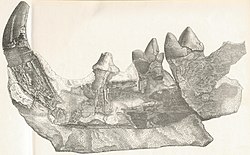
Hyainailouros ("hyena-cat") is an extinct polyphyletic genus of hyaenodont belonging to the family Hyainailouridae that lived during the Early to Late Miocene from 20.0 to 11.4 million years ago, making it one of the last known hyaenodonts. This genus comprises at least three species spread across Afro-Eurasia. Currently, there’s a debate whether or not Megistotherium was synonymous to Hyainailouros or a separate genus entirely. The genus currently consists of at least 3 species, H. bugtiensis, H. sulzeri, and H. napakensis. H. sulzeri was the type species of and the largest species within the genus, weighing 500 kg (1,100 lb). On the other hand, H. napakensis was believed to have been the smallest weighing 202–271 kg (445–597 lb), three species would’ve been some of the largest known hyaenodonts.
Hyainailouros and other large hyainailourines were thought to have been large, solitary predators that were specialized on hunting probsocideans and rhinoceroses. The extinction of large hyainailourines such as Hyainailouros, may have been due to the decline of large herbivores and competition with social carnivorans, as their larger, more complex brains, would’ve enabled them to steal kills from the solitary hyainailourines like Hyainailouros. However, studies have found that brain sizes have little to no correlation with sociality among carnivorans, with relative sizes of the anterior brain playing a larger role in the gregariousness among carnivorans, in addition to the habitats being unfavorable to pack hunting in Early Miocene Africa.
Hyainailouros is the type genus of the superfamily Hyainailouroidae, one of the two known superfamilies of the order Hyaenodonta, with Hyaenodontoidea representing the other superfamily. The genus is part of the subfamily known as Hyainailourine, within the family Hyainailouridae. This family of hyaenodonts was diverse, while hyainailourines consisted of terrestrial predators, the subfamily Apterodontinae consisted of hyainailourids with otter-like adaptations for a semi-aquatic lifestyle. The classification between Hyainailouros and Megistotherium has been debated by experts. Some experts consider H. bugtiensis to be synonymous with H. sulzeri.
Hyainailourine based on results by recovered by Matthew R. Borths and Nancy J. Stevens (2019):
Hyainailouroids were thought to have evolved during the Early Eocene in Africa, although a Middle Paleocene origin was also suspected for the superfamily. Hyainailourines were believed to have evolved during the Middle Eocene around 49.66 Ma in Asia, with the Miocene lineage evolving during the Early Oligocene around 29.73 Ma in Afro-Arabia.
Despite its large size, Hyainailouros may have evolved from small-bodied hyainailourines weighing less than 15 kg (33 lb). Due to the completion of the Gomphothere Land Bridge, Hyainailouros was able to disperse into Asia around 19.6 Ma, and would later disperse into Europe around 16.9 Ma.
Hyainailouros was one of the largest taxa of the order Hyaenodonta. The type species, H. sulzeri, species stood 100 cm (3 ft 3 in) at the shoulders, with a 2019 study estimating this species weighing between 266–1,276 kg (586–2,813 lb). H. bugtiensis was around the same size of H. sulzeri, if not slightly larger, weighing 267–1,744 kg (589–3,845 lb). Both species were similar in size to the closely related Simbakubwa. H. napakensis, on the other hand, was the smallest species of the genus, weighing just around 202–271 kg (445–597 lb). But these regressions are problematic as hyaenodonts possessed very large heads in proportion to their body size. Many experts argue smaller sizes. Based on postcranial remains, some experts argued Hyainailouros was about the size of a tiger, although other experts still suggest higher estimates for H. sulzeri, suggesting it weighed 500 kg (1,100 lb). H. bugtiensis (referred to as H. sulzeri) according to a 2025 study, was estimated to have weighed 430 kg (950 lb).
Several post cranial remains of Hyainailouros have been recovered. The seventh cervical vertebrae of H. sulzeri had a relatively short spine. Compared to Hyaenodon, the spine of Hyainailouros was shorter and less robust, suggesting it bore its head lower. The ulna of H. sulzeri was arched and supported a high, well-developed olecranon, as well as a long, but strong diaphysis to the distal end of ulna. Compared to carnivorans, the fibula of H. sulzeri was thicker in comparison, with the diaphysis being twice as antero-posteriorly elongated in its distal area compared to the proximal area.
Hyainailouros
Hyainailouros ("hyena-cat") is an extinct polyphyletic genus of hyaenodont belonging to the family Hyainailouridae that lived during the Early to Late Miocene from 20.0 to 11.4 million years ago, making it one of the last known hyaenodonts. This genus comprises at least three species spread across Afro-Eurasia. Currently, there’s a debate whether or not Megistotherium was synonymous to Hyainailouros or a separate genus entirely. The genus currently consists of at least 3 species, H. bugtiensis, H. sulzeri, and H. napakensis. H. sulzeri was the type species of and the largest species within the genus, weighing 500 kg (1,100 lb). On the other hand, H. napakensis was believed to have been the smallest weighing 202–271 kg (445–597 lb), three species would’ve been some of the largest known hyaenodonts.
Hyainailouros and other large hyainailourines were thought to have been large, solitary predators that were specialized on hunting probsocideans and rhinoceroses. The extinction of large hyainailourines such as Hyainailouros, may have been due to the decline of large herbivores and competition with social carnivorans, as their larger, more complex brains, would’ve enabled them to steal kills from the solitary hyainailourines like Hyainailouros. However, studies have found that brain sizes have little to no correlation with sociality among carnivorans, with relative sizes of the anterior brain playing a larger role in the gregariousness among carnivorans, in addition to the habitats being unfavorable to pack hunting in Early Miocene Africa.
Hyainailouros is the type genus of the superfamily Hyainailouroidae, one of the two known superfamilies of the order Hyaenodonta, with Hyaenodontoidea representing the other superfamily. The genus is part of the subfamily known as Hyainailourine, within the family Hyainailouridae. This family of hyaenodonts was diverse, while hyainailourines consisted of terrestrial predators, the subfamily Apterodontinae consisted of hyainailourids with otter-like adaptations for a semi-aquatic lifestyle. The classification between Hyainailouros and Megistotherium has been debated by experts. Some experts consider H. bugtiensis to be synonymous with H. sulzeri.
Hyainailourine based on results by recovered by Matthew R. Borths and Nancy J. Stevens (2019):
Hyainailouroids were thought to have evolved during the Early Eocene in Africa, although a Middle Paleocene origin was also suspected for the superfamily. Hyainailourines were believed to have evolved during the Middle Eocene around 49.66 Ma in Asia, with the Miocene lineage evolving during the Early Oligocene around 29.73 Ma in Afro-Arabia.
Despite its large size, Hyainailouros may have evolved from small-bodied hyainailourines weighing less than 15 kg (33 lb). Due to the completion of the Gomphothere Land Bridge, Hyainailouros was able to disperse into Asia around 19.6 Ma, and would later disperse into Europe around 16.9 Ma.
Hyainailouros was one of the largest taxa of the order Hyaenodonta. The type species, H. sulzeri, species stood 100 cm (3 ft 3 in) at the shoulders, with a 2019 study estimating this species weighing between 266–1,276 kg (586–2,813 lb). H. bugtiensis was around the same size of H. sulzeri, if not slightly larger, weighing 267–1,744 kg (589–3,845 lb). Both species were similar in size to the closely related Simbakubwa. H. napakensis, on the other hand, was the smallest species of the genus, weighing just around 202–271 kg (445–597 lb). But these regressions are problematic as hyaenodonts possessed very large heads in proportion to their body size. Many experts argue smaller sizes. Based on postcranial remains, some experts argued Hyainailouros was about the size of a tiger, although other experts still suggest higher estimates for H. sulzeri, suggesting it weighed 500 kg (1,100 lb). H. bugtiensis (referred to as H. sulzeri) according to a 2025 study, was estimated to have weighed 430 kg (950 lb).
Several post cranial remains of Hyainailouros have been recovered. The seventh cervical vertebrae of H. sulzeri had a relatively short spine. Compared to Hyaenodon, the spine of Hyainailouros was shorter and less robust, suggesting it bore its head lower. The ulna of H. sulzeri was arched and supported a high, well-developed olecranon, as well as a long, but strong diaphysis to the distal end of ulna. Compared to carnivorans, the fibula of H. sulzeri was thicker in comparison, with the diaphysis being twice as antero-posteriorly elongated in its distal area compared to the proximal area.
Recent media
Recent media