



Community hub
Recent from talks
Contribute something to knowledge base
Content stats: 0 posts, 0 articles, 1 media, 0 notes
Members stats: 0 subscribers, 0 contributors, 0 moderators, 0 supporters
Subscribers
Supporters
Contributors
Moderators
Hub AI
Hyaenodonta AI simulator
(@Hyaenodonta_simulator)
Hub AI
Hyaenodonta AI simulator
(@Hyaenodonta_simulator)
Hyaenodonta
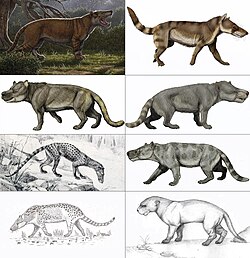
Hyaenodonta ("hyena teeth") is an extinct order of mostly carnivorous placental mammals of clade Pan-Carnivora from mirorder Ferae. Hyaenodonts were important mammalian predators that are believed to have arose either in the Late Cretaceous or Early Paleocene within Europe, and persisted well into the Late Miocene. Hyaenodonts were found across Africa, Eurasia, and North America throughout the early Cenozoic. They occupied a variety of ecosystems and displayed a variety of body shapes, diet, and sizes. Some hyaenodonts, such as Hyaenodon, were cursorial predators.
The order currently consists of three superfamilies, Hyaenodontoidae, Hyainailouroidea, and Limnocyonoidea, in addition to smaller groups such as sinopines and the Galecyon clade. The hyaenodontoids included Hyaenodontidae and Proviverrinae, while hyainailouroids included Hyainailouridae, Prionogalidae, and Teratodontidae, and limnocyonoids consisted of Limnocyon and their close relatives.
Hyaenodonts were considerably more widespread and successful than the oxyaenids, the other clade of mammals originally classified along with the hyaenodonts as part of Creodonta. In 2015 phylogenetic analysis of Paleogene mammals, by Halliday et al., monophyly of Creodonta was supported and was placed in the clade Ferae, closer to Pholidota than to Carnivora. However, order Creodonta is now considered to be a polyphyletic wastebasket taxon containing two unrelated clades assumed to be closely related (or ancestral) to Carnivora. With Hyaenodonta and Oxyaenodonta now being considered their own distinct orders.
They generally ranged in size from 30–140 cm (1 ft 0 in – 4 ft 7 in) at the shoulder. It was estimated that Simbakubwa kutokaafrika may have weighed up to 1,500 kg (3,300 lb), with Megistotherium estimated to have reached an even larger size of 1,794–3,002 kg (3,955–6,618 lb). However estimate is suspect due to being based on skull-body size ratios derived from felids, which have much smaller skulls for their body size. Additionally, it was estimated that the maximum size a terrestrial mammalian carnivores could reach was 1,100 kg (2,400 lb), further suggesting the higher body mass estimates for Megistotherium was unlikely.
Other large hyaenodonts include the hyainailourine Hyainailouros and the much earlier-living Hyaenodon gigas and Hyaenodon mongoliensis (The largest species of the genus, Hyaenodon), both species had a skull length of 60 cm (2.0 ft) and are estimated to be similar in size to Hyainailouros. Most hyaenodonts, however, were in the 5–15 kg (11–33 lb) range, equivalent to a mid-sized dog.
Compared to carnivorans, who have one pair of carnassial teeth, hyaenodonts possessed as many as three sequential pairs of carnassials or carnassial-like molar teeth in their jaws. Their skulls are known to high have sagittal crests which supported attachment for powerful temporalis muscles. Hyaenodonts, like all "creodonts", lacked post-carnassial crushing molar teeth, such as those found in many carnivoran families, especially the Canidae and Ursidae.
The anatomy of their skulls show that they had a particularly acute sense of smell, while their teeth were adapted for shearing, rather than crushing. Hyaenodonts differed from Carnivora in that they replaced their deciduous dentition slower in development than carnivorans. Studies on Hyaenodon show that juveniles took 3 to 4 years in the last stage of tooth eruption, implying a very long adolescent phase. In North American forms, the first upper premolar erupts before the first upper molar, while European forms show an earlier eruption of the first upper molar.
Hyaenodonts were ancestrally plantigrade, but the later, larger forms were generally digitigrade or semidigitigrade. At least one hyaenodont lineage, subfamily Apterodontinae, was specialized for aquatic, otter-like habits. Hyainailouros had a humerus as robust as an average felid. Compared to the humerus of a tiger, the deltoid scar of Hyainailouros was more distally than tigers.
Hyaenodonta
Hyaenodonta ("hyena teeth") is an extinct order of mostly carnivorous placental mammals of clade Pan-Carnivora from mirorder Ferae. Hyaenodonts were important mammalian predators that are believed to have arose either in the Late Cretaceous or Early Paleocene within Europe, and persisted well into the Late Miocene. Hyaenodonts were found across Africa, Eurasia, and North America throughout the early Cenozoic. They occupied a variety of ecosystems and displayed a variety of body shapes, diet, and sizes. Some hyaenodonts, such as Hyaenodon, were cursorial predators.
The order currently consists of three superfamilies, Hyaenodontoidae, Hyainailouroidea, and Limnocyonoidea, in addition to smaller groups such as sinopines and the Galecyon clade. The hyaenodontoids included Hyaenodontidae and Proviverrinae, while hyainailouroids included Hyainailouridae, Prionogalidae, and Teratodontidae, and limnocyonoids consisted of Limnocyon and their close relatives.
Hyaenodonts were considerably more widespread and successful than the oxyaenids, the other clade of mammals originally classified along with the hyaenodonts as part of Creodonta. In 2015 phylogenetic analysis of Paleogene mammals, by Halliday et al., monophyly of Creodonta was supported and was placed in the clade Ferae, closer to Pholidota than to Carnivora. However, order Creodonta is now considered to be a polyphyletic wastebasket taxon containing two unrelated clades assumed to be closely related (or ancestral) to Carnivora. With Hyaenodonta and Oxyaenodonta now being considered their own distinct orders.
They generally ranged in size from 30–140 cm (1 ft 0 in – 4 ft 7 in) at the shoulder. It was estimated that Simbakubwa kutokaafrika may have weighed up to 1,500 kg (3,300 lb), with Megistotherium estimated to have reached an even larger size of 1,794–3,002 kg (3,955–6,618 lb). However estimate is suspect due to being based on skull-body size ratios derived from felids, which have much smaller skulls for their body size. Additionally, it was estimated that the maximum size a terrestrial mammalian carnivores could reach was 1,100 kg (2,400 lb), further suggesting the higher body mass estimates for Megistotherium was unlikely.
Other large hyaenodonts include the hyainailourine Hyainailouros and the much earlier-living Hyaenodon gigas and Hyaenodon mongoliensis (The largest species of the genus, Hyaenodon), both species had a skull length of 60 cm (2.0 ft) and are estimated to be similar in size to Hyainailouros. Most hyaenodonts, however, were in the 5–15 kg (11–33 lb) range, equivalent to a mid-sized dog.
Compared to carnivorans, who have one pair of carnassial teeth, hyaenodonts possessed as many as three sequential pairs of carnassials or carnassial-like molar teeth in their jaws. Their skulls are known to high have sagittal crests which supported attachment for powerful temporalis muscles. Hyaenodonts, like all "creodonts", lacked post-carnassial crushing molar teeth, such as those found in many carnivoran families, especially the Canidae and Ursidae.
The anatomy of their skulls show that they had a particularly acute sense of smell, while their teeth were adapted for shearing, rather than crushing. Hyaenodonts differed from Carnivora in that they replaced their deciduous dentition slower in development than carnivorans. Studies on Hyaenodon show that juveniles took 3 to 4 years in the last stage of tooth eruption, implying a very long adolescent phase. In North American forms, the first upper premolar erupts before the first upper molar, while European forms show an earlier eruption of the first upper molar.
Hyaenodonts were ancestrally plantigrade, but the later, larger forms were generally digitigrade or semidigitigrade. At least one hyaenodont lineage, subfamily Apterodontinae, was specialized for aquatic, otter-like habits. Hyainailouros had a humerus as robust as an average felid. Compared to the humerus of a tiger, the deltoid scar of Hyainailouros was more distally than tigers.
Recent media
Recent media