


Community hub
Recent from talks
Knowledge base stats:
Talk channels stats:
Members stats:
Hydrogen-like atom
A hydrogen-like atom (or hydrogenic atom) is any atom or ion with a single electron. Examples of hydrogen-like atoms are H, He+, Li2+, Be3+ and so on, as well as any of their isotopes. These ions are isoelectronic with hydrogen and are sometimes called hydrogen-like ions. The non-relativistic Schrödinger equation and relativistic Dirac equation for the hydrogen atom and hydrogen-like atoms can be solved analytically, owing to the simplicity of the two-particle physical system. The one-electron wave function solutions are referred to as hydrogen-like atomic orbitals. Hydrogen-like atoms are of importance because their corresponding orbitals bear similarity to the hydrogen atomic orbitals.
The definition of hydrogen-like atoms can be extended to also include any system with only one valence electron (but more core electrons). Examples such atoms include, but are not limited to, all alkali metals such as Rb and Cs and singly ionized alkaline earth metals such as Ca+ and Sr+. In such a case, the hydrogen-like atom includes a positively charged core consisting of the atomic nucleus and any core electrons, as well as a single valence electron. Because helium is common in the universe, the spectroscopy of singly ionized helium is important in EUV astronomy, for example, of DO white dwarf stars.
Other systems may also be referred to as "hydrogen-like atoms", such as muonium (an electron orbiting an antimuon), positronium (an electron and a positron), certain exotic atoms (formed with other particles), or Rydberg atoms (in which one electron is in such a high energy state that it sees the rest of the atom effectively as a point charge).
Highly excited states of neutral atoms are well described in terms of one electron around a nucleus of a single positive charge resembling a hydrogen atom. These states are called Rydberg atoms. They have important applications in astrophysics, including in the dynamics of the primordial gas of the Big Bang.
In the solution to the Schrödinger equation, which is non-relativistic, hydrogen-like atomic orbitals are eigenfunctions of the one-electron angular momentum operator L (more precisely, its square, L2) and its z-component Lz. A hydrogen-like atomic orbital is uniquely identified by the values of the principal quantum number n, the angular momentum quantum number ℓ, and the magnetic quantum number m. The energy eigenvalues do not depend on ℓ or m, but solely on n. To these must be added the two-valued spin quantum number ms = ±1/2, setting the stage for the Aufbau principle. This principle restricts the allowed values of the four quantum numbers in electron configurations of more-electron atoms. In hydrogen-like atoms all degenerate orbitals of fixed n and ℓ, m and s varying between certain values (see below) form an atomic shell.
The Schrödinger equation of atoms or ions with more than one electron has not been solved analytically, because of the computational difficulty imposed by the Coulomb interaction between the electrons. Numerical methods must be applied in order to obtain (approximate) wavefunctions or other properties from quantum mechanical calculations. Due to the spherical symmetry (of the Hamiltonian), the total angular momentum J of an atom is a conserved quantity. Many numerical procedures start from products of atomic orbitals that are eigenfunctions of the one-electron operators L and Lz. The radial parts of these atomic orbitals are sometimes numerical tables or are sometimes Slater orbitals. By angular momentum coupling many-electron eigenfunctions of J2 (and possibly S2) are constructed.
In quantum chemical calculations hydrogen-like atomic orbitals cannot serve as an expansion basis, because they are not complete. The non-square-integrable continuum (E > 0) states must be included to obtain a complete set, i.e., to span all of one-electron Hilbert space. This was observed as early as 1928 by E. A. Hylleraas, and later by Harrison Shull and Per-Olov Löwdin.
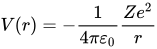
In the simplest model, the atomic orbitals of hydrogen-like atoms/ions are solutions to the Schrödinger equation in a spherically symmetric potential. In this case, the potential term is the potential given by Coulomb's law: where
Hub AI
Hydrogen-like atom AI simulator
(@Hydrogen-like atom_simulator)
Hydrogen-like atom
A hydrogen-like atom (or hydrogenic atom) is any atom or ion with a single electron. Examples of hydrogen-like atoms are H, He+, Li2+, Be3+ and so on, as well as any of their isotopes. These ions are isoelectronic with hydrogen and are sometimes called hydrogen-like ions. The non-relativistic Schrödinger equation and relativistic Dirac equation for the hydrogen atom and hydrogen-like atoms can be solved analytically, owing to the simplicity of the two-particle physical system. The one-electron wave function solutions are referred to as hydrogen-like atomic orbitals. Hydrogen-like atoms are of importance because their corresponding orbitals bear similarity to the hydrogen atomic orbitals.
The definition of hydrogen-like atoms can be extended to also include any system with only one valence electron (but more core electrons). Examples such atoms include, but are not limited to, all alkali metals such as Rb and Cs and singly ionized alkaline earth metals such as Ca+ and Sr+. In such a case, the hydrogen-like atom includes a positively charged core consisting of the atomic nucleus and any core electrons, as well as a single valence electron. Because helium is common in the universe, the spectroscopy of singly ionized helium is important in EUV astronomy, for example, of DO white dwarf stars.
Other systems may also be referred to as "hydrogen-like atoms", such as muonium (an electron orbiting an antimuon), positronium (an electron and a positron), certain exotic atoms (formed with other particles), or Rydberg atoms (in which one electron is in such a high energy state that it sees the rest of the atom effectively as a point charge).
Highly excited states of neutral atoms are well described in terms of one electron around a nucleus of a single positive charge resembling a hydrogen atom. These states are called Rydberg atoms. They have important applications in astrophysics, including in the dynamics of the primordial gas of the Big Bang.
In the solution to the Schrödinger equation, which is non-relativistic, hydrogen-like atomic orbitals are eigenfunctions of the one-electron angular momentum operator L (more precisely, its square, L2) and its z-component Lz. A hydrogen-like atomic orbital is uniquely identified by the values of the principal quantum number n, the angular momentum quantum number ℓ, and the magnetic quantum number m. The energy eigenvalues do not depend on ℓ or m, but solely on n. To these must be added the two-valued spin quantum number ms = ±1/2, setting the stage for the Aufbau principle. This principle restricts the allowed values of the four quantum numbers in electron configurations of more-electron atoms. In hydrogen-like atoms all degenerate orbitals of fixed n and ℓ, m and s varying between certain values (see below) form an atomic shell.
The Schrödinger equation of atoms or ions with more than one electron has not been solved analytically, because of the computational difficulty imposed by the Coulomb interaction between the electrons. Numerical methods must be applied in order to obtain (approximate) wavefunctions or other properties from quantum mechanical calculations. Due to the spherical symmetry (of the Hamiltonian), the total angular momentum J of an atom is a conserved quantity. Many numerical procedures start from products of atomic orbitals that are eigenfunctions of the one-electron operators L and Lz. The radial parts of these atomic orbitals are sometimes numerical tables or are sometimes Slater orbitals. By angular momentum coupling many-electron eigenfunctions of J2 (and possibly S2) are constructed.
In quantum chemical calculations hydrogen-like atomic orbitals cannot serve as an expansion basis, because they are not complete. The non-square-integrable continuum (E > 0) states must be included to obtain a complete set, i.e., to span all of one-electron Hilbert space. This was observed as early as 1928 by E. A. Hylleraas, and later by Harrison Shull and Per-Olov Löwdin.
In the simplest model, the atomic orbitals of hydrogen-like atoms/ions are solutions to the Schrödinger equation in a spherically symmetric potential. In this case, the potential term is the potential given by Coulomb's law: where