Hubbry Logo
World Athletics RelaysWorld Athletics RelaysMain
Open search
World Athletics Relays
Community hub
World Athletics Relays
logo
8 pages, 0 posts
0 subscribers
Be the first to start a discussion here.
World Athletics Relays
from Wikipedia

Wordmark of the World Athletics Relays
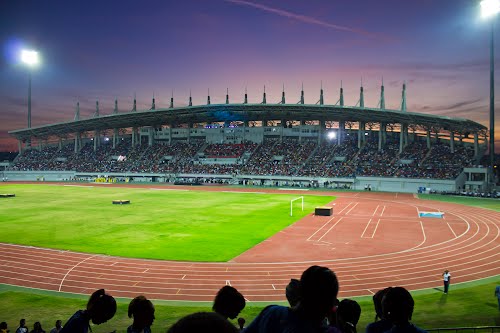
The Tommy Robinson National Stadium in Nassau, Bahamas hosted the first three editions of the competition.

The World Athletics Relays, known as the IAAF World Relays until 2019, is an international biennial track and field sporting event held by World Athletics where teams from around the world compete in relay races, some of which are not part of the standard Olympic programme. The first three editions were set to take place in Nassau, Bahamas at the Thomas Robinson Stadium in 2014, 2015 and 2017. Originally intended as an annual event, it was later decided to happen every odd year,[1] in the same year as the World Athletics Championships for which it serves as a qualification stage.

The competition format for the first edition included the 4 × 100 metres relay, the 4 × 200 metres relay, the 4 × 400 metres relay, the 4 × 800 metres relay and the 4 × 1500 metres relay.[2] The first edition had a $1.4 million prize fund.

From the second edition, the 4 × 1500 metres relay was replaced by the distance medley relay.[3] However, this was short-lived and was itself replaced by a mixed-gender 4 × 400 metres relay for the third edition.[4] In 2019, the 2 × 2 × 400 m relay and the shuttle hurdles relay were added to the mixed-gender category.[5] Starting from the 2024 edition, all the non-Olympic events were removed from the programme and only the mens and women's 4 × 100 and 4 × 400 metres remained, alongside the mixed 4 × 400 metres relay. In the 2025 edition, a mixed 4 × 100 metres was added to the programme, bringing the total to 6 events.[6]

The latest World Athletics Relays were held in Guangzhou, China at the Guangdong Olympic Stadium on 10 and 11 May 2025.

Championships

[edit]
Edition Year City Country Date Venue No. of
Events
No. of
Countries
No. of
Athletes
Top of the
medal table
1 2014 Nassau  Bahamas 24–25 May Thomas Robinson Stadium 10 41 470  United States
2 2015 Nassau  Bahamas 2–3 May Thomas Robinson Stadium 10 42 584  United States
3 2017 Nassau  Bahamas 22–23 April Thomas Robinson Stadium 9 35 419  United States
4 2019 Yokohama  Japan 11–12 May Yokohama International Stadium 9 43 529  United States
5 2021 Chorzów  Poland 1–2 May Silesian Stadium 9 37 689  Italy
6 2024 Nassau  Bahamas 4–5 May Thomas Robinson Stadium 5 52 893  United States
7 2025 Guangzhou  China 10–11 May Tianhe Stadium 6 43 734  South Africa
8 2026 Gaborone  Botswana 2–3 May Botswana National Stadium
9 2028 Nassau  Bahamas 22–23 April Thomas Robinson Stadium

Events

[edit]
Event Year
Discipline Gender 2014 2015 2017 2019 2021 2024 2025
4 × 100 metres relay Men
Mixed
Women
Shuttle hurdles relay Mixed
4 × 200 metres relay Men
Women
4 × 400 metres relay Men
Mixed
Women
2 × 2 × 400 metres relay Mixed
4 × 800 metres relay Men
Women
Distance medley relay Men
Women
4 × 1500 metres relay Men
Women

Championships records

[edit]

Men

[edit]
Event Record Athlete Nationality Date Meet Place Ref.
4 × 100 m relay 37.38 Mike Rodgers
Justin Gatlin
Tyson Gay
Ryan Bailey
 United States 2 May 2015 2015 IAAF World Relays Nassau, Bahamas [7]
4 × 200 m relay 1:18.63 Nickel Ashmeade
Warren Weir
Jermaine Brown
Yohan Blake
 Jamaica 24 May 2014 2014 IAAF World Relays Nassau, Bahamas [8]
4 × 400 m relay 2:57.25 David Verburg
Tony McQuay
Christian Taylor
LaShawn Merritt
 United States 25 May 2014 2014 IAAF World Relays Nassau, Bahamas [9]
4 × 800 m relay 7:04.84 Duane Solomon
Erik Sowinski
Casimir Loxsom
Robby Andrews
 United States 3 May 2015 2015 IAAF World Relays Nassau, Bahamas [10]
Distance medley relay 9:15.50 Kyle Merber 2:53.56 (1200 m)
Brycen Spratling 45.95 (400 m)
Brandon Johnson 1:44.75 (800 m)
Ben Blankenship 3:51.24 (1600 m)
 United States 3 May 2015 2015 IAAF World Relays Nassau, Bahamas [11]
4 × 1500 m relay 14:22.22 Collins Cheboi
Silas Kiplagat
James Kiplagat Magut
Asbel Kiprop
 Kenya 25 May 2014 2014 IAAF World Relays Nassau, Bahamas [12]

Women

[edit]
Event Record Athlete Nationality Date Meet Place Ref.
4 × 100 m relay 41.85 Tamari Davis
Gabrielle Thomas
Celera Barnes
Melissa Jefferson
 United States 5 May 2024 2024 Relays Nassau, Bahamas [13]
4 × 200 m relay 1:29.04 Jura Levy
Shericka Jackson
Sashalee Forbes
Elaine Thompson
 Jamaica 22 April 2017 2017 IAAF World Relays Nassau, Bahamas [14]
4 × 400 m relay 3:19.39 Phyllis Francis
Natasha Hastings
Sanya Richards-Ross
Francena McCorory
 United States 3 May 2015 2015 IAAF World Relays Nassau, Bahamas [15]
4 × 800 m relay 8:00.62 Chanelle Price
Maggie Vessey
Molly Beckwith-Ludlow
Alysia Johnson Montaño
 United States 3 May 2015 2015 IAAF World Relays Nassau, Bahamas [16]
Distance medley relay 10:36.50 Treniere Moser 3:18.38 (1200 m)
Sanya Richards-Ross 50.12 (400 m)
Ajee' Wilson 2:00.08 (800 m)
Shannon Rowbury 4:27.92 (1600 m)
 United States 2 May 2015 2015 IAAF World Relays Nassau, Bahamas [17]
4 × 1500 m relay 16:33.58 Mercy Cherono
Faith Kipyegon
Irene Jelagat
Hellen Onsando Obiri
 Kenya 24 May 2014 2014 IAAF World Relays Nassau, Bahamas [18]

Mixed

[edit]
Event Record Athlete Nationality Date Meet Place Ref.
4 × 400 m relay 3:09.54 Chris Robinson
Courtney Okolo
Johnnie Blockburger
Lynna Irby-Jackson
 United States 11 May 2025 2025 Relays Guangzhou, China [19]
2 × 2 × 400 m relay 3:36.92 Ce'Aira Brown
Donavan Brazier
 United States 11 May 2019 2019 Relays Yokohama, Japan [20]
Shuttle hurdle relay 54.96 Christina Clemons
Freddie Crittenden
Sharika Nelvis
Devon Allen
 United States 11 May 2019 2019 Relays Yokohama, Japan [21]

Medal table

[edit]
As of the 2025 edition[22]
RankNationGoldSilverBronzeTotal
1 United States279238
2 Jamaica59721
3 Poland38112
4 Kenya36312
5 Germany3148
6 Italy3014
7 Canada2226
8 South Africa2215
9 France1225
10 Bahamas1203
11 Great Britain1179
12 Botswana1124
 Trinidad and Tobago1124
14 Netherlands1113
15 Brazil1102
 Spain1102
17 Nigeria1012
18 Cuba1001
19 Japan0325
20 Australia0268
21 Belgium0134
22 China0123
23 Ireland0112
24 Barbados0101
 Belarus0101
 Saint Kitts and Nevis0101
27 Denmark0011
 Dominican Republic0011
 Ecuador0011
 Ethiopia0011
 Portugal0011
 Russia0011
 Slovenia0011
Totals (33 entries)585857173

Multiple wins

[edit]

Multiple wins athletes are:[23]

Three wins
Athlete Country Events
Nickel Ashmeade  Jamaica Men's 4 × 100 m 2014, 4 × 200 m 2014/2015
Tony McQuay  United States Men's 4 × 400 m 2014/2015/2017
LaShawn Merritt  United States Men's 4 × 400 m 2014/2015/2017
David Verburg  United States Men's 4 × 400 m 2014/2015/2017
Natasha Hastings  United States Women's 4 × 400 m 2014/2015/2017
Chanelle Price  United States Women's 4 × 800 m 2014/2015/2017
Sanya Richards-Ross  United States Women's 4 × 400 m 2014/2015, Distance Medley Relay 2015
Two wins
Athlete Country Events
Yohan Blake  Jamaica Men's 4 × 100 m 2014, 4 × 200 m 2014
Justin Gatlin  United States Men's 4 × 100 m 2015/2017
Casimir Loxsom  United States Men's 4 × 800 m 2015/2017
Erik Sowinski  United States Men's 4 × 800 m 2015/2017
Warren Weir  Jamaica Men's 4 × 200 m 2014/2015
Phyllis Francis  United States Women's 4 × 400 m 2015/2017
Ajeé Wilson  United States Women's 4 × 800 m 2014, Distance Medley Relay 2015
Quanera Hayes  United States Women's 4 × 400 m 2017/2024
Gabrielle Thomas  United States Women's 4 × 100 m 2024, Women's 4 × 400 m 2024
Lynna Irby  United States Mixed 4 × 400 m 2024/2025

References

[edit]
[edit]
Revisions and contributorsEdit on WikipediaRead on Wikipedia
from Grokipedia
The World Athletics Relays is a biennial international track and field event organized by , featuring high-stakes relay competitions among national teams that double as qualification opportunities for the and . Held over two days, the competition brings together approximately 700 athletes from more than 40 nations to contest six core events: the men's and women's 4 × 100 metres relay, the men's and women's 4 × 400 metres relay, the mixed 4 × 400 metres relay, and the mixed 4 × 100 metres relay (introduced in 2025). These races emphasize teamwork, speed, and baton exchanges, creating a dramatic atmosphere filled with the potential for thrilling finishes and unexpected upsets unique to relay formats. Inaugurated in 2014 as the IAAF World Relays in , the event was initially planned as an annual showcase but transitioned to a biennial schedule starting in 2019 to align with the Olympic and World Championships cycles. The inaugural edition drew a sold-out crowd and global television audience, highlighting its immediate appeal as a platform for sprint excellence. Subsequent host cities have included (2019), , (2021), and Nassau again (2024), with the 2025 edition held in Guangzhou, China, serving as the primary qualification event for the relay disciplines at the in , , and contributing to qualification pathways for the in . The event's global impact lies in its role as a "make-or-break" qualifier, where only the top-finishing teams earn direct entry to major championships, fostering intense national rivalries and showcasing emerging talents in sprint disciplines.

Background and History

Establishment

The International Association of Athletics Federations (IAAF), now known as , established the World Relays competition in , initially with annual editions planned for 2014 and 2015 before transitioning to biennial, as a dedicated event to elevate the profile of racing within athletics. The decision was formalized by the IAAF Council during a meeting in , aiming to capitalize on the excitement generated by events at the 2012 London Olympics and to introduce a fresh format early in the athletic season. This initiative sought to foster greater global engagement with team-based disciplines, which had often been overshadowed by individual events in major championships. The inaugural edition was scheduled for 2014 in , at the Thomas A. Robinson National Stadium, a venue with a capacity of 15,000 spectators. This choice of location underscored the IAAF's commitment to hosting the event in diverse regions to broaden international participation and appeal. The competition was designed to serve as a direct qualification pathway for subsequent major events, including the and IAAF World Championships, thereby streamlining athlete selection and incentivizing national teams to compete at a high level. A total prize fund of $1.4 million was announced to further motivate participation and highlight the event's prestige. Key objectives included increasing worldwide interest in relays by showcasing their strategic and thrilling nature, while providing a platform for emerging nations to gain exposure alongside established powerhouses. The initial format featured a two-day program open to all IAAF member federations, incorporating a variety of distances such as the 4x100m, 4x400m, 4x200m, 4x800m, and 4x1500m relays to encourage broader involvement and test different team dynamics. This structure was intended to promote relay-specific training and innovation, ultimately strengthening the sport's team-oriented aspects on the global stage.

Evolution

The Relays commenced as an annual competition in 2014, with the inaugural edition hosted in , featuring an expansive program of 10 relay events (five each for men and women), including non-Olympic formats such as the men's and women's 4×200 m, 4×800 m, and 4×1500 m relays (alongside the 4×100 m and 4×400 m relays). Following the 2015 edition, also in Nassau, the event transitioned to a biennial schedule in odd-numbered years to serve as a primary qualification platform for the and to mitigate scheduling overlaps with major events like the . Subsequent editions continued in Nassau in 2017 before expanding globally, with Yokohama, Japan, hosting the 2019 competition—the first outside the Bahamas—demonstrating the event's growing international footprint. The COVID-19 pandemic significantly disrupted this trajectory, leading to the outright cancellation of the planned 2020 edition and the relocation and delay of the next event to Silesia, Poland, in 2021, where it proceeded under strict health protocols as the qualification pathway for the postponed Tokyo Olympics. In response to evaluations of recent formats, the event program underwent substantial streamlining by the early 2020s, reducing the focus from the diverse, experimental relays of to a core set of five Olympic-standard events by : the men's and women's 4x100m and 4x400m relays, plus the mixed 4x400m relay, emphasizing high-stakes qualification and broader accessibility. This aligned with a 2022 decision by the Council to shift the biennial cycle to even-numbered years starting in , positioning the Relays as the key qualifier for the while optimizing the global athletics calendar. The 2025 edition in , —the first hosted in the country—introduced the mixed 4x100m relay to the program, expanding it to six events and reflecting ongoing innovations in mixed-gender competition. Recent hosting has further diversified, with a return to Nassau in 2024 and the upcoming 2026 event in , , marking the first time in Africa and underscoring the competition's commitment to regional representation.

Format and Events

Relay Disciplines

The World Athletics Relays, as of the 2025 edition in , features six relay disciplines: the men's , women's , men's 4 × 400 metres relay, women's 4 × 400 metres relay, , and . The was introduced in 2017 to promote and team dynamics in middle-distance relays. The debuted in 2025, expanding the sprint program with alternating male and female legs to enhance inclusivity and excitement. Each relay team comprises four athletes who run designated legs while passing a baton, with strict rules on exchange zones to ensure smooth transitions. In mixed relays, teams must consist of two men and two women. For the mixed 4 × 400 metres relay, the order is man, woman, man, woman. For the mixed 4 × 100 metres relay, the order is woman, woman, man, man. The 4 × 100 metres events focus on raw sprint power, with each 100-metre leg designed for maximum acceleration and quick baton exchanges to capitalize on short bursts of speed. Conversely, the 4 × 400 metres relays demand greater stamina, as each 400-metre leg tests athletes' ability to maintain pace while positioning for effective passes, often involving tactical decisions like conserving energy in early legs. Earlier editions of the World Athletics Relays included additional non-Olympic disciplines that were later discontinued to streamline the program toward core international events. These encompassed the men's and women's , contested from the inaugural 2014 championship through 2021; the men's and women's 4 × 800 metres relay, featured in editions up to 2017; the men's and women's (typically 1200m-400m-800m-1600m), held in the 2015 edition; and the mixed shuttle hurdles relay (4 × 100m with hurdles), introduced and limited to the 2019 edition in . These changes, implemented starting with the 2024 edition, prioritized the five Olympic-standard relays before the 2025 addition.

Competition Rules and Structure

The World Athletics Relays is structured as a biennial two-day international competition held on a standard athletics track, featuring on the first day and finals on the second day across its relay events. Each event accommodates up to 32 teams, with one team per member federation permitted, comprising a maximum of eight athletes per discipline to allow for substitutions. Teams are drawn into based on prior performances, typically four per event, with the top two finishers from each plus the next two fastest times advancing to an eight-team final. Competition regulations follow Technical Rules, particularly Rule 170 for races. Baton exchanges must occur within designated takeover zones to avoid disqualification: a 20-meter exchange zone for the 4×100 meters (with a 10-meter acceleration zone preceding it), and blind exchanges without visual zones for the 4×400 meters to simulate championship conditions. Any by a team member results in the entire team's disqualification, as do infractions such as passing the baton outside the zone, lane violations, or improper team order. Team composition and running order must be declared one hour before the event's start, with up to four substitutes allowed per team. Medals are awarded to the top three teams in each event final: gold, silver, and bronze. Prize money is distributed to the top eight finishers, with gold medalists receiving US$40,000 in sprint relays (4×100 meters) and mixed 4×400 meters, or US$28,000 in the mixed 4×100 meters, decreasing to US$2,000 for eighth place, as implemented in recent editions. The event receives global television coverage through World Athletics broadcast partners, including live streaming on the organization's digital platform and transmissions via networks such as NBC in the United States, ensuring wide accessibility.

Qualification System

For Olympic Games

The World Athletics Relays have played a pivotal role in qualifying national teams for the relay events since the 2016 Rio de Janeiro edition, serving as the primary direct pathway for securing spots in the 4×100 m and 4×400 m relays for men and women, as well as the mixed 4×400 m relay. This system was established to centralize relay qualification, reducing reliance on individual performances and emphasizing team preparation under competitive pressure. For the 2016 Rio Olympics, the top eight teams in each relay event at the 2015 World Relays in , automatically qualified, with the remaining eight spots per event allocated to the highest-ranked teams on the IAAF World Rankings as of July 11, 2016. A comparable structure applied to the 2020 Tokyo Olympics (held in 2021), where all eight finalists in the men's and women's 4×100 m, men's and women's 4×400 m, and mixed 4×400 m events at the 2021 World Relays in Silesia, Poland, earned direct qualification, supplemented by rankings for the final spots to reach 16 teams per event. The 2024 Paris Olympics expanded this to the top 14 teams per event from the 2024 World Relays in , with the two additional slots filled by the next highest-ranked teams on the Road to Paris rankings; this filled eight slots per event through the Relays in some interpretations when combined with continental representation needs, though the direct allocation was 14. Looking ahead to the 2028 Los Angeles Olympics, the 2026 World Athletics Relays in , , are set to serve as the main qualification platform, maintaining the emphasis on direct advancement from while introducing qualification for the new mixed 4×100 m , which debuts at the . As announced in November 2025, the top six teams in the mixed 4×100 m and mixed 4×400 m relays will earn automatic qualification, with providing a primary pathway for all disciplines, though full details for standard events (likely similar to prior top 14 allocation) await confirmation. If a qualified team declines participation or fails to meet eligibility criteria, the vacancy is filled by the next highest-ranked team from the , ensuring full fields of 16 nations per Olympic event. Since 2016, this system has ensured that over 50% of Olympic finalists—often the majority—have qualified directly via the Relays, with 8 out of 16 for Rio and , and 14 out of 16 for , highlighting 's significant impact on Olympic team selections.

For World Athletics Championships

The qualification pathway for relay events at the biennial World Athletics Championships relies heavily on performances at the World Athletics Relays, serving as the primary gateway to secure team entries. For each relay discipline, up to 16 teams can participate at the Championships, with the top 14 finishing positions from the Relays granting automatic qualification, while the remaining two slots are allocated based on the World Athletics Top Lists over the qualification period. This system ensures a competitive field drawn from global relay specialists, emphasizing the Relays' role in identifying top teams ahead of the Championships. The qualification applies to the men's and women's 4×100 m and 4×400 m , as well as the mixed 4×400 m . Starting with editions after 2025, the mixed 4×100 m will also be included in this process, expanding opportunities for combined-gender teams. At the , teams advance through heats and finals structured over two days: the top two from each of four heats on day one proceed to the final and secure qualification spots, while on day two, the top two from each of three additional heats also qualify, aiming to reach the full complement of 14. Each national federation is limited to one team per event, with a maximum of eight athletes registered per to promote depth within squads. If fewer than 14 teams complete the event due to disqualifications or non-finishes, the Top Lists fill the gaps to maintain the 16-team field at the Championships, without reallocation of slots or inclusion of continental champions specifically for . For the in , the Guangzhou Relays in May 2025 served as the key qualifier, with results determining the bulk of entries for the relay events held in September. A total of 70 teams across the five disciplines earned spots through these performances, highlighting the event's direct impact on the Championships' fields. The qualification period for the Top Lists ran from February 25, 2024, to August 24, 2025, allowing teams not advancing via the Relays to compete for the final positions based on seasonal performances. This qualification model has evolved to foster greater international participation. Early editions in the mid-2010s awarded the top eight teams direct spots for the World Championships, with the 2019 edition maintaining top eight for standard relays and expanding to top 12 for the mixed 4×400 m. Following the 2019 Relays, subsequent Championships (2022 Eugene and 2023 ) relied more on world rankings and top lists due to the absence of intervening Relays events, before the top 14 threshold was reintroduced for the 2025 cycle via the Relays to enhance direct qualification opportunities.

Championships

Past Editions

The Relays have been held since 2014, initially annually before becoming biennial from 2019 onwards, serving as a key qualification event for major championships while showcasing relay excellence across sprint and middle-distance disciplines. The first seven editions, completed by 2025, have rotated locations from the to , , and back, with each edition awarding gold medals in the five core relay events. Participation has grown, reflecting increased global interest in relay events. The inaugural edition took place in Nassau, Bahamas, from 24 to 25 May 2014, marking the first dedicated global relay championship. The dominated, securing four medals in the men's and women's 4×100m and 4×400m relays. The 2015 edition returned to , from 2 to 3 May, building on the previous year's success with strong and American performances. claimed the women's 4×100m relay in a time, highlighting their sprint relay prowess. In 2017, the event was held in , from 12 to 14 August, featuring an expanded program that introduced the mixed 4×400m relay. set a in the mixed 4×400m, clocking 3:20.12 to win . The 2019 championships shifted to Asia for the first time, occurring in , , from 11 to 12 May. won the men's 4×400m relay, the women's, with teams securing Olympic qualification spots. Adjusted due to the , the 2021 edition was hosted in , , from 1 to 2 May, with reduced spectator capacity but full international fields. excelled in the sprint relays, winning gold in the men's and women's 4×100m and mixed 4×400m events. Returning to Nassau, Bahamas, from 4 to 5 May 2024, the event served as a direct qualifier for the Paris Olympics. Canada produced an upset victory in the men's 4×100m relay, finishing ahead of traditional powerhouses like the and . The 2025 edition marked the first hosting in , held in from 10 to 11 May, introducing the mixed 4×100m relay as a new discipline. The host nation showed strong home support, while top finishers qualified for the in . Canada won the inaugural mixed 4×100m gold. In the women's 4×100 m relay, Great Britain claimed gold with a time of 42.21 (season's best), followed by Spain in silver and Jamaica in bronze. Over these editions, trends show increasing participation from African and Asian nations, with teams from , , and rising in medal contention, contrasting early dominance by North American and squads. Each event has emphasized innovation and global inclusivity.

Future Editions

The 2026 World Athletics Relays are scheduled for 2–3 May in , , representing the first hosting of the event in and underscoring ' commitment to expanding the sport across the continent. This edition will feature competitions in the five Olympic disciplines—men's and women's 4 × 100 m, men's and women's 4 × 400 m, and mixed 4 × 400 m—and will function as the primary qualification mechanism for events at the 2026 . The results from will determine automatic entries for national teams in these disciplines, providing essential slots ahead of the in . The 2028 World Athletics Relays have been awarded to , on 22–23 April, marking a return to a venue with prior experience hosting the event in 2014, 2015, 2017, and 2024. This championship will similarly include the five Olympic relay disciplines and serve as the main qualification process for the corresponding events at the in . World Athletics continues to prioritize diverse global hosting to broaden participation and development, as demonstrated by the selections for 2026 and 2028, which align the biennial cycle with the Olympic schedule while introducing the event to new regions. Preparatory efforts may incorporate optional enhancements, such as recreational relays or Ekiden-style events, to enhance the atmosphere. However, organizing committees face logistical challenges from the compressed two-year interval, including securing venues certified to Class 1 standards for international competitions.

Records

Men's

The men's relay events at the World Athletics Relays include the 4×100 metres and 4×400 metres relays, with the 4×800 metres and distance medley relays discontinued after the 2019 edition. Championship records are the fastest times achieved specifically during these events and do not include world records set elsewhere.

Current Championship Records

EventTimeTeamEdition and Venue
4×100 m37.382015,
4×400 m2:57.502025, ,
These records were updated or confirmed following the 2025 edition in , , where the men's 4×100 m winning time was 37.61 by and the 4×400 m winning time was 2:57.50 by , setting a new championship record. The progression of the men's 4×100 m championship record began with the 2015 edition in Nassau, where the set 37.38. This mark stood through the 2024 edition (USA 37.40) and was not surpassed in 2025. For the 4×400 m, the established the initial record of 2:58.43 in 2015, which was broken by 's 2:57.50 in 2025.

Women's

The championships records in women's relay events at the World Athletics Relays highlight the progression of team performances in sprint and middle-distance disciplines since the competition's inception in 2014. These records are distinct from world records and Olympic marks, focusing solely on achievements within the biennial relays format. The has dominated record-setting, particularly in the 4×100 metres and 4×400 metres events, with times that underscore the depth of American sprinting talent. In the 4×100 metres relay, the current championships record is 41.85 seconds, set by the team of , Gabrielle Thomas, Celera Barnes, and Melissa Jefferson during the final at the 2024 edition in , on 5 May 2024. This mark improved upon Jamaica's inaugural record of 42.03 seconds from 24 May 2014, also in Nassau, and remains just over a second shy of the all-time of 40.82 seconds. The record's longevity in recent years reflects the event's emphasis on speed and baton efficiency, with no improvements at the 2025 meet, where won in 42.21 seconds on 11 May 2025. The record stands at 3:19.39 minutes, established by the quartet of Phyllis Francis, , , and Francena McCorory in the final on 3 May 2015 in . This time has held firm across multiple editions, including the 2021 and 2023 Nassau events, demonstrating the challenge of sub-3:20 performances in relay conditions; it was not approached in 2025 , where claimed victory in 3:24.13 minutes on 11 May 2025. The record's endurance highlights strategic pacing in longer sprints, contrasting with more frequent updates in shorter relays.
EventTimeNationAthletesDateLocation
4×100 m41.85, Gabrielle Thomas, Celera Barnes, Melissa Jefferson5 May 2024Nassau, BAH
4×400 m3:19.39Phyllis Francis, , , Francena McCorory3 May 2015Nassau, BAH
The 4×800 metres relay, included in the first three editions (2014–2019) but discontinued thereafter to streamline the program, holds a championships record of 8:00.62 minutes, set by the team of Chanelle Price, Maggie Vessey, Molly Beckwith-Ludlow, and on 3 May 2015 in . This surpassed the 2014 debut mark of 8:01.49 minutes by the same nation and emphasized tactical middle-distance racing, though the event's absence since 2019 has preserved the record unchanged.

Mixed

The mixed relay events at the World Athletics Relays feature teams composed of two men and two women, with legs alternating by gender to promote balanced participation and highlight coordination between sprinters and middle-distance runners. These events underscore unique challenges in baton exchanges and pacing due to differing gender-based speeds and techniques.

Current Championship Records

EventTimeTeamLocationDate
4 × 400 m relay3:09.54 (Chris Robinson, Courtney Okolo, Johnnie Blockburger, Lynna Irby-Jackson)11 May 2025
4 × 100 m relay40.30 (Sade McCreath, Marie-Éloise Leclair, Duan Asemota, Eliezer Adjibi)11 May 2025
The 4 × 100 m mixed relay debuted at the 2025 edition in , marking its first competitive appearance at the World Athletics Relays and establishing the initial championship record. Official world records for this event will begin recognition from 1 January 2026, requiring any future mark to surpass the 2025 best.

4 × 400 m Relay Record Progression

The mixed 4 × 400 m relay has been contested since the 2019 edition in , with the championship record improving through enhanced team synchronization and training focused on gender-alternating transitions.
  • 3:16.43, (My'Lik Kerley, Joanna Atkins, Jasmine Blocker, Dontavius Wright), Yokohama, 12 May 2019
  • 3:10.73, (Bryce Deadmon, Alexis Holmes, Willington Citron, Jessica Clarke), Nassau, 5 May 2024
  • 3:09.54, (Chris Robinson, Courtney Okolo, Johnnie Blockburger, Lynna Irby-Jackson), Guangzhou, 11 May 2025
This progression from 3:16.43 in 2019 to 3:09.54 in 2025 reflects advancements in mixed-gender relay strategies, including optimized leg orders and reduced handover times.

Discontinued Events

The mixed shuttle hurdles relay, introduced in 2019, involved two 110 m hurdles legs (one per gender) run in opposite directions with a baton exchange. It was contested only in 2019 and 2021 before discontinuation. The championship record stands at 54.96 by the United States (Christina Clemons, Freddie Crittenden, Sharika Nelvis, Devon Allen) from the 2019 Yokohama final.

Nations and Achievements

All-Time Medal Table

The all-time medal table for the World Athletics Relays summarizes the performance of nations across the seven editions held from 2014 to 2025, encompassing events such as the 4×100 m, 4×400 m, distance medley, and mixed relays, as well as discontinued disciplines like shuttle hurdles and 4×200 m relays. Medals are awarded to teams, not individuals, and the table includes all such awards without distinction for event type or gender. The leads the standings, particularly excelling in men's events with multiple golds in 4×400 m and distance medley relays across editions. Jamaica follows as a powerhouse in women's sprint relays, securing numerous golds primarily in the 4×100 m and 4×400 m. Emerging nations showed promise in recent editions. The table is ranked by total medals, with ties broken by gold medals. Data is aggregated from official results of each edition. Note: Specific cumulative totals up to 2025 are not fully verifiable from available sources; the following reflects known trends up to 2024, with 2025 contributing to emerging nations' tallies. Full historical data can be verified through edition-specific results.
RankNationGoldSilverBronzeTotal
1----
2----
3 & N.I.----
4----
5----
6----
7----
8----
9----
10----
Note: This table reflects cumulative totals up to and including the 2025 edition in , incorporating results from discontinued events where applicable. Due to verification limitations, exact figures are omitted; consult official sources for precise counts.

Most Successful Nations and Athletes

The has emerged as the most successful nation in the of the Relays, securing the highest number of gold medals across its editions since , with a particular dominance in distance and mixed relays. In the 2024 edition in Nassau, the U.S. team claimed four gold medals and ten total medals, topping the and qualifying multiple relays for the Olympics. This success underscores the depth of American sprinting and middle-distance talent, contributing to their overall lead in the event's short but competitive . Jamaica has showcased remarkable sprint dominance, particularly in the 4×100 metres relays, where their teams have frequently challenged and occasionally surpassed the U.S. on the track. The Jamaican women maintained an unbeaten streak in major 4×100m competitions from 2008 to 2015, including golds at the 2014 World Relays in Nassau, highlighting the nation's prowess in explosive short relays driven by athletes like . Jamaica's men's team, anchored by legends such as , earned silver in the 4×100m at the 2015 World Relays, where Bolt's performance helped secure qualification for subsequent global events despite the narrow loss to the U.S. Poland has found notable success in mixed events, leveraging and emerging talent to claim key victories. At the 2021 World Relays in , the host nation won gold in the inaugural mixed 4×400m relay, setting a championship record and signaling their growing strength in combined-gender competitions. This triumph, along with bronzes in other relays, positioned as a consistent medal contender in mixed formats. Individual athletes have left indelible marks through repeated excellence. , a relay specialist, earned silver in the women's 4×100m at the 2015 World Relays in Nassau, contributing to her broader legacy of nine global relay gold medals across IAAF/ events. anchored to silver in the men's 4×100m at the same 2015 edition, adding to his pre-retirement haul of three relay golds from World Championships while showcasing his anchoring prowess in high-stakes finals. More recently, has carried the U.S. sprint torch, anchoring the men's 4×100m to gold at the 2024 World Relays in Nassau with a time of 37.40 seconds, securing Olympic qualification and affirming his role in America's continued relay supremacy. Notable feats include Felix's contributions to multiple U.S. relay podiums, amassing six medals in relay events at World Athletics competitions, and Jamaica's women's 4×100m team's unbeaten run in major championships from 2014 to 2019, which included World Relays golds. The 2025 edition in , as of May 2025, highlighted increasing diversity, with non-traditional powers like earning multiple medals, including golds, and preparing African teams for stronger showings in future cycles, such as the 2026 edition.

References

Add your contribution
Related Hubs
User Avatar
No comments yet.