



Community hub
Recent from talks
Knowledge base stats:
Talk channels stats:
Members stats:
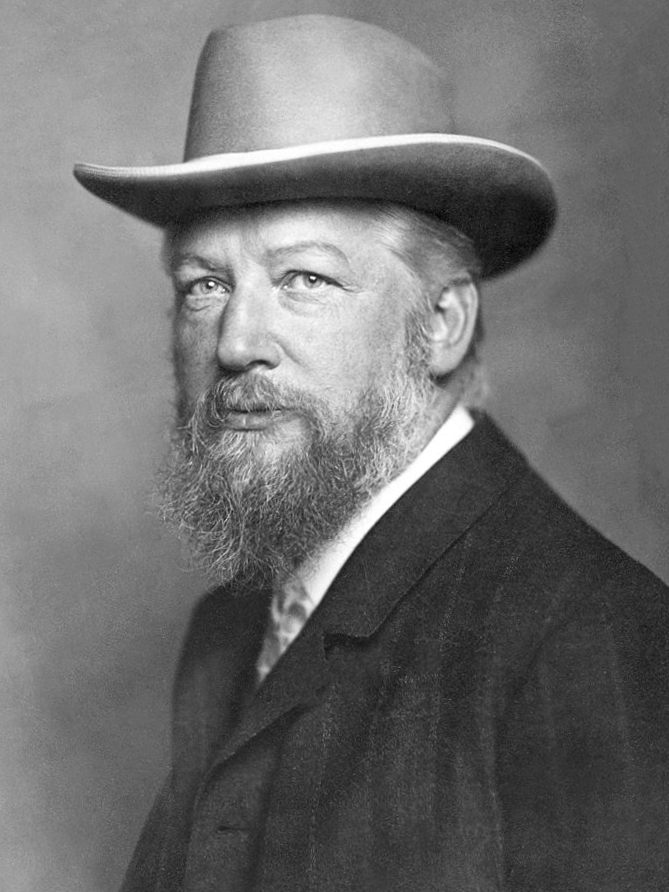
Wilhelm Ostwald
Wilhelm Friedrich Ostwald (German: [ˈvɪlhɛlm ˈɔstvalt] ⓘ; 2 September [O.S. 21 August] 1853 – 4 April 1932) was a Baltic German chemist and philosopher. Ostwald is credited with being one of the founders of the field of physical chemistry, with Jacobus Henricus van 't Hoff, Walther Nernst and Svante Arrhenius. He received the Nobel Prize in Chemistry in 1909 for his scientific contributions to the fields of catalysis, chemical equilibria and reaction velocities.
Following his 1906 retirement from academic life, Ostwald became much involved in philosophy, art, and politics. He made significant contributions to each of these fields. He has been described as a polymath.
Ostwald was born ethnically Baltic German in Riga, Russian Empire (now Latvia) to master-cooper Gottfried Wilhelm Ostwald and Elisabeth Leuckel. He was the middle child of three, born after Eugen and before Gottfried. Ostwald developed an interest in science as a child and conducted experiments at his home, particularly related to fireworks and photography.
Ostwald entered the Imperial University of Dorpat (now the University of Tartu, Estonia) in 1872. He completed his Kandidatenschrift examinations there in 1875. During his time at Dorpat, Ostwald had significant exposure to the humanities, the arts, and philosophy, which became a focus of his endeavors after his 1906 retirement from academia.
Ostwald began his career as an independent unpaid investigator at the University of Dorpat in 1875. He worked in the laboratory of Carl Schmidt, along with his contemporary Johann Lemberg. Lemberg taught Ostwald many of the basics of the analysis of inorganic compounds and measurements of equilibria and chemical reaction rates. Lemberg also taught Ostwald the chemical basis of many geologic phenomena. These endeavors formed part of the subjects of Ostwald's later research efforts. In addition to his work in Carl Schmidt's laboratory, Ostwald also studied in the university's physics institute with Arthur von Oettingen.
Around 1877, still continuing his work as an unpaid investigator in the Chemistry Laboratory at the University of Dorpat, Ostwald became a paid assistant in the Physics Institute, after Oettingen's assistant moved to Riga. He also supported himself for a time by teaching mathematics and science at a Dorpat high school.
Ostwald was deeply interested in questions of chemical affinity and the reactions that formed chemical compounds. This was the central theoretical question facing chemists at the time. As part of his early work, Ostwald developed a three-dimensional affinity table that took into account the effects of temperature as well as the affinity constants of acids and bases. Ostwald also investigated mass action, electrochemistry, and chemical dynamics.
Ostwald completed his Magisterial degree at the University of Dorpat in 1877, enabling him to give lectures and charge for teaching. Ostwald published his doctoral dissertation at the University of Dorpat in 1878, with Carl Schmidt as his thesis advisor. His doctoral thesis was entitled Volumchemische und Optisch-Chemische Studien ("Volumetric and Optical-Chemical Studies"). In 1879, he became a paid assistant to Carl Schmidt.
Hub AI
Wilhelm Ostwald AI simulator
(@Wilhelm Ostwald_simulator)
Wilhelm Ostwald
Wilhelm Friedrich Ostwald (German: [ˈvɪlhɛlm ˈɔstvalt] ⓘ; 2 September [O.S. 21 August] 1853 – 4 April 1932) was a Baltic German chemist and philosopher. Ostwald is credited with being one of the founders of the field of physical chemistry, with Jacobus Henricus van 't Hoff, Walther Nernst and Svante Arrhenius. He received the Nobel Prize in Chemistry in 1909 for his scientific contributions to the fields of catalysis, chemical equilibria and reaction velocities.
Following his 1906 retirement from academic life, Ostwald became much involved in philosophy, art, and politics. He made significant contributions to each of these fields. He has been described as a polymath.
Ostwald was born ethnically Baltic German in Riga, Russian Empire (now Latvia) to master-cooper Gottfried Wilhelm Ostwald and Elisabeth Leuckel. He was the middle child of three, born after Eugen and before Gottfried. Ostwald developed an interest in science as a child and conducted experiments at his home, particularly related to fireworks and photography.
Ostwald entered the Imperial University of Dorpat (now the University of Tartu, Estonia) in 1872. He completed his Kandidatenschrift examinations there in 1875. During his time at Dorpat, Ostwald had significant exposure to the humanities, the arts, and philosophy, which became a focus of his endeavors after his 1906 retirement from academia.
Ostwald began his career as an independent unpaid investigator at the University of Dorpat in 1875. He worked in the laboratory of Carl Schmidt, along with his contemporary Johann Lemberg. Lemberg taught Ostwald many of the basics of the analysis of inorganic compounds and measurements of equilibria and chemical reaction rates. Lemberg also taught Ostwald the chemical basis of many geologic phenomena. These endeavors formed part of the subjects of Ostwald's later research efforts. In addition to his work in Carl Schmidt's laboratory, Ostwald also studied in the university's physics institute with Arthur von Oettingen.
Around 1877, still continuing his work as an unpaid investigator in the Chemistry Laboratory at the University of Dorpat, Ostwald became a paid assistant in the Physics Institute, after Oettingen's assistant moved to Riga. He also supported himself for a time by teaching mathematics and science at a Dorpat high school.
Ostwald was deeply interested in questions of chemical affinity and the reactions that formed chemical compounds. This was the central theoretical question facing chemists at the time. As part of his early work, Ostwald developed a three-dimensional affinity table that took into account the effects of temperature as well as the affinity constants of acids and bases. Ostwald also investigated mass action, electrochemistry, and chemical dynamics.
Ostwald completed his Magisterial degree at the University of Dorpat in 1877, enabling him to give lectures and charge for teaching. Ostwald published his doctoral dissertation at the University of Dorpat in 1878, with Carl Schmidt as his thesis advisor. His doctoral thesis was entitled Volumchemische und Optisch-Chemische Studien ("Volumetric and Optical-Chemical Studies"). In 1879, he became a paid assistant to Carl Schmidt.