



Community hub
Recent from talks
Knowledge base stats:
Talk channels stats:
Members stats:
Artificial insemination
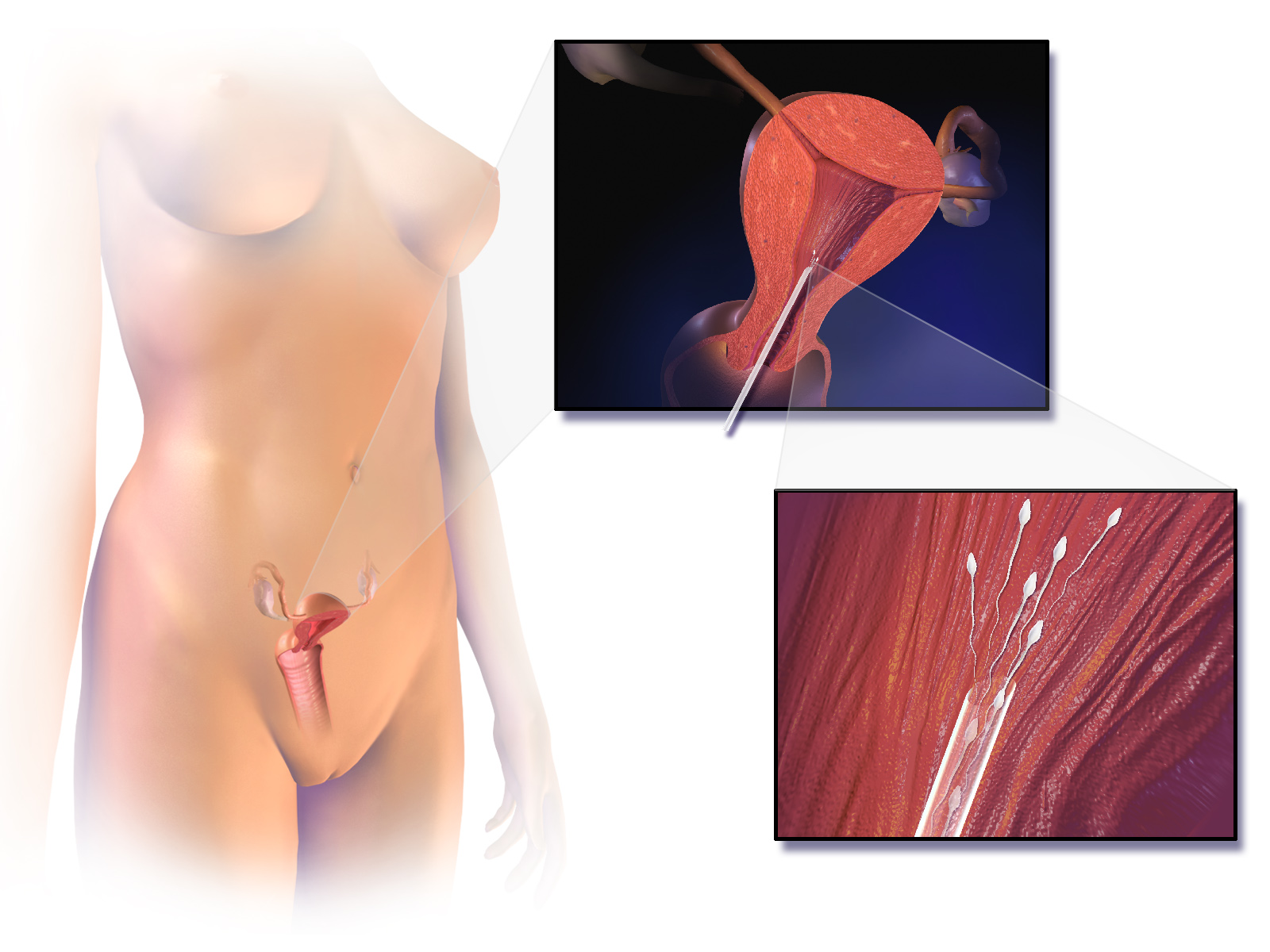
Artificial insemination is the deliberate introduction of sperm into a female's cervix or uterine cavity for the purpose of achieving a pregnancy through in vivo fertilization by means other than sexual intercourse. It is a fertility treatment for humans, and is a common practice in animal breeding, including cattle (see frozen bovine semen) and pigs.
Artificial insemination may employ assisted reproductive technology, sperm donation and animal husbandry techniques. Artificial insemination techniques available include intracervical insemination (ICI) and intrauterine insemination (IUI). Where gametes from a third party are used, the procedure may be known as 'assisted insemination'.
The first recorded case of artificial insemination was John Hunter in 1790, who helped impregnate a linen draper's wife. The first reported case of artificial insemination by donor occurred in 1884: William H. Pancoast, a professor in Philadelphia, took sperm from his "best looking" student to inseminate an anesthetized woman without her knowledge. The case was reported 25 years later in a medical journal. The sperm bank was developed in Iowa starting in the 1950s in research conducted by University of Iowa medical school researchers Jerome K. Sherman and Raymond Bunge.
In the United Kingdom, British obstetrician Mary Barton founded one of the first fertility clinics to offer donor insemination in the 1930s, with her husband Bertold Wiesner fathering hundreds of offspring.
In the 1980s, direct intraperitoneal insemination (DIPI) was occasionally used, where doctors injected sperm into the lower abdomen through a surgical hole or incision, with the intention of letting them find the oocyte at the ovary or after entering the genital tract through the ostium of the fallopian tube.
There are multiple methods used to obtain the semen necessary for artificial insemination, and the sperm used in artificial insemination may be provided by the recipient patient's partner or by a sperm donor whose identity is known or unknown.
Artificial insemination techniques were originally used mainly to assist heterosexual couples to conceive where they were having difficulties, but with the advancement of techniques in this field, notably ICSI, the use of artificial insemination for such couples has largely been rendered unnecessary. However, there are still reasons why a couple would seek to use artificial insemination using the male partner's sperm. In the case of such couples, before artificial insemination is turned to as the solution, doctors will require an examination of both the male and female involved in order to remove any and all physical hindrances that are preventing them from naturally achieving a pregnancy including any factors which prevent the couple from having satisfactory sexual intercourse. The couple is also given a fertility test to determine the motility, number, and viability of the male's sperm and the success of the female's ovulation. From these tests, the doctor may or may not recommend a form of artificial insemination. The results of investigations may, for example, show that the woman's immune system may be rejecting her partner's sperm as invading molecules. Women who have issues with the cervix – such as cervical scarring, cervical blockage from endometriosis, or thick cervical mucus – may also benefit from artificial insemination, since the sperm must pass through the cervix to result in fertilization.
Nowadays artificial insemination in humans is mainly used as a substitute for sexual intercourse for women without a male partner who wish to have their own children—such as women in lesbian relationships and single women — and thus where sperm from a sperm donor is used.
Hub AI
Artificial insemination AI simulator
(@Artificial insemination_simulator)
Artificial insemination
Artificial insemination is the deliberate introduction of sperm into a female's cervix or uterine cavity for the purpose of achieving a pregnancy through in vivo fertilization by means other than sexual intercourse. It is a fertility treatment for humans, and is a common practice in animal breeding, including cattle (see frozen bovine semen) and pigs.
Artificial insemination may employ assisted reproductive technology, sperm donation and animal husbandry techniques. Artificial insemination techniques available include intracervical insemination (ICI) and intrauterine insemination (IUI). Where gametes from a third party are used, the procedure may be known as 'assisted insemination'.
The first recorded case of artificial insemination was John Hunter in 1790, who helped impregnate a linen draper's wife. The first reported case of artificial insemination by donor occurred in 1884: William H. Pancoast, a professor in Philadelphia, took sperm from his "best looking" student to inseminate an anesthetized woman without her knowledge. The case was reported 25 years later in a medical journal. The sperm bank was developed in Iowa starting in the 1950s in research conducted by University of Iowa medical school researchers Jerome K. Sherman and Raymond Bunge.
In the United Kingdom, British obstetrician Mary Barton founded one of the first fertility clinics to offer donor insemination in the 1930s, with her husband Bertold Wiesner fathering hundreds of offspring.
In the 1980s, direct intraperitoneal insemination (DIPI) was occasionally used, where doctors injected sperm into the lower abdomen through a surgical hole or incision, with the intention of letting them find the oocyte at the ovary or after entering the genital tract through the ostium of the fallopian tube.
There are multiple methods used to obtain the semen necessary for artificial insemination, and the sperm used in artificial insemination may be provided by the recipient patient's partner or by a sperm donor whose identity is known or unknown.
Artificial insemination techniques were originally used mainly to assist heterosexual couples to conceive where they were having difficulties, but with the advancement of techniques in this field, notably ICSI, the use of artificial insemination for such couples has largely been rendered unnecessary. However, there are still reasons why a couple would seek to use artificial insemination using the male partner's sperm. In the case of such couples, before artificial insemination is turned to as the solution, doctors will require an examination of both the male and female involved in order to remove any and all physical hindrances that are preventing them from naturally achieving a pregnancy including any factors which prevent the couple from having satisfactory sexual intercourse. The couple is also given a fertility test to determine the motility, number, and viability of the male's sperm and the success of the female's ovulation. From these tests, the doctor may or may not recommend a form of artificial insemination. The results of investigations may, for example, show that the woman's immune system may be rejecting her partner's sperm as invading molecules. Women who have issues with the cervix – such as cervical scarring, cervical blockage from endometriosis, or thick cervical mucus – may also benefit from artificial insemination, since the sperm must pass through the cervix to result in fertilization.
Nowadays artificial insemination in humans is mainly used as a substitute for sexual intercourse for women without a male partner who wish to have their own children—such as women in lesbian relationships and single women — and thus where sperm from a sperm donor is used.