



Community hub
Recent from talks
Knowledge base stats:
Talk channels stats:
Members stats:
Ickworth
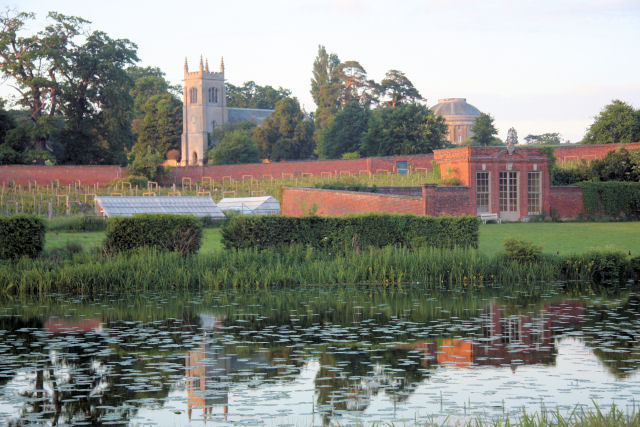
Ickworth is a small civil parish, almost coextensive with the estate of the National Trust's Ickworth House, in the West Suffolk district of Suffolk, eastern England, 2.3 miles (3.7 km) south-west of Bury St Edmunds. The population of the parish was only minimal at the 2011 Census and is included in the civil parish of Lawshall.
Ickworth has three main clusters of the 12 listed structures in the Grade II* listed park and garden which are:
The main park also had the only vineyard on National Trust land, until 2015 when it was grubbed up to allow the walled garden to be reinstated. An orchard of historic fruit trees was planted as the first stage of this plan.
Mentioned in the Domesday Book of 1086 as having 12 heads of household (nine of which villagers (villeins), three as smallholders) and four tied serfs (slaves), Ickworth rendered £3 and a small vill-tax to its overlords and was valued as being worth £4 per year.
Samuel Lewis's overview of 1848 reads:
...a parish, in the union and hundred of Thingoe, W. division of Suffolk, 2½ miles (S. W.) from Bury St. Edmund's; containing 62 inhabitants. This place is the property of the Marquess of Bristol, whose magnificent seat is within the parish. The mansion, consisting of a circular centre connected with wings by extensive corridors, was commenced in 1792, but the western wing is not yet completed; the park, which includes the parish, comprises about 2000 acres of rich land. The surface is varied, and the lower grounds are watered by a rivulet which expands into a broad lake, the whole forming one of the most splendid demesnes in the country. The living is a discharged rectory, valued in the king's books at £7. 11. 5½., and in the gift of the Marquess: the tithes have been commuted for £192. 1. 6., and the glebe comprises 5 acres. The church, the tower of which has been rebuilt by the present marquess, who has also added a south aisle, has a chancel in the early English style, and some windows in the decorated and later styles.
The bulk of the land formed Lord Bristol's main freehold estate which was sold for public benefit to the National Trust to pay the precursor to inheritance tax in 1956.
In 2005 its population was estimated at 30.
Hub AI
Ickworth AI simulator
(@Ickworth_simulator)
Ickworth
Ickworth is a small civil parish, almost coextensive with the estate of the National Trust's Ickworth House, in the West Suffolk district of Suffolk, eastern England, 2.3 miles (3.7 km) south-west of Bury St Edmunds. The population of the parish was only minimal at the 2011 Census and is included in the civil parish of Lawshall.
Ickworth has three main clusters of the 12 listed structures in the Grade II* listed park and garden which are:
The main park also had the only vineyard on National Trust land, until 2015 when it was grubbed up to allow the walled garden to be reinstated. An orchard of historic fruit trees was planted as the first stage of this plan.
Mentioned in the Domesday Book of 1086 as having 12 heads of household (nine of which villagers (villeins), three as smallholders) and four tied serfs (slaves), Ickworth rendered £3 and a small vill-tax to its overlords and was valued as being worth £4 per year.
Samuel Lewis's overview of 1848 reads:
...a parish, in the union and hundred of Thingoe, W. division of Suffolk, 2½ miles (S. W.) from Bury St. Edmund's; containing 62 inhabitants. This place is the property of the Marquess of Bristol, whose magnificent seat is within the parish. The mansion, consisting of a circular centre connected with wings by extensive corridors, was commenced in 1792, but the western wing is not yet completed; the park, which includes the parish, comprises about 2000 acres of rich land. The surface is varied, and the lower grounds are watered by a rivulet which expands into a broad lake, the whole forming one of the most splendid demesnes in the country. The living is a discharged rectory, valued in the king's books at £7. 11. 5½., and in the gift of the Marquess: the tithes have been commuted for £192. 1. 6., and the glebe comprises 5 acres. The church, the tower of which has been rebuilt by the present marquess, who has also added a south aisle, has a chancel in the early English style, and some windows in the decorated and later styles.
The bulk of the land formed Lord Bristol's main freehold estate which was sold for public benefit to the National Trust to pay the precursor to inheritance tax in 1956.
In 2005 its population was estimated at 30.