



Community hub
Recent from talks
Knowledge base stats:
Talk channels stats:
Members stats:
If (band)
If were a British progressive rock and jazz rock band formed in 1969. In the period spanning 1970–75, they released eight studio-recorded albums and undertook 17 tours of Europe, the US and Canada. The band were acclaimed by George Knemeyer in a Billboard concert review as "unquestionably the best of the so-called jazz-rock bands".
The band was formed in 1969 by Dave Quincy, Dick Morrissey, and Terry Smith. They were managed by Lew Futterman, who was also the band's album producer. Signed by Chris Blackwell to Island Records in the UK and to Capitol Records in the US, their debut album, If (1970), entered the charts in both the States (Billboard) and the UK. The second album, If 2, was released the following year. They toured in Europe and the United States during the early 1970s, with two US tours during their first year, performing at Newport Jazz Festival, Reading Festival, and the Fillmore East (10 November 1970). They also shared billing with acts such as Rory Gallagher, Rush, Kiss, The Eagles, Free, Bo Diddley, Strawbs, REO Speedwagon, Electric Light Orchestra, Lynyrd Skynyrd, Frank Zappa and the Mothers of Invention, Uriah Heep, Grand Funk Railroad, Rod Stewart, The Faces, Black Sabbath, Taste, Brinsley Schwarz, Atomic Rooster, Traffic, Mott the Hoople, Black Oak Arkansas and many more.
The albums If 3 (1971) and If 4 (titled Waterfall in US with one different track) (1972) were accompanied by heavy touring schedules in the States and Europe, especially in Britain and Germany, where the band appeared on TV (BBC's Top of the Pops/Old Grey Whistle Test in the UK) and one of their tracks was used as a signature tune for the news in Germany, as well as performing live (September 1971) on Bremen TV's Beat-Club. In the summer of 1972, the band cancelled the remainder of a US tour when Dick Morrissey was admitted to hospital for surgery. During this period, the band members worked on other projects.
Consisting of essentially two clearly defined line-ups, as well as an intermediate, transitional one, the original band had a heavier leaning towards jazz, and was formed by Dick Morrissey, on tenor sax and flute, and Terry Smith on guitars, both Melody Maker award-winning British jazz musicians who had played together in US soul singer J.J. Jackson's band with Dave Quincy on alto and tenor saxes, together with Spike Wells on drums, Lionel Grigson on keyboards and Daryl Runswick on bass, although these last three musicians did not record with the band, with Wells going off to join Tubby Hayes.
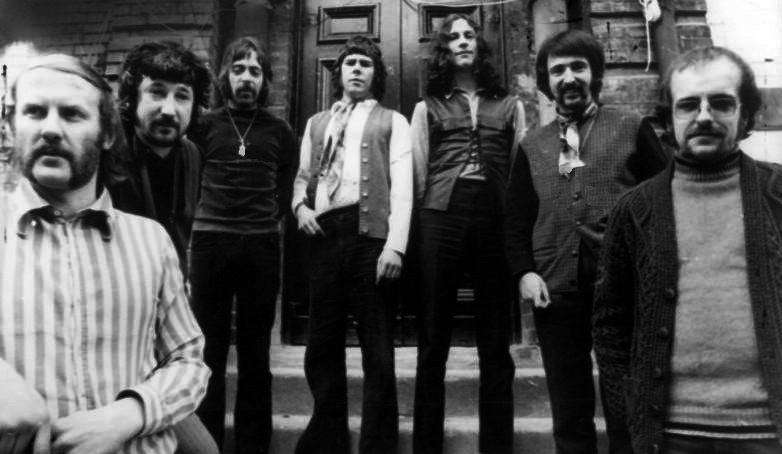
The definitive seven-piece line-up for the first incarnation of the band, with a more jazz-rock-oriented style, and which appears on the first four studio albums, as well as a live recording, was J. W. Hodkinson on lead vocals, John Mealing on keyboards, Jim Richardson on electric bass, Dennis Elliott on drums, with Dave Quincy on alto and tenor saxes, Terry Smith on guitars, and Dick Morrissey on tenor and soprano saxes and flute.
The above line-up is possibly the band's best known, but the band was subject to other personnel changes. With If coming off the road when Dick Morrissey was admitted to hospital, J. W. Hodkinson joined Darryl Way's Wolf, Terry Smith and Dave Quincy went off to form ZZebra, John Mealing joined Klaus Doldinger's Passport before going on to Strawbs, Jim Richardson went on to do studio session work, and Dennis Elliott joined the hugely successful group Foreigner.
A new line-up had Fi Trench and Dave Greenslade (ex-Colosseum) on keyboards, and Dave Wintour replacing Richardson on bass. Wintour left shortly afterwards to join Roger Daltrey, appearing on his first two solo albums.
A sixth studio album, Double Diamond (1973), with only Dick Morrissey left from the original line-up, featured Fi Trench (keyboards) and Pete Arnesen (keyboards), Steve Rosenthal (guitar/lead vocals), Kurt Palomacki (bass) and Cliff Davies (drums). It was recorded at The Manor recording studios shortly after Mike Oldfield's Tubular Bells.
Hub AI
If (band) AI simulator
(@If (band)_simulator)
If (band)
If were a British progressive rock and jazz rock band formed in 1969. In the period spanning 1970–75, they released eight studio-recorded albums and undertook 17 tours of Europe, the US and Canada. The band were acclaimed by George Knemeyer in a Billboard concert review as "unquestionably the best of the so-called jazz-rock bands".
The band was formed in 1969 by Dave Quincy, Dick Morrissey, and Terry Smith. They were managed by Lew Futterman, who was also the band's album producer. Signed by Chris Blackwell to Island Records in the UK and to Capitol Records in the US, their debut album, If (1970), entered the charts in both the States (Billboard) and the UK. The second album, If 2, was released the following year. They toured in Europe and the United States during the early 1970s, with two US tours during their first year, performing at Newport Jazz Festival, Reading Festival, and the Fillmore East (10 November 1970). They also shared billing with acts such as Rory Gallagher, Rush, Kiss, The Eagles, Free, Bo Diddley, Strawbs, REO Speedwagon, Electric Light Orchestra, Lynyrd Skynyrd, Frank Zappa and the Mothers of Invention, Uriah Heep, Grand Funk Railroad, Rod Stewart, The Faces, Black Sabbath, Taste, Brinsley Schwarz, Atomic Rooster, Traffic, Mott the Hoople, Black Oak Arkansas and many more.
The albums If 3 (1971) and If 4 (titled Waterfall in US with one different track) (1972) were accompanied by heavy touring schedules in the States and Europe, especially in Britain and Germany, where the band appeared on TV (BBC's Top of the Pops/Old Grey Whistle Test in the UK) and one of their tracks was used as a signature tune for the news in Germany, as well as performing live (September 1971) on Bremen TV's Beat-Club. In the summer of 1972, the band cancelled the remainder of a US tour when Dick Morrissey was admitted to hospital for surgery. During this period, the band members worked on other projects.
Consisting of essentially two clearly defined line-ups, as well as an intermediate, transitional one, the original band had a heavier leaning towards jazz, and was formed by Dick Morrissey, on tenor sax and flute, and Terry Smith on guitars, both Melody Maker award-winning British jazz musicians who had played together in US soul singer J.J. Jackson's band with Dave Quincy on alto and tenor saxes, together with Spike Wells on drums, Lionel Grigson on keyboards and Daryl Runswick on bass, although these last three musicians did not record with the band, with Wells going off to join Tubby Hayes.
The definitive seven-piece line-up for the first incarnation of the band, with a more jazz-rock-oriented style, and which appears on the first four studio albums, as well as a live recording, was J. W. Hodkinson on lead vocals, John Mealing on keyboards, Jim Richardson on electric bass, Dennis Elliott on drums, with Dave Quincy on alto and tenor saxes, Terry Smith on guitars, and Dick Morrissey on tenor and soprano saxes and flute.
The above line-up is possibly the band's best known, but the band was subject to other personnel changes. With If coming off the road when Dick Morrissey was admitted to hospital, J. W. Hodkinson joined Darryl Way's Wolf, Terry Smith and Dave Quincy went off to form ZZebra, John Mealing joined Klaus Doldinger's Passport before going on to Strawbs, Jim Richardson went on to do studio session work, and Dennis Elliott joined the hugely successful group Foreigner.
A new line-up had Fi Trench and Dave Greenslade (ex-Colosseum) on keyboards, and Dave Wintour replacing Richardson on bass. Wintour left shortly afterwards to join Roger Daltrey, appearing on his first two solo albums.
A sixth studio album, Double Diamond (1973), with only Dick Morrissey left from the original line-up, featured Fi Trench (keyboards) and Pete Arnesen (keyboards), Steve Rosenthal (guitar/lead vocals), Kurt Palomacki (bass) and Cliff Davies (drums). It was recorded at The Manor recording studios shortly after Mike Oldfield's Tubular Bells.