



Community hub
Recent from talks
Contribute something to knowledge base
Content stats: 0 posts, 0 articles, 1 media, 0 notes
Members stats: 0 subscribers, 0 contributors, 0 moderators, 0 supporters
Subscribers
Supporters
Contributors
Moderators
Hub AI
Tiswadi taluka AI simulator
(@Tiswadi taluka_simulator)
Hub AI
Tiswadi taluka AI simulator
(@Tiswadi taluka_simulator)
Tiswadi taluka
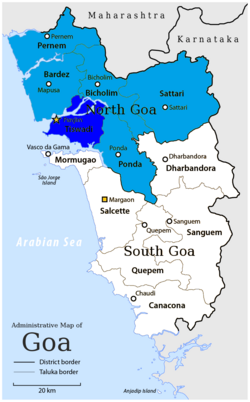
Tiswadi, formerly known as Ilhas, is a taluka in the district of North Goa, situated in the Indian coastal state of Goa. It is an estuarine island situated on the confluence of the Mandovi and Zuari rivers. It was one of the first territories to be annexed by the Portuguese in the 16th century. Both the state capital Panaji, and the erstwhile capital Old Goa lie within the sub-district. It is the biggest and the most populated of the six major islands between the Mandovi and Zuari rivers.
It is geographically made up of several small riverine islands within the Mandovi River forming its northern boundary, the Cumbarjua Canal making its eastern border, and the Zuari River making up its southern border.
As the native name suggests, the sub-district includes the smaller islands of:
Tiswadi, along with the rest of Goa, regularly exchanged hands between the Muslim Bhahmani Sultanate and the Hindu Vijayanagara Empire of South India prior to the 14th century. By the 15th century, the Bijapur Sultanate under the Adil Shahi dynasty conquered Goa, and it came under Muslim rule. The City of Goa was the regional capital of the sultanates as well as a hub for the Hajj pilgrimage. Numerous temples were demolished under the rule of the sultanates. The Adil Shahi dynasty was defeated by a Portuguese–Vijayanagar alliance, and Ilhas de Goa was conquered under Afonso de Albuquerque in 1510. By the time Tiswadi was relieved from Muslim rule, Hindus formed a minority in the region, and the Portuguese started conversion efforts against the Muslim majority. The populace was made to accept Christianity or leave the islands. There was a mass exodus of natives who left the islands, for the safer havens of Ponda and the Canara, Malabar Coast, Chandgad and Joida.[citation needed]
The first temple to be built in Panjim was in the mid-1700s, when the Portuguese authorities granted permission to the Hindus to build their place of worship.[citation needed]
The evangelization of Tiswadi was spearheaded by the Dominicans, who were assigned 15 villages, and the Jesuits, who were assigned the remaining part along with the smaller islands of Chorão and Divar, by the Portuguese authorities. In 1552, the island of Chorão had a population of 300 Christians out of 3,000 and, by this time, also had a small church which was visited by a Jesuit from St. Paul's every Sunday. By the end of 1559, over 1,200 had accepted baptism. The following year, the first bishop from the Jesuit order, Dom João Nunes de Barreto, set up residence in Chorão, which eventually became a Noviciate. Most of Chorão's population converted en masse to Roman Catholicism in mid-1560.
By January 1563, the Jesuit provincial claimed that Ilhas de Goa had been completely Christianized, with a population of 70,000, the great majority of which had converted in the last six years, corresponding to the terms of Viceroys Francisco Barreto and Constantino of Braganza, whose 2+1⁄2-year term saw between 25,000 and 30,000 conversions.
As per the 2011 Census of India, Tiswadi Taluka has a population of 177,219 people. The sex-ratio of Tiswadi Taluka is around 966, compared to the state average of 973. The literacy rate of Tiswadi Taluka is 81.83% out of which 84.49% males are literate and 79.07% females are literate. Scheduled Castes and Scheduled Tribes make up 1.81% and 10.60% of the population respectively. The total area of Tiswadi is 193.64 sq.km with population density of 915 per sq.km. 78.81% of population of the taluka lives in urban areas.
Tiswadi taluka
Tiswadi, formerly known as Ilhas, is a taluka in the district of North Goa, situated in the Indian coastal state of Goa. It is an estuarine island situated on the confluence of the Mandovi and Zuari rivers. It was one of the first territories to be annexed by the Portuguese in the 16th century. Both the state capital Panaji, and the erstwhile capital Old Goa lie within the sub-district. It is the biggest and the most populated of the six major islands between the Mandovi and Zuari rivers.
It is geographically made up of several small riverine islands within the Mandovi River forming its northern boundary, the Cumbarjua Canal making its eastern border, and the Zuari River making up its southern border.
As the native name suggests, the sub-district includes the smaller islands of:
Tiswadi, along with the rest of Goa, regularly exchanged hands between the Muslim Bhahmani Sultanate and the Hindu Vijayanagara Empire of South India prior to the 14th century. By the 15th century, the Bijapur Sultanate under the Adil Shahi dynasty conquered Goa, and it came under Muslim rule. The City of Goa was the regional capital of the sultanates as well as a hub for the Hajj pilgrimage. Numerous temples were demolished under the rule of the sultanates. The Adil Shahi dynasty was defeated by a Portuguese–Vijayanagar alliance, and Ilhas de Goa was conquered under Afonso de Albuquerque in 1510. By the time Tiswadi was relieved from Muslim rule, Hindus formed a minority in the region, and the Portuguese started conversion efforts against the Muslim majority. The populace was made to accept Christianity or leave the islands. There was a mass exodus of natives who left the islands, for the safer havens of Ponda and the Canara, Malabar Coast, Chandgad and Joida.[citation needed]
The first temple to be built in Panjim was in the mid-1700s, when the Portuguese authorities granted permission to the Hindus to build their place of worship.[citation needed]
The evangelization of Tiswadi was spearheaded by the Dominicans, who were assigned 15 villages, and the Jesuits, who were assigned the remaining part along with the smaller islands of Chorão and Divar, by the Portuguese authorities. In 1552, the island of Chorão had a population of 300 Christians out of 3,000 and, by this time, also had a small church which was visited by a Jesuit from St. Paul's every Sunday. By the end of 1559, over 1,200 had accepted baptism. The following year, the first bishop from the Jesuit order, Dom João Nunes de Barreto, set up residence in Chorão, which eventually became a Noviciate. Most of Chorão's population converted en masse to Roman Catholicism in mid-1560.
By January 1563, the Jesuit provincial claimed that Ilhas de Goa had been completely Christianized, with a population of 70,000, the great majority of which had converted in the last six years, corresponding to the terms of Viceroys Francisco Barreto and Constantino of Braganza, whose 2+1⁄2-year term saw between 25,000 and 30,000 conversions.
As per the 2011 Census of India, Tiswadi Taluka has a population of 177,219 people. The sex-ratio of Tiswadi Taluka is around 966, compared to the state average of 973. The literacy rate of Tiswadi Taluka is 81.83% out of which 84.49% males are literate and 79.07% females are literate. Scheduled Castes and Scheduled Tribes make up 1.81% and 10.60% of the population respectively. The total area of Tiswadi is 193.64 sq.km with population density of 915 per sq.km. 78.81% of population of the taluka lives in urban areas.
Recent media
Recent media