
Recent from talks
Shoulder impingement syndrome
Knowledge base stats:
Talk channels stats:
Members stats:
Shoulder impingement syndrome
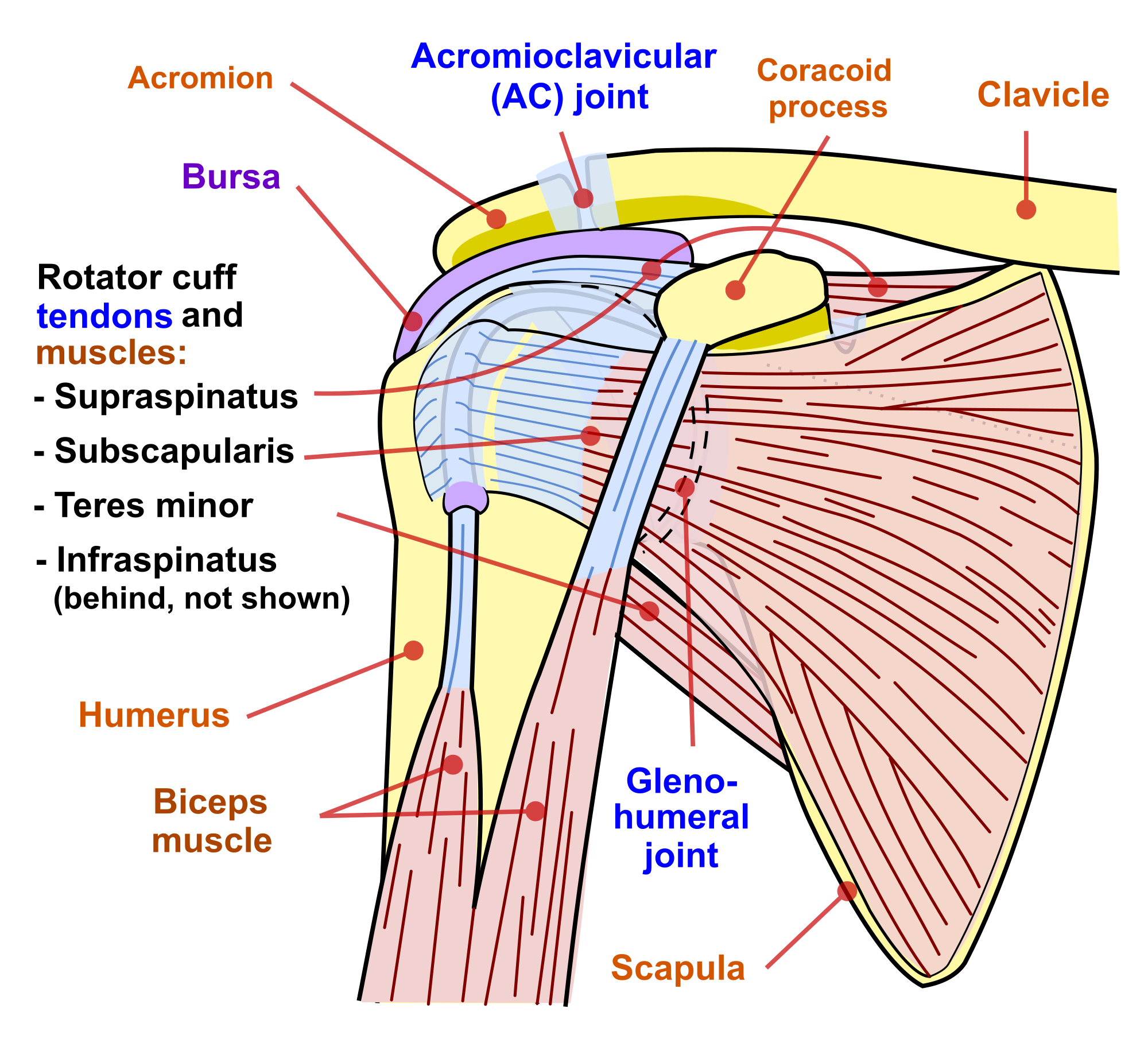
Shoulder impingement syndrome is a syndrome involving tendonitis (inflammation of tendons) of the rotator cuff muscles as they pass through the subacromial space, the passage beneath the acromion. It is particularly associated with tendonitis of the supraspinatus muscle. This can result in pain, weakness, and loss of movement at the shoulder.
The most common symptoms in impingement syndrome are pain, weakness and a loss of movement at the affected shoulder. The pain is often worsened by shoulder overhead movement and may occur at night, especially when lying on the affected shoulder. The onset of the pain may be acute if due to an injury or insidious if due to a gradual process such as an osteoarthritic spur. The pain has been described as dull rather than sharp, and lingers for long periods of time, making it hard to fall asleep. Other symptoms can include a grinding or popping sensation during movement of the shoulder.
The range of motion at the shoulder may be limited by pain. A painful arc of movement may be present during forward elevation of the arm from 60° to 120°. Passive movement at the shoulder will appear painful when a downward force is applied at the acromion but the pain will ease once the force is removed.
When the arm is raised, the subacromial space (gap between the anterior edge of the acromion and the head of the humerus) narrows; the supraspinatus muscle tendon passes through this space. Anything that causes further narrowing has the tendency to impinge the tendon and cause an inflammatory response, resulting in impingement syndrome. Such causes can be bony structures such as subacromial spurs (bony projections from the acromion), osteoarthritic spurs on the acromioclavicular joint, and variations in the shape of the acromion. Thickening or calcification of the coracoacromial ligament can also cause impingement. Loss of function of the rotator cuff muscles, due to injury or loss of strength, may cause the humerus to move superiorly, resulting in impingement. Inflammation and subsequent thickening of the subacromial bursa may also cause impingement.
Weight training exercises where the arms are elevated above shoulder height but in an internally rotated position such as the upright row have been suggested as a cause of subacromial impingement. Another common cause of Impingement syndrome is restrictions in the range movement of the scapulo-thoracic surfaces. Commonly, one or more ribs between rib 2 and rib 7/8 on the side of the impingement may jut out slightly and/or feel hard when the person springs on it or them. When this occurs, the scapula is raised and anteverted (angled forwards). This in turn pushes the acromion and the humeral head out of its usual anatomical position placing pressure downwards at the head of the humerus at the position of the nerve thus causing the impingement syndrome. This is visibly demonstrated by a slightly raised and protracted shoulder girdle. Note: the humerus anteverts in this position causing a more protrusive section of the humerus to press upwards towards the acromion. Sleeping with the arm in the overhead position can cause shoulder impingement and may account for shoulder symptoms in those ordinarily not considered to be at risk. This position begins in infancy and continues throughout one’s life. Since we are unconscious at night, this is rarely recognized as a cause of shoulder impingement. Impingement (pinching) of the rotator cuff tendon every night causes injury to the cells of the rotator cuff tendon and some cells may die. Over time, very few cells may be left to hold the rotator cuff together resulting in a complete tear of this tendon with minimal trauma. When the cells die, the contents of the cell are released locally. Some of these contents are chemicals that are toxic to the surrounding tissues (nociceptive). This may cause spasm and pain in the adjacent muscle of the rotator cuff, the supraspinatus muscle. This shoulder muscle is between the shoulder and the base of the neck and is a likely cause of common chronic neck pain. This can easily be treated by keeping the arm down at one’s side at night, and not overhead.
The scapula plays an important role in shoulder impingement syndrome. It is a wide, flat bone lying on the posterior thoracic wall that provides an attachment for three different groups of muscles. The intrinsic muscles of the scapula include the muscles of the rotator cuff- the subscapularis, infraspinatus, teres minor and supraspinatus. These muscles attach to the surface of the scapula and are responsible for the internal and external rotation of the glenohumeral joint, along with humeral abduction. The extrinsic muscles include the biceps, triceps, and deltoid muscles and attach to the coracoid process and supraglenoid tubercle of the scapula, infraglenoid tubercle of the scapula, and spine of the scapula. These muscles are responsible for several actions of the glenohumeral joint. The third group, which is mainly responsible for stabilization and rotation of the scapula, consists of the trapezius, serratus anterior, levator scapulae, and rhomboid muscles and attach to the medial, superior, and inferior borders of the scapula. Each of these muscles has its own role in shoulder function and must be in balance with the others in order to avoid shoulder pathology.
The combined movement of glenohumeral joint and scapulothoracic joint is called as scapulohumeral rhythm. During shoulder elevation two-third of movement occurs at glenohumeral joint and one-third at scapulothoracic. This coupling movements maintain glenoid fossa.
Abnormal scapular function is called scapular dyskinesis. One action the scapula performs during a throwing or serving motion is elevation of the acromion process in order to avoid impingement of the rotator cuff tendons. If the scapula fails to properly elevate the acromion, impingement may occur during the cocking and acceleration phase of an overhead activity. The two muscles most commonly inhibited during this first part of an overhead motion are the serratus anterior and the lower trapezius. These two muscles act as a force couple within the glenohumeral joint to properly elevate the acromion process, and if a muscle imbalance exists, shoulder impingement may develop.
Hub AI
Shoulder impingement syndrome AI simulator
(@Shoulder impingement syndrome_simulator)
Shoulder impingement syndrome
Shoulder impingement syndrome is a syndrome involving tendonitis (inflammation of tendons) of the rotator cuff muscles as they pass through the subacromial space, the passage beneath the acromion. It is particularly associated with tendonitis of the supraspinatus muscle. This can result in pain, weakness, and loss of movement at the shoulder.
The most common symptoms in impingement syndrome are pain, weakness and a loss of movement at the affected shoulder. The pain is often worsened by shoulder overhead movement and may occur at night, especially when lying on the affected shoulder. The onset of the pain may be acute if due to an injury or insidious if due to a gradual process such as an osteoarthritic spur. The pain has been described as dull rather than sharp, and lingers for long periods of time, making it hard to fall asleep. Other symptoms can include a grinding or popping sensation during movement of the shoulder.
The range of motion at the shoulder may be limited by pain. A painful arc of movement may be present during forward elevation of the arm from 60° to 120°. Passive movement at the shoulder will appear painful when a downward force is applied at the acromion but the pain will ease once the force is removed.
When the arm is raised, the subacromial space (gap between the anterior edge of the acromion and the head of the humerus) narrows; the supraspinatus muscle tendon passes through this space. Anything that causes further narrowing has the tendency to impinge the tendon and cause an inflammatory response, resulting in impingement syndrome. Such causes can be bony structures such as subacromial spurs (bony projections from the acromion), osteoarthritic spurs on the acromioclavicular joint, and variations in the shape of the acromion. Thickening or calcification of the coracoacromial ligament can also cause impingement. Loss of function of the rotator cuff muscles, due to injury or loss of strength, may cause the humerus to move superiorly, resulting in impingement. Inflammation and subsequent thickening of the subacromial bursa may also cause impingement.
Weight training exercises where the arms are elevated above shoulder height but in an internally rotated position such as the upright row have been suggested as a cause of subacromial impingement. Another common cause of Impingement syndrome is restrictions in the range movement of the scapulo-thoracic surfaces. Commonly, one or more ribs between rib 2 and rib 7/8 on the side of the impingement may jut out slightly and/or feel hard when the person springs on it or them. When this occurs, the scapula is raised and anteverted (angled forwards). This in turn pushes the acromion and the humeral head out of its usual anatomical position placing pressure downwards at the head of the humerus at the position of the nerve thus causing the impingement syndrome. This is visibly demonstrated by a slightly raised and protracted shoulder girdle. Note: the humerus anteverts in this position causing a more protrusive section of the humerus to press upwards towards the acromion. Sleeping with the arm in the overhead position can cause shoulder impingement and may account for shoulder symptoms in those ordinarily not considered to be at risk. This position begins in infancy and continues throughout one’s life. Since we are unconscious at night, this is rarely recognized as a cause of shoulder impingement. Impingement (pinching) of the rotator cuff tendon every night causes injury to the cells of the rotator cuff tendon and some cells may die. Over time, very few cells may be left to hold the rotator cuff together resulting in a complete tear of this tendon with minimal trauma. When the cells die, the contents of the cell are released locally. Some of these contents are chemicals that are toxic to the surrounding tissues (nociceptive). This may cause spasm and pain in the adjacent muscle of the rotator cuff, the supraspinatus muscle. This shoulder muscle is between the shoulder and the base of the neck and is a likely cause of common chronic neck pain. This can easily be treated by keeping the arm down at one’s side at night, and not overhead.
The scapula plays an important role in shoulder impingement syndrome. It is a wide, flat bone lying on the posterior thoracic wall that provides an attachment for three different groups of muscles. The intrinsic muscles of the scapula include the muscles of the rotator cuff- the subscapularis, infraspinatus, teres minor and supraspinatus. These muscles attach to the surface of the scapula and are responsible for the internal and external rotation of the glenohumeral joint, along with humeral abduction. The extrinsic muscles include the biceps, triceps, and deltoid muscles and attach to the coracoid process and supraglenoid tubercle of the scapula, infraglenoid tubercle of the scapula, and spine of the scapula. These muscles are responsible for several actions of the glenohumeral joint. The third group, which is mainly responsible for stabilization and rotation of the scapula, consists of the trapezius, serratus anterior, levator scapulae, and rhomboid muscles and attach to the medial, superior, and inferior borders of the scapula. Each of these muscles has its own role in shoulder function and must be in balance with the others in order to avoid shoulder pathology.
The combined movement of glenohumeral joint and scapulothoracic joint is called as scapulohumeral rhythm. During shoulder elevation two-third of movement occurs at glenohumeral joint and one-third at scapulothoracic. This coupling movements maintain glenoid fossa.
Abnormal scapular function is called scapular dyskinesis. One action the scapula performs during a throwing or serving motion is elevation of the acromion process in order to avoid impingement of the rotator cuff tendons. If the scapula fails to properly elevate the acromion, impingement may occur during the cocking and acceleration phase of an overhead activity. The two muscles most commonly inhibited during this first part of an overhead motion are the serratus anterior and the lower trapezius. These two muscles act as a force couple within the glenohumeral joint to properly elevate the acromion process, and if a muscle imbalance exists, shoulder impingement may develop.
Recent media