Hubbry Logo
TricepsTricepsMain
Open search
Triceps
Community hub
Triceps
logo
8 pages, 0 posts
0 subscribers
Be the first to start a discussion here.
Triceps
Triceps
from Wikipedia
Not found
Revisions and contributorsEdit on WikipediaRead on Wikipedia
from Grokipedia
The triceps brachii is a large, muscle located in the posterior compartment of the upper arm, consisting of three distinct heads that primarily function to extend the elbow joint, enabling essential movements such as pushing and straightening the arm. Composed of the long, lateral, and medial heads, it originates from the and before converging into a single that inserts on the process of the , making it the chief antagonist to the biceps brachii in forearm flexion. This muscle plays a critical role in strength and stability, supporting activities like on the hands and wrists, as well as dynamic actions in sports and daily tasks. Structurally, the long head arises from the of the , crossing both the and joints, while the lateral head originates from the posterior surface of the superior to the , and the medial head from the inferior aspect of the groove along the posterior . These heads unite distally to form the triceps , which not only attaches to the but also blends with the antebrachial via expansions, contributing to overall arm stability. The muscle is innervated by the (roots C6–C8), which provides motor supply to all three heads, and receives its blood supply primarily from branches of the profunda brachii artery, ensuring robust during contraction. In terms of function, all heads of the triceps brachii contribute to extension, with the long head additionally facilitating adduction and extension of the at the , particularly in a third-class system where is applied between the axis and load. The lateral and medial heads are more active during extension with the in neutral positions, whereas the long head predominates at higher elevations, optimizing distribution across varying postures. Clinically, the triceps is susceptible to tendon avulsions or strains from forceful extensions, such as in or falls, highlighting its importance in rehabilitation and surgical interventions like triceps repairs.

Anatomy

Gross structure

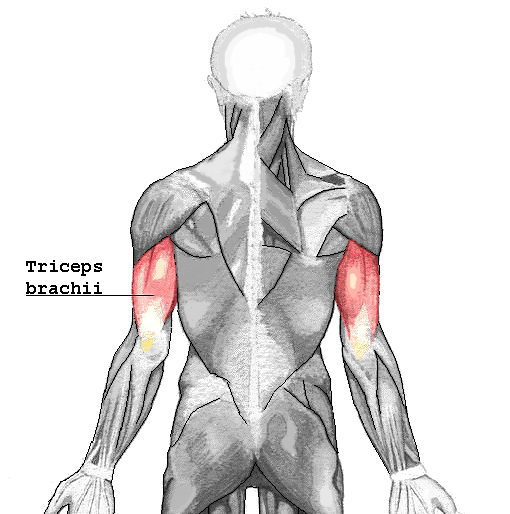
The triceps brachii is a large, thick muscle located on the posterior aspect of the upper arm, forming the primary muscle of the posterior compartment. It exhibits a characteristic horseshoe shape when viewed from the back and consists of three distinct heads: the long head, lateral head, and medial head. The long head originates from the of the , allowing it to cross both the and joints. The lateral head arises from the posterior surface of the , specifically the region superior to the . The medial head originates from the posterior inferior to the , as well as from the medial intermuscular septum. The three heads converge distally, blending into a single, broad tendon that inserts onto the posterior surface of the olecranon process of the ulna, with additional attachments to the elbow joint capsule and antebrachial fascia. This muscle covers the posterior surface of the humerus throughout its course. It lies deep to the deltoid muscle proximally, while the long head forms the inferior and medial boundary of the triangular interval, which is bounded superiorly by the teres major and laterally by the humerus. In adults, the triceps brachii extends along the length of the upper arm, typically spanning 25–35 cm from the glenoid region to the , with an average muscle volume of approximately 450–475 cm³ and a of around 40–60 cm², varying by age, sex, and measurement technique.

Innervation

The triceps brachii muscle receives its primary motor innervation from the , a branch of the of the derived from spinal roots C6, C7, and C8. This nerve supplies motor fibers to all three heads of the muscle—the long, lateral, and medial heads—enabling coordinated extension of the . The radial nerve's pathway to the triceps begins as it exits the posterior to the and enters the posterior compartment of the through the , bounded by the long head of the triceps medially, the teres major superiorly, and the laterally. It then descends in the on the posterior aspect of the , accompanied by the profunda brachii artery, where it pierces the groove between the lateral and medial heads of the triceps. From this position, the nerve pierces the lateral intermuscular septum approximately midway down the to transition into the anterior compartment, but not before issuing its key branches to the triceps. Specific branches arise along this course: the long and lateral heads receive proximal innervation from branches emanating between the long and medial heads, often in the upper arm or region, while the medial head is innervated distally by a branch given off directly in the . These entry points ensure distributed across the muscle's origins and insertions. Additionally, the provides minor proprioceptive sensory feedback to the triceps brachii through afferent fibers within these branches, contributing to and signaling for position sense and tension regulation.

Blood supply

The arterial supply to the triceps brachii muscle is primarily derived from the profunda brachii artery (also known as the deep brachial artery), the largest branch of the brachial artery, which originates proximally in the arm and courses posteriorly between the long and medial heads of the triceps. This artery travels distally along the radial groove of the humerus, accompanying the radial nerve, and emits muscular branches that perfuse the lateral and medial heads via its terminal divisions: the middle collateral artery (supplying the medial head) and the radial collateral artery (supplying the lateral head). The long head receives its primary arterial supply from the posterior circumflex humeral artery, a branch of the axillary artery that passes through the quadrangular space to reach the posterior shoulder region. Additional contributions to the medial head come from the superior ulnar collateral artery, which arises from the distal brachial artery and descends posteriorly with the ulnar nerve. Venous drainage of the triceps brachii parallels the arterial supply, with venae comitantes accompanying the profunda brachii artery and converging into the , which ultimately empty into the at the superior border of the . Lymphatic drainage from the triceps brachii occurs through deep lymphatic vessels that follow the course of the accompanying veins and arteries, directing lymph toward the for filtration before returning to the systemic circulation.

Anatomical variations

The triceps brachii muscle typically consists of three heads—long, lateral, and medial—with distinct origins from the of the , the posterior , and the intermuscular and , respectively. Deviations from this standard configuration occur infrequently, primarily involving accessory muscular heads or alterations in head positioning, as documented in cadaveric dissections. One common variation is the presence of a fourth (accessory) head, which arises superficial to the medial head and often originates from the or via a tendinous attachment before merging with the common triceps . This accessory head has been reported in multiple cadaveric cases, highlighting its rarity but potential relevance during surgical approaches to the posterior . Another frequent structural deviation involves the medial head, where it may extend distally as a low-lying muscle belly or tendon, inserting closer to the than typical. Studies indicate a high of this variant, with cadaveric findings in small samples reporting approximately 60% for low-lying muscle bellies and 100% for low-lying tendons, and MRI in individuals suggesting up to 92% for low-lying tendons. Fusion between heads is uncommon, though occasional interconnections or shared tendinous expansions among the long, lateral, and medial heads have been noted in dissections, potentially altering the muscle's biomechanical profile without reported clinical sequelae. Rare anomalies of the triceps brachii include supernumerary tendons or osseous inclusions within the common . For instance, a tricipital embedded in the triceps near its insertion has been observed in approximately 0.05% of cadavers (1 in 1940 cases), representing a sesamoid variant that may influence mechanics. Reports of complete absence of any head, such as the medial head, are exceedingly scarce and typically associated with traumatic rupture rather than congenital malformation, with no well-documented in population-based studies. Unusual insertions, such as extensions to the , remain anecdotal and unverified in large-scale cadaveric analyses. These variations arise embryologically from the differentiation of paraxial mesoderm into somites during the third to fifth weeks of , where myotomal cells migrate into the upper limb bud to form the posterior compartment musculature. Disruptions in this somite-derived migration or condensation along the limb's central axis can lead to accessory formations or positional shifts, as seen in the fourth head variant, which reflects incomplete regression of primitive muscular condensations. Cadaveric data for such structural anomalies remain limited, with most insights derived from small-series dissections emphasizing their infrequency in the general (e.g., accessory heads in fewer than 5 reported cases across reviews).

Function

Primary movements

The triceps brachii muscle is the primary extensor of the elbow joint, facilitating the straightening of the from a flexed position. This action occurs at the humeroulnar and humeroradial articulations, where the muscle's contraction generates force to overcome resistance and extend the . As the chief antagonist to the biceps brachii, which drives elbow flexion, the triceps ensures balanced reciprocal motion during activities. Due to the biarticular origin of its long head from the of the , the triceps brachii also performs secondary actions at the , including adduction and extension of the . These contributions are most pronounced when the is elevated or abducted, as the long head's tension increases across both joints. The lateral and medial heads, originating solely on the , focus predominantly on elbow extension without direct shoulder involvement. The three heads contribute differentially based on shoulder position, with the long head more active during initial phases of extension at elevated shoulder angles and the medial head dominating beyond 90 degrees of . In coordination with the , the triceps brachii completes full elbow extension and maintains joint stability, particularly by compressing the against the to prevent lateral deviations. This synergy enhances the muscle's role in stabilizing the during dynamic pushing actions, where sustained extension force is required. Kinematically, the elbow exhibits a normal range of motion from 0 degrees (full extension) to 140-150 degrees of flexion, allowing the triceps to operate across this arc. Torque generation by the triceps peaks during extension in the mid-range, typically around 90 degrees of flexion, with maximum values reaching approximately 30 Nm in healthy adults.

Biomechanical role

The triceps brachii muscle contributes significantly to arm through its moment arms and leverage during joint movements. The long head exhibits the longest moment arm for extension due to its biarticular origin on the infraglenoid tubercle of the , enabling greater torque production at the glenohumeral joint compared to the lateral and medial heads, which are monoarticular at the . This leverage is most pronounced when the is flexed, with the long head's extension moment arm increasing from approximately 1.5 cm at 0° flexion to over 2.0 cm at 90° flexion. During extension, the triceps generates force vectors that primarily oppose flexion, producing peak extension moment arms of about 2.5 cm in the initial 40° of motion, facilitating efficient power transfer along the posterior arm. The muscle's synergies enhance overall stability and force production in compound actions. In overhead presses, the long head of the triceps synergizes with the latissimus dorsi to stabilize the and contribute to extension and adduction, optimizing force distribution across the during vertical pushing. Similarly, during dynamic activities like , the triceps provides elbow stability by countering decelerative forces, working in concert with stabilizers to prevent subluxation and maintain control. These interactions underscore the triceps' role in integrating elbow and mechanics for coordinated propulsion. As a biarticular muscle, the long head's tension spans both the and joints, influencing efficiency in compound movements. This cross-joint arrangement lengthens the long head more during overhead positions, enhancing its active insufficiency at the but improving overall for multi-joint tasks like pressing or reaching. In contrast, the lateral and medial heads provide consistent extension without involvement, balancing the system's leverage. Quantitative electromyographic (EMG) studies reveal distinct activation patterns, with the medial head showing the highest EMG activity during isometric holds at 90° flexion, reflecting its role in sustained force maintenance.

Training

Key exercises

Key exercises for developing the triceps brachii target extension, emphasizing the muscle's three heads through and isolation movements. Primary exercises engage the triceps alongside other upper body muscles, while isolation exercises focus primarily on the triceps for targeted and strength gains. Triceps dips, performed bodyweight or with assistance, are a fundamental exercise that effectively activates all three triceps heads. To execute, mount a parallel bar with hands shoulder-width apart, arms fully extended, and shoulders aligned over the hands; lower the body in a controlled descent by bending the s until they reach a 90-degree angle, keeping elbows tracking back and tucked close to the body while maintaining shoulders down to avoid excessive shrugging, then press back to full extension (lockout) while maintaining a straight torso to minimize shoulder involvement. Prioritize full range of motion without pain, ensuring a proper warm-up beforehand and gradual progression to build strength safely. This full from 90-degree flexion to lockout maximizes triceps engagement, with electromyographic (EMG) studies showing high activation comparable to other top exercises. Assisted variations use machines or bands to reduce bodyweight load for beginners, allowing ; those new to the exercise may start with bench dips. The close-grip bench press, a barbell variation, shifts emphasis from the chest to the triceps by narrowing the hand placement to approximately shoulder-width or closer. Lie on a bench, grip the with hands 8-12 inches apart, unrack it over the chest, and lower it toward the lower by flexing the elbows; press upward to full arm extension without flaring the elbows outward. Some EMG studies indicate greater triceps brachii activation with narrow grips compared to wide grips in certain populations, while others find no significant difference; it reduces involvement relative to wider grips. For isolation, overhead triceps extensions using dumbbells or cables target the long head of the triceps by stretching it under load. Stand or sit with the weight held overhead by both hands (bilateral) or one hand (unilateral), elbows pointed upward and close to the head; extend the elbows to lower the weight behind the head, then fully straighten the arms without allowing flexion. Research demonstrates substantially greater triceps hypertrophy from overhead positions versus neutral arm orientations, due to enhanced long head recruitment. Avoid shoulder compensation by keeping elbows fixed and torso stable throughout the movement. Skull crushers, also known as lying triceps extensions, isolate the triceps using a , EZ-bar, or dumbbells while on a bench. Hold the weight above the with arms extended, elbows tucked; flex the elbows to lower the weight toward the or just beyond, then extend to the starting position. This exercise effectively targets the medial and lateral heads, with studies supporting its use for balanced triceps development when combined with other presses. Unilateral variations with dumbbells address asymmetries. Variations include unilateral executions for all exercises to correct imbalances and equipment-free options like diamond push-ups, where hands form a diamond shape under the chest during a , yielding high triceps EMG activation akin to dips. These adaptations allow bilateral or unilateral training based on equipment availability and fitness level, maintaining focus on controlled extension mechanics.

Training principles

Effective training of the triceps brachii follows evidence-based principles of resistance training and frequency to optimize and strength gains. For most individuals, incorporating 2-3 sessions per week targeting the triceps, with a total weekly of 10-20 sets per muscle group, has been shown to elicit superior muscle growth compared to lower volumes, particularly when distributed across multiple sessions. This approach aligns with meta-analytic findings indicating that volumes exceeding 10 sets per muscle group per week promote greater , a recommendation confirmed by recent as of 2024. Repetition ranges of 8-12 per set are recommended for , as they balance mechanical tension and metabolic stress on the muscle fibers. Progression is essential for continued adaptation and should employ by gradually increasing resistance, repetitions, or sets to challenge the muscle beyond previous capacities. For beginners, linear —starting with foundational loads and steadily ramping up over 4-8 weeks—facilitates safe and effective gains without overwhelming recovery demands. More advanced trainees may benefit from undulating or block to vary intensity and volume, preventing plateaus and . These methods ensure sustained improvements in triceps strength and size by progressively taxing the muscle's force-velocity capabilities. Training the triceps should include considerations for muscular balance and recovery to maintain joint health and performance. Pairing triceps work with antagonist exercises promotes symmetrical arm development. Post-training plays a critical role in recovery, with protein of 20-40 grams within 1-2 hours after exercise supporting muscle protein synthesis and repair processes. Adequate consumption alongside protein replenishes stores, further aiding recovery. To further support recovery and relieve post-workout soreness in the triceps, static stretching is recommended as part of a cooldown routine. One effective stretch is the overhead triceps stretch: raise one arm overhead, bend the elbow to bring the hand toward the upper back, and use the opposite hand to gently pull the elbow back and down toward the body; hold for 20-30 seconds and repeat 2-3 times per side. Another option is the cross-body triceps stretch: extend the arm down and across the body, using the opposite hand to pull the wrist or elbow further across; hold for 20-30 seconds, performing 2-3 sets per side. These stretches enhance flexibility, improve blood flow, and reduce muscle tension and delayed onset muscle soreness following triceps training. Modifications for special populations ensure accessibility and specificity. Beginners should use lighter loads (50-70% of ) with higher repetitions (12-15) and fewer sets (1-2 per exercise) to build technique and confidence while minimizing injury risk. For athletes, incorporating explosive variants—like ballistic push-ups or throws—can enhance power output in the triceps, aligning with sport-specific demands for rapid force production during extension movements. These adjustments tailor the principles to individual needs without compromising foundational guidelines.

Clinical significance

Common injuries

The triceps brachii is susceptible to several common injuries, primarily tendon ruptures and muscle strains, which can impair extension and function. Triceps ruptures, the most notable injury type, typically occur at the distal insertion on the and account for approximately 1-2% of all injuries. These ruptures are often complete but can be partial, and they are more prevalent among weightlifters during activities like bench pressing or in individuals experiencing falls onto an outstretched hand, leading to hyperextension and eccentric loading of the . Symptoms include acute in the posterior or upper , immediate weakness in extension, swelling, ecchymosis, and sometimes a palpable defect at the insertion site. Epidemiologically, these ruptures have an incidence of about 1.1 per 100,000 person-years in the general , with higher rates among males over 40 years old and athletes in contact sports or strength training.30369-2/pdf) Triceps strains, involving partial tears (graded 1-3) in the muscle belly or myotendinous , are another frequent , particularly from overuse in repetitive extension motions. These occur acutely from sudden trauma, such as hyperextension during falls, or chronically through repetitive stress in like , throwing, or . Symptoms manifest as localized pain along the posterior arm, tenderness to , swelling, and reduced strength during resisted extension, with severity correlating to the tear grade. Strains are more common in athletes engaging in overhead or explosive arm activities, though specific incidence data is limited compared to ruptures; risk is elevated in males over 40 and those in contact or power .

Diagnosis and treatment

Diagnosis of triceps tendon injuries typically begins with a thorough clinical examination, where a high index of suspicion is crucial due to the rarity of these injuries. Key physical findings include or inability to extend the against resistance, particularly in a flexed position, and a palpable gap at the insertion in cases of complete rupture. Radiographic imaging, such as plain X-rays, may reveal an avulsion flake sign indicative of detachment from the . Advanced imaging is essential for confirming the extent of . (MRI) serves as the gold standard for differentiating partial from full-thickness tears and assessing retraction or associated muscle involvement. provides a dynamic, non-invasive of integrity and is particularly useful for detecting partial tears or fluid collections. If nerve involvement, such as radial or , is suspected due to associated weakness or sensory changes, (EMG) can help localize and characterize the neuropathy. Conservative management is the initial approach for partial triceps tendon tears or tendinopathies with preserved strength. The RICE protocol—rest, ice, compression, and elevation—is employed to reduce swelling and pain, often combined with nonsteroidal anti-inflammatory drugs (NSAIDs) for symptomatic relief. Immobilization in a long-arm splint or brace with the at 90 degrees for 4-6 weeks supports healing, followed by focused on progressive range-of-motion exercises and eccentric strengthening to restore function. For triceps tendinopathy specifically, training requires caution, with consultation of a doctor or physical therapist recommended first to ensure a personalized plan. Efforts should prioritize rehabilitation over heavy lifting and be limited to pain-free ranges (0-3/10 pain maximum). A phased rehabilitation protocol is advised, such as the 12-week progression model outlined by E3 Rehab. In weeks 1-2/4, relative rest from aggravating activities is advised, along with light presses if painless, ice application for 15-20 minutes post-training, transverse massage at the tendon insertion, and warm-ups including arm circles, band pull-aparts, or light cardio. Isometric exercises should be started immediately, for example, triceps isometric holds with the arm at 90 degrees pressing against a wall or hand for 10-30 seconds repeated 5-10 times, 2-3 times per day, or pushdown holds for 20-45 seconds repeated 5-8 times, ensuring pain levels remain ≤3/10. Progression then involves slow eccentrics, such as 3-6 second lowering phases in extensions for 3-4 sets of 10-20 reps using light weights or bodyweight, 2-4 times per week with rest days, advancing slowly only if pain-free for 1-2 weeks. Heavy slow resistance training with 3-5 second phases can follow in tolerated exercises like pushdowns, incorporating neutral grip movements to target other triceps heads. Post-workout care includes icing, use of an elbow sleeve for support, and correction of form in compound exercises to prevent aggravation. Exercises to avoid include dips, skull crushers, heavy overhead extensions, deep or full-range push-ups, and heavy close-grip bench or presses, as these may exacerbate symptoms. Recommended exercises include: 1. Rope cable pushdowns using a high pulley with elbows pinned, extending and flaring the rope with light weights and high reps (10-20 reps, 3 sets). 2. Dumbbell kickbacks by hinging at the hips with upper arm parallel to the ground, extending and squeezing without swinging (10-15 reps, 3 sets). 3. Overhead dumbbell extensions only if pain-free, performed seated or standing by slowly lowering one light dumbbell with two hands behind the head without lockout (10-15 reps, 3 sets). 4. Modified diamond push-ups with hands in a diamond position under the chest, using knees or an incline if needed, with slow lowering and no full lockout (10-15 reps, 3 sets). Post-workout triceps stretches, such as the overhead towel stretch, should be added for flexibility. Bracing may be continued for partial tears to offload the tendon during daily activities, with conservative treatment generally effective if symptoms improve within 3 months. Surgical intervention is indicated for complete ruptures, significant partial tears (>50% thickness) with functional deficit, or failed conservative management. Primary repair involves reattachment of the to the using suture anchors or a suture bridge technique, ideally performed within 3 weeks of injury for optimal outcomes. For chronic ruptures or irreparable tears with substantial retraction, reconstruction using autografts (e.g., Achilles or ) or allografts may be necessary. Postoperatively, the is immobilized in extension for 6-12 weeks to protect the repair, followed by a structured rehabilitation program emphasizing gradual strengthening and return to activity at 3-6 months. Surgical repairs of distal triceps tendon ruptures yield favorable outcomes, with approximately 92% of patients returning to preinjury levels of function and near-normal strength (4/5 or better on manual muscle testing). Complications occur in about 14% of cases, including , irritation, and re-rupture rates ranging from 0-7%, though reoperation is required in up to 13% due to hardware issues or persistent .

History and etymology

Etymology

The term "triceps" derives from the Latin triceps, meaning "three-headed," a compound of tri- (three) and caput (head). This nomenclature highlights the muscle's three distinct origins or heads, which converge into a single tendon. The full anatomical name, triceps brachii, incorporates brachii, the genitive form of brachium (arm), to denote its position on the posterior aspect of the upper arm. This naming convention emerged in the context of anatomy, where 16th-century scholars like described the muscle's tripartite structure as three separate components that "mingle" toward the elbow, laying the groundwork for later standardized terminology. The term triceps brachii first appears in Latin anatomical texts in the early , such as in James Douglas's 1729 work, though English usage dates to around 1676. It linguistically parallels the biceps brachii ("two-headed muscle of the arm"), emphasizing the numerical distinction in head count based on observable morphology.

Historical development

The study of the arm's extensor musculature began in antiquity with the Roman physician Galen in the 2nd century AD, who described muscles in the upper arm responsible for extending the forearm in his texts on human anatomy, such as On the Usefulness of the Parts of the Body. These early observations, based primarily on animal dissections with some human cadaver studies, established the role of posterior arm muscles in counteracting flexion, though without specific identification of the triceps brachii. Galen's reliance on non-human models for some details laid foundational concepts in Roman medical literature for posterior arm extension. During the , significant progress occurred with ' De Humani Corporis Fabrica (), which provided the first accurate illustrations and descriptions of the triceps brachii's three distinct heads. Vesalius depicted the long, lateral, and medial heads as separate origins converging into a unified tendon inserting on the , highlighting their inseparable mingling in humans to facilitate extension; he corrected prior inaccuracies by basing his account on direct human dissections. This work revolutionized anatomical accuracy, portraying the triceps in dynamic figures that showcased its horseshoe shape and functional unity. The brought refinements through systematic dissections, as seen in Henry Gray's Anatomy: Descriptive and Surgical (), which offered detailed accounts of the triceps brachii's origins, insertions, and variations. Gray described the long head arising from the of the , the lateral head from the posterior above the , and the medial head from below it, while noting common anatomical variations such as accessory heads or altered tendon insertions in a subset of individuals. His , illustrated with precise engravings from studies, standardized the muscle's and contributed to its integration into . In the , (EMG) studies from the advanced understanding of the triceps' innervation and activation patterns, confirming primary supply by the (C6-C8) across all heads and revealing differential contributions during elbow extension. Pioneering EMG research, including work by John V. Basmajian, demonstrated silent periods in the medial head during certain movements and coordinated firing of the heads influenced by shoulder position, which informed surgical techniques for triceps repairs and elbow reconstructions by highlighting functional synergies. These findings shifted focus from static to dynamic , underpinning modern orthopedic interventions.

Comparative anatomy

In humans

The triceps brachii in humans consists of three heads, with the long head originating from the of the , crossing both the and joints. Sexual dimorphism is pronounced, with males possessing approximately 75-78% more arm muscle mass overall, including the triceps brachii, which correlates with enhanced upper body strength advantageous for activities like and physical . Developmentally, the triceps brachii arises from the of the bud during the fifth week of , with dorsal muscle mass condensing to form the three heads. By week 8, the basic architecture is established, including innervation by the (C6-C8), which penetrates the muscle to supply all heads and enable coordinated extension. Human-specific overuse from repetitive activities, such as throwing in sports or , predisposes the triceps to injuries, with distal ruptures accounting for about 1% of all injuries but rising in active populations due to eccentric loading. These injuries often manifest as partial or at the insertion.

In other animals

In quadrupedal mammals such as dogs, the triceps brachii muscle typically comprises four heads—long, lateral, medial, and accessory—with the lateral head being particularly well-developed to facilitate extension and weight-bearing during locomotion. This configuration supports the demands of terrestrial quadrupedal , where the forelimbs bear significant body weight and propel the animal forward. In felids like cats, the triceps brachii also features four heads, but exhibits adaptations for enhanced , including a higher proportion of fast-twitch fibers in the lateral and long heads to enable powerful extensions during climbing and pouncing maneuvers. In birds, the triceps brachii is notably reduced and restructured as part of the pectoral musculature to prioritize flight control over propulsion, consisting primarily of two distinct parts: the scapulotriceps and humeral triceps, which modulate wing shape through limited extension and flexion during aerial maneuvers. These components operate over smaller strain ranges (12–23%) compared to mammalian counterparts, reflecting their role in fine-tuned adjustments rather than forceful extension. Reptiles, such as , possess a triceps brachii homologous to that in tetrapods, serving elbow extension for terrestrial movement, but often with three heads (lateral, long, and medial) in species like the , enabling robust support in predatory and burrowing behaviors. In basal vertebrates including , the triceps homolog—derived from fin ray extensors like the abductor profundus—is simpler, typically a single-headed or undifferentiated muscle mass that facilitates fin in aquatic environments. Evolutionarily, the triceps structure traces from rudimentary fin extensors in sarcopterygian fish to more complex multi-headed forms in tetrapods, with progressive differentiation and increased head complexity observed across lineages, peaking in where the three-headed configuration (contrasting the four heads in many quadrupeds) optimizes bipedal arm function. This trend reflects adaptations to diverse locomotor demands, from aquatic undulation to terrestrial limb support.

References

Add your contribution
Related Hubs
User Avatar
No comments yet.