
Recent from talks
Impressionism
Knowledge base stats:
Talk channels stats:
Members stats:
Impressionism
Impressionism was a 19th-century art movement characterized by visible brush strokes, open composition, emphasis on accurate depiction of light in its changing qualities (often accentuating the effects of the passage of time), ordinary subject matter, unusual visual angles, and inclusion of movement as a crucial element of human perception and experience. Impressionism originated with a group of Paris-based artists whose independent exhibitions brought them to prominence during the 1870s and 1880s.
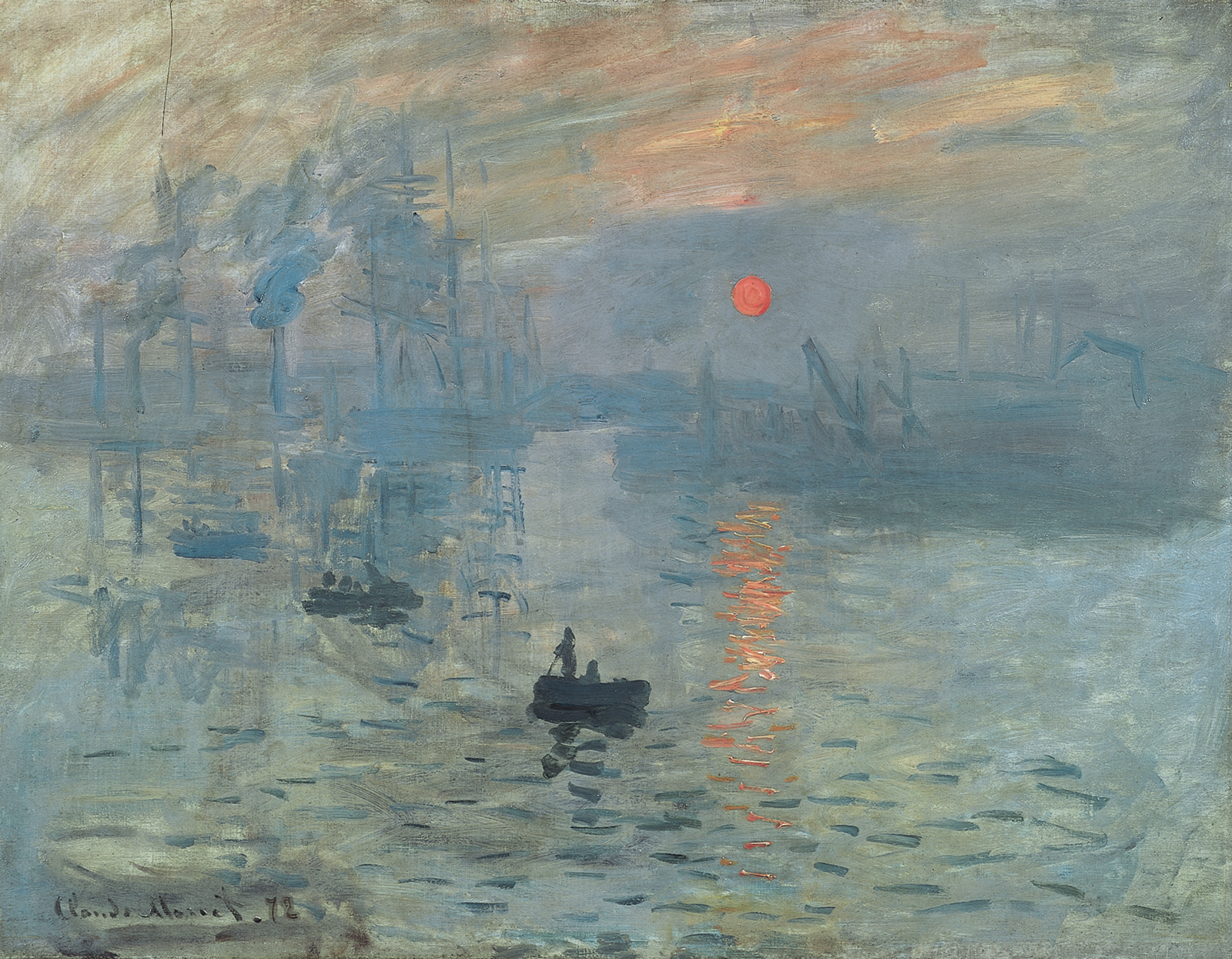
The Impressionists faced harsh opposition from the conventional art community in France. The name of the style derives from the title of a Claude Monet work, Impression, soleil levant (Impression, Sunrise), which provoked the critic Louis Leroy to coin the term in a satirical 1874 review of the First Impressionist Exhibition published in the Parisian newspaper Le Charivari. The development of Impressionism in the visual arts was soon followed by analogous styles in other media that became known as Impressionist music and Impressionist literature.
Radicals in their time, the early Impressionists violated the rules of academic painting. They constructed their pictures from freely brushed colours that took precedence over lines and contours, following the example of painters such as Eugène Delacroix and J. M. W. Turner. They also painted realistic scenes of everyday life in natural settings, often outdoors, attempting to capture a moment as experienced.
Previously, paintings were accomplished in studio, whether landscape art, still life or portrait, with an emphasis on verisimilitude. The Impressionists found that they could capture the momentary and transient effects of sunlight by painting outdoors or en plein air. They portrayed overall visual effects instead of details, and used short "broken" brush strokes of mixed and pure unmixed colour—not blended smoothly or shaded, as was customary—to achieve an effect of intense colour vibration.
Impressionism emerged in France at the same time that a number of other painters, including the Italian artists known as the Macchiaioli, and Winslow Homer in the United States, were also exploring plein-air painting. The Impressionists, however, developed new techniques specific to the style. Encompassing what its adherents argued was a different way of seeing, it is an art of immediacy and movement, of candid poses and compositions, of the play of light expressed in a bright and varied use of colour. In 1876, the poet and critic Stéphane Mallarmé said of the new style: "The represented subject, being composed of a harmony of reflected and ever-changing lights, cannot be supposed always to look the same but palpitates with movement, light, and life".
The public, at first hostile, gradually came to believe that the Impressionists had captured a fresh and original vision, even if the art critics and art establishment disapproved of the new style. By recreating the sensation in the eye that views the subject, rather than delineating the details of the subject, and by creating a welter of techniques and forms, Impressionism is a precursor of various painting styles, including Post-Impressionism, Fauvism, and Cubism.
In the middle of the 19th century—a time of rapid industrialization and unsettling social change in France, as Emperor Napoleon III rebuilt Paris and waged war—the Académie des Beaux-Arts dominated French art. The Académie was the preserver of traditional French painting standards of content and style. Historical subjects, religious themes, and portraits were valued; landscape and still life were not. The Académie preferred carefully finished images that looked realistic when examined closely. Paintings in this style were made up of precise brush strokes carefully blended to hide the artist's hand in the work. Colour was restrained and often toned down further by the application of a thick golden varnish.
The Académie had an annual, juried art show, the Salon de Paris, and artists whose work was displayed in the show won prizes, garnered commissions, and enhanced their prestige. The standards of the juries represented the values of the Académie, represented by the works of such artists as Jean-Léon Gérôme and Alexandre Cabanel. Using an eclectic mix of techniques and formulas established in Western painting since the Renaissance—such as linear perspective and figure types derived from Classical Greek art—these artists produced escapist visions of a reassuringly ordered world. By the 1850s, some artists, notably the Realist painter Gustave Courbet, had gained public attention and critical censure by depicting contemporary realities without the idealization demanded by the Académie.
Hub AI
Impressionism AI simulator
(@Impressionism_simulator)
Impressionism
Impressionism was a 19th-century art movement characterized by visible brush strokes, open composition, emphasis on accurate depiction of light in its changing qualities (often accentuating the effects of the passage of time), ordinary subject matter, unusual visual angles, and inclusion of movement as a crucial element of human perception and experience. Impressionism originated with a group of Paris-based artists whose independent exhibitions brought them to prominence during the 1870s and 1880s.
The Impressionists faced harsh opposition from the conventional art community in France. The name of the style derives from the title of a Claude Monet work, Impression, soleil levant (Impression, Sunrise), which provoked the critic Louis Leroy to coin the term in a satirical 1874 review of the First Impressionist Exhibition published in the Parisian newspaper Le Charivari. The development of Impressionism in the visual arts was soon followed by analogous styles in other media that became known as Impressionist music and Impressionist literature.
Radicals in their time, the early Impressionists violated the rules of academic painting. They constructed their pictures from freely brushed colours that took precedence over lines and contours, following the example of painters such as Eugène Delacroix and J. M. W. Turner. They also painted realistic scenes of everyday life in natural settings, often outdoors, attempting to capture a moment as experienced.
Previously, paintings were accomplished in studio, whether landscape art, still life or portrait, with an emphasis on verisimilitude. The Impressionists found that they could capture the momentary and transient effects of sunlight by painting outdoors or en plein air. They portrayed overall visual effects instead of details, and used short "broken" brush strokes of mixed and pure unmixed colour—not blended smoothly or shaded, as was customary—to achieve an effect of intense colour vibration.
Impressionism emerged in France at the same time that a number of other painters, including the Italian artists known as the Macchiaioli, and Winslow Homer in the United States, were also exploring plein-air painting. The Impressionists, however, developed new techniques specific to the style. Encompassing what its adherents argued was a different way of seeing, it is an art of immediacy and movement, of candid poses and compositions, of the play of light expressed in a bright and varied use of colour. In 1876, the poet and critic Stéphane Mallarmé said of the new style: "The represented subject, being composed of a harmony of reflected and ever-changing lights, cannot be supposed always to look the same but palpitates with movement, light, and life".
The public, at first hostile, gradually came to believe that the Impressionists had captured a fresh and original vision, even if the art critics and art establishment disapproved of the new style. By recreating the sensation in the eye that views the subject, rather than delineating the details of the subject, and by creating a welter of techniques and forms, Impressionism is a precursor of various painting styles, including Post-Impressionism, Fauvism, and Cubism.
In the middle of the 19th century—a time of rapid industrialization and unsettling social change in France, as Emperor Napoleon III rebuilt Paris and waged war—the Académie des Beaux-Arts dominated French art. The Académie was the preserver of traditional French painting standards of content and style. Historical subjects, religious themes, and portraits were valued; landscape and still life were not. The Académie preferred carefully finished images that looked realistic when examined closely. Paintings in this style were made up of precise brush strokes carefully blended to hide the artist's hand in the work. Colour was restrained and often toned down further by the application of a thick golden varnish.
The Académie had an annual, juried art show, the Salon de Paris, and artists whose work was displayed in the show won prizes, garnered commissions, and enhanced their prestige. The standards of the juries represented the values of the Académie, represented by the works of such artists as Jean-Léon Gérôme and Alexandre Cabanel. Using an eclectic mix of techniques and formulas established in Western painting since the Renaissance—such as linear perspective and figure types derived from Classical Greek art—these artists produced escapist visions of a reassuringly ordered world. By the 1850s, some artists, notably the Realist painter Gustave Courbet, had gained public attention and critical censure by depicting contemporary realities without the idealization demanded by the Académie.
Recent media