



Community hub
Recent from talks
Knowledge base stats:
Talk channels stats:
Members stats:
Inchworm motor
An inchworm motor is a cooperative linear actuator system in which multiple elements (originally piezoelectric, later often electrostatic) are activated in a coordinated sequence of step-wise motions, enabling extended motion range relative to individual actuators and high-precision positioning.
Inchworm motors originated in the 1960s as multi-actuator mechanisms for high-precision positioning. Driven by advances in micromachining and microfabrication, designs shifted in the 1990s toward electrostatic microactuators, employing coordinated step sequences to achieve precise, linear motion beyond the limits of single actuator elements.
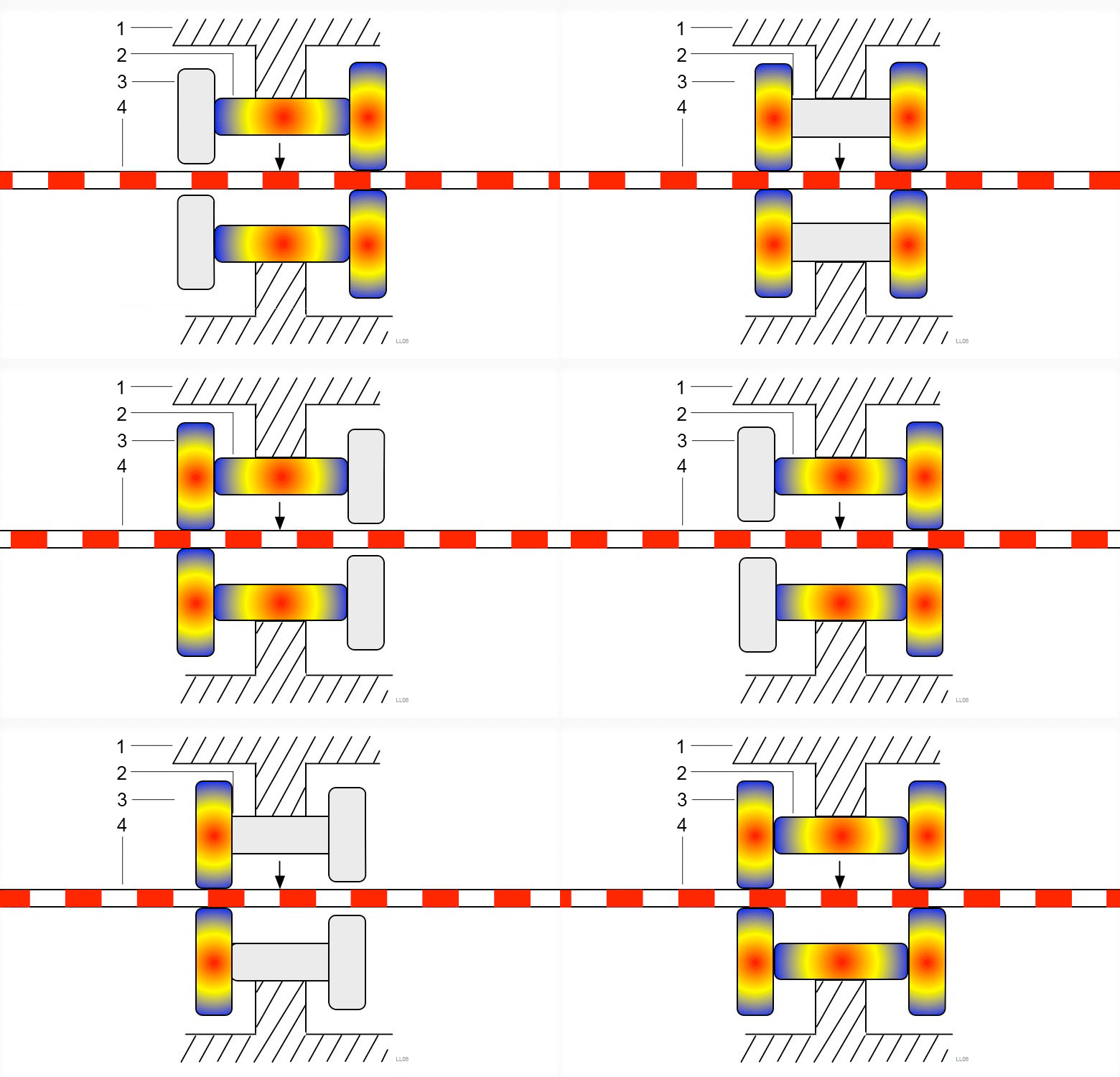
In its simplest form, the inchworm motor uses three piezo-actuators (2 and 3, see Figure 1.) mounted inside a tube (1) and electrified in sequence to grip a shaft (4) which is then moved in a linear direction. Motion of the shaft is due to the extension of the lateral piezo (2) pushing on two clutching piezos (3).
The actuation process of the inchworm motor is a six-step cyclical process after the initial relaxation and initialization phase. Initially, all three piezos are relaxed and unextended. To initialize the inchworm motor the clutching piezo closest to the direction of desired motion (which then becomes the forward clutch piezo) is electrified first then the six-step cycle begins as follows (see Figure 2.):
Step 1. Extension of the lateral piezo.
Step 2. Extension of the aft clutch piezo.
Step 3. Relaxation of the forward clutch piezo.
Step 4. Relaxation of the lateral piezo.
Hub AI
Inchworm motor AI simulator
(@Inchworm motor_simulator)
Inchworm motor
An inchworm motor is a cooperative linear actuator system in which multiple elements (originally piezoelectric, later often electrostatic) are activated in a coordinated sequence of step-wise motions, enabling extended motion range relative to individual actuators and high-precision positioning.
Inchworm motors originated in the 1960s as multi-actuator mechanisms for high-precision positioning. Driven by advances in micromachining and microfabrication, designs shifted in the 1990s toward electrostatic microactuators, employing coordinated step sequences to achieve precise, linear motion beyond the limits of single actuator elements.
In its simplest form, the inchworm motor uses three piezo-actuators (2 and 3, see Figure 1.) mounted inside a tube (1) and electrified in sequence to grip a shaft (4) which is then moved in a linear direction. Motion of the shaft is due to the extension of the lateral piezo (2) pushing on two clutching piezos (3).
The actuation process of the inchworm motor is a six-step cyclical process after the initial relaxation and initialization phase. Initially, all three piezos are relaxed and unextended. To initialize the inchworm motor the clutching piezo closest to the direction of desired motion (which then becomes the forward clutch piezo) is electrified first then the six-step cycle begins as follows (see Figure 2.):
Step 1. Extension of the lateral piezo.
Step 2. Extension of the aft clutch piezo.
Step 3. Relaxation of the forward clutch piezo.
Step 4. Relaxation of the lateral piezo.