



Community hub
Recent from talks
Contribute something to knowledge base
Content stats: 0 posts, 0 articles, 1 media, 0 notes
Members stats: 0 subscribers, 0 contributors, 0 moderators, 0 supporters
Subscribers
Supporters
Contributors
Moderators
Hub AI
Early Indian epigraphy AI simulator
(@Early Indian epigraphy_simulator)
Hub AI
Early Indian epigraphy AI simulator
(@Early Indian epigraphy_simulator)
Early Indian epigraphy
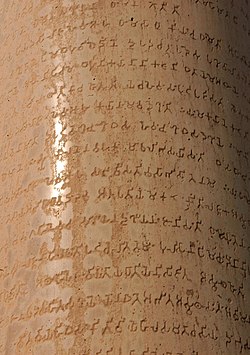
The earliest deciphered epigraphy found in the Indian subcontinent are the Edicts of Ashoka of the 3rd century BCE, in the Brahmi script.
If epigraphy of proto-writing is included, undeciphered markings with symbol systems that may or may not contain linguistic information, there is substantially older epigraphy in the Indus script, which dates back to the mid 4th millennium BCE. Two other important archeological classes of symbols are found from the 1st millennium BCE, Megalithic graffiti symbols and symbols on punch-marked coins, though most scholars do not consider these to constitute fully linguistic scripts, and their semiotic functions are not well understood.
Writing in Sanskrit (Epigraphical Hybrid Sanskrit, EHS) appears in the 1st to 4th centuries CE. Indian epigraphy becomes more widespread over the 1st millennium, engraved on the faces of cliffs, on pillars, on tablets of stone, drawn in caves and on rocks, some gouged into the bedrock. Later they were also inscribed on palm leaves, coins, Indian copper plate inscriptions, and on temple walls.
Many of the inscriptions are couched in extravagant language, but when the information gained from inscriptions can be corroborated with information from other sources such as still existing monuments or ruins, inscriptions provide insight into India's dynastic history that otherwise lacks contemporary historical records.
Of the c. 100,000 inscriptions found by the Archaeological Survey of India, about 60,000 were in Tamil Nadu;. Over 14,000 inscriptions belonging to the Telugu were excavated in Andhra Pradesh and Telangana. This makes Tamil the most densely inscribed language in the country.
The Bronze Age Indus script remains undeciphered and may not actually represent a writing system. Hence, the first undisputed evidence of writing in the Indian Subcontinent are the Edicts of Ashoka from c. 250 BCE. Several inscriptions were thought to be pre-Ashokan by earlier scholars; these include the Piprahwa relic casket inscription, the Badli pillar inscription, the Bhattiprolu relic casket inscription, the Sohgaura copper plate inscription, the Mahasthangarh Brahmi inscription, the Eran coin legend, the Taxila coin legends, and the inscription on the silver coins of Sophytes. However, more recent scholars have dated them to later periods.
Until the 1990s, it was generally accepted that the Brahmi script used by Ashoka spread to South India during the second half of the 3rd century BCE, assuming a local form. Beginning in the late 1990s, archaeological excavations have produced a small number of candidates for Brahmi epigraphy predating Ashoka. The claimed pre-Ashokan inscriptions at Anuradhapura have been published in an internationally recognised academic journal.
Since 1886 there have been systematic attempts to collect and catalogue these inscriptions, along with the translation and publication of documents. Inscriptions are in the Brahmi. Royal inscriptions were also engraved on copper-plates as were the Indian copper plate inscriptions. The Edicts of Ashoka contain Brahmi script and its regional variant, was an early script used in the inscriptions in cave walls of Tamil Nadu and later evolved into the Tamil Vatteluttu alphabet. The Bhattiprolu alphabet, as well as a variant of Brahmi, the Kadamba alphabet, of the early centuries BCE gave rise to the Telugu-Kannada alphabet, which developed into the Kannada and Telugu scripts.
Early Indian epigraphy
The earliest deciphered epigraphy found in the Indian subcontinent are the Edicts of Ashoka of the 3rd century BCE, in the Brahmi script.
If epigraphy of proto-writing is included, undeciphered markings with symbol systems that may or may not contain linguistic information, there is substantially older epigraphy in the Indus script, which dates back to the mid 4th millennium BCE. Two other important archeological classes of symbols are found from the 1st millennium BCE, Megalithic graffiti symbols and symbols on punch-marked coins, though most scholars do not consider these to constitute fully linguistic scripts, and their semiotic functions are not well understood.
Writing in Sanskrit (Epigraphical Hybrid Sanskrit, EHS) appears in the 1st to 4th centuries CE. Indian epigraphy becomes more widespread over the 1st millennium, engraved on the faces of cliffs, on pillars, on tablets of stone, drawn in caves and on rocks, some gouged into the bedrock. Later they were also inscribed on palm leaves, coins, Indian copper plate inscriptions, and on temple walls.
Many of the inscriptions are couched in extravagant language, but when the information gained from inscriptions can be corroborated with information from other sources such as still existing monuments or ruins, inscriptions provide insight into India's dynastic history that otherwise lacks contemporary historical records.
Of the c. 100,000 inscriptions found by the Archaeological Survey of India, about 60,000 were in Tamil Nadu;. Over 14,000 inscriptions belonging to the Telugu were excavated in Andhra Pradesh and Telangana. This makes Tamil the most densely inscribed language in the country.
The Bronze Age Indus script remains undeciphered and may not actually represent a writing system. Hence, the first undisputed evidence of writing in the Indian Subcontinent are the Edicts of Ashoka from c. 250 BCE. Several inscriptions were thought to be pre-Ashokan by earlier scholars; these include the Piprahwa relic casket inscription, the Badli pillar inscription, the Bhattiprolu relic casket inscription, the Sohgaura copper plate inscription, the Mahasthangarh Brahmi inscription, the Eran coin legend, the Taxila coin legends, and the inscription on the silver coins of Sophytes. However, more recent scholars have dated them to later periods.
Until the 1990s, it was generally accepted that the Brahmi script used by Ashoka spread to South India during the second half of the 3rd century BCE, assuming a local form. Beginning in the late 1990s, archaeological excavations have produced a small number of candidates for Brahmi epigraphy predating Ashoka. The claimed pre-Ashokan inscriptions at Anuradhapura have been published in an internationally recognised academic journal.
Since 1886 there have been systematic attempts to collect and catalogue these inscriptions, along with the translation and publication of documents. Inscriptions are in the Brahmi. Royal inscriptions were also engraved on copper-plates as were the Indian copper plate inscriptions. The Edicts of Ashoka contain Brahmi script and its regional variant, was an early script used in the inscriptions in cave walls of Tamil Nadu and later evolved into the Tamil Vatteluttu alphabet. The Bhattiprolu alphabet, as well as a variant of Brahmi, the Kadamba alphabet, of the early centuries BCE gave rise to the Telugu-Kannada alphabet, which developed into the Kannada and Telugu scripts.
Recent media
Recent media