
Recent from talks
Indus script
Knowledge base stats:
Talk channels stats:
Members stats:
Indus script
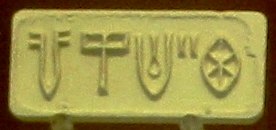
The Indus script, also known as the Harappan script and the Indus Valley script, is a corpus of symbols produced by the Indus Valley Civilisation. Most inscriptions containing these symbols are extremely short, making it difficult to judge whether or not they constituted a writing system used to record a Harappan language, any of which are yet to be identified. Despite many attempts, the "script" has not yet been deciphered. There is no known bilingual inscription to help decipher the script, which shows no significant changes over time. However, some of the syntax (if that is what it may be termed) varies depending upon location.
The first publication of a seal with Harappan symbols dates to 1875, in a drawing by Alexander Cunningham. By 1992, an estimated 4,000 inscribed objects had been discovered, some as far afield as Mesopotamia due to existing Indus–Mesopotamia relations, with over 400 distinct signs represented across known inscriptions.
Some scholars, such as G. R. Hunter, S. R. Rao, John Newberry, and Krishna Rao have argued that the Brahmi script has some connection with the Indus system. Raymond Allchin has somewhat cautiously supported the possibility of the Brahmi script being influenced by the Indus script. But this connection has not been proven. Another possibility for the continuity of the Indus tradition is in the megalithic graffiti symbols of southern and central India and Sri Lanka, which probably do not constitute a linguistic script, but may have some overlap with the Indus symbol inventory. Linguists such as Iravatham Mahadevan, Kamil Zvelebil, and Asko Parpola have argued that the script had a relation to a Dravidian language.
By 1977 at least 2,906 inscribed objects with legible inscriptions had been discovered, and by 1992 a total of approx. 4,000 inscribed objects had been found. In 2025, it was reported around 5,000 inscriptions have been excavated since 1924.
Indus script symbols have primarily been found on stamp seals, pottery, bronze, and copper plates, tools, and weapons. The majority of the textual corpus consists of seals, impressions of such seals, and graffiti markings inscribed on pottery. Seals and their impressions were typically small in size and portable, with most being just 2–3 centimetres in length on each side. No extant examples of the Indus script have been found on perishable organic materials like papyrus, paper, textiles, leaves, wood, or bark.
Early examples of the Indus script have been found on pottery inscriptions and clay impressions of inscribed Harappan seals dating to around c. 2800–2600 BCE during the Early Harappan period, and emerging alongside administrative objects such as seals and standardised weights during the Kot Diji phase of this period. However, excavations at Harappa have demonstrated the development of some symbols from potter's marks and graffiti belonging to the earlier Ravi phase from c. 3500–2800 BCE.
In the Mature Harappan period, from about c. 2600–1900 BCE, strings of Indus signs are commonly found on flat, rectangular stamp seals as well as written or inscribed on a multitude of other objects including pottery, tools, tablets, and ornaments. Signs were written using a variety of methods including carving, chiselling, embossing, and painting applied to diverse materials such as terracotta, sandstone, soapstone, bone, shell, copper, silver, and gold. As of 1977[update], Iravatham Mahadevan noted that about 90% of the Indus script seals and inscribed objects discovered so far were found at sites in Pakistan along the Indus River and its tributaries, such as Mohenjo-daro and Harappa, while other sites located elsewhere account for the remaining 10%. Often, animals such as bulls, water buffaloes, elephants, rhinoceros, and the mythical "unicorn" accompanied the text on seals, possibly to help the illiterate identify the origin of a particular seal.
The Late Harappan period, from c. 1900–1300 BCE, followed the more urbanised Mature Harappan period, and was a period of fragmentation and localisation which preceded the early Iron Age in the Indian subcontinent. Inscriptions have been found at sites associated with the localised phases of this period. At Harappa, the use of the script largely ceased as the use of inscribed seals ended around c. 1900 BCE; however, the use of the Indus script may have endured for a longer duration in other regions such as at Rangpur, Gujarat, particularly in the form of graffiti inscribed on pottery. Seals from the Jhukar phase of the Late Harappan period, centred on the present-day province of Sindh in Pakistan, lack the Indus script, however, some potsherd inscriptions from this phase have been noted. Both seals and potsherds bearing Indus script text, dated c. 2200–1600 BCE, have been found at sites associated with the Daimabad culture of the Late Harappan period, in present-day Maharashtra.
Hub AI
Indus script AI simulator
(@Indus script_simulator)
Indus script
The Indus script, also known as the Harappan script and the Indus Valley script, is a corpus of symbols produced by the Indus Valley Civilisation. Most inscriptions containing these symbols are extremely short, making it difficult to judge whether or not they constituted a writing system used to record a Harappan language, any of which are yet to be identified. Despite many attempts, the "script" has not yet been deciphered. There is no known bilingual inscription to help decipher the script, which shows no significant changes over time. However, some of the syntax (if that is what it may be termed) varies depending upon location.
The first publication of a seal with Harappan symbols dates to 1875, in a drawing by Alexander Cunningham. By 1992, an estimated 4,000 inscribed objects had been discovered, some as far afield as Mesopotamia due to existing Indus–Mesopotamia relations, with over 400 distinct signs represented across known inscriptions.
Some scholars, such as G. R. Hunter, S. R. Rao, John Newberry, and Krishna Rao have argued that the Brahmi script has some connection with the Indus system. Raymond Allchin has somewhat cautiously supported the possibility of the Brahmi script being influenced by the Indus script. But this connection has not been proven. Another possibility for the continuity of the Indus tradition is in the megalithic graffiti symbols of southern and central India and Sri Lanka, which probably do not constitute a linguistic script, but may have some overlap with the Indus symbol inventory. Linguists such as Iravatham Mahadevan, Kamil Zvelebil, and Asko Parpola have argued that the script had a relation to a Dravidian language.
By 1977 at least 2,906 inscribed objects with legible inscriptions had been discovered, and by 1992 a total of approx. 4,000 inscribed objects had been found. In 2025, it was reported around 5,000 inscriptions have been excavated since 1924.
Indus script symbols have primarily been found on stamp seals, pottery, bronze, and copper plates, tools, and weapons. The majority of the textual corpus consists of seals, impressions of such seals, and graffiti markings inscribed on pottery. Seals and their impressions were typically small in size and portable, with most being just 2–3 centimetres in length on each side. No extant examples of the Indus script have been found on perishable organic materials like papyrus, paper, textiles, leaves, wood, or bark.
Early examples of the Indus script have been found on pottery inscriptions and clay impressions of inscribed Harappan seals dating to around c. 2800–2600 BCE during the Early Harappan period, and emerging alongside administrative objects such as seals and standardised weights during the Kot Diji phase of this period. However, excavations at Harappa have demonstrated the development of some symbols from potter's marks and graffiti belonging to the earlier Ravi phase from c. 3500–2800 BCE.
In the Mature Harappan period, from about c. 2600–1900 BCE, strings of Indus signs are commonly found on flat, rectangular stamp seals as well as written or inscribed on a multitude of other objects including pottery, tools, tablets, and ornaments. Signs were written using a variety of methods including carving, chiselling, embossing, and painting applied to diverse materials such as terracotta, sandstone, soapstone, bone, shell, copper, silver, and gold. As of 1977[update], Iravatham Mahadevan noted that about 90% of the Indus script seals and inscribed objects discovered so far were found at sites in Pakistan along the Indus River and its tributaries, such as Mohenjo-daro and Harappa, while other sites located elsewhere account for the remaining 10%. Often, animals such as bulls, water buffaloes, elephants, rhinoceros, and the mythical "unicorn" accompanied the text on seals, possibly to help the illiterate identify the origin of a particular seal.
The Late Harappan period, from c. 1900–1300 BCE, followed the more urbanised Mature Harappan period, and was a period of fragmentation and localisation which preceded the early Iron Age in the Indian subcontinent. Inscriptions have been found at sites associated with the localised phases of this period. At Harappa, the use of the script largely ceased as the use of inscribed seals ended around c. 1900 BCE; however, the use of the Indus script may have endured for a longer duration in other regions such as at Rangpur, Gujarat, particularly in the form of graffiti inscribed on pottery. Seals from the Jhukar phase of the Late Harappan period, centred on the present-day province of Sindh in Pakistan, lack the Indus script, however, some potsherd inscriptions from this phase have been noted. Both seals and potsherds bearing Indus script text, dated c. 2200–1600 BCE, have been found at sites associated with the Daimabad culture of the Late Harappan period, in present-day Maharashtra.
Recent media