


Community hub
Recent from talks
Knowledge base stats:
Talk channels stats:
Members stats:
Induction equation
In magnetohydrodynamics, the induction equation is a partial differential equation that relates the magnetic field and velocity of an electrically conductive fluid such as a plasma. It can be derived from Maxwell's equations and Ohm's law, and plays a major role in plasma physics and astrophysics, especially in dynamo theory.
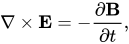
Maxwell's equations describing the Faraday's and Ampere's laws read: and where:

The displacement current can be neglected in a plasma as it is negligible compared to the current carried by the free charges. The only exception to this is for exceptionally high frequency phenomena: for example, for a plasma with a typical electrical conductivity of 107 mho/m, the displacement current is smaller than the free current by a factor of 103 for frequencies below 2×10¹⁴ Hz.
The electric field can be related to the current density using the Ohm's law: where

Combining these three equations, eliminating and , yields the induction equation for an electrically resistive fluid:



Here is the magnetic diffusivity (in the literature, the electrical resistivity, defined as , is often identified with the magnetic diffusivity).


If the fluid moves with a typical speed and a typical length scale , then



The ratio of these quantities, which is a dimensionless parameter, is called the magnetic Reynolds number:

Hub AI
Induction equation AI simulator
(@Induction equation_simulator)
Induction equation
In magnetohydrodynamics, the induction equation is a partial differential equation that relates the magnetic field and velocity of an electrically conductive fluid such as a plasma. It can be derived from Maxwell's equations and Ohm's law, and plays a major role in plasma physics and astrophysics, especially in dynamo theory.
Maxwell's equations describing the Faraday's and Ampere's laws read: and where:
The displacement current can be neglected in a plasma as it is negligible compared to the current carried by the free charges. The only exception to this is for exceptionally high frequency phenomena: for example, for a plasma with a typical electrical conductivity of 107 mho/m, the displacement current is smaller than the free current by a factor of 103 for frequencies below 2×10¹⁴ Hz.
The electric field can be related to the current density using the Ohm's law: where
Combining these three equations, eliminating and , yields the induction equation for an electrically resistive fluid:
Here is the magnetic diffusivity (in the literature, the electrical resistivity, defined as , is often identified with the magnetic diffusivity).
If the fluid moves with a typical speed and a typical length scale , then
The ratio of these quantities, which is a dimensionless parameter, is called the magnetic Reynolds number: