
Recent from talks
Indo-Mesopotamia relations
Knowledge base stats:
Talk channels stats:
Members stats:
Indo-Mesopotamia relations
Indus–Mesopotamia relations are thought to have developed during the second half of the 3rd millennium BCE, until they came to a halt with the extinction of the Indus valley civilization after around 1900 BCE. Mesopotamia had already been an intermediary in the trade of lapis lazuli between the Indian subcontinent and Egypt since at least about 3200 BCE, in the context of Egypt-Mesopotamia relations.
A first period of indirect contacts seems to have occurred as a consequence of the Neolithic Revolution and the diffusion of agriculture after 9000 BCE. The prehistoric agriculture of the Indian subcontinent is thought to have combined local resources, such as humped cattle, with agricultural resources from the Near East as a first step in the 8th–7th millennium BCE, to which were later added resources from Africa and East Asia from the 3rd millennium BCE. Mehrgarh is one of the earliest sites with evidence of farming and herding in the subcontinent. At Mehrgarh, around 7000 BCE, the full set of Near Eastern incipient agricultural products can be found: wheat, barley, as well as goats, sheep and cattle. The rectangular houses of Mehrgarh as well as the female figurines are essentially identical with those of the Near East.
The Near-Eastern origin of South Asian agriculture is generally accepted, and it has been the "virtual archaeological dogma for decades". Gregory Possehl however argues for a more nuanced model, in which the early domestication of plant and animal species may have occurred in a wide area from the Mediterranean to the Indus, in which new technology and ideas circulated fast and were widely shared. Today, the main objection to this model lies in the fact that wild wheat has never been found in South Asia, suggesting that either wheat was first domesticated in the Near-East from well-known domestic wild species and then brought to South Asia, or that wild wheat existed in the past in South Asia but somehow became extinct without leaving a trace.
Jean-François Jarrige argues for an independent origin of Mehrgarh. Jarrige notes "the assumption that farming economy was introduced full-fledged from Near-East to South Asia", and the similarities between Neolithic sites from eastern Mesopotamia and the western Indus valley, which are evidence of a "cultural continuum" between those sites. But given the originality of Mehrgarh, Jarrige concludes that Mehrgarh has an earlier local background, and is not a "'backwater' of the Neolithic culture of the Near East".
Sea levels have been rising about 100 meters over the last 15,000 years until modern times, with the effect that coast lines have been receding vastly. This is especially the case of the coast lines of the Indus and Mesopotamia, which were originally only separated by a distance of about 1000 kilometers, compared to 2000 kilometers today. For the ancestors of the Sumerians, the distance between the coasts of the Mesopotamian area and the Indus area would have been much shorter than it is today. In particular the Persian Gulf, which is only about 30 meters deep today, would have been at least partially dry, and would have formed an extension of the Mesopotamian basin.
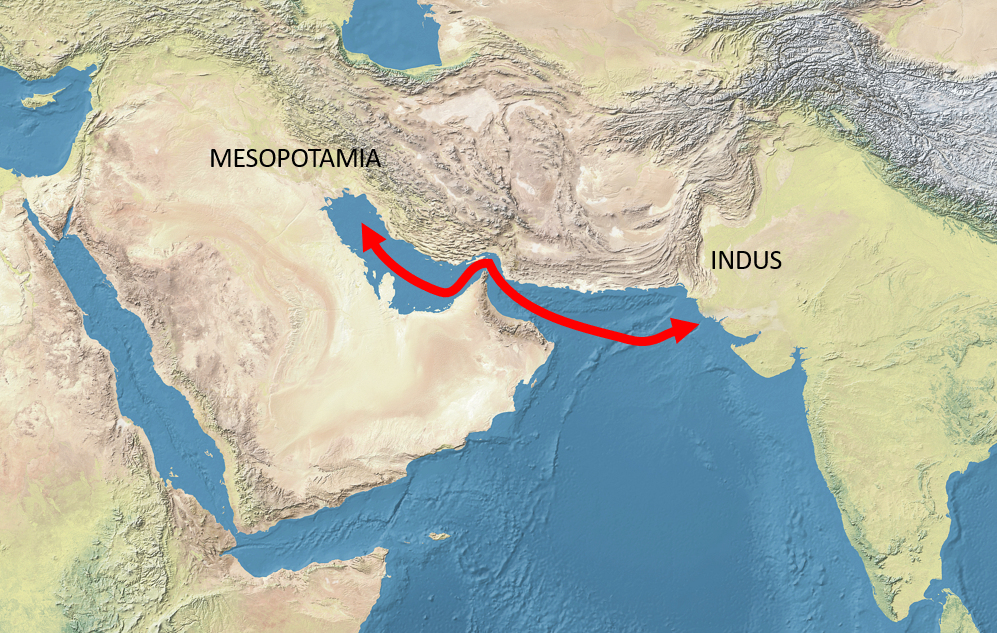
The westernmost Harappan city was located on the Makran coast at Sutkagan Dor, near the tip of the Arabian Peninsula, and is considered as an ancient maritime trading station, probably between modern day Pakistan and the Persian Gulf.
Sea-going vessels were known in the Indus region, as shown by seals showing ships with land-finding birds (disha-kaka), dating to 2500–1750 BCE. When a boat was lost at sea, with land beyond the horizon, birds released by the mariners would securely fly back to land, and therefore show the boats the way to safety. Various stamp seals are known from the Indus and the Persian Gulf area, with depictions of large ships pertaining to different shipbuilding traditions. Sargon of Akkad (c. 2334–2284 BCE) claimed in one of his inscriptions that "ships from Meluhha, Magan and Dilmun made fast at the docks of Akkad".
Many archaeological finds suggest that maritime trade along the shores of Africa and Asia started several millennia ago. Indus pottery and seals have been found along the sea routes between the Indus and Mesopotamia, as in Ras al-Jinz, at the tip of Arabia.
Hub AI
Indo-Mesopotamia relations AI simulator
(@Indo-Mesopotamia relations_simulator)
Indo-Mesopotamia relations
Indus–Mesopotamia relations are thought to have developed during the second half of the 3rd millennium BCE, until they came to a halt with the extinction of the Indus valley civilization after around 1900 BCE. Mesopotamia had already been an intermediary in the trade of lapis lazuli between the Indian subcontinent and Egypt since at least about 3200 BCE, in the context of Egypt-Mesopotamia relations.
A first period of indirect contacts seems to have occurred as a consequence of the Neolithic Revolution and the diffusion of agriculture after 9000 BCE. The prehistoric agriculture of the Indian subcontinent is thought to have combined local resources, such as humped cattle, with agricultural resources from the Near East as a first step in the 8th–7th millennium BCE, to which were later added resources from Africa and East Asia from the 3rd millennium BCE. Mehrgarh is one of the earliest sites with evidence of farming and herding in the subcontinent. At Mehrgarh, around 7000 BCE, the full set of Near Eastern incipient agricultural products can be found: wheat, barley, as well as goats, sheep and cattle. The rectangular houses of Mehrgarh as well as the female figurines are essentially identical with those of the Near East.
The Near-Eastern origin of South Asian agriculture is generally accepted, and it has been the "virtual archaeological dogma for decades". Gregory Possehl however argues for a more nuanced model, in which the early domestication of plant and animal species may have occurred in a wide area from the Mediterranean to the Indus, in which new technology and ideas circulated fast and were widely shared. Today, the main objection to this model lies in the fact that wild wheat has never been found in South Asia, suggesting that either wheat was first domesticated in the Near-East from well-known domestic wild species and then brought to South Asia, or that wild wheat existed in the past in South Asia but somehow became extinct without leaving a trace.
Jean-François Jarrige argues for an independent origin of Mehrgarh. Jarrige notes "the assumption that farming economy was introduced full-fledged from Near-East to South Asia", and the similarities between Neolithic sites from eastern Mesopotamia and the western Indus valley, which are evidence of a "cultural continuum" between those sites. But given the originality of Mehrgarh, Jarrige concludes that Mehrgarh has an earlier local background, and is not a "'backwater' of the Neolithic culture of the Near East".
Sea levels have been rising about 100 meters over the last 15,000 years until modern times, with the effect that coast lines have been receding vastly. This is especially the case of the coast lines of the Indus and Mesopotamia, which were originally only separated by a distance of about 1000 kilometers, compared to 2000 kilometers today. For the ancestors of the Sumerians, the distance between the coasts of the Mesopotamian area and the Indus area would have been much shorter than it is today. In particular the Persian Gulf, which is only about 30 meters deep today, would have been at least partially dry, and would have formed an extension of the Mesopotamian basin.
The westernmost Harappan city was located on the Makran coast at Sutkagan Dor, near the tip of the Arabian Peninsula, and is considered as an ancient maritime trading station, probably between modern day Pakistan and the Persian Gulf.
Sea-going vessels were known in the Indus region, as shown by seals showing ships with land-finding birds (disha-kaka), dating to 2500–1750 BCE. When a boat was lost at sea, with land beyond the horizon, birds released by the mariners would securely fly back to land, and therefore show the boats the way to safety. Various stamp seals are known from the Indus and the Persian Gulf area, with depictions of large ships pertaining to different shipbuilding traditions. Sargon of Akkad (c. 2334–2284 BCE) claimed in one of his inscriptions that "ships from Meluhha, Magan and Dilmun made fast at the docks of Akkad".
Many archaeological finds suggest that maritime trade along the shores of Africa and Asia started several millennia ago. Indus pottery and seals have been found along the sea routes between the Indus and Mesopotamia, as in Ras al-Jinz, at the tip of Arabia.
Recent media