Recent from talks
Contribute something
Nothing was collected or created yet.
Indus River
View on Wikipedia
| Indus Mehran, Sênggê Zangbo, Shiquan He, Sindhu[1] | |
|---|---|
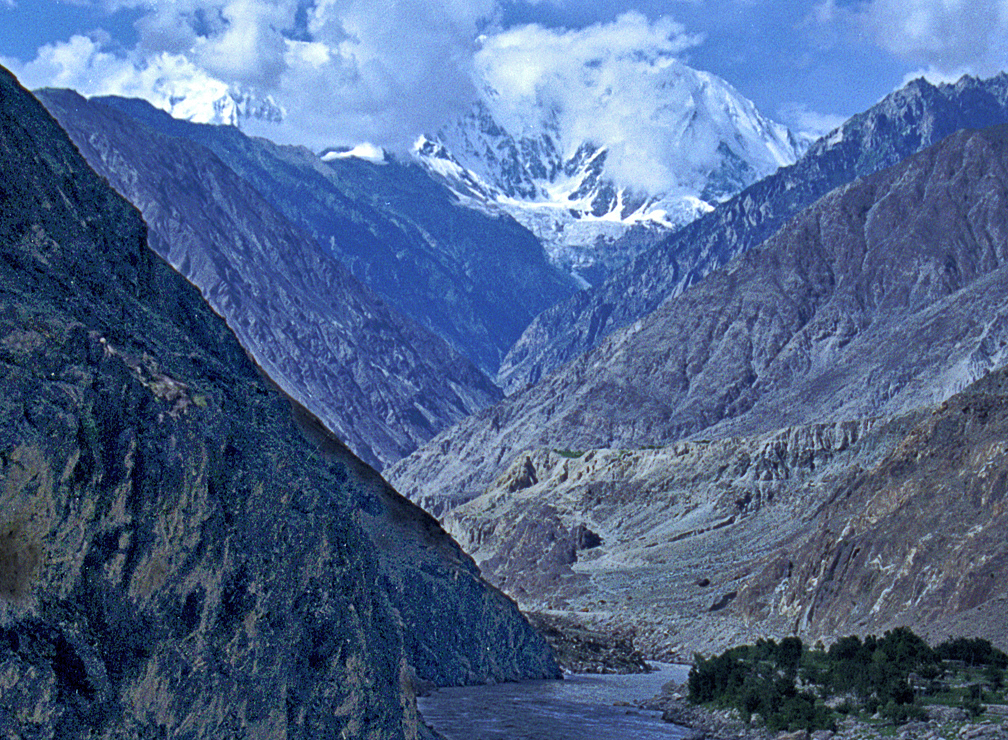
The Indus Gorge is formed as the Indus River bends around the Nanga Parbat massif, shown towering behind, defining the western anchor of the Himalayan mountain range. | |
Course and major tributaries of the Indus | |
| Location | |
| Countries or regions | China, Kashmir (disputed region),[2][3] Pakistan |
| States, provinces or administered regions | Tibet Autonomous Region, Indian-administered Ladakh, Pakistani-administered Gilgit-Baltistan, Khyber Pakhtunkhwa, Punjab, and Sindh[2][3] |
| Cities | Leh, Kargil, Skardu, Dasu, Besham, Thakot, Swabi, Mianwali, Dera Ismail Khan, Bhakkar, Sukkur, Hyderabad, Karachi |
| Physical characteristics | |
| Source | Upper Gê'gyai |
| • location | Ngari Prefecture |
| • coordinates | 31°12′03″N 81°45′16″E / 31.20083°N 81.75444°E |
| • elevation | 5,555 m (18,225 ft) |
| 2nd source | Lake Manasarovar[4] |
| • location | Ngari Prefecture |
| • coordinates | 30°35′35″N 81°25′25″E / 30.59306°N 81.42361°E |
| • elevation | 4,600 m (15,100 ft) |
| Source confluence | |
| • location | Shiquanhe (confluence), Tibet Autonomous Region, People's Republic of China |
| • coordinates | 32°29′54″N 79°41′28″E / 32.49833°N 79.69111°E |
| • elevation | 4,255 m (13,960 ft) |
| Mouth | Arabian Sea[5] |
• location |
|
• coordinates | 23°59′42″N 67°26′06″E / 23.99500°N 67.43500°E |
• elevation | 0 m (0 ft) |
| Length | 3,180 km (1,980 mi)[6] |
| Basin size | 1,120,000 km2 (430,000 sq mi)[6] |
| Discharge | |
| • location | Indus Delta |
| • average | 5,533 m3/s (195,400 cu ft/s)[7] |
| • minimum | 1,200 m3/s (42,000 cu ft/s) |
| • maximum | 58,000 m3/s (2,000,000 cu ft/s) |
| Discharge | |
| • location | Sukkur |
| • average | (Period: 1971–2000)5,673.5 m3/s (200,360 cu ft/s)[8] |
| Discharge | |
| • location | Mithankot |
| • average | (Period: 1971–2000)5,812.3 m3/s (205,260 cu ft/s)[8] |
| Discharge | |
| • location | Tarbela Dam |
| • average | (Period: 1971–2000)2,469 m3/s (87,200 cu ft/s)[8] |
| Basin features | |
| Progression | Arabian Sea |
| River system | Indus River |
| Tributaries | |
| • left | Zanskar, Suru, Soan, Panjnad, Ghaggar |
| • right | Shyok, Hunza, Gilgit, Swat, Kunar, Kabul, Kurram, Gomal, Zhob |
![]() | |
The Indus (/ˈɪndəs/ IN-dəs) is a transboundary river of Asia and a trans-Himalayan river of South and Central Asia.[9] The 3,180 km (1,980 mi)[6] river rises in western China, flows northwest through the disputed[2] Kashmir region,[3] first through the Indian-administered Ladakh, and then the Pakistani-administered Gilgit-Baltistan,[a][11] bends sharply to the left after the Nanga Parbat massif, and flows south-by-southwest through Pakistan, before bifurcating and emptying into the Arabian Sea, its main stem located near the port city of Karachi.[12][13]
The Indus River has a total drainage area of circa 1,120,000 km2 (430,000 sq mi).[6] Its estimated annual flow is around 175 km3/a (5,500 m3/s), making it one of the 50 largest rivers in the world in terms of average annual flow.[14] Its left-bank tributary in Ladakh is the Zanskar River, and its left-bank tributary in the plains is the Panjnad River which is formed by the successive confluences of the five Punjab rivers, namely the Chenab, Jhelum, Ravi, Beas, and Sutlej rivers. Its principal right-bank tributaries are the Shyok, Gilgit, Kabul, Kurram, and Gomal rivers. Beginning in a mountain spring and fed with glaciers and rivers in the Himalayan, Karakoram, and Hindu Kush ranges, the river supports the ecosystems of temperate forests, plains, and arid countryside.
Geologically, the headwaters of the Indus and to their east those of the Yarlung Tsangpo (later in its course, the Brahmaputra) flow along the Indus-Yarlung suture zone, which defines the boundary along which the Indian plate collided with the Eurasian plate in the Early Eocene (approximately 50 Million years ago).[15] These two Eurasian rivers, whose courses were continually diverted by the rising Himalayas, define the western and eastern limits, respectively, of the mountain range.[15] After the Indus debouches from its narrow Himalayan valley, it forms, along with its tributaries, the Punjab region of South Asia. The lower course of the river ends in a large delta in the Sindh province of Pakistan.
Historically, the Indus was important to many cultures. The 3rd millennium BC saw the rise of Indus Valley Civilisation, a major urban civilization of the Bronze Age. During the 2nd millennium BC, the Punjab region was mentioned in the Rigveda hymns as Sapta Sindhu and in the Avesta religious texts as Hapta Həndu (both terms meaning "seven rivers"). Early historical kingdoms that arose in the Indus Valley include Gandhāra and Sindhu-Sauvīra. The Indus River came into the knowledge of the Western world early in the classical period, when King Darius of Persia sent his Greek subject Scylax of Caryanda to explore the river, c. 515 BC.[16]
Etymology and names
[edit]Etymologically, English language word "Indus" comes from Late Latin Indus (1598), specifically a use of classical Latin Indus (inhabitant of India, Indian) from ancient Greek Ἰνδός "inhabitant of India, Indian, the River Indus" from Achaemenian Old Persian "hindu," denoting an eastern province of the Achaemenid empire (Persian language hind India), and Avestan hiṇdu, həṇdu "river," (natural) frontier; with same Proto Indo-Iranian language-root as Sanskrit sindhu (river), specifically the River Indus; hence also the region of the Indus, the province Sindh (which also developed into Hellenistic Greek Σίνθος ("the River Indus").[17][18] This river's traditional name in Sanskrit and Tibetan is "sindhu". In Sanskrit, its range of meanings includes: stream, river; Indus; flood; sea or ocean; region or country in the vicinity of the Indus, Sindh, people of Sindh."[19][20]
The modern name in Urdu is Sindh (Urdu: سندھ) or Daryā-i-Sindh (Urdu: دریائے سندھ, lit. 'The River Sindh'), contrasting to the Province of Sindh (Urdu: صوبہِ سندھ, romanized: Sūba-i-sindh). The Ladakhis and Tibetans call the river Senge Tsangpo (སེང་གེ་གཙང་པོ།), Baltis call it Gemtsuh and Tsuh-Fo, Pashtuns call it Nilab, Sher Darya and Abbasin, while Sindhis call it Sindhu, Mehran, Purali and Samundar.[12][21]
Description
[edit]
The Indus River provides key water resources for Pakistan's economy – especially the breadbasket of Punjab province, which accounts for most of the nation's agricultural production, and Sindh. The word Punjab means "land of five rivers" and the five rivers are Jhelum, Chenab, Ravi, Beas and Sutlej, all of which finally flow into the Indus. The Indus also supports many heavy industries and provides the main supply of potable water in Pakistan.
The total length of the river varies in different sources. The length used in this article is 3,180 km (1,980 mi), taken from the Himalayan Climate and Water Atlas (2015).[6] Historically, the 1909 The Imperial Gazetteer of India gave it as "just over 1,800 miles".[22] A shorter figure of 2,880 km (1,790 mi) has been widely used in modern sources, as has the one of 3,180 km (1,980 mi). The modern Encyclopedia Britannica was originally published in 1999 with the shorter measurement, but was updated in 2015 to use the longer measurement.[12] Both lengths are commonly found in modern publications; in some cases, both measurements can be found within the same work.[23] An extended figure of circa 3,600 km (2,200 mi) was announced by a Chinese research group in 2011, based on a comprehensive remeasurement from satellite imagery, and a ground expedition to identify an alternative source point, but detailed analysis has not yet been published.[24]
The ultimate source of the Indus is in Tibet, but there is some debate about the exact source. The traditional source of the river is the Sênggê Kanbab (Sênggê Zangbo) or "Lion's Mouth", a perennial spring not far from the sacred Mount Kailash, marked by a long low line of Tibetan chortens. There are several other tributaries nearby, which may form a longer stream than Sênggê Kanbab, but unlike the Sênggê Kanbab, are all dependent on snowmelt. The Zanskar River, which flows into the Indus in Ladakh, has a greater volume of water than the Indus itself before that point.[25] An alternative reckoning begins the river around 300 km further upstream, at the confluence of the Sênggê Zangbo and Gar Tsangpo rivers, which drain the Nganglong Kangri and Gangdise Shan (Gang Rinpoche, Mt. Kailash) mountain ranges. The 2011 remeasurement suggested the source was a small lake northeast of Mount Kailash, rather than either of the two points previously used.[24]
The Indus then flows northwest through Ladakh (Indian-administered Kashmir) and Baltistan and Gilgit (Pakistan-administered Kashmir), just south of the Karakoram range. The Shyok, Shigar and Gilgit rivers carry glacial waters into the main river. It gradually bends to the south and descends into the Punjab plains at Kalabagh, Pakistan. The Indus passes gigantic gorges 4,500–5,200 metres (15,000–17,000 ft) deep near the Nanga Parbat massif. It flows swiftly across Hazara and is dammed at the Tarbela Reservoir. The Kabul River joins it near Attock. The remainder of its route to the sea is in the plains of the Punjab[26] and Sindh, where the flow of the river becomes slow and highly braided. It is joined by the Panjnad at Mithankot. Beyond this confluence, the river, at one time, was named the Satnad River (sat = "seven", nadī = "river"), as the river now carried the waters of the Kabul River, the Indus River and the five Punjab rivers. When the river passes Jamshoro, it ends in a large delta to the South of Thatta in the Sindh province of Pakistan.
The Indus is one of the few rivers in the world to exhibit a tidal bore. The Indus system is largely fed by the snow and glaciers of the Himalayas, Karakoram and the Hindu Kush ranges. The flow of the river is also determined by the seasons – it diminishes greatly in the winter while flooding its banks in the monsoon months from July to September. There is also evidence of a steady shift in the course of the river since prehistoric times – it deviated westwards from flowing into the Rann of Kutch and adjoining Banni grasslands after the 1816 earthquake.[27][28] As of 2011[update], Indus water flows in to the Rann of Kutch during its floods breaching flood banks.[29]
History
[edit]
The major cities of the Indus Valley Civilisation, such as Harappa and Mohenjo-daro, date back to around 3300 BC, and represent some of the largest human habitations of the ancient world. The Indus Valley Civilisation extended from across northeast Afghanistan to Pakistan and northwest India,[30] with an upward reach from east of the Jhelum River to Ropar on the upper Sutlej. The coastal settlements extended from Sutkagan Dor at the Pakistan-Iran border to Kutch in modern Gujarat, India. There is an Indus site on the Amu Darya at Shortughai in northern Afghanistan, and the Indus site Alamgirpur at the Hindon River is located only 28 km (17 mi) from Delhi. As of now, over 1,052 cities and settlements have been found, mainly in the general region of the Ghaggar-Hakra River and its tributaries. Among the settlements were the major urban centres of Harappa and Mohenjo-daro, as well as Lothal, Dholavira, Ganeriwala, and Rakhigarhi. Only 40 Indus Valley sites have been discovered on the Indus and its tributaries.[31] However, it is notable that majority of the Indus script seals and inscribed objects discovered were found at sites along the Indus river.[b][32][33]
Most scholars believe that settlements of Gandhara grave culture of the early Indo-Aryans flourished in Gandhara from 1700 BC to 600 BC, when Mohenjo-daro and Harappa had already been abandoned.[citation needed]
The Rigveda describes several rivers, including one named "Sindhu". The Rigvedic "Sindhu" is thought to be the present-day Indus River. It is attested 176 times in its text, 94 times in the plural, and most often used in the generic sense of "river". In the Rigveda, notably in the later hymns, the meaning of the word is narrowed to refer to the Indus River in particular; for example, in the list of rivers mentioned in the hymn of Nadistuti sukta. The Rigvedic hymns apply a feminine gender to all the rivers mentioned therein, except for the Brahmaputra.
The word "India" is derived from the Indus River. In ancient times, "India" initially referred to those regions immediately along the east bank of the Indus, where are Punjab and Sindh now but by 300 BC, Greek writers including Herodotus and Megasthenes were applying the term to the entire subcontinent that extends much farther eastward.[34][35]
The lower basin of the Indus forms a natural boundary between the Iranian Plateau and the Indian subcontinent; this region embraces all or parts of the Pakistani provinces Balochistan, Khyber Pakhtunkhwa, Punjab and Sindh and the countries Afghanistan and India. The first West Eurasian empire to annex the Indus Valley was the Persian Empire, during the reign of Darius the Great. During his reign, the Greek explorer Scylax of Caryanda was commissioned to explore the course of the Indus. It was crossed by the invading armies of Alexander. Still, after his Macedonians conquered the west bank—joining it to the Hellenic world, they elected to retreat along the southern course of the river, ending Alexander's Asian campaign. Alexander's admiral Nearchus set out from the Indus Delta to explore the Persian Gulf, until reaching the Tigris. The Indus Valley was later dominated by the Mauryan and Kushan Empires, Indo-Greek Kingdoms, Indo-Scythians and Hepthalites. Over several centuries Muslim armies of Muhammad ibn al-Qasim, Mahmud of Ghazni, Muhammad of Ghor, Timur and Babur crossed the river to invade Sindh and Punjab, providing a gateway to the Indian subcontinent.
Geology
[edit]
The Indus River is an antecedent river, meaning that it existed before the Himalayas and entrenched itself while they were rising.
The Indus River feeds the Indus submarine fan, which is the second largest sediment body on Earth.[36] It consists of around 5 million cubic kilometers of material eroded from the mountains. Studies of the sediment in the modern river indicate that the Karakoram Mountains in northern Pakistan and India are the single most important source of material, with the Himalayas providing the next largest contribution, mostly via the large rivers of the Punjab (Jhelum, Ravi, Chenab, Beas and Sutlej). Analysis of sediments from the Arabian Sea has demonstrated that before five million years ago the Indus was not connected to these Punjab rivers which instead flowed east into the Ganga and were captured after that time.[37] Earlier work showed that sand and silt from western Tibet was reaching the Arabian Sea by 45 million years ago, implying the existence of an ancient Indus River by that time.[38] The delta of this proto-Indus River has subsequently been found in the Katawaz Basin, on the Afghan-Pakistan border.
In the Nanga Parbat region, the massive amounts of erosion due to the Indus River following the capture and rerouting through that area are thought to bring middle and lower crustal rocks to the surface.[39]
In November 2011, satellite images showed that the Indus River had re-entered India and was feeding the Great Rann of Kutch, Little Rann of Kutch and a lake near Ahmedabad known as Nal Sarovar.[29] Heavy rains had left the river basin along with the Lake Manchar, Lake Hemal and Kalri Lake (all in modern-day Pakistan) inundated. This happened two centuries after the Indus River shifted its course westwards following the 1819 Rann of Kutch earthquake.
The Induan Age at the start of the Triassic Period of geological time is named for the Indus region.
Tributaries
[edit]Wildlife
[edit]
Accounts of the Indus Valley from the times of Alexander's campaign indicate a healthy forest cover in the region. The Mughal Emperor Babur writes of encountering rhinoceroses along its bank in his memoirs (the Baburnama). Extensive deforestation and human interference in the ecology of the Shivalik Hills has led to a marked deterioration in vegetation and growing conditions. The Indus Valley regions are arid with poor vegetation. Agriculture is sustained largely due to irrigation works. The Indus River and its watershed have a rich biodiversity. It is home to around 25 amphibian species.[40]
Mammals
[edit]The Indus River dolphin (Platanista indicus minor) is found only in the Indus River. It is a subspecies of the South Asian river dolphin. The Indus River dolphin formerly also occurred in the tributaries of the Indus River. According to the World Wildlife Fund it is one of the most threatened cetaceans with only about 1,816 still existing.[41] It is threatened by habitat degradation from the construction of dams and canals, entanglement in fishing gear, and industrial water pollution.[42]
There are two otter species in the Indus River basin: the Eurasian otter in the northeastern highland sections and the smooth-coated otter elsewhere in the river basin. The smooth-coated otters in the Indus River represent a subspecies found nowhere else, the Sindh otter (Lutrogale perspicillata sindica).[43]
Fish
[edit]The Indus River basin has high diversity, being the home of more than 180 freshwater fish species,[44] including 22 which are found nowhere else.[40] Fish also played a major role in earlier cultures of the region, including the ancient Indus Valley Civilisation where depictions of fish were frequent. The Indus script has a commonly used fish sign, which in its various forms may simply have meant "fish", or referred to stars or gods.[45]
In the uppermost, highest part of the Indus River basin there are relatively few genera and species: Diptychus, Ptychobarbus, Schizopyge, Schizopygopsis and Schizothorax snowtrout, Triplophysa loaches, and the catfish Glyptosternon reticulatum.[44] Going downstream these are soon joined by the golden mahseer Tor putitora (alternatively T. macrolepis, although it often is regarded as a synonym of T. putitora) and Schistura loaches. Downriver from around Thakot, Tarbela, the Kabul–Indus river confluence, Attock Khurd and Peshawar the diversity rises strongly, including many cyprinids (Amblypharyngodon, Aspidoparia, Barilius, Chela, Cirrhinus, Crossocheilus, Cyprinion, Danio, Devario, Esomus, Garra, Labeo, Naziritor, Osteobrama, Pethia, Puntius, Rasbora, Salmophasia, Securicula and Systomus), true loaches (Botia and Lepidocephalus), stone loaches (Acanthocobitis and Nemacheilus), ailiid catfish (Clupisoma), bagridae catfish (Batasio, Mystus, Rita and Sperata), airsac catfish (Heteropneustes), schilbid catfish (Eutropiichthys), silurid catfish (Ompok and Wallago), sisorid catfish (Bagarius, Gagata, Glyptothorax and Sisor), gouramis (Trichogaster), nandid leaffish (Nandus), snakeheads (Channa), spiny eel (Macrognathus and Mastacembelus), knifefish (Notopterus), glassfish (Chanda and Parambassis), clupeids (Gudusia), needlefish (Xenentodon) and gobies (Glossogobius), as well as a few introduced species.[44] As the altitude further declines the Indus basin becomes overall quite slow-flowing as it passes through the Punjab Plain. Major carp become common, and chameleonfish (Badis), mullet (Sicamugil) and swamp eel (Monopterus) appear.[44] In some upland lakes and tributaries of the Punjab region snow trout and mahseer are still common, but once the Indus basin reaches its lower plain the former group is absent and the latter are rare.[44] Many of the species of the middle sections of the Indus basin are also present in the lower. Notable examples of genera that are present in the lower plain but generally not elsewhere in the Indus River basin are the Aphanius pupfish, Aplocheilus killifish, palla fish (Tenualosa ilisha), catla (Labeo catla), rohu (Labeo rohita) and Cirrhinus mrigala.[44] The lowermost part of the river and its delta are home to freshwater fish, but also several brackish and marine species.[44] This includes pomfret and prawns. The large delta has been recognized by conservationists as an important ecological region. Here, the river turns into many marshes, streams and creeks and meets the sea at shallow levels.
Palla fish (Tenualosa ilisha) of the river is a delicacy for people living along the river. The population of fish in the river is moderately high, with Sukkur, Thatta, and Kotri being the major fishing centres – all in the lower Sindh course. As a result, damming and irrigation have made fish farming an important economic activity.
Economy
[edit]
The Indus is the most important supplier of water resources to the Punjab and Sindh plains – it forms the backbone of agriculture and food production in Pakistan. The river is especially critical since rainfall is meagre in the lower Indus valley. Irrigation canals were first built by the people of the Indus Valley Civilisation, and later by the engineers of the Kushan Empire and the Mughal Empire. Modern irrigation was introduced by the British East India Company in 1850 – the construction of modern canals accompanied with the restoration of old canals. The British supervised the construction of one of the most complex irrigation networks in the world. The Guddu Barrage is 1,350 m (4,430 ft) long – irrigating Sukkur, Jacobabad, Larkana and Kalat. The Sukkur Barrage serves over 20,000 km2 (7,700 sq mi).
After Pakistan came into existence, a water control treaty signed between India and Pakistan in 1960 guaranteed that Pakistan would receive water from the Indus River and its two tributaries the Jhelum River and the Chenab River independently of upstream control by India.[46]
The Indus Basin Project consisted primarily of the construction of two main dams, the Mangla Dam built on the Jhelum River and the Tarbela Dam constructed on the Indus River, together with their subsidiary dams.[47] The Pakistan Water and Power Development Authority undertook the construction of the Chashma-Jhelum link canal – linking the waters of the Indus and Jhelum rivers – extending water supplies to the regions of Bahawalpur and Multan. Pakistan constructed the Tarbela Dam near Rawalpindi – standing 2,743 metres (9,000 ft) long and 143 metres (470 ft) high, with an 80-kilometre (50 mi) long reservoir. It supports the Chashma Barrage near Dera Ismail Khan for irrigation use and flood control and the Taunsa Barrage near Dera Ghazi Khan which also produces 100,000 kilowatts of electricity. The Kotri Barrage near Hyderabad is 915 metres (3,000 ft) long and provides additional water supplies for Karachi. The extensive linking of tributaries with the Indus has helped spread water resources to the valley of Peshawar, in the Khyber Pakhtunkhwa. The extensive irrigation and dam projects provide the basis for Pakistan's large production of crops such as cotton, sugarcane and wheat. The dams also generate electricity for heavy industries and urban centres.
People
[edit]
The Indus River is sacred to Hindus.[49][50] The Sindhu Darshan Festival is held on every Guru Purnima on the banks of the Indus.[51]
The ethnicities of the Indus Valley (Pakistan and Northwest India) have a greater amount of ANI (or West Eurasian) admixture than other South Asians, including inputs from Western Steppe Herders, with evidence of more sustained and multi-layered migrations from the west.[52]
Modern issues
[edit]Indus delta
[edit]Originally, the delta used to receive almost all of the water from the Indus River, which has an annual flow of approximately 180 billion cubic metres (240×109 cu yd), and is accompanied by 400 million tonnes (390×106 long tons) of silt.[53] Since the 1940s, dams, barrages and irrigation works have been constructed on the river. The Indus Basin Irrigation System is the "largest contiguous irrigation system developed over the past 140 years" anywhere in the world.[54] This has reduced the flow of water and by 2018, the average annual flow of water below the Kotri barrage was 33 billion cubic metres (43×109 cu yd),[55] and annual amount of silt discharged was estimated at 100 million tonnes (98×106 long tons).[citation needed] As a result, the 2010 Pakistan floods were considered "good news" for the ecosystem and population of the river delta as they brought much-needed fresh water.[56][57] Any further utilization of the river basin water is not economically feasible.[58][59]
Vegetation and wildlife of the Indus delta are threatened by the reduced inflow of fresh water, along with extensive deforestation, industrial pollution and global warming. Damming has also isolated the delta population of Indus River dolphins from those further upstream.[60]
Large-scale diversion of the river's water for irrigation has raised far-reaching issues. Sediment clogging from poor maintenance of canals has affected agricultural production and vegetation on numerous occasions. Irrigation itself is increasing soil salinization, reducing crop yields and in some cases rendering farmland useless for cultivation.[61]
Effects of climate change on the river
[edit]The Tibetan Plateau contains the world's third-largest store of ice. Qin Dahe, the former head of the China Meteorological Administration, said the recent fast pace of melting and warmer temperatures will be good for agriculture and tourism in the short term, but issued a strong warning:
Temperatures are rising four times faster than elsewhere in China, and the Tibetan glaciers are retreating at a higher speed than in any other part of the world... In the short term, this will cause lakes to expand and bring floods and mudflows... In the long run, the glaciers are vital lifelines of the Indus River. Once they vanish, water supplies in Pakistan will be in peril.[62]
"There is insufficient data to say what will happen to the Indus," says David Grey, the World Bank's senior water advisor in South Asia. "But we all have very nasty fears that the flows of the Indus could be severely, severely affected by glacier melt as a consequence of climate change," and reduced by perhaps as much as 50 per cent. "Now what does that mean to a population that lives in a desert [where], without the river, there would be no life? I don't know the answer to that question," he says. "But we need to be concerned about that. Deeply, deeply concerned."
U.S. diplomat Richard Holbrooke said, shortly before he died in 2010, that he believed that falling water levels in the Indus River "could very well precipitate World War III."[63]
Pollution
[edit]Over the years factories on the banks of the Indus River have increased levels of water pollution in the river and the atmosphere around it. High levels of pollutants in the river have led to the deaths of endangered Indus River dolphin. The Sindh Environmental Protection Agency has ordered polluting factories around the river to shut down under the Pakistan Environmental Protection Act, 1997.[64] Death of the Indus river dolphin has also been attributed to fishermen using poison to kill fish and scooping them up.[65][66] As a result, the government banned fishing from Guddu Barrage to Sukkur.[67]
The Indus is second among a group of ten rivers responsible for about 90% of all the plastic that reaches the oceans. The Yangtze is the only river contributing more plastic.[68][69]
2010 floods
[edit]
Frequently, Indus River is prone to moderate to severe flooding.[70] In July 2010, following abnormally heavy monsoon rains, the Indus River rose above its banks and started flooding. The rain continued for the next two months, devastating large areas of Pakistan. In Sindh, the Indus burst its banks near Sukkur on 8 August, submerging the village of Mor Khan Jatoi.[71] In early August, the heaviest flooding moved southward along the Indus River from severely affected northern regions toward western Punjab, where at least 1,400,000 acres (570,000 ha) of cropland was destroyed, and the southern province of Sindh.[72] As of September 2010[update], over two thousand people had died and over a million homes had been destroyed since the flooding began.[73][74]
2011 floods
[edit]The 2011 Sindh floods began during the Pakistani monsoon season in mid-August 2011, resulting from heavy monsoon rains in Sindh, eastern Balochistan, and southern Punjab.[75] The floods caused considerable damage; an estimated 434 civilians were killed, with 5.3 million people and 1,524,773 homes affected.[76] Sindh is a fertile region and often called the "breadbasket" of the country; the damage and toll of the floods on the local agrarian economy was said to be extensive. At least 1.7 million acres (690,000 ha; 2,700 sq mi) of arable land were inundated. The flooding followed the previous year's floods, which devastated a large part of the country.[76] Unprecedented torrential monsoon rains caused severe flooding in 16 districts of Sindh.[77]
Barrages, bridges, levees and dams
[edit]In Pakistan currently there are six barrages on the Indus: Guddu Barrage, Sukkur Barrage, Kotri Barrage (also called Ghulam Muhammad barrage), Taunsa Barrage, Chashma Barrage and Jinnah Barrage. Another new barrage called "Sindh Barrage" is planned as a terminal barrage on the Indus River.[78][79] There are some bridges on River Indus, such as Dadu Moro Bridge, Larkana Khairpur Indus River Bridge, Thatta-Sujawal bridge, Jhirk-Mula Katiar bridge and recently planned Kandhkot-Ghotki bridge.[80]
The entire left bank of the Indus River in Sind province is protected from river flooding by constructing around 600 km long levees. The right bank side is also leveed from Guddu barrage to Lake Manchar.[81] In response to the levees construction, the river has been aggrading rapidly over the last 20 years leading to breaches upstream of barrages and inundation of large areas.[82]
Tarbela Dam in Pakistan is constructed on the Indus River, while the controversial Kalabagh dam is also being constructed on Indus River. Pakistan is also building Munda Dam.
Gallery
[edit]-
Video of River Indus at Kotri Barrage, Sindh, Pakistan.
-
Lansdowne Bridge and Ayub Bridge connecting the cities of Rohri and Sukkur in Sindh, Pakistan.
-
Frozen Indus, Near Nyoma
-
Indus at Skardu
-
Indus near Dera Ismail Khan
-
The Indus near Leh
Tourism
[edit]Many Buddhist monasteries in Ladakh, Indus-Sarasvati Valley Civilisation sites along the banks of Indus and Sarasvati River (Ghaggar-Hakra River) and in Indus Sagar Doab, Indus River Delta, various dams such as Baglihar Dam, Sindhu Darshan Festival held every year at Leh,[83] Sindhu Pushkaram festival held every 12 years at confluence of Indus and Zanskar River at Nimoo once every 12 years for 12 days starting from when Jupiter enter into Kumbha rasi (Aquarius),[84] etc. are tourism opportunities.
See also
[edit]Explanatory notes
[edit]- ^ For about 200 miles (320 km) it flows northwest, crossing the southeastern boundary of the disputed Kashmir region at about 15,000 feet (4,600 meters). A short way beyond Leh, in the Indian-administered union territory of Ladakh, it is joined on its left by its first major tributary, the Zanskar River. Continuing for 150 miles (240 km) in the same direction into the Pakistani-administered areas of the Kashmir region, the Indus is joined by its notable tributary the Shyok River on the right bank.[10]
- ^ Number of Indus script inscribed objects and seals obtained from various Harappan sites: 1540 from Mohanjodaro, 985 from Harappa, 66 from Chanhudaro, 165 from Lothal, 99 from Kalibangan, 7 from Banawali, 6 from Ur in Iraq, 5 from Surkotada, 4 from Chandigarh
- ^ as seen from a plane approximately above the historic Sawal Dher village, in Khyber Pakhtunkhwa, Pakistan
Citations
[edit]- ^ Lodrick, Deryck; Ahmad, Nafis (12 November 2024). Indus River. Encyclopedia Britannica. Retrieved 25 November 2024.
- ^ a b c "Indus River". Encyclopædia Britannica. Retrieved 8 March 2025.
For about 200 miles (320 km) it flows northwest, crossing the southeastern boundary of the disputed Kashmir region at about 15,000 feet (4,600 meters). A short way beyond Leh, in the Indian-administered union territory of Ladakh, it is joined on its left by its first major tributary, the Zanskar River. Continuing for 150 miles (240 km) in the same direction into the Pakistani-administered areas of the Kashmir region, the Indus is joined by its notable tributary the Shyok River on the right bank. Below its confluence with the Shyok, as far as the Kohistan region of Pakistan's Khyber Pakhtunkhwa province, it is fed by mighty glaciers
- ^ a b c
(a) Kashmir, region Indian subcontinent, Encyclopaedia Britannica, archived from the original on 13 August 2019, retrieved 15 August 2019 (subscription required) Quote: "Kashmir, region of the northwestern Indian subcontinent ... has been the subject of dispute between India and Pakistan since the partition of the Indian subcontinent in 1947. The northern and western portions are administered by Pakistan and comprise three areas: Azad Kashmir, Gilgit, and Baltistan, the last two being part of a territory called the Northern Areas. Administered by India are the southern and southeastern portions, which constitute the state of Jammu and Kashmir but are slated to be split into two union territories.";
(b) Pletcher, Kenneth, Aksai Chin, Plateau Region, Asia, Encyclopaedia Britannica, archived from the original on 2 April 2019, retrieved 16 August 2019 (subscription required) Quote: "Aksai Chin, Chinese (Pinyin) Aksayqin, portion of the Kashmir region, at the northernmost extent of the Indian subcontinent in south-central Asia. It constitutes nearly all the territory of the Chinese-administered sector of Kashmir that is claimed by India to be part of the Ladakh area of Jammu and Kashmir state.";
(c) "Kashmir", Encyclopedia Americana, Scholastic Library Publishing, 2006, p. 328, ISBN 978-0-7172-0139-6, archived from the original on 17 January 2023, retrieved 6 November 2019 C. E Bosworth, University of Manchester Quote: "KASHMIR, kash'mer, the northernmost region of the Indian subcontinent, administered partly by India, partly by Pakistan, and partly by China. The region has been the subject of a bitter dispute between India and Pakistan since they became independent in 1947";
(d) Osmańczyk, Edmund Jan (2003), Encyclopedia of the United Nations and International Agreements: G to M, Taylor & Francis, pp. 1191–, ISBN 978-0-415-93922-5, archived from the original on 17 January 2023, retrieved 12 June 2023 Quote: "Jammu and Kashmir: Territory in northwestern India, subject to a dispute between India and Pakistan. It has borders with Pakistan and China."
(e) Talbot, Ian (2016), A History of Modern South Asia: Politics, States, Diasporas, Yale University Press, pp. 28–29, ISBN 978-0-300-19694-8 Quote: "We move from a disputed international border to a dotted line on the map that represents a military border not recognized in international law. The line of control separates the Indian and Pakistani administered areas of the former Princely State of Jammu and Kashmir.";
(f) Skutsch, Carl (2015) [2007], "China: Border War with India, 1962", in Ciment, James (ed.), Encyclopedia of Conflicts Since World War II (2nd ed.), London and New York: Routledge, p. 573, ISBN 978-0-7656-8005-1,The situation between the two nations was complicated by the 1957–1959 uprising by Tibetans against Chinese rule. Refugees poured across the Indian border, and the Indian public was outraged. Any compromise with China on the border issue became impossible. Similarly, China was offended that India had given political asylum to the Dalai Lama when he fled across the border in March 1959. In late 1959, there were shots fired between border patrols operating along both the ill-defined McMahon Line and in the Aksai Chin.
(g) Fisher, Michael H. (2018), An Environmental History of India: From Earliest Times to the Twenty-First Century, Cambridge University Press, p. 166, ISBN 978-1-107-11162-2 Quote: "Kashmir's identity remains hotly disputed with a UN-supervised "Line of Control" still separating Pakistani-held Azad ("Free") Kashmir from Indian-held Kashmir."; - ^ Ahmad, Ijaz; Zhang, Fan; Tayyab, Muhammad; Anjum, Muhammad Naveed; Zaman, Muhammad; Liu, Junguo; Farid, Hafiz Umar; Saddique, Qaisar (15 November 2018). "Spatiotemporal analysis of precipitation variability in annual, seasonal and extreme values over upper Indus River basin". Atmospheric Research. 213: 346–60. Bibcode:2018AtmRe.213..346A. doi:10.1016/j.atmosres.2018.06.019. ISSN 0169-8095. S2CID 125980503.
- ^ a b Lodrick, Deryck; Ahmad, Nafis (12 November 2024). Indus River. Encyclopedia Britannica. Retrieved 25 November 2024.
Near Tatta the Indus branches into distributaries that form a delta and join the sea at various points south-southeast of Karachi. The delta covers an area of 3,000 square miles (7,800 square km) or more (and extends along the coast for about 130 miles (210 km). The uneven surface of the delta contains a network of existing and abandoned channels. The coastal strip, from about 5 to 20 miles (8 to 32 km) inland, is flooded by high tides. The Indus delta has elongated protruding distributaries and low sandy beaches.
- ^ a b c d e Shrestha AB, Agrawal NK, Alfthan B, Bajracharya SR, Maréchal J, van Oort B (eds.). The Himalayan Climate and Water Atlas: Impact of Climate Change on Water Resources in Five of Asia's Major River Basins. International Centre for Integrated Mountain Development. p. 58. ISBN 978-92-9115-357-2. Archived from the original on 17 August 2024. Retrieved 21 September 2022.
- ^ Amir, Khan; Naresh, Pant; Anuj, Goswami; Ravish, Lal; Rajesh, Joshi (December 2015). "Critical Evaluation and Assessment of Average Annual Precipitation in The Indus, The Ganges and The Brahmaputra Basins, Northern India – Himalayan Cryospheric Observations and Modelling (HiCOM)".
- ^ a b c "Indus".
- ^ Richardson, Hugh E.; Wylie, Turrell V.; Falkenheim, Victor C.; Shakabpa, Tsepon W. D. (3 March 2020). "Tibet". Encyclopedia Britannica. Archived from the original on 14 August 2021. Retrieved 9 August 2021.
historic region and autonomous region of China that is often called "the roof of the world." It occupies a vast area of plateaus and mountains in Central Asia
- ^ "Indus River". Encyclopædia Britannica. Retrieved 8 March 2025.
- ^ "Kashmir: region, Indian subcontinent". Encyclopædia Britannica. Archived from the original on 13 August 2019. Retrieved 16 July 2016. Quote: "Kashmir, region of the northwestern Indian subcontinent. It is bounded by the Uygur Autonomous Region of Xinjiang to the northeast and the Tibet Autonomous Region to the east (both parts of China), by the Indian states of Himachal Pradesh and Punjab to the south, by Pakistan to the west, and by Afghanistan to the northwest. The northern and western portions are administered by Pakistan and comprise three areas: Azad Kashmir, Gilgit, and Baltistan, ... The southern and southeastern portions constitute the Indian state of Jammu and Kashmir. The Indian- and Pakistani-administered portions are divided by a "line of control" agreed to in 1972, although neither country recognizes it as an international boundary. In addition, China became active in the eastern area of Kashmir in the 1950s and since 1962 has controlled the northeastern part of Ladakh (the easternmost portion of the region)."
- ^ a b c Ahmad, Nafis; Lodrick, Deryck (6 February 2019). "Indus River". Encyclopedia Britannica. Archived from the original on 7 May 2020. Retrieved 5 February 2021.
- ^ Natural Wonders of the World. Penguin Random House/DK & Smithsonian. 2017. p. 240. ISBN 978-1-4654-9492-4. Archived from the original on 17 August 2024. Retrieved 5 February 2021.
- ^ "Indus water flow data in to reservoirs of Pakistan". Archived from the original on 6 August 2017. Retrieved 15 August 2017.
- ^ a b Frisch, Meschede & Blakey 2011, p. 172.
- ^ Allchin, F.R.; Erdosy, G. (1995). The Archaeology of Early Historic South Asia: The Emergence of Cities and States. Cambridge University Press. p. 292. ISBN 978-0-521-37695-2.
- ^ "Indus". Oxford English Dictionary (Online ed.). Oxford University Press. doi:10.1093/OED/7247270110. (Subscription or participating institution membership required.)
- ^ "India". Oxford English Dictionary (Online ed.). Oxford University Press. doi:10.1093/OED/3183874375. (Subscription or participating institution membership required.)
- ^ Macdonell, Arthur Anthony (2020) [1929]. "सिन्धु sindhu". A practical Sanskrit dictionary. Oxford University Press. Retrieved 24 November 2024.
m. f. [moving to a goal: √2. sidh] stream, river; Indus; m. flood (V.); ocean; region of the Indus, Sindh, people of Sindh
- ^ Apte, Vaman Shivaram (2023) [1959]. "सिन्धुः sindhuḥ". A practical Sanskrit dictionary. Poona: Prasad Prakashan. Retrieved 24 November 2024.
1 The sea, ocean; 2 The Indus. 3 The country around the Indus.
- ^ Albinia, Alice (28 August 2008). "The guardian first book award longlist: Empires of the Indus by Alice Albinia". the Guardian. Retrieved 19 May 2022.
- ^ Imperial Gazetteer of India. Vol. 13. Oxford University Press. 1909. p. 357. Archived from the original on 17 August 2024. Retrieved 21 September 2022.
- ^ For example, The Indus River: biodiversity, resources, humankind. Karachi: Oxford University Press. 1999. ISBN 0195779053. Papers in this edited collection generally use the shorter measurement, but at least two use the longer one.
- ^ a b "Earthly matters: Origins of the Indus". Dawn. 4 September 2011. Archived from the original on 17 August 2024. Retrieved 29 September 2022.
- ^ Albinia (2008), p. 307.
- ^ Holdich, Thomas Hungerford (1911). . In Chisholm, Hugh (ed.). Encyclopædia Britannica. Vol. 14 (11th ed.). Cambridge University Press. pp. 507–508.
- ^ 70% of cattle-breeders desert Banni Archived 3 April 2019 at the Wayback Machine; by Narandas Thacker, TNN, 14 February 2002; The Times of India
- ^ "564 Charul Bharwada & Vinay Mahajan, Lost and forgotten: grasslands and pastoralists of Gujarat". Archived from the original on 1 January 2022. Retrieved 17 January 2022.
- ^ a b "Indus re-enters India after two centuries, feeds Little Rann, Nal Sarovar". 7 November 2011. Archived from the original on 9 January 2018. Retrieved 22 December 2017.
- ^ Williams, Brian (2016). Daily Life in the Indus Valley Civilization. Raintree. p. 6. ISBN 978-1406298574.
- ^ Malik, Dr Malti (1943). History of India. New Saraswati House India Pvt Ltd. p. 12. ISBN 978-81-7335-498-4. Archived from the original on 3 July 2023. Retrieved 26 October 2020.
{{cite book}}: ISBN / Date incompatibility (help) - ^ Iravatham Mahadevan, 1977, The Indus Script: Text, Concordance and Tables, pp. 6–7
- ^ Upinder Singh, 2008, A History of Ancient and Early Medieval India From the Stone Age to the 12th Century Archived 29 November 2022 at the Wayback Machine, p. 169
- ^ Henry Yule: India, Indies Archived 28 June 2012 at archive.today. In Hobson-Jobson: A glossary of colloquial Anglo-Indian words and phrases, and of kindred terms, etymological, historical, geographical and discursive. New ed. edited by William Crooke, B.A. London: J. Murray, 1903
- ^ "Was the Ramayana actually set in and around today's Afghanistan?". 26 April 2015. Archived from the original on 6 November 2019. Retrieved 16 June 2015.
- ^ Clift P, Gaedicke C, Edwards R, Lee JI, Hildebrand P, Amjad S, White RS, Schlüter HU (2002). "The stratigraphic evolution of the Indus Fan and the history of sedimentation in the Arabian Sea". Marine Geophysical Researches. 23 (3): 223–245. Bibcode:2002MarGR..23..223C. doi:10.1023/A:1023627123093. S2CID 129735252.
- ^ Clift, Peter D.; Blusztajn, Jerzy (15 December 2005). "Reorganization of the western Himalayan river system after five million years ago". Nature. 438 (7070): 1001–1003. Bibcode:2005Natur.438.1001C. doi:10.1038/nature04379. PMID 16355221. S2CID 4427250.
- ^ Clift, Peter D.; Shimizu, N.; Layne, G.D.; Blusztajn, J.S.; Gaedicke, C.; Schlüter, H.-U.; Clark, M.K.; Amjad, S. (August 2001). "Development of the Indus Fan and its significance for the erosional history of the Western Himalaya and Karakoram". GSA Bulletin. 113 (8): 1039–1051. Bibcode:2001GSAB..113.1039C. doi:10.1130/0016-7606(2001)113<1039:DOTIFA>2.0.CO;2.
- ^ Zeitler, Peter K.; Koons, Peter O.; Bishop, Michael P.; Chamberlain, C. Page; Craw, David; Edwards, Michael A.; Hamidullah, Syed; Jam, Qasim M.; Kahn, M. Asif; Khattak, M. Umar Khan; Kidd, William S. F.; Mackie, Randall L.; Meltzer, Anne S.; Park, Stephen K.; Pecher, Arnaud; Poage, Michael A.; Sarker, Golam; Schneider, David A.; Seeber, Leonardo; Shroder, John F. (October 2001). "Crustal reworking at Nanga Parbat, Pakistan: Metamorphic consequences of thermal-mechanical coupling facilitated by erosion". Tectonics. 20 (5): 712–728. Bibcode:2001Tecto..20..712Z. doi:10.1029/2000TC001243.
- ^ a b "Indus River" (PDF). World' top 10 rivers at risk. WWF. Archived from the original (PDF) on 4 October 2012. Retrieved 11 July 2012.
- ^ "Indus River Dolphin | Species | WWF". World Wildlife Fund. Retrieved 29 January 2023.
- ^ Fisheries, NOAA (15 September 2022). "Indus River Dolphin | NOAA Fisheries". NOAA. Archived from the original on 26 June 2021. Retrieved 29 January 2023.
- ^ Khan, W.A.; Bhagat, H.B. (2010). "Otter Conservation in Pakistan". IUCN Otter Spec. Group Bull. 27 (2): 89–92.
- ^ a b c d e f g Mirza, M.R.; Mirza, Z.S. (2014). "Longitudinal Zonation in the Fish Fauna of the Indus River in Pakistan". Biologia (Pakistan). 60 (1): 149–152.
- ^ Sparavigna, A. (2008). Icons and signs from the ancient Harappa. Dipartimento di Fisica, Politecnico di Torino.
- ^ "Tarabela Dam". structurae.the cat in the hat. Archived from the original on 29 June 2011. Retrieved 9 July 2007.
- ^ "Indus Basin Project". Encyclopædia Britannica. Retrieved 9 July 2007.
- ^ Caron, Sarah. "The Last Mohana People". Le Figaro Magazine. Archived from the original on 19 April 2023. Retrieved 19 April 2023.
- ^ Kapoor, Subodh (2002). The Indian Encyclopaedia: Hinayana-India (Central India). Cosmo Publications. ISBN 978-81-7755-267-6. Archived from the original on 17 August 2024. Retrieved 26 October 2020.
- ^ Basu, Baman Das (2007). The Sacred books of the Hindus. Cosmo Publications. ISBN 978-81-307-0533-0. Archived from the original on 17 August 2024. Retrieved 26 October 2020.
- ^ "Corona effect: Only Sindhis allowed for Sindhu Darshan Fest". Archived from the original on 24 October 2020. Retrieved 24 October 2020.
- ^ Pathak, Ajai K.; Kadian, Anurag; Kushniarevich, Alena; Montinaro, Francesco; Mondal, Mayukh; Ongaro, Linda; Singh, Manvendra; Kumar, Pramod; Rai, Niraj; Parik, Jüri; Metspalu, Ene (6 December 2018). "The Genetic Ancestry of Modern Indus Valley Populations from Northwest India". The American Journal of Human Genetics. 103 (6): 918–929. doi:10.1016/j.ajhg.2018.10.022. ISSN 0002-9297. PMC 6288199. PMID 30526867.
- ^ "Indus Delta, Pakistan: economic costs of reduction in freshwater flow" (PDF). International Union for Conservation of Nature. May 2003. Archived from the original (PDF) on 16 November 2011. Retrieved 9 July 2018.
- ^ Sarfraz Khan Quresh (March 2005). "Water, Growth and Poverty in Pakistan" (PDF). World Bank. Archived (PDF) from the original on 3 March 2016. Retrieved 9 July 2018.
- ^ "Pakistan's water economy: getting the balance right". July 2018. Archived from the original on 28 July 2018. Retrieved 28 July 2018.
- ^ Walsh, Declan (21 October 2010). "Pakistan floods: The Indus delta". The Guardian. Archived from the original on 17 August 2024. Retrieved 9 July 2018.
- ^ Walsh, Declan (5 October 2010). "Pakistan's floodwaters welcomed along Indus delta". The Guardian. Archived from the original on 17 August 2024. Retrieved 9 July 2018.
- ^ Keller, Jack; Keller, Andrew; Davids, Grant (January 1998). "River basin development phases and implications of closure". Retrieved 25 September 2020.
- ^ "Integrated Water Resource Systems: Theory and Policy Implications" (PDF). Archived (PDF) from the original on 3 March 2016. Retrieved 22 June 2018.
- ^ "Indus River Delta". World Wildlife Fund. Archived from the original on 23 January 2012.
- ^ "Technology Breakthroughs for Global Water Security: A Deep Dive into South Asia". 12 September 2018. Archived from the original on 17 August 2024. Retrieved 24 December 2018.
- ^ "Global warming benefits to Tibet: Chinese official. Reported 18 August 2009". Google News. 17 August 2009. Archived from the original on 23 January 2010. Retrieved 4 December 2012.
- ^ Farrow, Ronan (2018). War on Peace: The End of Diplomacy and the Decline of American Influence. W. W. Norton. ISBN 978-0393652109.
- ^ "SEPA orders polluting factory to stop production". Dawn. 3 December 2008. Archived from the original on 1 November 2013. Retrieved 28 June 2012.
- ^ "Fishing poison killing Indus dolphins, PA told". Dawn. 8 March 2012. Archived from the original on 9 May 2016. Retrieved 27 April 2016.
- ^ "18 dolphins died from poisoning in Jan". Dawn. 1 May 2012. Archived from the original on 7 July 2012. Retrieved 28 June 2012.
- ^ "Threat to dolphin: Govt bans fishing between Guddu and Sukkur". The Express Tribune. 9 March 2012. Archived from the original on 21 May 2012. Retrieved 28 June 2012.
- ^ "Almost all plastic in the ocean comes from just 10 rivers – 30.11.2017". DW.COM. Archived from the original on 22 August 2018. Retrieved 22 August 2018.
about 90 per cent of all the plastic that reaches the world's oceans gets flushed through just 10 rivers: The Yangtze, the Indus, Yellow River, Hai River, the Nile, the Ganges, Pearl River, Amur River, the Niger, and the Mekong (in that order).
- ^ Schmidt, Christian; Krauth, Tobias; Wagner, Stephan (11 October 2017). "Export of Plastic Debris by Rivers into the Sea" (PDF). Environmental Science & Technology. 51 (21). American Chemical Society (ACS): 12246–12253. Bibcode:2017EnST...5112246S. doi:10.1021/acs.est.7b02368. ISSN 0013-936X. PMID 29019247. Archived (PDF) from the original on 14 September 2020. Retrieved 25 August 2020.
- ^ "Indus Basin Floods" (PDF). Asian Development Bank. 2013. Archived (PDF) from the original on 17 August 2024. Retrieved 20 November 2018.
- ^ Bodeen, Christopher (8 August 2010). "Asia flooding plunges millions into misery". Associated Press. Archived from the original on 4 September 2010. Retrieved 8 August 2010.
- ^ Guerin, Orla (7 August 2010). "Pakistan issues flooding 'red alert' for Sindh province". British Broadcasting Corporation. Archived from the original on 7 August 2010. Retrieved 7 August 2010.
- ^ "BBC News – Pakistan floods: World Bank to lend $900m for recovery". bbc.co.uk. 17 August 2010. Archived from the original on 25 August 2010. Retrieved 24 August 2010.
- ^ "BBC News – Millions of Pakistan children at risk of flood diseases". bbc.co.uk. 16 August 2010. Archived from the original on 16 August 2010. Retrieved 24 August 2010.
- ^ "Pakistan floods: Oxfam launches emergency aid response". BBC World News South Asia. 14 September 2011. Archived from the original on 15 September 2011. Retrieved 15 September 2011.
- ^ a b "Floods worsen, 270 killed: officials". The Express Tribune. 13 September 2011. Archived from the original on 15 May 2021. Retrieved 13 September 2011.
- ^ Government of Pakistan Pakmet.com.pk Retrieved on 19 September 2011 Archived 24 April 2012 at the Wayback Machine
- ^ "PM okays Indus river barrage to mitigate water woes". Archived from the original on 17 August 2024. Retrieved 8 August 2019.
- ^ "Center announces Rs125bn Sindh barrage project". Archived from the original on 24 August 2019. Retrieved 24 August 2019.
- ^ "Government to launch Kandhkot-Ghotki bridge over River Indus next month: Sindh CM". The Express Tribune. Retrieved 1 August 2016.
- ^ "Restore Pakistan's rivers, handle floods, droughts and climate change". 23 August 2016. Retrieved 29 July 2019.
- ^ "Pakistan: Getting More from Water (see Page 50)" (PDF). World Bank. Archived (PDF) from the original on 30 March 2019. Retrieved 29 March 2019.
- ^ "The Summit Adventure ladakh". www.ladakhs.com. Archived from the original on 5 April 2010.
- ^ Sindhu Pushkaram festival Archived 28 July 2023 at the Wayback Machine, accessed 27 July 2023.
General and cited references
[edit]- Albinia, Alice. (2008) Empires of the Indus: The Story of a River. First American Edition (20101) W. W. Norton & Company, New York. ISBN 978-0-393-33860-7.
- Alexander Burnes, A voyage on the Indus, London, 1973
- Philippe Fabry, Wandering with the Indus, with Yusuf Shahid (text) Lahore, 1995
- Jean Fairley, The Lion River: The Indus, London, 1975
- Frisch, Wolfgang; Meschede, Martin; Blakey, Ronald (2011). Plate Tectonics: Continental Drift and Mountain Building. Heidelberg: Springer. doi:10.1007/978-3-540-76504-2. ISBN 978-3-540-76503-5.
- G.P. Malalasekera (1 September 2003). Dictionary of Pali Proper Names. Vol. 1. Asian Educational Services. ISBN 978-81-2061-823-7.
- D. Murphy, Where the Indus is Young, London, 1977
- Parpola, Asko (15 July 2015). The Roots of Hinduism: The Early Aryans and the Indus Civilization. Oxford University Press. ISBN 978-0-19-022693-0.
- Samina Quraeshi, Legacy of the Indus, New York, 1974
- Schomberg, Between Oxus and Indus, London, 1935
- Francine Tissot, Les Arts anciens du Pakistan et de l'Afghanistan, Paris, 1987
- Sir M. Wheeler, Civilisations of the Indus Valley and Beyond, London, 1966
- World Atlas, Millennium Edition, p. 265.
External links
[edit]This section's use of external links may not follow Wikipedia's policies or guidelines. (April 2020) |
- The origins of Indus:
- 1159539 Gar basin on OpenStreetMap
- 1159538 Sengge basin on OpenStreetMap
- Northern Areas Development Gateway
- The Mountain Areas Conservancy Project – covered parts of the Indus River
- Indus River watershed map (World Resources Institute) Archived 13 April 2005 at the Wayback Machine
- Indus Wildlife at the Wayback Machine (archived 7 October 2006)
- Pulitzer Center on Crisis Reporting's project on water issues in South Asia
Indus River
View on GrokipediaEtymology and Names
Origins of the Name
The earliest recorded name for the river is Sindhu, derived from the Sanskrit root sindh- meaning "to flow" or denoting a large body of water, as attested in the Rigveda, the oldest extant Indo-Aryan text composed circa 1500–1200 BCE.[8][9] In Vedic hymns, Sindhu specifically refers to this river as a swift, mighty stream with seven mouths, symbolizing its formidable flow and marking the northwestern frontier of early Vedic settlements.[9][10] Linguistic evolution transformed the name through contact with neighboring cultures: Old Persian speakers, influenced by a phonemic shift where intervocalic /s/ became /h/, adapted it to Hinduš for both the river and adjacent lands, a form appearing in Achaemenid inscriptions from the 6th century BCE.[11] Greeks, via Persian intermediaries during the campaigns of Alexander the Great in 326 BCE, transliterated it as Indós, which Latin scholars romanized as Indus by the 1st century CE, establishing the basis for the modern English designation.[12][8] The names "India" for the Republic of India and the Indian subcontinent derive from this etymological progression via the Greek Indía, denoting the lands around and beyond the river.[8] This progression reflects phonetic approximations rather than semantic shifts, preserving the core connotation of a grand river while adapting to Indo-European and Iranian sound systems.[11]Geography
Course and Physical Characteristics
The Indus River originates from glaciers near Bokhar Chu in the Kailash Mountain range of the Tibetan Plateau, adjacent to Lake Mansarovar, at an elevation of approximately 5,500 meters.[13][14] Its total length measures about 3,180 kilometers, making it one of the longest rivers in Asia.[13] The river's course begins with a northwestward flow through the Tibetan region, crossing into India near Demchok in Ladakh, where it navigates between the Karakoram and Ladakh ranges.[13] In its upper reaches, the Indus carves deep gorges through Himalayan and Karakoram terrain, exhibiting a braided channel pattern interrupted by mountain barriers such as the Kohistan and Himalaya ranges.[13][1] The river enters Pakistan after passing through Ladakh, continuing through Gilgit-Baltistan and Khyber Pakhtunkhwa, where it receives major tributaries and descends rapidly from high-altitude plateaus to lower elevations, dropping from over 4,800 meters at its source to under 600 meters by the time it reaches the plains near Attock.[15] Upon entering the Punjab and Sindh plains, the Indus widens into a slower-moving stream, with widths reaching up to 550 meters in some sections and depths varying from 3.7 to 4.6 meters during typical flows, facilitating extensive sediment deposition that forms alluvial plains.[15] The river maintains a predominantly southwest trajectory through Pakistan, merging with the Panjnad River at Mithankot before forming a delta spanning approximately 7,800 square kilometers along a 210-kilometer coastline, emptying into the Arabian Sea near Karachi.[13][14] Physically, the Indus is characterized by high seasonal variability in discharge, driven by glacial melt and monsoon inflows, with an annual volume of roughly 243 cubic kilometers, predominantly contributed by its upper catchment.[14] In mountainous sections, flow velocities can exceed 1.4 meters per second, while in the lower plains, the river shifts to meandering patterns with reduced gradient, supporting a diverse morphology from steep gradients in gorges to broad floodplains.[1]Tributaries and Basin
The Indus River basin covers an area of approximately 1,165,000 square kilometers, extending across portions of China (primarily Tibet), India, Pakistan, and Afghanistan.[16] Pakistan encompasses the largest portion at about 65% of its national territory within the basin, while India accounts for significant upstream areas in Ladakh and Punjab; China and Afghanistan contribute smaller shares of 8% and 6%, respectively.[17] This transboundary drainage supports agriculture for over 268 million inhabitants, with the majority of water use concentrated in Pakistan's irrigated plains.[18] The river's hydrology relies heavily on glacial melt and monsoon precipitation feeding its extensive tributary network, which amplifies discharge downstream. Major tributaries join from both banks, with left-bank inputs primarily from the eastern Punjab system and right-bank from western Afghan and Karakoram sources. These confluences occur progressively along the 3,180-kilometer course, transforming the Indus from a high-altitude torrent into a sediment-laden floodplain artery.[13] Key left-bank tributaries include the Zanskar River in Ladakh and the five eastern rivers—Jhelum (1,050 km long, originating in Kashmir), Chenab (960 km, formed by Chandra and Bhaga rivers), Ravi (725 km), Beas (470 km), and Sutlej (1,450 km, the longest)—which merge into the Panjnad before entering the Indus near Mithankot in Punjab, Pakistan.[19] [20] Right-bank tributaries comprise the Shyok (from the Karakoram), Gilgit and Hunza (northern feeders), Kabul (460 km, incorporating Swat and Kunar from Afghanistan), Kurram, and Gomal rivers, providing critical seasonal flows amid arid terrains.[21] These tributaries collectively contribute over half the Indus's total discharge, with the Punjab rivers alone adding substantial volume during monsoons.[22]| Major Tributaries | Bank | Approximate Length (km) | Origin Region |
|---|---|---|---|
| Jhelum | Left | 1,050 | Kashmir |
| Chenab | Left | 960 | Himachal Pradesh/Himachal |
| Ravi | Left | 725 | Himachal Pradesh |
| Beas | Left | 470 | Himachal Pradesh |
| Sutlej | Left | 1,450 | Tibet |
| Shyok | Right | 550 | Karakoram |
| Gilgit | Right | 150 | Karakoram |
| Kabul | Right | 460 | Afghanistan |
| Gomal | Right | 150 | Sulaiman Range |
Geology and Hydrology
Geological Formation
The Indus River system formed in response to the tectonic collision between the Indian and Eurasian plates, which commenced approximately 50 million years ago during the early Eocene. This convergence initiated the uplift of the Tibetan Plateau and the Himalayan orogen, establishing the elevated source regions in western Tibet and the steep topographic gradients that directed fluvial incision along the Indus Suture Zone—the remnant tectonic boundary between the colliding plates. Geological evidence from sedimentary provenance and thermochronology indicates that the proto-Indus drainage captured sediments primarily from the suture zone and Kohistan-Ladakh arc terranes rather than the High Himalaya, reflecting early stabilization of the river's axial course amid ongoing convergence.[25][26][1] Subsequent Miocene uplift and erosion intensified the river's entrenchment, with the development of deep gorges such as the Indus Gorge around the syntaxis of Nanga Parbat-Haramosh massif, where the river executes a sharp 180-degree bend due to localized tectonic extrusion and rapid exhumation rates exceeding 5 mm per year. Paleocurrent indicators and fan deposits in the adjacent Arabian Sea basin confirm that the Indus maintained its westerly drainage from Tibet through the suture zone, avoiding major captures by adjacent systems like the Ganges, as tectonic barriers prevented significant rearrangement until the Pliocene. This stability contrasts with models positing Miocene initiation tied to High Himalayan unroofing, as suture-dominated provenance persists in modern sands.[27][28][29] Hydrological and climatic feedbacks further shaped the basin's geology, with monsoon enhancement around 7-5 million years ago accelerating chemical weathering and sediment flux, evident in shifts toward finer-grained deltaic sequences offshore. Quaternary aggradation and incision cycles in the upper basin, driven by glacial-interglacial fluctuations and tectonic pulses, have preserved gravel geometries recording paleodischarge variations, underscoring the river's adaptation to a tectonically dynamic landscape without fundamental reconfiguration.[30][31][32]Hydrological Regime and Flow Dynamics
The hydrological regime of the Indus River is characterized by a nival flow pattern, dominated by snowmelt and glacial ablation from the Upper Indus Basin (UIB), with contributions from seasonal rainfall varying by sub-basin. Approximately 50% or more of the river's total flow derives from snow and glacier melt in the northern mountains, particularly during the ablation season from April to September, while monsoon precipitation plays a lesser role in the UIB but influences downstream dynamics through direct runoff.[33][34] Glacier melt alone accounts for over one-third of discharge, sustaining baseflow amid low winter precipitation.[34] Flow dynamics exhibit pronounced seasonality, with 75-80% of annual discharge occurring between April and September due to synchronized snowmelt peaks and summer monsoon rains, reaching maxima from mid-July to mid-August. Winter flows drop to minima from December to February, reliant on residual glacial melt and minimal precipitation, resulting in interannual variability driven by westerly disturbances and ablation rates. Average annual discharge at key gauging stations, such as Tarbela Dam, approximates 7,610 cubic meters per second (m³/s), with total basin inflow estimated at 146 million acre-feet (MAF) annually, though observational biases have overstated historical increases by up to 22.5% on average.[35][7][36] Human interventions, including major reservoirs like Tarbela and Mangla, significantly alter natural flow dynamics by storing monsoon and meltwater peaks for irrigation release, reducing flood magnitudes but exacerbating low-flow periods and sediment transport deficits downstream. This regulation shifts the regime toward greater controllability, yet exposes vulnerabilities to climate-driven changes in melt timing, with upper basin flows sensitive to temperature rises accelerating early-season ablation. Flood events, amplified by rapid melt or intense monsoons, demonstrate the river's high variability, as seen in historical peaks exceeding 20,000 m³/s during extreme years.[37][38][39]History
Prehistoric and Ancient Civilizations
Prehistoric settlements along the Indus River basin date back to the Neolithic period, with the site of Mehrgarh in present-day Balochistan, Pakistan, providing evidence of early agriculture and animal domestication around 7000 BCE.[40] Excavations reveal mud-brick structures, granaries, and cultivation of wheat, barley, and dates, alongside herding of cattle, sheep, and goats, marking a transition from hunter-gatherer societies to sedentary farming communities near the Indus periphery.[41] This period laid the groundwork for later developments, as populations expanded into the fertile alluvial plains sustained by seasonal flooding of the Indus and its tributaries. The Indus Valley Civilization (IVC), also known as the Harappan Civilization, emerged in the Early Harappan phase around 3300 BCE, evolving into its mature urban form by 2600 BCE and persisting until approximately 1900 BCE.[42] Major sites clustered along the Indus River included Harappa in Punjab, Pakistan, and Mohenjo-Daro in Sindh, Pakistan, featuring advanced urban planning with grid layouts, standardized baked bricks, sophisticated drainage systems, and public baths, indicative of organized municipal governance without evident palaces or monumental temples.[43] The civilization's economy relied on Indus-irrigated agriculture, producing cotton, sesame, and grains, supplemented by trade in lapis lazuli, carnelian beads, and seals exchanged with Mesopotamia, as evidenced by artifacts found in Sumerian sites.[42] An undeciphered script on seals suggests administrative functions, while the absence of large-scale weaponry points to a relatively peaceful society with populations estimated at over 5 million across more than 1,000 sites spanning modern Pakistan, northwest India, and Afghanistan. The mature phase declined around 1900 BCE, with major cities abandoned as populations shifted eastward, attributed primarily to climate change including a weakened monsoon, prolonged droughts, and the drying of the Ghaggar-Hakra (ancient Sarasvati) river system, corroborated by paleoclimate proxies such as oxygen isotopes in stalagmites and sediment cores from the region.[44][45] Tectonic activity and river course shifts may have exacerbated flooding or aridification, leading to reduced agricultural productivity, though no conclusive evidence supports widespread invasion or warfare as primary causes.[46] In the Late Harappan phase (1900–1300 BCE), smaller rural settlements persisted with cultural continuity in pottery and crafts, transitioning into the post-urban period. Subsequent ancient civilizations interacted with the Indus region during the Vedic period (c. 1500–500 BCE), where the Rigveda hymns reference the Indus (Sindhu) as a mighty river bounding the Sapta Sindhu lands of seven rivers in the Punjab area, reflecting pastoral and ritualistic societies with emerging iron use.[47] The Achaemenid Empire under Cyrus the Great and Darius I incorporated the Indus Valley as satrapies like Hindush and Gandhara by 515 BCE, extracting tribute and integrating local economies into Persian networks.[48] Alexander the Great reached the Indus in 326 BCE, defeating Porus at the Battle of Hydaspes on a tributary, before his troops refused further advance. The Mauryan Empire, founded by Chandragupta Maurya in 321 BCE, consolidated control over the Indus basin, utilizing the river for administration and military logistics under Ashoka's expansions.[49]Medieval and Colonial Periods
The Arab conquest of Sindh in 711 CE, led by Muhammad bin Qasim under the Umayyad Caliphate, marked the first major Muslim incursion across the Indus River, with forces capturing the port of Debal after naval and land assaults facilitated by local betrayals.[50] This campaign extended Islamic governance to the lower Indus basin, integrating the river's fertile alluvial plains into Arab-administered territories until the Abbasid overthrow in 750 CE, though control waned amid local Hindu Rajput resistance and environmental challenges like seasonal flooding.[51] Subsequent medieval dynasties, including the Ghaznavids under Mahmud of Ghazni (997–1030 CE) and the Delhi Sultanate from 1206 CE, asserted dominance over the upper Indus in Punjab through repeated crossings for raids and consolidation, relying on the river for supply lines and fortresses like Multan.[52] The Mughal Empire, founded by Babur after his 1526 CE victory at Panipat but with earlier Indus crossings in the 1520s, expanded to encompass the Indus basin by the 16th century, with emperors like Akbar (r. 1556–1605 CE) and Shah Jahan (r. 1628–1658 CE) investing in hydraulic infrastructure. Mughal engineers constructed irrigation canals and permanent brick bridges across Indus tributaries to support agricultural taxation and urban centers like Lahore, enhancing perennial cropping in Punjab's doabs (interfluves) despite the river's variable flows.[53] These efforts built on earlier precedents but were limited by feudal decentralization and invasions, such as Timur's 1398 CE sack of Delhi, which disrupted basin-wide control until Mughal stabilization.[54] British colonial expansion into the Indus region began with the 1843 annexation of Sindh following Charles Napier's defeat of the Talpur Amirs at Miani, securing the lower river for strategic and revenue purposes amid fears of Russian influence.[55] In Punjab, annexed in 1849 after the Anglo-Sikh Wars, administrators like the Famine Commission of 1880 initiated large-scale perennial canal systems, diverting Indus waters via headworks such as the 1861 Upper Bari Doab Canal, which irrigated over 1 million acres by 1900 and converted arid wastelands into wheat-producing zones.[56] By 1947, British engineering had expanded irrigated acreage in the basin to approximately 26 million acres through barrages and distributaries, prioritizing cotton and food grains for export while enforcing riparian doctrines that foreshadowed post-partition disputes.[57] This hydraulic transformation, however, induced salinization and ecological strain, as unchecked withdrawals depleted groundwater in over-irrigated tracts.[58]Post-Independence Developments
Following the partition of British India on August 14, 1947, acute water disputes emerged between India and the newly formed Pakistan, as the Indus River system's canal headworks—such as those at Madhopur and Ferozepur—fell under Indian control, disrupting irrigation flows into Pakistani Punjab and Sindh provinces that supported over 80% of Pakistan's irrigated agriculture.[59] India briefly withheld waters in 1948, prompting Pakistan to challenge the move as an act of economic coercion, which escalated into formal negotiations mediated by the World Bank starting in 1951.[60] The resulting Indus Waters Treaty, signed on September 19, 1960, in Karachi, delineated permanent allocations: India received exclusive control over the eastern rivers (Ravi, Beas, Sutlej), while Pakistan gained primary rights to the western rivers (Indus, Jhelum, Chenab), with India permitted limited non-consumptive uses (e.g., hydropower) on the latter subject to safeguards against reducing downstream flows.[61] The treaty, facilitated by World Bank financing of $893 million for Pakistan's replacement infrastructure (equivalent to about $9 billion in 2023 dollars), enabled the construction of link canals and storage works to offset pre-partition canal losses.[60] It has endured three wars and multiple crises, though implementation disputes—such as over India's Baglihar Dam (operational 2008 on the Chenab, generating 900 MW)—have required neutral expert arbitration.[62] Pakistan pursued extensive post-treaty development on the Indus, completing the Tarbela Dam in 1976—the world's largest earth-filled dam by volume at 138.6 million cubic meters—on the main Indus stem near Haripur, providing 4,888 MW hydropower and irrigating 16.3 million acres via reservoirs holding up to 13.7 million acre-feet.[63] Complementary projects included the Mangla Dam (1967) on the Jhelum and over 100 barrages and link canals, expanding the Indus Basin Irrigation System to cover 21 million acres by the 1980s, though siltation has reduced Tarbela's live storage by over 30% since commissioning.[57] India, leveraging eastern river allocations, accelerated projects like the Bhakra Dam (completed 1963 on the Sutlej), but western river developments remain constrained by treaty provisions.[62] Flood management evolved reactively, with 21 major Indus Basin floods from 1950 to 2010 claiming 8,887 lives and causing $30 billion in damages, exemplified by the 2010 deluge that submerged 20% of Pakistan's land and displaced 20 million people due to monsoon swells exceeding 30 million cusecs at Sukkur.[64] Early reliance on embankments (over 5,500 km constructed post-1947) proved inadequate against breaches, prompting integrated approaches incorporating dams for attenuation—e.g., Tarbela reduced 2010 peak flows by 20%—yet chronic under-maintenance and climate variability have perpetuated vulnerabilities, with non-structural measures like early warning systems implemented only sporadically.[64] These developments underscore the river's centrality to Pakistan's economy, irrigating 90% of its food production, while treaty tensions persist amid India's upstream storage expansions.[65]International Water Sharing
Indus Waters Treaty Provisions
The Indus Waters Treaty, signed on September 19, 1960, in Karachi by Indian Prime Minister Jawaharlal Nehru and Pakistani President Mohammad Ayub Khan, with mediation by the International Bank for Reconstruction and Development (now the World Bank), delineates the allocation and use of the Indus River system's waters between India and Pakistan.[60][66] The treaty divides the six main rivers into two groups: the Eastern Rivers (Ravi, Beas, and Sutlej), allocated primarily to India for unrestricted use except for specified transitional deliveries to Pakistan, and the Western Rivers (Indus, Jhelum, and Chenab), allocated primarily to Pakistan.[67] This division assigns India approximately 20% of the total average annual flow (about 33 million acre-feet from the Eastern Rivers), while Pakistan receives the remaining 80% (about 135 million acre-feet from the Western Rivers).[60] Under Article III, India gains full rights to the waters of the Eastern Rivers for irrigation, power generation, and other uses, subject to a ten-year transition period ending March 31, 1970, during which India was obligated to release specified volumes to Pakistan—initially up to 7.16 million acre-feet annually from the Ravi, tapering to minimal flows post-transition.[67] Pakistan, in turn, must allow those transitional flows and receives credits for any waters from non-Eastern River sources delivered into the Ravi or Sutlej Main above specified points.[66] Article IV assigns Pakistan unrestricted control over the Western Rivers, prohibiting India from interfering with their natural flow except for limited exceptions outlined in Annexes D and E, which permit India domestic consumption (up to 1.34 million acre-feet annually), non-consumptive uses (e.g., navigation, power generation via run-of-river projects without storage), and restricted irrigation via small works or replacement uses totaling no more than 1.34 million acre-feet in specified areas like Jammu and Kashmir.[67] India is barred from constructing storage reservoirs on the Western Rivers beyond 3.6 million acre-feet for sediment control or power, with any larger projects requiring prior notification and design scrutiny by Pakistan.[67] The treaty mandates cooperative mechanisms, including Article V's requirement for both parties to exchange hydrological, meteorological, and flood data in real-time to prevent undue interference or harm, and Article VIII's establishment of the Permanent Indus Commission, comprising one commissioner from each country, to facilitate implementation, conduct inspections, and resolve minor differences through tours and reports submitted every five years.[67] Article VII provides a tiered dispute resolution process: first, bilateral negotiation via the Commission; if unresolved, reference to a neutral expert appointed by the World Bank for questions of treaty interpretation or technical matters; and for broader disputes, possible arbitration by a seven-member court with one member from each party, three neutrals, and umpires.[67] Additional provisions under Article X(10) urge both parties to prevent pollution of the rivers that could adversely affect downstream uses, though enforcement relies on mutual intent rather than binding penalties.[67] The treaty remains in force indefinitely, terminable only by mutual consent or after twelve months' notice following a material breach determination, with no provisions for unilateral suspension.[67]Disputes, Arbitration, and Recent Tensions
The primary disputes over the Indus River stem from interpretations of the 1960 Indus Waters Treaty (IWT), which allocates the waters of the three western rivers—Indus, Jhelum, and Chenab—predominantly to Pakistan, while permitting India limited non-consumptive uses such as run-of-the-river hydropower. Pakistan has repeatedly objected to India's construction of hydroelectric projects on these rivers, arguing they reduce downstream flows and violate treaty limits on storage and interference with water delivery.[68] The treaty establishes the Permanent Indus Commission (PIC) for bilateral consultations, with escalation options to a Neutral Expert or arbitration under Annexure G. Key arbitration cases include the 2005 Baglihar dispute, where a Neutral Expert ruled India's project design permissible but required modifications to gates for sediment flushing.[69] In 2010, the Permanent Court of Arbitration (PCA) addressed the Kishanganga project, permitting India to divert water but mandating a minimum environmental flow of 9 cubic meters per second to Pakistan. A 2016 PCA arbitration initiated by Pakistan challenged India's Kishanganga and Ratle projects, alleging systematic violations; parallel Neutral Expert proceedings were appointed for technical aspects.[70] In 2023, India invoked Article XII(3) of the IWT to seek treaty modifications, citing population growth, climate change, and increased upstream demands as fundamental changes in circumstances.[68] Tensions escalated when India ceased PIC participation that year and, on April 23, 2025, temporarily suspended treaty implementation following a Kashmir-related attack, blaming Pakistan and prioritizing national security.[71] Pakistan condemned the move as a violation, warning of reduced flows exacerbating its water scarcity, where the Indus system supplies 80% of irrigation needs.[72] On August 8, 2025, the PCA Court of Arbitration issued an award in the 2016 case, affirming its competence and interpreting the treaty to limit India's western river uses to domestic, non-consumptive, and unlimited agricultural drainage, while rejecting broader storage rights; it upheld Pakistan's concerns over potential flow interference.[73] India rejected the tribunal's authority, arguing it oversteps bilateral mechanisms and ignores modification requests.[74] Pakistan hailed the ruling as validating its position, though enforcement remains uncertain amid suspended cooperation.[75] These developments have heightened risks of unilateral actions, with no resolution as of October 2025.[76]Economic Role
Irrigation and Agricultural Productivity
The Indus Basin Irrigation System (IBIS) irrigates over 18 million hectares across 45 major canal commands in Pakistan, supporting nearly 90% of the country's agricultural production.[77] This network, comprising more than 63,000 kilometers of canals, serves a culturable command area of 19.36 million hectares and diverts approximately 90% of the Indus River's mean annual flow of 176 billion cubic meters for irrigation purposes.[78][79] Key infrastructure includes barrages at Sukkur, Guddu, and Taunsa, which enable water diversion to extensive canal systems in Punjab and Sindh, with the Sukkur Barrage alone irrigating 2.95 million hectares in the lower Indus region.[80] Agriculture in the basin relies on Indus waters for 92% of production, enabling cultivation of major crops such as wheat, rice, cotton, sugarcane, and maize under cropping intensities of 105-110%.[78][77] The sector contributes 22% to Pakistan's GDP and employs 45% of the labor force, with crop production accounting for 6.8% of GDP as of 2019.[77] Irrigation has expanded arable land by facilitating multiple cropping seasons, though overall water-use efficiency stands at 37% due to conveyance and application losses.[77] Crop yields in the basin lag behind global benchmarks, reflecting inefficiencies in water and nutrient management:| Crop | National Average (kg/ha, ~2005) | Global Average (kg/ha, ~2005) |
|---|---|---|
| Wheat | 2,586 | 2,906 |
| Rice | 1,995 | 4,019 |
| Maize | 2,848 | 4,752 |
Hydropower Generation
The Indus River supports substantial hydropower generation, primarily in Pakistan, where it contributes approximately one-fifth of the nation's electricity through major dams and run-of-the-river schemes.[65] The river's high-altitude origins and steep gradients in the Himalayan and Karakoram ranges enable high-head hydropower, with the basin's total potential estimated at around 60 gigawatts (GW), though only about 12% was exploited as of recent assessments.[81] [82] All of Pakistan's hydropower output derives from the Indus basin, underscoring the river's centrality to the country's energy security amid reliance on seasonal monsoon and glacial melt flows.[83] Pakistan's Tarbela Dam, located on the Indus in Khyber Pakhtunkhwa province and completed in 1976, stands as the largest hydropower facility on the river, with a current installed capacity of 4,888 megawatts (MW) following prior extensions.[84] The ongoing Tarbela 5th Extension project, funded in part by the World Bank and set for completion in 2025-2026, will add 1,530 MW, elevating total capacity to 6,418 MW and enabling an average annual generation of about 1,347 gigawatt-hours (GWh).[85] [86] Downstream run-of-river projects like Ghazi Barotha further harness Indus flows, contributing to peak generation periods during high-water seasons, though output drops significantly in dry periods, as evidenced by Tarbela's reduction to around 1,100 MW in early 2025 amid low reservoir levels.[87] The Diamer-Bhasha Dam, under construction since 2020 on the Indus near Chilas in Gilgit-Baltistan and Khyber Pakhtunkhwa, represents a key future addition with a planned 4,500 MW capacity from its roller-compacted concrete gravity structure, the tallest of its type at 272 meters.[88] [89] Expected to store 8.1 million acre-feet of water, it aims to boost baseload power and irrigation while addressing energy deficits, though progress has accelerated amid regional tensions, with Chinese involvement in construction.[90] In India, hydropower development on the Indus main stem is limited to run-of-river projects compliant with the 1960 Indus Waters Treaty, which allocates the river primarily to Pakistan. The Nimoo Bazgo project in Ladakh, operational since 2014, generates 45 MW (3 x 15 MW units) from Indus flows near Alchi village, serving local electricity needs in the power-deficient region without significant storage.[91] [92] Further upstream in China, no major dams directly target Indus hydropower generation, with Tibetan projects focused more on eastern tributaries like the Yarlung Zangbo (Brahmaputra).[93] Overall, untapped potential persists due to topographic challenges, funding constraints, and geopolitical sensitivities, limiting exploitation to storage dams like Tarbela and emerging multipurpose projects.[94]Other Economic Utilizations
The Indus River sustains a substantial inland fishing industry in Pakistan, where it provides habitat for approximately 35 fish species historically recorded in its upper reaches and tributaries prior to major impoundments like Tarbela Dam.[95] In 2014, inland fisheries across Pakistan, dominated by the Indus system, engaged 211,609 individuals, contributing to local livelihoods through capture of species such as mahseer and catfish, though stocks have declined due to overfishing, dams, and pollution.[96] Communities like the Mohana, traditional riverine fisherfolk, rely on seasonal catches from the river and its delta for income, with fisheries forming a key non-agricultural economic activity in Sindh province.[97] Navigation on the Indus remains limited but holds historical and prospective economic value for cargo transport. During the colonial era, the Indus Flotilla Company operated steamers and barges from 1859 to move goods along the river through present-day Pakistan, facilitating trade until infrastructure like the Sukkur Barrage—lacking navigation locks—disrupted continuous passage in the mid-20th century.[98] Recent studies advocate reviving an inland waterways system along the Indus corridor from Port Qasim to upstream reaches, potentially reducing road transport reliance and boosting regional economies, though implementation faces challenges from variable water depths and sedimentation.[99][100] Tourism leverages the Indus for adventure activities, including rafting and scenic boating in northern sections like Ladakh and Gilgit-Baltistan, drawing visitors to sites near Skardu and Leh for cultural and natural experiences tied to the river's course.[14] This sector supports local economies through guided expeditions, though it remains underdeveloped compared to agriculture, with potential growth constrained by security concerns and infrastructure gaps.[97] Riverbed extraction of sand, gravel, and placer gold provides ancillary economic benefits, particularly in Punjab and Khyber Pakhtunkhwa. Traditional gold washing persists along banks using rudimentary panning of sediments, while regulated and illegal mining yields construction aggregates, though excessive activity erodes beds and invites environmental scrutiny.[101] In 2019, Punjab authorities investigated unauthorized gravel zones near Attock, highlighting tensions between resource extraction revenues and regulatory enforcement.[102]Ecology
Biodiversity and Wildlife
The Indus River basin encompasses diverse aquatic and riparian habitats, from high-altitude cold-water streams in the Himalayas to lowland wetlands and the saline Indus Delta mangroves, supporting a range of endemic and migratory wildlife adapted to its sediment-laden flows and seasonal variability.[103][104] The basin's biodiversity includes flagship species like the Indus river dolphin (Platanista gangetica minor), a freshwater cetacean endemic to the Indus system, characterized by its side-swimming locomotion and reliance on echolocation in turbid waters, with an estimated population of around 2,000 individuals primarily in Pakistan's lower river segments below major barrages.[105][106][107] Aquatic vertebrates feature prominently, with the lower Indus hosting at least 44 fish species across 18 families and 9 orders, dominated by Cyprinidae (13 species including carps and mahseer like Tor macrolepis), alongside catfishes and introduced species such as common carp (Cyprinus carpio); many native fishes are endemic to the basin and vulnerable to flow alterations from dams.[108][109] In the delta, marine influences sustain 38 finfish and 21 shellfish species, integral to local food webs.[110] Riparian zones along the main stem include otter populations, such as the smooth-coated otter (Lutrogale perspicillata) in lower reaches and Eurasian otter (Lutra lutra) in upstream highlands, which depend on the river for foraging and refuge.[111] Avian diversity is notable, with the delta alone recording 75 bird species, including waders, waterfowl, and shorebirds in mangrove swamps and tidal creeks; upstream areas like the upper basin near Skardu host 169 bird species, encompassing residents and migrants utilizing riverine wetlands as stopover sites during journeys across arid Ladakh.[110][112][111] Mammals in the broader ecosystem number around 18 species in highland hotspots, including ungulates and small carnivores that access the river for hydration in water-scarce terrains, while the delta supports 10 mammal species amid its transitional brackish habitats.[112][110] Reptiles and amphibians, totaling 14 species in surveyed upper basin sites, include river-dependent turtles and frogs tied to seasonal flooding cycles.[112] Overall, the basin's wildlife faces fragmentation from infrastructure, with conservation efforts emphasizing protected river segments to maintain connectivity for these species.[113][114]Ecosystem Services
The Indus River basin delivers provisioning services, including freshwater for potable use, agriculture, and industry, sustaining approximately 90% of Pakistan's food production through irrigation-dependent systems.[115] Its fisheries yield significant protein sources, with Pakistan's inland capture fisheries—predominantly from the Indus and tributaries—producing around 180,000 tonnes annually as of 2000, supporting livelihoods for communities like those in the delta where 90% of some villages rely on fishing.[116] The river hosts about 180 fish species, including 22 endemics, with commercially valued species such as the palla fish contributing to local economies despite declining stocks from pollution and damming.[117] Regulating services encompass flood attenuation and water quality maintenance via riparian zones and wetlands, which historically absorbed excess waters and reduced downstream flooding in the basin's floodplains.[3] Riparian vegetation, including willows, tamarisk, and reeds, stabilizes banks, prevents erosion, and filters sediments and pollutants, enhancing water clarity for downstream users.[118] In the delta, mangroves and wetlands provide coastal protection against storm surges and support nutrient cycling that maintains soil fertility in adjacent arid lands.[119] Supporting services include habitat provision for diverse aquatic and riparian species, such as freshwater turtles and migratory birds utilizing riverine wetlands.[120] The river's flow regime facilitates sediment deposition, enriching floodplains with nutrients essential for ecosystem productivity and supporting flora like poplars and wild grasses.[103] These processes underpin biodiversity hotspots, including desert and forest ecosystems, though intensive human use has diminished their extent.[117] Cultural services derive from the river's role in local traditions, providing sand for construction and gardens in regions like Ladakh, while wetlands serve as foraging grounds for birds integral to ecological and aesthetic values.[111] Restoration efforts, such as the Living Indus Initiative targeting 30% basin recovery by 2030, aim to bolster these services through nature-based solutions.[121]Environmental and Hydrological Challenges
Flood Events and Management
The Indus River basin experiences frequent flooding primarily due to monsoon rainfall from July to September, compounded by glacial melt and high sediment loads that elevate riverbeds and reduce channel capacity. From 1950 to 2012, the basin recorded 22 significant floods, resulting in over 9,300 deaths and extensive damage to infrastructure and agriculture.[97] These events are exacerbated by the river's steep gradients in upper reaches and flat plains downstream, where avulsions and embankment breaches occur when discharge exceeds design capacities.[122] The 2010 floods, triggered by extreme precipitation in the upper Indus catchment—reaching up to three times normal levels—initiated in late July and peaked in August, inundating nearly 40,000 km² across Khyber Pakhtunkhwa, Punjab, Sindh, and Balochistan provinces. This disaster affected over 20 million people, caused 1,985 confirmed deaths and 2,946 injuries, displaced millions, and inflicted economic losses estimated at $19 billion, including destruction of crops, homes, and infrastructure.[123][124] Flood peaks along the Indus exceeded 20 million m³/s in some sections, leading to widespread levee failures due to overtopping and piping.[125][122] In 2022, unprecedented monsoon rains—1,700% above average in Sindh—combined with glacial lake outbursts from seven events in upper tributaries, caused the Indus to swell into a 100 km-wide lake, submerging one-third of Pakistan and affecting 33 million people. The floods resulted in approximately 1,700 deaths, destroyed 2 million homes, killed over 900,000 livestock, and caused severe agricultural losses in the Indus plains, with total damages exceeding $30 billion.[126][127] Peak flows in the Indus and its tributaries overwhelmed existing defenses, highlighting contributions from central range runoff previously underestimated.[128] Flood management in the Indus basin relies on a mix of structural measures, such as dams (e.g., Tarbela and Mangla), barrages, and embankments spanning over 5,000 km, alongside non-structural approaches like flood forecasting via the Pakistan Meteorological Department and community early warning systems. However, challenges persist, including a 17.75% reduction in the Indus's flood-carrying capacity from sediment accumulation, frequent embankment breaches, and inadequate maintenance, which contributed to cascading failures in 2010 and 2022.[129] Initiatives like Recharge Pakistan promote ecosystem-based adaptation, including wetland restoration and nature-based flood barriers to enhance resilience, while calls for India-Pakistan cooperation on shared forecasting data aim to improve transboundary risk mitigation.[130][131] Experts advocate shifting toward holistic strategies integrating structural reinforcements with drought-flood planning, recognizing recurrent floods as a potential new normal amid climate variability.[132][129]Pollution Sources and Impacts
The Indus River faces severe pollution primarily from three categories: untreated municipal and industrial wastewater discharges, agricultural return flows laden with fertilizers and pesticides, and solid waste including plastics.[133] In Pakistan, approximately 99 percent of industrial sewage is released untreated into streams and canals feeding the river, introducing heavy metals such as arsenic (10-200 µg/L in Punjab areas), mercury, cadmium, chromium, lead, and copper.[134] [135] Agricultural runoff contributes sodium nitrates, phosphates, and pesticides, exacerbating eutrophication and chemical contamination across the basin, where intensive farming relies on these inputs for crop yields.[115] Domestic sewage from urban centers like those near barrages adds organic pollutants and pathogens without treatment in most cases.[136] Plastics constitute about 40 percent of solid waste in the river and its banks, with over 90 percent of sampled plastic waste from the Upper Indus Basin entering the waterway directly.[137] These pollutants have led to gross degradation of water and sediment quality, with sediment arsenic levels reaching 7.452 µg/g near Lloyd Barrage and elevated heavy metals in fish muscle, such as mercury (3.920 µg/g) and arsenic (3.072 µg/g) at Guddu Barrage.[138] Seasonal variations intensify contamination, with higher heavy metal concentrations in water, sediment, and biota during dry periods due to reduced dilution from runoff.[139] Bioaccumulation and biomagnification of toxins in aquatic organisms disrupt food chains, while pesticides pose direct risks to fish and invertebrates, potentially collapsing local ecosystems.[140] The river's status as one of the world's most plastic-polluted waterways threatens biodiversity, including endangered species like the Indus River dolphin, through ingestion and habitat smothering.[141] Human impacts include diminished fish stocks, reducing subsistence protein for riparian communities, and health risks from contaminated water used for drinking, irrigation, and fishing.[115] Exposure to heavy metals and agrochemicals correlates with elevated disease burdens in basin populations, compounded by the river's role in supplying water to over 200 million people.[72] Overall, pollution diminishes the river's ecological services, such as filtration and habitat provision, while annual salt inflows (33 million tons) exceed outflows (16.4 million tons), salinizing downstream areas and impairing agricultural productivity.[142]Climate Variability Effects
![Indus flooding in 2010, illustrating extreme variability in river flow][float-right] The Indus River's hydrological regime exhibits high sensitivity to climate variability, primarily due to its dependence on snowmelt and glacier melt from the Upper Indus Basin, where cryospheric contributions account for over one-third of total discharge, with glacier melt dominating up to 85% of summer flows.[143][144] Seasonal peaks in discharge occur from May to August, driven by monsoon rains and accelerated melt under rising temperatures, while winter lows reflect reduced precipitation and frozen storage.[145] Historical records indicate interannual variability, with observed increases in mean annual discharge since the 1970s, though measurement biases may exaggerate trends by up to 22.5% annually and 210% in peak months.[39] Climate warming has intensified glacier retreat in the Karakoram and Himalayan ranges, initially boosting meltwater volumes and elevating flood risks through higher peak discharges. Analysis of hydrological models projects very likely increases in the intensity and frequency of extreme flows in the upper basin under future scenarios, with Indus inflows at Tarbela potentially rising more than those of tributaries like the Jhelum or Chenab.[146][145] For instance, extreme events such as the 2010 floods, which caused widespread inundation, exemplify how anomalous precipitation combined with rapid melt can overwhelm the system, with multiday heavy rains on saturated soils driving overflows.[126] Longer-term projections under scenarios like RCP8.5 forecast a 5.3°C temperature rise and 17% precipitation increase by century's end, shifting peak flows earlier (e.g., from June-July to April-May in sub-basins) and potentially amplifying variability, including cycles of severe droughts followed by intense floods.[144][147] While near-term melt enhancements may sustain or increase average flows to around 4500 m³/s annually from the UIB, sustained glacier mass loss could lead to diminished dry-season reliability, exacerbating downstream water scarcity amid population pressures.[148] These dynamics underscore the basin's vulnerability, where land-use changes compound climatic drivers, contributing 38% to streamflow variations in upper reaches.[149]Delta and Downstream Degradation
The Indus River Delta, located in southeastern Pakistan where the river discharges into the Arabian Sea, has undergone severe degradation primarily due to diminished freshwater inflows and sediment delivery resulting from upstream dams and irrigation diversions.[150][151] Large-scale infrastructure such as the Tarbela and Mangla dams, constructed in the 1960s and 1970s, has trapped over 90% of the river's sediment load, preventing natural deposition that historically sustained the delta's morphology and coastal stability.[152][153] This reduction in sediment flux, combined with average annual freshwater flows to the delta dropping from approximately 150 billion cubic meters pre-1960s to less than 10 billion cubic meters in recent decades, has triggered widespread coastal erosion and channel incision.[154][155] Saltwater intrusion has advanced inland as a direct consequence, penetrating up to 100 kilometers from the coast and elevating soil and water salinity by about 70% since 1990, rendering vast tracts unsuitable for agriculture and fisheries.[156][157] This has led to the loss of over 486,000 hectares of arable land through erosion and salinization, alongside the destruction of approximately 10% of the delta's cultivated areas, exacerbating food insecurity for local communities dependent on rice, cotton, and sugarcane cultivation.[156][158] Fish stocks have declined sharply, with commercial catches reduced by up to 90% in some sectors due to altered estuarine conditions and habitat loss, impacting the livelihoods of over 1.5 million people in fishing-dependent villages.[150][159] Mangrove ecosystems, once covering around 260,000 hectares in the 1940s, have contracted dramatically to fragmented patches totaling less than 100,000 hectares by the 2000s, driven by hypersalinity, reduced fluvial nutrients, and physical damage from erosion.[160][161] These forests provided critical coastal protection against erosion and storm surges, but their degradation has amplified vulnerability, with accelerated shoreline retreat rates exceeding 50 meters per year in exposed areas.[162] Efforts to rehabilitate mangroves through afforestation have shown localized success, increasing cover in some zones by 20-30% since the 1990s via community-led planting of species like Avicennia marina, yet overall systemic decline persists without restored freshwater regimes.[163] Compounding these anthropogenic factors, sea-level rise—projected at 0.3-1 meter by 2100 under moderate emissions scenarios—threatens further inundation, potentially submerging an additional 550 square kilometers of agricultural land and 535 square kilometers of remaining mangroves by 2150.[164][165] The delta's low elevation, averaging under 5 meters above sea level, renders it highly susceptible, with models indicating that even modest rises could displace hundreds of thousands and erode another 7,500 square kilometers under a 2-meter scenario.[166] Restoration proposals emphasize mandatory environmental flows of at least 10-15 billion cubic meters annually to the delta, though implementation remains contested amid upstream water demands.[155][167]Infrastructure
Major Dams, Barrages, and Canals
The principal dam on the main stem of the Indus River is the Tarbela Dam in Pakistan's Khyber Pakhtunkhwa province, constructed between 1968 and 1976 with a structural volume of 106 million cubic meters and a height of 143 meters above the riverbed.[63] Its reservoir holds 11.1 million acre-feet of water, supporting irrigation for 2.2 million hectares, hydropower generation of 4,888 megawatts, and flood control by attenuating peak flows.[63] Downstream projects include the Ghazi-Barotha Hydropower Project, a run-of-the-river facility completed in 2003 with 1,450 megawatts capacity, diverting water via a 52-kilometer tunnel for power before returning it to the river.[168] Under construction is the Diamer-Bhasha Dam in Gilgit-Baltistan, initiated in 2020 and projected for completion by 2029, featuring a 272-meter roller-compacted concrete structure with 8.1 million acre-feet storage capacity and 4,500 megawatts hydropower output to address siltation reducing Tarbela's live storage.[169] In India, development on the Indus main stem is limited by the 1960 Indus Waters Treaty to non-consumptive run-of-the-river projects, such as the Nimoo-Bazgo hydroelectric plant in Ladakh (commissioned 2013, 45 megawatts), with no large storage dams.[170] Barrages on the Indus primarily regulate flows for irrigation diversion and sediment management in Pakistan, where six operate on the main channel: Jinnah (completed 1946), Taunsa (1958), Chashma (1971), Guddu (1962), Sukkur (1932), and Kotri (1955).[171] The Sukkur Barrage, spanning the river near Sukkur in Sindh, features 66 gates and diverts up to 1.5 million cubic feet per second into five canals irrigating 3 million hectares across Sindh and Rajasthan, marking it as one of the world's largest irrigation structures upon its 1932 completion under British colonial engineering.[172] These barrages, lacking significant storage, enable perennial canal irrigation but contribute to downstream sediment trapping, exacerbating coastal erosion in the Indus Delta by reducing annual sediment delivery from 200 million tons pre-dam era to under 20 million tons currently.[173] The Indus sustains the world's largest contiguous irrigation network, the Indus Basin Irrigation System (IBIS), covering 18 million hectares through 19 barrages, 12 inter-river link canals, 45 major canals totaling over 58,000 kilometers, and 1.6 million kilometers of ancillary watercourses and field channels.[174][175] Key canals from Indus barrages include the Nara Canal (from Sukkur, 274 kilometers long, serving 1.3 million hectares), Dadu Canal (also from Sukkur), and Thal Canal system (linked via Jhelum but drawing Indus flows), which collectively support 90% of Pakistan's cotton, wheat, and rice production by enabling two to three annual cropping cycles via controlled water releases averaging 102 billion cubic meters yearly.[38] Link canals such as Taunsa-Panjnad transfer surplus Indus water to eastern tributaries, optimizing basin-wide allocation under perennial irrigation principles established post-1947 partition.[176] This infrastructure, financed partly by the World Bank via the 1960 Indus Basin Project, has expanded cultivable land by 50% since independence but faces efficiency losses from seepage (40-50% unrecovered) and over-reliance on surface flows amid groundwater depletion.[38]| Major Barrage | Completion Year | Design Discharge (million cusecs) | Irrigated Area (million hectares) |
|---|---|---|---|
| Jinnah | 1946 | 0.95 | 0.9 |
| Taunsa | 1958 | 0.64 | 1.3 |
| Guddu | 1962 | 1.2 | 1.1 |
| Sukkur | 1932 | 1.5 | 3.0 |
| Kotri | 1955 | 0.86 | 0.7 |

