
Recent from talks
Infill wall
Knowledge base stats:
Talk channels stats:
Members stats:
Infill wall
The infill wall is the supported wall that closes the perimeter of a building constructed with a three-dimensional framework structure (generally made of steel or reinforced concrete). Therefore, the structural frame ensures the bearing function, whereas the infill wall serves to separate inner and outer space, filling up the boxes of the outer frames. The infill wall has the unique static function to bear its own weight. The infill wall is an external vertical opaque type of closure. With respect to other categories of wall, the infill wall differs from the partition that serves to separate two interior spaces, yet also non-load bearing, and from the load bearing wall. The latter performs the same functions of the infill wall, hygro-thermically and acoustically, but performs static functions too.
The use of masonry infill walls, and to some extent veneer walls, especially in reinforced concrete frame structures, is common in many countries. In fact, the use of masonry infill walls offers an economical and durable solution. They are easy to build, attractive for architecture and have a very efficient cost-performance.
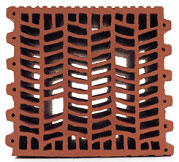
Today, masonry enclosures and partition walls are mainly made of clay units, but also aggregate concrete units (dense and lightweight aggregate) and autoclaved aerated concrete units are used. More recently, industry is also trying to introduce wood concrete blocks. Partition walls, made with both vertically and horizontally perforated clay blocks, represent two-thirds of the corresponding market.
Masonry enclosure walls systems, must meet some structural and non-structural requirements.
The requirements relating structural stability are currently defined and regulated by Eurocode 6 for load bearing masonry structures and by Eurocode 8 for seismic safety. These codes impose requirements for masonry walls, particularly non-collapse (in-plane/out of plane) and damage limitation, providing methods of calculation to ensure these two requirements. Some of the non-structural requirements are: fire safety, thermal comfort, acoustic comfort, durability and water leakage.
The safety against fire is one of the requirements that is often required to enclosures walls. However, as usually the more traditionally used materials (blocks, bricks and mortar) are not fuel products, it is relatively easy to achieve the requirements relating to the limitation of spread of fire, thermal insulation and structural strength, which in severe cases, must be guaranteed for 180 minutes.
The thermal comfort is a requirement with which the enclosure walls must comply. This requirement has a direct influence on the construction of the walls. The thermal regulations are demanding increasingly higher values of thermal resistance to the walls. To meet these demands new products and building systems, which ensure that the thermal resistances requested by the regulations will be provided, are developed. It is likely that in the near future traditional construction solutions with double leaf walls (with new, more thermally efficient bricks and blocks) will be adapted, and there will be increased use of thermal insulation systems for exterior (ETICS), such as use of single leaf walls. Also the use of insulation systems from the inside will increase. The development of new enclosure wall systems should, apart from trying to improve requisites relating to structural stability in case of earthquake, improve the thermal resistance of the solution.
To ensure durability and waterproofing, the most important thing is to avoid errors in design and construction, leading to the appearance of (structural and non-structural) pathologies. Some requisites that the walls must have in order to avoid pathologies are: adequate expansion joints, correct support of the walls in the correction of thermal bridges, appropriate clipping between masonry leafs, correct implementation of space between leafs, proper placement of thermal insulation. The proper use of paints, protection against moisture and the correct preparation and application of traditional plasters, among others, are important factors
Hub AI
Infill wall AI simulator
(@Infill wall_simulator)
Infill wall
The infill wall is the supported wall that closes the perimeter of a building constructed with a three-dimensional framework structure (generally made of steel or reinforced concrete). Therefore, the structural frame ensures the bearing function, whereas the infill wall serves to separate inner and outer space, filling up the boxes of the outer frames. The infill wall has the unique static function to bear its own weight. The infill wall is an external vertical opaque type of closure. With respect to other categories of wall, the infill wall differs from the partition that serves to separate two interior spaces, yet also non-load bearing, and from the load bearing wall. The latter performs the same functions of the infill wall, hygro-thermically and acoustically, but performs static functions too.
The use of masonry infill walls, and to some extent veneer walls, especially in reinforced concrete frame structures, is common in many countries. In fact, the use of masonry infill walls offers an economical and durable solution. They are easy to build, attractive for architecture and have a very efficient cost-performance.
Today, masonry enclosures and partition walls are mainly made of clay units, but also aggregate concrete units (dense and lightweight aggregate) and autoclaved aerated concrete units are used. More recently, industry is also trying to introduce wood concrete blocks. Partition walls, made with both vertically and horizontally perforated clay blocks, represent two-thirds of the corresponding market.
Masonry enclosure walls systems, must meet some structural and non-structural requirements.
The requirements relating structural stability are currently defined and regulated by Eurocode 6 for load bearing masonry structures and by Eurocode 8 for seismic safety. These codes impose requirements for masonry walls, particularly non-collapse (in-plane/out of plane) and damage limitation, providing methods of calculation to ensure these two requirements. Some of the non-structural requirements are: fire safety, thermal comfort, acoustic comfort, durability and water leakage.
The safety against fire is one of the requirements that is often required to enclosures walls. However, as usually the more traditionally used materials (blocks, bricks and mortar) are not fuel products, it is relatively easy to achieve the requirements relating to the limitation of spread of fire, thermal insulation and structural strength, which in severe cases, must be guaranteed for 180 minutes.
The thermal comfort is a requirement with which the enclosure walls must comply. This requirement has a direct influence on the construction of the walls. The thermal regulations are demanding increasingly higher values of thermal resistance to the walls. To meet these demands new products and building systems, which ensure that the thermal resistances requested by the regulations will be provided, are developed. It is likely that in the near future traditional construction solutions with double leaf walls (with new, more thermally efficient bricks and blocks) will be adapted, and there will be increased use of thermal insulation systems for exterior (ETICS), such as use of single leaf walls. Also the use of insulation systems from the inside will increase. The development of new enclosure wall systems should, apart from trying to improve requisites relating to structural stability in case of earthquake, improve the thermal resistance of the solution.
To ensure durability and waterproofing, the most important thing is to avoid errors in design and construction, leading to the appearance of (structural and non-structural) pathologies. Some requisites that the walls must have in order to avoid pathologies are: adequate expansion joints, correct support of the walls in the correction of thermal bridges, appropriate clipping between masonry leafs, correct implementation of space between leafs, proper placement of thermal insulation. The proper use of paints, protection against moisture and the correct preparation and application of traditional plasters, among others, are important factors
Recent media