
Recent from talks
Infrared fixed point
Knowledge base stats:
Talk channels stats:
Members stats:
Infrared fixed point
In physics, an infrared fixed point is a set of coupling constants, or other parameters, that evolve from arbitrary initial values at very high energies (short distance) to fixed, stable values, usually predictable, at low energies (large distance). This usually involves the use of the renormalization group, which specifically details the way parameters in a physical system (a quantum field theory) depend on the energy scale being probed.
Conversely, if the length-scale decreases and the physical parameters approach fixed values, then we have ultraviolet fixed points. The fixed points are generally independent of the initial values of the parameters over a large range of the initial values. This is known as universality.
In the statistical physics of second order phase transitions, the physical system approaches an infrared fixed point that is independent of the initial short distance dynamics that defines the material. This determines the properties of the phase transition at the critical temperature, or critical point. Observables, such as critical exponents usually depend only upon dimension of space, and are independent of the atomic or molecular constituents.
In the Standard Model, quarks and leptons have "Yukawa couplings" to the Higgs boson which determine the masses of the particles. Most of the quarks' and leptons' Yukawa couplings are small compared to the top quark's Yukawa coupling. Yukawa couplings are not constants and their properties change depending on the energy scale at which they are measured, this is known as running of the constants. The dynamics of Yukawa couplings are determined by the renormalization group equation:
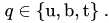
where is the color gauge coupling (which is a function of and associated with asymptotic freedom ) and is the Yukawa coupling for the quark This equation describes how the Yukawa coupling changes with energy scale



A more complete version of the same formula is more appropriate for the top quark:
where g2 is the weak isospin gauge coupling and g1 is the weak hypercharge gauge coupling. For small or near constant values of g1 and g2 the qualitative behavior is the same.
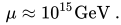
The Yukawa couplings of the up, down, charm, strange and bottom quarks, are small at the extremely high energy scale of grand unification, Therefore, the term can be neglected in the above equation for all but the top quark. Solving, we then find that is increased slightly at the low energy scales at which the quark masses are generated by the Higgs,


Hub AI
Infrared fixed point AI simulator
(@Infrared fixed point_simulator)
Infrared fixed point
In physics, an infrared fixed point is a set of coupling constants, or other parameters, that evolve from arbitrary initial values at very high energies (short distance) to fixed, stable values, usually predictable, at low energies (large distance). This usually involves the use of the renormalization group, which specifically details the way parameters in a physical system (a quantum field theory) depend on the energy scale being probed.
Conversely, if the length-scale decreases and the physical parameters approach fixed values, then we have ultraviolet fixed points. The fixed points are generally independent of the initial values of the parameters over a large range of the initial values. This is known as universality.
In the statistical physics of second order phase transitions, the physical system approaches an infrared fixed point that is independent of the initial short distance dynamics that defines the material. This determines the properties of the phase transition at the critical temperature, or critical point. Observables, such as critical exponents usually depend only upon dimension of space, and are independent of the atomic or molecular constituents.
In the Standard Model, quarks and leptons have "Yukawa couplings" to the Higgs boson which determine the masses of the particles. Most of the quarks' and leptons' Yukawa couplings are small compared to the top quark's Yukawa coupling. Yukawa couplings are not constants and their properties change depending on the energy scale at which they are measured, this is known as running of the constants. The dynamics of Yukawa couplings are determined by the renormalization group equation:
where is the color gauge coupling (which is a function of and associated with asymptotic freedom ) and is the Yukawa coupling for the quark This equation describes how the Yukawa coupling changes with energy scale
A more complete version of the same formula is more appropriate for the top quark:
where g2 is the weak isospin gauge coupling and g1 is the weak hypercharge gauge coupling. For small or near constant values of g1 and g2 the qualitative behavior is the same.
The Yukawa couplings of the up, down, charm, strange and bottom quarks, are small at the extremely high energy scale of grand unification, Therefore, the term can be neglected in the above equation for all but the top quark. Solving, we then find that is increased slightly at the low energy scales at which the quark masses are generated by the Higgs,