
Recent from talks
Inrush current
Knowledge base stats:
Talk channels stats:
Members stats:
Inrush current
Inrush current, input surge current, or switch-on surge is the maximal instantaneous input current drawn by an electrical device when first turned on. Alternating-current electric motors and transformers may draw several times their normal full-load current when first energized, for a few cycles of the input waveform. Power converters also often have inrush currents much higher than their steady-state currents, due to the charging current of the input capacitance. The selection of over-current-protection devices such as fuses and circuit breakers is made more complicated when high inrush currents must be tolerated. The over-current protection must react quickly to overload or short-circuit faults but must not interrupt the circuit when the (usually harmless) inrush current flows.
A discharged or partially charged capacitor appears as a short circuit to the source when the source voltage is higher than the potential of the capacitor. A fully discharged capacitor will take approximately 5 RC time periods to fully charge; during the charging period, instantaneous current can exceed steady-state current by a substantial multiple. Instantaneous current declines to steady-state current as the capacitor reaches full charge. In the case of open circuit, the capacitor will be charged to the peak AC voltage (one cannot actually charge a capacitor with AC line power, so this refers to a varying but unidirectional voltage; e.g., the voltage output from a rectifier).
In the case of charging a capacitor from a linear DC voltage, like that from a battery, the capacitor will still appear as a short circuit; it will draw current from the source limited only by the internal resistance of the source and ESR of the capacitor. In this case, charging current will be continuous and decline exponentially to the load current. For open circuit, the capacitor will be charged to the DC voltage.
Safeguarding against the filter capacitor’s charging period’s initial current inrush flow is crucial for the performance of the device. Temporarily introducing a high resistance between the input power and rectifier can increase the resistance of the powerup, leading to reducing the inrush current. Using an inrush current limiter for this purpose helps, as it can provide the initial resistance needed.
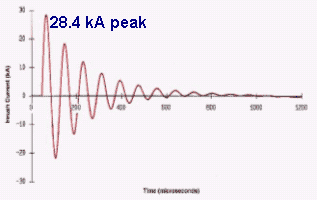
When a transformer is first energized, a transient current up to 10 to 15 times larger than the rated transformer current can flow for several cycles. Toroidal transformers, using less copper for the same power handling, can have up to 60 times inrush to running current. Worst-case inrush happens when the primary winding is connected at an instant around the zero crossing of the primary voltage (which for a pure inductance would be the current maximum in the AC cycle) and if the polarity of the voltage half-cycle has the same polarity as the remanence in the iron core has (the magnetic remanence was left high from a preceding half cycle). Unless the windings and core are sized to normally never exceed 50% of saturation (and in an efficient transformer they never are, such a construction would be overly heavy and inefficient), then during such a start-up the core will be saturated. This can also be expressed as the remnant magnetism in normal operation is nearly as high as the saturation magnetism at the "knee" of the hysteresis loop. Once the core saturates, however, the winding inductance appears greatly reduced, and only the resistance of the primary-side windings and the impedance of the power line are limiting the current. As saturation occurs for part half-cycles only, harmonic-rich waveforms can be generated and can cause problems to other equipment. For large transformers with low winding resistance and high inductance, these inrush currents can last for several seconds until the transient has died away (decay time proportional to XL/R) and the regular AC equilibrium is established. To avoid magnetic inrush, only for transformers with an air gap in the core, the inductive load needs to be synchronously connected near a supply voltage peak, in contrast with the zero-voltage switching, which is desirable to minimize sharp-edged current transients with resistive loads such as high-power heaters. But for toroidal transformers only a premagnetising procedure before switching on allows to start those transformers without any inrush-current peak.
Inrush current can be divided in three categories:
When an electric motor, AC or DC, is first energized, the rotor is not moving, and a current equivalent to the stalled current will flow, reducing as the motor picks up speed and develops a back EMF to oppose the supply. AC induction motors behave as transformers with a shorted secondary until the rotor begins to move, while brushed motors present essentially the winding resistance. The duration of the starting transient is less if the mechanical load on the motor is relieved until it has picked up speed.
For high-power motors, the winding configuration may be changed (wye at start and then delta) during start-up to reduce the current drawn.
Hub AI
Inrush current AI simulator
(@Inrush current_simulator)
Inrush current
Inrush current, input surge current, or switch-on surge is the maximal instantaneous input current drawn by an electrical device when first turned on. Alternating-current electric motors and transformers may draw several times their normal full-load current when first energized, for a few cycles of the input waveform. Power converters also often have inrush currents much higher than their steady-state currents, due to the charging current of the input capacitance. The selection of over-current-protection devices such as fuses and circuit breakers is made more complicated when high inrush currents must be tolerated. The over-current protection must react quickly to overload or short-circuit faults but must not interrupt the circuit when the (usually harmless) inrush current flows.
A discharged or partially charged capacitor appears as a short circuit to the source when the source voltage is higher than the potential of the capacitor. A fully discharged capacitor will take approximately 5 RC time periods to fully charge; during the charging period, instantaneous current can exceed steady-state current by a substantial multiple. Instantaneous current declines to steady-state current as the capacitor reaches full charge. In the case of open circuit, the capacitor will be charged to the peak AC voltage (one cannot actually charge a capacitor with AC line power, so this refers to a varying but unidirectional voltage; e.g., the voltage output from a rectifier).
In the case of charging a capacitor from a linear DC voltage, like that from a battery, the capacitor will still appear as a short circuit; it will draw current from the source limited only by the internal resistance of the source and ESR of the capacitor. In this case, charging current will be continuous and decline exponentially to the load current. For open circuit, the capacitor will be charged to the DC voltage.
Safeguarding against the filter capacitor’s charging period’s initial current inrush flow is crucial for the performance of the device. Temporarily introducing a high resistance between the input power and rectifier can increase the resistance of the powerup, leading to reducing the inrush current. Using an inrush current limiter for this purpose helps, as it can provide the initial resistance needed.
When a transformer is first energized, a transient current up to 10 to 15 times larger than the rated transformer current can flow for several cycles. Toroidal transformers, using less copper for the same power handling, can have up to 60 times inrush to running current. Worst-case inrush happens when the primary winding is connected at an instant around the zero crossing of the primary voltage (which for a pure inductance would be the current maximum in the AC cycle) and if the polarity of the voltage half-cycle has the same polarity as the remanence in the iron core has (the magnetic remanence was left high from a preceding half cycle). Unless the windings and core are sized to normally never exceed 50% of saturation (and in an efficient transformer they never are, such a construction would be overly heavy and inefficient), then during such a start-up the core will be saturated. This can also be expressed as the remnant magnetism in normal operation is nearly as high as the saturation magnetism at the "knee" of the hysteresis loop. Once the core saturates, however, the winding inductance appears greatly reduced, and only the resistance of the primary-side windings and the impedance of the power line are limiting the current. As saturation occurs for part half-cycles only, harmonic-rich waveforms can be generated and can cause problems to other equipment. For large transformers with low winding resistance and high inductance, these inrush currents can last for several seconds until the transient has died away (decay time proportional to XL/R) and the regular AC equilibrium is established. To avoid magnetic inrush, only for transformers with an air gap in the core, the inductive load needs to be synchronously connected near a supply voltage peak, in contrast with the zero-voltage switching, which is desirable to minimize sharp-edged current transients with resistive loads such as high-power heaters. But for toroidal transformers only a premagnetising procedure before switching on allows to start those transformers without any inrush-current peak.
Inrush current can be divided in three categories:
When an electric motor, AC or DC, is first energized, the rotor is not moving, and a current equivalent to the stalled current will flow, reducing as the motor picks up speed and develops a back EMF to oppose the supply. AC induction motors behave as transformers with a shorted secondary until the rotor begins to move, while brushed motors present essentially the winding resistance. The duration of the starting transient is less if the mechanical load on the motor is relieved until it has picked up speed.
For high-power motors, the winding configuration may be changed (wye at start and then delta) during start-up to reduce the current drawn.
Recent media