
.svg/250px-RC_Series_Filter_(with_V&I_Labels).svg.png)


.svg/2000px-RC_Series_Filter_(with_V&I_Labels).svg.png)
Community hub
Recent from talks
Contribute something
Nothing was collected or created yet.
RC time constant
View on WikipediaThe RC time constant, denoted τ (lowercase tau), the time constant of a resistor–capacitor circuit (RC circuit), is equal to the product of the circuit resistance and the circuit capacitance:

.svg)
It is the time required to charge the capacitor, through the resistor, from an initial charge voltage of zero to approximately 63.2% of the value of an applied DC voltage, or to discharge the capacitor through the same resistor to approximately 36.8% of its initial charge voltage. These values are derived from the mathematical constant e, where and . When using the International System of Units, R is in ohms, C is in farads, and τ is in seconds.

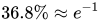
Discharging a capacitor through a series resistor to zero volts from an initial voltage of V0 results in the capacitor having the following exponentially-decaying voltage curve:

Charging an uncharged capacitor through a series resistor to an applied constant input voltage V0 results in the capacitor having the following voltage curve over time:

which is a vertical mirror image of the charging curve.
Cutoff frequency
[edit]The time constant is related to the RC circuit's cutoff frequency fc, by


or, equivalently,

Using resistance in ohms and capacitance in farads yields a time constant in seconds and cutoff frequency in hertz (Hz). The cutoff frequency when expressed as an angular frequency is simply the reciprocal of the time constant.

In more complicated circuits consisting of more than one resistor and/or capacitor, the open-circuit time constant method provides a way of approximating the cutoff frequency by computing a sum of several RC time constants.
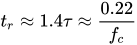
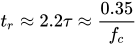
A rise time that depends primarily on an RC circuit will be proportional to the time constant:
- rise time (20% to 80%)
- rise time (10% to 90%)
Calculator
[edit]
For instance, 1 of resistance with 1 of capacitance produces a time constant of approximately 1 seconds. This τ corresponds to a cutoff frequency of approximately 159 millihertz or 1 radians per second. If the capacitor has an initial voltage V0 of 1 , then after 1 τ (approximately 1 seconds or 1.443 half-lives), the capacitor's voltage will discharge to approximately 368 millivolts:


The tangent of the voltage hits the zero axis at a time .


Delay
[edit]The signal delay of a wire or other circuit, measured as group delay or phase delay or the effective propagation delay of a digital transition, may be dominated by resistive-capacitive effects, depending on the distance and other parameters, or may alternatively be dominated by inductive, wave, and speed of light effects in other realms.
Resistive-capacitive delay (RC delay) hinders microelectronic integrated circuit (IC) speed improvements. As semiconductor feature size becomes smaller and smaller to increase the clock rate, the RC delay plays an increasingly important role. This delay can be reduced by replacing the aluminum conducting wire by copper to reduce resistance or by changing the interlayer dielectric (typically silicon dioxide) to low-dielectric-constant materials to reduce capacitance.
The typical digital propagation delay of a resistive wire is about half of R times C; since both R and C are proportional to wire length, the delay scales as the square of wire length. Charge spreads by diffusion in such a wire, as explained by Lord Kelvin in the mid-nineteenth century.[1] Until Heaviside discovered that Maxwell's equations imply wave propagation when sufficient inductance is in the circuit, this square diffusion relationship was thought to provide a fundamental limit to the improvement of long-distance telegraph cables. That old analysis was superseded in the telegraph domain, but remains relevant for long on-chip interconnects.[2][3][4]
See also
[edit]References
[edit]- ^ Andrew Gray (1908). Lord Kelvin. Dent. p. 265.
- ^ Ido Yavetz (1995). From Obscurity to Enigma. Birkhäuser. ISBN 3-7643-5180-2.
- ^ Jari Nurmi; Hannu Tenhunen; Jouni Isoaho & Axel Jantsch (2004). Interconnect-centric Design for Advanced SoC and NoC. Springer. ISBN 1-4020-7835-8.
- ^ Scott Hamilton (2007). An Analog Electronics Companion. Cambridge University Press. ISBN 978-0-521-68780-5.
External links
[edit]RC time constant
View on GrokipediaFundamentals
Definition
An RC circuit consists of a resistor and a capacitor connected in series, forming a fundamental building block in electronics for applications involving timing and transient responses.[6] The RC time constant, denoted by τ, is defined as the product of the resistance R and capacitance C in the circuit, τ = RC.[7] This parameter represents the characteristic time scale over which the voltage across the capacitor changes in response to a step input. Specifically, during the charging process, τ is the time required for the capacitor voltage to reach approximately 63% (more precisely, 1 - 1/e ≈ 0.632) of its final steady-state value.[7] Conversely, during discharging, it is the time for the voltage to decay to about 37% (1/e ≈ 0.368) of its initial value.[2] Physically, the time constant τ quantifies the speed at which the circuit responds to voltage changes, governed by the capacitor's ability to store charge and the resistor's opposition to current flow. A larger τ indicates a slower response, as more time is needed for charge to accumulate or dissipate, limiting the circuit's transient dynamics. These changes follow an exponential form, reflecting the first-order nature of the system. In terms of units, τ is measured in seconds (s), with R in ohms (Ω) and C in farads (F), ensuring dimensional consistency since 1 Ω × 1 F = 1 s.Derivation
The derivation of the RC time constant begins with Kirchhoff's voltage law applied to a series RC circuit consisting of a resistor and capacitor . For a charging configuration with a constant DC voltage source , the law states that the source voltage equals the sum of the voltage drops across the resistor and capacitor: where is the current through the circuit and is the voltage across the capacitor.[8][9] The relationship between current and capacitor voltage is given by , as the capacitor's charge and . Substituting this into the voltage equation yields Rearranging terms produces the first-order linear differential equation [10][11] This differential equation has the standard form , where and are constants. The integrating factor is . Multiplying through by the integrating factor and integrating both sides with respect to time gives where is the constant of integration. Solving for yields the general solution Applying the initial condition for an uncharged capacitor determines , resulting in The exponential term identifies the time constant .[12][13] For the discharging case, the voltage source is removed, leaving the resistor and capacitor in a closed loop with initial capacitor voltage . Kirchhoff's voltage law simplifies to , or equivalently, The solution follows similarly, yielding , where again appears as the coefficient in the exponential decay. This demonstrates the symmetry of the time constant for both charging and discharging under ideal assumptions of lossless components with no parasitic effects or initial charge specified beyond the standard cases.[9][8]Time-Domain Behavior
Charging Process
In the charging process of an RC circuit, an initially uncharged capacitor is connected to a DC voltage source through a resistor , leading to a transient response where the capacitor voltage rises exponentially from zero toward the steady-state value . The time constant characterizes the rate of this charging, with in ohms and in farads, yielding in seconds./University_Physics_II_-Thermodynamics_Electricity_and_Magnetism(OpenStax)/10%3A_Direct-Current_Circuits/10.06%3A_RC_Circuits)[14] The voltage across the capacitor during charging is given by where is time in seconds. This equation describes how approaches asymptotically, never quite reaching it in finite time but getting arbitrarily close./University_Physics_II_-Thermodynamics_Electricity_and_Magnetism(OpenStax)/10%3A_Direct-Current_Circuits/10.06%3A_RC_Circuits)[14] The current through the circuit, which flows from the source through the resistor to charge the capacitor, starts at its maximum value and decays exponentially: Initially, at , , and it decreases as the capacitor charges, reaching zero in steady state when ./University_Physics_II_-Thermodynamics_Electricity_and_Magnetism(OpenStax)/10%3A_Direct-Current_Circuits/10.06%3A_RC_Circuits)[14] Key milestones in the charging process highlight the role of : at , reaches approximately 63.2% of , marking the time for significant initial charging; by , has reached about 99.3% of , considered effectively fully charged for most practical purposes. These percentages arise directly from the exponential term , with leaving 63.2% uncharged at one , and leaving only 0.7% uncharged at five .[15] During charging, energy from the voltage source is partitioned between storage in the capacitor's electric field and dissipation as heat in the resistor. The total energy supplied by the source over the full charging period is , of which half, , is stored in the capacitor, and the other half is dissipated in the resistor via Joule heating. The instantaneous power dissipated in the resistor is , while the rate of energy storage in the capacitor is .[16][17] Graphically, the charging curves for and versus time form characteristic exponential shapes: exhibits a concave-down rise starting at 0 and flattening toward , while shows a concave-up decay from to 0, both governed by the same scale on the time axis. These plots illustrate the smooth, non-linear transition to steady state without oscillations.[18][9]Discharging Process
In the discharging process of an RC circuit, a capacitor initially charged to a voltage is connected in series with a resistor, forming a closed loop without an external voltage source, which allows the capacitor to release its stored charge through the resistor. The voltage across the capacitor decays exponentially as the charge dissipates, following the differential equation derived from Kirchhoff's voltage law and the capacitor's current-voltage relationship. This transient behavior is characterized by the time constant , where is the resistance and is the capacitance.[13] The voltage across the discharging capacitor is expressed as where is the time elapsed since discharge begins. The corresponding current through the resistor, which flows in the direction opposite to the charging current, is These expressions highlight the exponential nature of the decay, with the initial current magnitude decreasing over time. Key milestones in the process include the voltage dropping to approximately 37% of (precisely ) at , and to about 0.7% of (precisely ) at , after which the capacitor is considered effectively discharged for most practical purposes.[19][20] The time constant that governs this discharging decay is identical to that in the charging process, underscoring the inherent symmetry of the RC circuit's transient response despite the differing initial and steady-state conditions. In practical applications, such as timing circuits for delays, oscillators, or pulse generation, the predictable residual voltage after multiples of enables precise control of signal timing and duration.[15][21]Frequency-Domain Applications
Cutoff Frequency
In the frequency domain, the RC time constant τ relates directly to the cutoff frequency f_c of an RC low-pass filter, defined as f_c = 1/(2πτ) = 1/(2πRC). This frequency marks the -3 dB point, where the power gain drops to half (or voltage gain to 1/√2 ≈ 0.707) of its low-frequency value, signifying the transition from the passband to the stopband.[22][23] The derivation bridges the time-domain time constant to the frequency domain through the circuit's transfer function. For an RC low-pass filter, the transfer function is H(jω) = 1 / (1 + jωτ), where ω is the angular frequency and τ = RC. The magnitude |H(jω)| = 1 / √(1 + (ωτ)^2) reaches -3 dB when ωτ = 1, yielding the angular cutoff frequency ω_c = 1/τ. Since ω = 2πf, the cutoff frequency follows as f_c = ω_c / (2π) = 1/(2πτ). This pole location at s = -1/τ in the s-plane corresponds to the break frequency in the frequency response.[24][25][26] The cutoff frequency determines the filter's frequency-selective behavior: signals with frequencies well below f_c experience minimal attenuation (gain approximately 1), while those above f_c are progressively attenuated. In the Bode magnitude plot, the response is flat (0 dB) in the passband and exhibits a roll-off of -20 dB per decade for frequencies much higher than f_c, characteristic of a first-order filter.[27] The cutoff frequency is expressed in hertz (Hz). In practical applications, such as audio signal processing, typical values range from 3 kHz for voice bandwidth limiting in telecommunications to 20 kHz for low-pass filters preserving the audible spectrum up to the limit of human hearing. In general signal processing, a cutoff around 1 kHz might be used for smoothing moderate-frequency noise.[28][29][27]Filter Response
In low-pass RC filters, the RC time constant fundamentally shapes the frequency response by determining the transition from the passband to the stopband. The transfer function is expressed aswhere is the angular frequency and . The magnitude of this transfer function is
which approaches unity for frequencies much lower than (allowing low-frequency signals to pass unattenuated) and rolls off asymptotically as for high frequencies, attenuating them progressively.[30] For high-pass RC filters, the configuration inverts the low-pass response, emphasizing high frequencies while suppressing low ones, with the time constant similarly governing the transition. The transfer function is
This results in a magnitude
which is near zero at low frequencies and approaches unity at high frequencies, effectively blocking DC and low-frequency components.[31][32] The phase response in these filters introduces a shift dependent on , affecting signal timing in applications. For the low-pass filter, the phase shift is
starting at 0° for DC and approaching -90° at high frequencies, with a notable -45° shift occurring precisely at . This lag can distort waveforms containing multiple frequencies but is characteristic of the filter's first-order nature. The high-pass filter exhibits a complementary leading phase shift from +90° at low frequencies to 0° at high frequencies.[33][34] In signal processing, RC filters leverage these frequency-dependent behaviors for practical tasks such as smoothing signals to remove high-frequency noise or approximating integrators (low-pass) and differentiators (high-pass). Low-pass configurations are commonly employed for noise reduction by limiting bandwidth to preserve the signal's core content while attenuating unwanted fluctuations, as seen in instrumentation and audio systems. High-pass filters facilitate edge detection or AC coupling by emphasizing transient changes.[35][36] Despite their simplicity, RC filters are limited as first-order systems, providing only a moderate 6 dB/octave roll-off without an ideal sharp cutoff, which can allow some stopband leakage compared to higher-order filters that achieve steeper attenuation for more precise frequency separation.[24]