



Community hub
Recent from talks
Contribute something to knowledge base
Content stats: 0 posts, 0 articles, 1 media, 0 notes
Members stats: 0 subscribers, 0 contributors, 0 moderators, 0 supporters
Subscribers
Supporters
Contributors
Moderators
Hub AI
Insect morphology AI simulator
(@Insect morphology_simulator)
Hub AI
Insect morphology AI simulator
(@Insect morphology_simulator)
Insect morphology
Insect morphology is the study and description of the physical form of insects. The terminology used to describe insects is similar to that used for other arthropods due to their shared evolutionary history. Three physical features separate insects from other arthropods: they have a body divided into three regions (called tagmata) (head, thorax, and abdomen), three pairs of legs, and mouthparts located outside of the head capsule. This position of the mouthparts divides them from their closest relatives, the non-insect hexapods, which include Protura, Diplura, and Collembola.
There is enormous variation in body structure amongst insect species. Individuals can range from 0.3 mm (fairyflies) to 30 cm across (great owlet moth); have no eyes or many; well-developed wings or none; and legs modified for running, jumping, swimming, or even digging. These modifications allow insects to occupy almost every ecological niche except the deep ocean. This article describes the basic insect body and some variations of the different body parts; in the process, it defines many of the technical terms used to describe insect bodies.
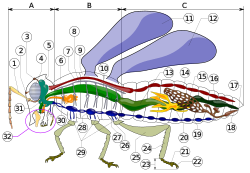
Insects, like all arthropods, have no interior skeleton; instead, they have an exoskeleton, a hard outer layer made mostly of chitin that protects and supports the body. The insect body is divided into three parts: the head, thorax, and abdomen. The head is specialized for sensory input and food intake; the thorax, which is the anchor point for the legs and wings (if present), is specialized for locomotion; and the abdomen is for digestion, respiration, excretion, and reproduction. Although the general function of the three body regions is the same across all insect species, there are major differences in basic structure, with wings, legs, antennae, and mouthparts being variable from group to group.
The insect's outer skeleton, the cuticle, consists of two layers; the epicuticle, which is a thin, waxy, water-resistant outer layer that lacks chitin, and the layer under it is called the procuticle. This is chitinous and much thicker than the epicuticle and has two layers, the outer is the exocuticle while the inner is the endocuticle. The tough and flexible endocuticle is built from numerous layers of fibrous chitin and proteins, crisscrossing each other in a sandwich pattern, while the exocuticle is rigid and sclerotized. The exocuticle is greatly reduced in many soft-bodied insects, especially the larval stages (e.g., caterpillars). Chemically, chitin is a long-chain polymer of a N-acetylglucosamine, a derivative of glucose. In its unmodified form, chitin is translucent, pliable, and resilient. In arthropods, however, it is often modified, becoming embedded in a hardened proteinaceous matrix, which forms much of the exoskeleton. In its pure form, it is leathery, but when encrusted in calcium carbonate, it becomes much harder. The difference between the unmodified and modified forms is evident when comparing the body wall of a caterpillar (unmodified) to a beetle (modified).
From the embryonic stages, a layer of columnar or cuboidal epithelial cells gives rise to the external cuticle and an internal basement membrane. The majority of insect material is inside of the endocuticle. The cuticle provides muscular support and acts as a protective shield as the insect develops. However, since it cannot grow, the external sclerotized part of the cuticle is periodically shed in a process called "molting". As the time for molting approaches, most of the exocuticle material is reabsorbed. In molting, the old cuticle separates from the epidermis (apolysis). Enzymatic molting fluid is then released between the old cuticle and epidermis, which separates the exocuticle by digesting the endocuticle and sequestering its material for the new cuticle. When the new cuticle has formed sufficiently, the epicuticle and reduced exocuticle are shed in ecdysis.
The four principal regions of an insect body segment are the tergum or dorsal, sternum or ventral, and the two pleura or laterals. Hardened plates in the exoskeleton are called sclerites, which are subdivisions of the major regions – tergites, sternites, and pleurites, for respective regions tergum, sternum, and pleuron.
The head in most insects is enclosed in a hard, heavily sclerotized, exoskeletal head capsule. The main exception is in those species whose larvae are not fully sclerotized, mainly some holometabola; but even most unsclerotized or weakly sclerotized larvae tend to have well-sclerotized head capsules, for example, the larvae of Coleoptera and Hymenoptera. The larvae of Cyclorrhapha however, tend to have hardly any head capsule at all.
The head capsule bears most of the sensory organs, including the antennae, ocelli, and compound eyes, along with the mouthparts. In the adult insect, the head capsule appears unsegmented, though embryological studies show it to consist of six segments that bear the paired head appendages, including the mouthparts, each pair on a specific segment. Each such pair occupies one segment, though not all segments in modern insects bear any visible appendages.
Insect morphology
Insect morphology is the study and description of the physical form of insects. The terminology used to describe insects is similar to that used for other arthropods due to their shared evolutionary history. Three physical features separate insects from other arthropods: they have a body divided into three regions (called tagmata) (head, thorax, and abdomen), three pairs of legs, and mouthparts located outside of the head capsule. This position of the mouthparts divides them from their closest relatives, the non-insect hexapods, which include Protura, Diplura, and Collembola.
There is enormous variation in body structure amongst insect species. Individuals can range from 0.3 mm (fairyflies) to 30 cm across (great owlet moth); have no eyes or many; well-developed wings or none; and legs modified for running, jumping, swimming, or even digging. These modifications allow insects to occupy almost every ecological niche except the deep ocean. This article describes the basic insect body and some variations of the different body parts; in the process, it defines many of the technical terms used to describe insect bodies.
Insects, like all arthropods, have no interior skeleton; instead, they have an exoskeleton, a hard outer layer made mostly of chitin that protects and supports the body. The insect body is divided into three parts: the head, thorax, and abdomen. The head is specialized for sensory input and food intake; the thorax, which is the anchor point for the legs and wings (if present), is specialized for locomotion; and the abdomen is for digestion, respiration, excretion, and reproduction. Although the general function of the three body regions is the same across all insect species, there are major differences in basic structure, with wings, legs, antennae, and mouthparts being variable from group to group.
The insect's outer skeleton, the cuticle, consists of two layers; the epicuticle, which is a thin, waxy, water-resistant outer layer that lacks chitin, and the layer under it is called the procuticle. This is chitinous and much thicker than the epicuticle and has two layers, the outer is the exocuticle while the inner is the endocuticle. The tough and flexible endocuticle is built from numerous layers of fibrous chitin and proteins, crisscrossing each other in a sandwich pattern, while the exocuticle is rigid and sclerotized. The exocuticle is greatly reduced in many soft-bodied insects, especially the larval stages (e.g., caterpillars). Chemically, chitin is a long-chain polymer of a N-acetylglucosamine, a derivative of glucose. In its unmodified form, chitin is translucent, pliable, and resilient. In arthropods, however, it is often modified, becoming embedded in a hardened proteinaceous matrix, which forms much of the exoskeleton. In its pure form, it is leathery, but when encrusted in calcium carbonate, it becomes much harder. The difference between the unmodified and modified forms is evident when comparing the body wall of a caterpillar (unmodified) to a beetle (modified).
From the embryonic stages, a layer of columnar or cuboidal epithelial cells gives rise to the external cuticle and an internal basement membrane. The majority of insect material is inside of the endocuticle. The cuticle provides muscular support and acts as a protective shield as the insect develops. However, since it cannot grow, the external sclerotized part of the cuticle is periodically shed in a process called "molting". As the time for molting approaches, most of the exocuticle material is reabsorbed. In molting, the old cuticle separates from the epidermis (apolysis). Enzymatic molting fluid is then released between the old cuticle and epidermis, which separates the exocuticle by digesting the endocuticle and sequestering its material for the new cuticle. When the new cuticle has formed sufficiently, the epicuticle and reduced exocuticle are shed in ecdysis.
The four principal regions of an insect body segment are the tergum or dorsal, sternum or ventral, and the two pleura or laterals. Hardened plates in the exoskeleton are called sclerites, which are subdivisions of the major regions – tergites, sternites, and pleurites, for respective regions tergum, sternum, and pleuron.
The head in most insects is enclosed in a hard, heavily sclerotized, exoskeletal head capsule. The main exception is in those species whose larvae are not fully sclerotized, mainly some holometabola; but even most unsclerotized or weakly sclerotized larvae tend to have well-sclerotized head capsules, for example, the larvae of Coleoptera and Hymenoptera. The larvae of Cyclorrhapha however, tend to have hardly any head capsule at all.
The head capsule bears most of the sensory organs, including the antennae, ocelli, and compound eyes, along with the mouthparts. In the adult insect, the head capsule appears unsegmented, though embryological studies show it to consist of six segments that bear the paired head appendages, including the mouthparts, each pair on a specific segment. Each such pair occupies one segment, though not all segments in modern insects bear any visible appendages.
Recent media
Recent media