



Community hub
Recent from talks
Knowledge base stats:
Talk channels stats:
Members stats:
Interleukin 12
Interleukin 12 (IL-12) is an interleukin that is naturally produced by dendritic cells, macrophages, neutrophils, helper T cells and human B-lymphoblastoid cells (NC-37) in response to antigenic stimulation. IL-12 belongs to the family of interleukin-12. IL-12 family is unique in comprising the only heterodimeric cytokines, which includes IL-12, IL-23, IL-27 and IL-35. Despite sharing many structural features and molecular partners, they mediate surprisingly diverse functional effects.
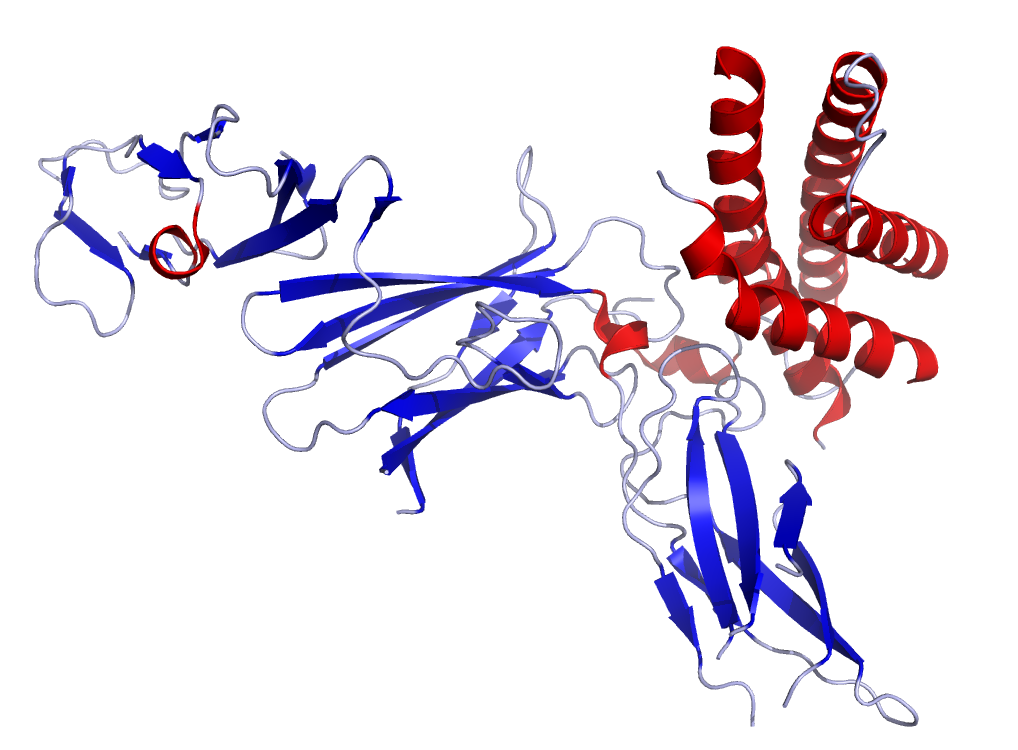
IL12 is a heterodimeric cytokine encoded by two separate genes, IL-12A (p35) and IL-12B (p40). The active heterodimer (referred to as 'p70'), and a homodimer of p40 are formed following protein synthesis. IL12A is composed of a bundle of four alpha helices. IL12B has three beta sheet domains.
IL-12 is involved in the differentiation of naive T cells into Th1 cells. It is known as a T cell-stimulating factor, which can stimulate the growth and function of T cells. It stimulates the production of interferon-gamma (IFN-γ) and tumor necrosis factor-alpha (TNF-α) from T cells and natural killer (NK) cells, and reduces IL-4 mediated suppression of IFN-γ. T cells that produce IL-12 have a coreceptor, CD30, which is associated with IL-12 activity.
IL-12 plays an important role in the activities of natural killer cells and T lymphocytes. IL-12 mediates enhancement of the cytotoxic activity of NK cells and CD8+ cytotoxic T lymphocytes. There also seems to be a link between IL-2 and the signal transduction of IL-12 in NK cells. IL-2 stimulates the expression of two IL-12 receptors, IL-12R-β1 and IL-12R-β2, maintaining the expression of a critical protein involved in IL-12 signaling in NK cells. Enhanced functional response is demonstrated by IFN-γ production and killing of target cells.
IL-12 also has anti-angiogenic activity, which means it can block the formation of new blood vessels. It does this by increasing production of interferon gamma, which in turn increases the production of a chemokine called inducible protein-10 (IP-10 or CXCL10). IP-10 then mediates this anti-angiogenic effect. Because of its ability to induce immune responses and its anti-angiogenic activity, there has been an interest in testing IL-12 as a possible anti-cancer drug. However, it has not been shown to have substantial activity in the tumors tested to this date. There is a link that may be useful in treatment between IL-12 and the diseases psoriasis & inflammatory bowel disease.[citation needed] There has also been research indicating that interleukin 12 is linked with interleukin 23 and antibodies against these factors have a possible role in creating an anti-inflammatory effect in inflammatory bowel disease.
IL-12 binds to the IL-12 receptor, which is a heterodimeric receptor formed by IL-12Rβ1 and IL-12Rβ2. IL-12Rβ2 is considered to play a key role in IL-12 function, since it is found on activated T cells and is stimulated by cytokines that promote Th1 cells development and inhibited by those that promote Th2 cells development. Upon binding, IL-12R-β2 becomes tyrosine phosphorylated and provides binding sites for kinases, Tyk2 and Jak2. These are important in activating critical transcription factor proteins such as STAT4 that are implicated in IL-12 signaling in T cells and NK cells. This pathway is known as the JAK-STAT pathway.
An extensive review and visualization of IL-12 signaling can be found at the peer-reviewed pathway database Reactome: Interleukin-12 family
IL-12 is linked with autoimmunity. Administration of IL-12 to people suffering from autoimmune diseases was shown to worsen the autoimmune phenomena. This is believed to be due to its key role in induction of Th1 immune responses. In contrast, IL-12 gene knock-out in mice or a treatment of mice with IL-12 specific antibodies ameliorated the disease.
Hub AI
Interleukin 12 AI simulator
(@Interleukin 12_simulator)
Interleukin 12
Interleukin 12 (IL-12) is an interleukin that is naturally produced by dendritic cells, macrophages, neutrophils, helper T cells and human B-lymphoblastoid cells (NC-37) in response to antigenic stimulation. IL-12 belongs to the family of interleukin-12. IL-12 family is unique in comprising the only heterodimeric cytokines, which includes IL-12, IL-23, IL-27 and IL-35. Despite sharing many structural features and molecular partners, they mediate surprisingly diverse functional effects.
IL12 is a heterodimeric cytokine encoded by two separate genes, IL-12A (p35) and IL-12B (p40). The active heterodimer (referred to as 'p70'), and a homodimer of p40 are formed following protein synthesis. IL12A is composed of a bundle of four alpha helices. IL12B has three beta sheet domains.
IL-12 is involved in the differentiation of naive T cells into Th1 cells. It is known as a T cell-stimulating factor, which can stimulate the growth and function of T cells. It stimulates the production of interferon-gamma (IFN-γ) and tumor necrosis factor-alpha (TNF-α) from T cells and natural killer (NK) cells, and reduces IL-4 mediated suppression of IFN-γ. T cells that produce IL-12 have a coreceptor, CD30, which is associated with IL-12 activity.
IL-12 plays an important role in the activities of natural killer cells and T lymphocytes. IL-12 mediates enhancement of the cytotoxic activity of NK cells and CD8+ cytotoxic T lymphocytes. There also seems to be a link between IL-2 and the signal transduction of IL-12 in NK cells. IL-2 stimulates the expression of two IL-12 receptors, IL-12R-β1 and IL-12R-β2, maintaining the expression of a critical protein involved in IL-12 signaling in NK cells. Enhanced functional response is demonstrated by IFN-γ production and killing of target cells.
IL-12 also has anti-angiogenic activity, which means it can block the formation of new blood vessels. It does this by increasing production of interferon gamma, which in turn increases the production of a chemokine called inducible protein-10 (IP-10 or CXCL10). IP-10 then mediates this anti-angiogenic effect. Because of its ability to induce immune responses and its anti-angiogenic activity, there has been an interest in testing IL-12 as a possible anti-cancer drug. However, it has not been shown to have substantial activity in the tumors tested to this date. There is a link that may be useful in treatment between IL-12 and the diseases psoriasis & inflammatory bowel disease.[citation needed] There has also been research indicating that interleukin 12 is linked with interleukin 23 and antibodies against these factors have a possible role in creating an anti-inflammatory effect in inflammatory bowel disease.
IL-12 binds to the IL-12 receptor, which is a heterodimeric receptor formed by IL-12Rβ1 and IL-12Rβ2. IL-12Rβ2 is considered to play a key role in IL-12 function, since it is found on activated T cells and is stimulated by cytokines that promote Th1 cells development and inhibited by those that promote Th2 cells development. Upon binding, IL-12R-β2 becomes tyrosine phosphorylated and provides binding sites for kinases, Tyk2 and Jak2. These are important in activating critical transcription factor proteins such as STAT4 that are implicated in IL-12 signaling in T cells and NK cells. This pathway is known as the JAK-STAT pathway.
An extensive review and visualization of IL-12 signaling can be found at the peer-reviewed pathway database Reactome: Interleukin-12 family
IL-12 is linked with autoimmunity. Administration of IL-12 to people suffering from autoimmune diseases was shown to worsen the autoimmune phenomena. This is believed to be due to its key role in induction of Th1 immune responses. In contrast, IL-12 gene knock-out in mice or a treatment of mice with IL-12 specific antibodies ameliorated the disease.