
Recent from talks
Interleukin 2
Knowledge base stats:
Talk channels stats:
Members stats:
Interleukin 2
Interleukin-2 (IL-2) is an interleukin, which is a type of cytokine signaling molecule forming part of the immune system. It regulates the activities of white blood cells (leukocytes, often lymphocytes) that are responsible for immunity. IL-2 is part of the body's natural response to microbial infection, and in discriminating between foreign ("non-self") and "self". IL-2 mediates its effects by binding to IL-2 receptors, which are expressed by lymphocytes. The major sources of IL-2 are activated CD4+ T cells and activated CD8+ T cells. Put shortly, the function of IL-2 is to stimulate the growth of helper, cytotoxic and regulatory T cells.
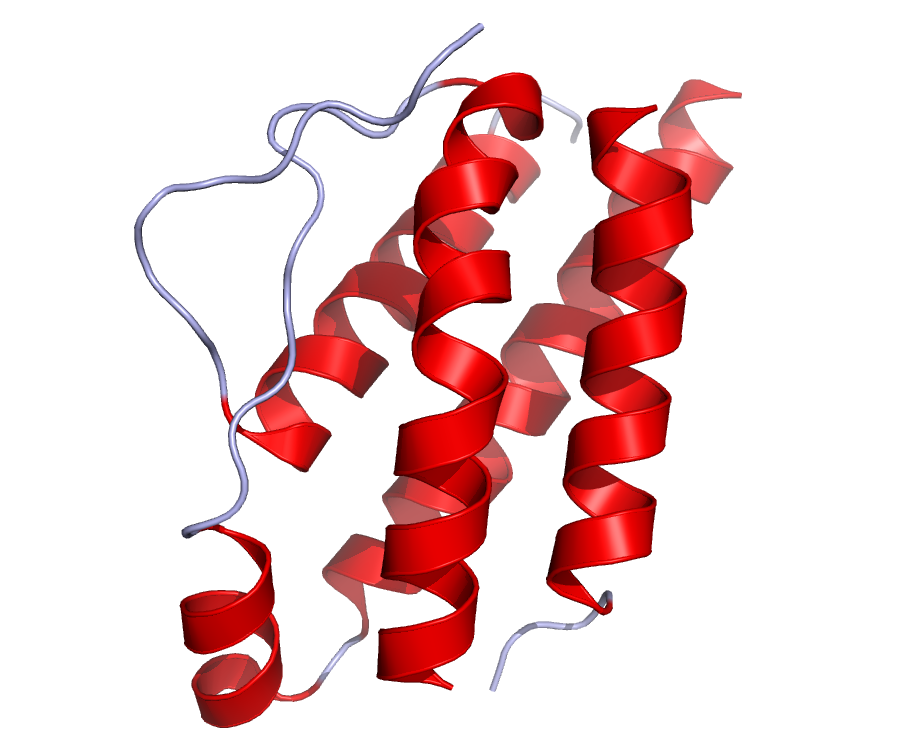
IL-2 is a 15.5–16 kDa protein that is a member of a specific family of cytokines, each member of which has a four alpha helix bundle; this cytokine family also includes IL-4, IL-7, IL-9, IL-15 and IL-21. IL-2 signals through a IL-2 receptor, a complex consisting of three chains, termed alpha (CD25), beta (CD122) and gamma (CD132). The gamma chain is common to all family members.
The IL-2 receptor (IL-2R) α subunit binds IL-2 with low affinity (Kd~ 10−8 M). Interaction of IL-2 and CD25 alone does not lead to signal transduction due to its short intracellular chain but has the ability (when bound to the β and γ subunit) to increase the IL-2R affinity 100-fold. Heterodimerization of the β and γ subunits of IL-2R is essential for signalling in T cells. IL-2 can signal either via intermediate-affinity dimeric CD122/CD132 IL-2R (Kd~ 10−9 M) or high-affinity trimeric CD25/CD122/CD132 IL-2R (Kd~ 10−11 M). Dimeric IL-2R is expressed by memory CD8+ T cells and NK cells, whereas regulatory T cells and activated T cells express high levels of trimeric IL-2R.
Instructions to express proteins in response to an IL-2 signal (called IL-2 transduction) can take place via 3 different signaling pathways; they are: (1) the JAK-STAT pathway, (2) the PI3K/Akt/mTOR pathway and (3) the MAPK/ERK pathway. The signalling is commenced by IL-2 binding to its receptor, following which cytoplasmatic domains of CD122 and CD132 heterodimerize. This leads to the activation of Janus kinases JAK1 and JAK3 which subsequently phosphorylate T338 on CD122. This phosphorylation recruits STAT transcription factors, predominantly STAT5, which dimerize and migrate to the cell nucleus where they bind to DNA. with an "express other proteins" signal. The proteins expressed by means of the three pathways include bcl-6 (the PI3K/Akt/mTOR pathway), CD25 & prdm-1 (the JAK-STAT pathway) and certain cyclins (the MAPK/ERK pathway).
Gene expression regulation for IL-2 can be on multiple levels or by different ways. One of the checkpoints (in other words one of the things which needs to be done before IL-2 is expressed) is that there must be signaling through a conjunction of a T Cell Receptor (a TCR) and an HLA-peptide complex. As a result of that conjunction a signalling pathway (signalling a cell's protein making machinery to express or 'make' IL-2), a PhosphoLipase-C (PLC) dependent pathway, is set up. PLC activates 3 major transcription factors and their pathways: NFAT, NFkB and AP-1. In addition and after costimulation from CD28 the optimal activation of expression of IL-2 and these pathways is induced. In summary therefore before a cell will make IL-2 in accordance with this pathway there have to be two reactions: TCR+HLA and protein complex on the one hand and CD28 costimulation on the other indeed mere IL-2 ligation to its receptor is too low affinity to enable pathway.
At the same time Oct-1 is expressed. It helps the activation. Oct1 is expressed in T-lymphocytes and Oct2 is induced after cell activation.
NFAT has multiple family members, all of them are located in cytoplasm and signaling goes through calcineurin, NFAT is dephosphorylated and therefore translocated to the nucleus.
AP-1 is a dimer and is composed of c-Jun and c-Fos proteins. It cooperates with other transcription factors including NFkB and Oct.
Hub AI
Interleukin 2 AI simulator
(@Interleukin 2_simulator)
Interleukin 2
Interleukin-2 (IL-2) is an interleukin, which is a type of cytokine signaling molecule forming part of the immune system. It regulates the activities of white blood cells (leukocytes, often lymphocytes) that are responsible for immunity. IL-2 is part of the body's natural response to microbial infection, and in discriminating between foreign ("non-self") and "self". IL-2 mediates its effects by binding to IL-2 receptors, which are expressed by lymphocytes. The major sources of IL-2 are activated CD4+ T cells and activated CD8+ T cells. Put shortly, the function of IL-2 is to stimulate the growth of helper, cytotoxic and regulatory T cells.
IL-2 is a 15.5–16 kDa protein that is a member of a specific family of cytokines, each member of which has a four alpha helix bundle; this cytokine family also includes IL-4, IL-7, IL-9, IL-15 and IL-21. IL-2 signals through a IL-2 receptor, a complex consisting of three chains, termed alpha (CD25), beta (CD122) and gamma (CD132). The gamma chain is common to all family members.
The IL-2 receptor (IL-2R) α subunit binds IL-2 with low affinity (Kd~ 10−8 M). Interaction of IL-2 and CD25 alone does not lead to signal transduction due to its short intracellular chain but has the ability (when bound to the β and γ subunit) to increase the IL-2R affinity 100-fold. Heterodimerization of the β and γ subunits of IL-2R is essential for signalling in T cells. IL-2 can signal either via intermediate-affinity dimeric CD122/CD132 IL-2R (Kd~ 10−9 M) or high-affinity trimeric CD25/CD122/CD132 IL-2R (Kd~ 10−11 M). Dimeric IL-2R is expressed by memory CD8+ T cells and NK cells, whereas regulatory T cells and activated T cells express high levels of trimeric IL-2R.
Instructions to express proteins in response to an IL-2 signal (called IL-2 transduction) can take place via 3 different signaling pathways; they are: (1) the JAK-STAT pathway, (2) the PI3K/Akt/mTOR pathway and (3) the MAPK/ERK pathway. The signalling is commenced by IL-2 binding to its receptor, following which cytoplasmatic domains of CD122 and CD132 heterodimerize. This leads to the activation of Janus kinases JAK1 and JAK3 which subsequently phosphorylate T338 on CD122. This phosphorylation recruits STAT transcription factors, predominantly STAT5, which dimerize and migrate to the cell nucleus where they bind to DNA. with an "express other proteins" signal. The proteins expressed by means of the three pathways include bcl-6 (the PI3K/Akt/mTOR pathway), CD25 & prdm-1 (the JAK-STAT pathway) and certain cyclins (the MAPK/ERK pathway).
Gene expression regulation for IL-2 can be on multiple levels or by different ways. One of the checkpoints (in other words one of the things which needs to be done before IL-2 is expressed) is that there must be signaling through a conjunction of a T Cell Receptor (a TCR) and an HLA-peptide complex. As a result of that conjunction a signalling pathway (signalling a cell's protein making machinery to express or 'make' IL-2), a PhosphoLipase-C (PLC) dependent pathway, is set up. PLC activates 3 major transcription factors and their pathways: NFAT, NFkB and AP-1. In addition and after costimulation from CD28 the optimal activation of expression of IL-2 and these pathways is induced. In summary therefore before a cell will make IL-2 in accordance with this pathway there have to be two reactions: TCR+HLA and protein complex on the one hand and CD28 costimulation on the other indeed mere IL-2 ligation to its receptor is too low affinity to enable pathway.
At the same time Oct-1 is expressed. It helps the activation. Oct1 is expressed in T-lymphocytes and Oct2 is induced after cell activation.
NFAT has multiple family members, all of them are located in cytoplasm and signaling goes through calcineurin, NFAT is dephosphorylated and therefore translocated to the nucleus.
AP-1 is a dimer and is composed of c-Jun and c-Fos proteins. It cooperates with other transcription factors including NFkB and Oct.
Recent media