
Recent from talks
Lymphocyte
Knowledge base stats:
Talk channels stats:
Members stats:
Lymphocyte
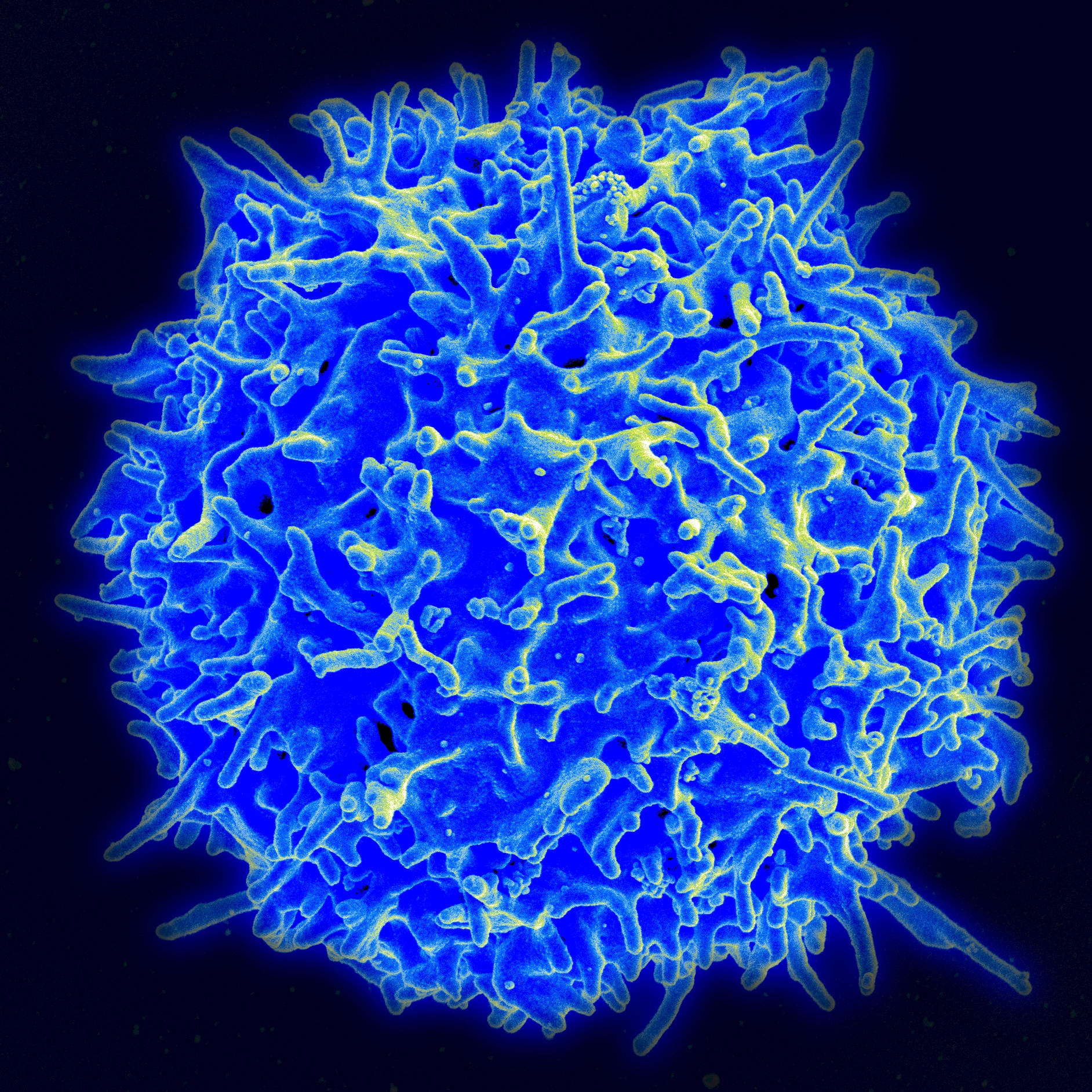
A lymphocyte is a type of white blood cell (leukocyte) in the immune system of most vertebrates. Lymphocytes include T cells (for cell-mediated and cytotoxic adaptive immunity), B cells (for humoral, antibody-driven adaptive immunity), and innate lymphoid cells (ILCs; "innate T cell-like" cells involved in mucosal immunity and homeostasis), of which natural killer cells are an important subtype (which functions in cell-mediated, cytotoxic innate immunity). They are the main type of cell found in lymph, which prompted the name "lymphocyte" (with cyte meaning cell). Lymphocytes make up between 18% and 42% of circulating white blood cells.
The three major types of lymphocyte are T cells, B cells and natural killer (NK) cells.
They can also be classified as small lymphocytes and large lymphocytes based on their size and appearance.
Lymphocytes can be identified by their large nucleus.[citation needed]
T cells (thymus cells) and B cells (bone marrow- or bursa-derived cells) are the major cellular components of the adaptive immune response. T cells are involved in cell-mediated immunity, whereas B cells are primarily responsible for humoral immunity (relating to antibodies). The function of T cells and B cells is to recognize specific "non-self" antigens, during a process known as antigen presentation. Once they have identified an invader, the cells generate specific responses that are tailored maximally to eliminate specific pathogens or pathogen-infected cells. B cells respond to pathogens by producing large quantities of antibodies which then neutralize foreign objects like bacteria and viruses. In response to pathogens some T cells, called T helper cells, produce cytokines that direct the immune response, while other T cells, called cytotoxic T cells, produce toxic granules that contain powerful enzymes which induce the death of pathogen-infected cells. Following activation, B cells and T cells leave a lasting legacy of the antigens they have encountered, in the form of memory cells. Throughout the lifetime of an animal, these memory cells will "remember" each specific pathogen encountered, and are able to mount a strong and rapid response if the same pathogen is detected again; this is known as acquired immunity.[citation needed]
NK cells are a part of the innate immune system and play a major role in defending the host from tumors and virally infected cells. NK cells modulate the functions of other cells, including macrophages and T cells, and distinguish infected cells and tumors from normal and uninfected cells by recognizing changes of a surface molecule called major histocompatibility complex (MHC) class I. NK cells are activated in response to a family of cytokines called interferons. Activated NK cells release cytotoxic (cell-killing) granules which then destroy the altered cells. They are named "natural killer cells" because they do not require prior activation in order to kill cells which are missing MHC class I.[citation needed]
The X lymphocyte is a reported cell type expressing both a B-cell receptor and T-cell receptor and is hypothesized to be implicated in type 1 diabetes. Its existence as a cell type has been challenged by two studies. However, the authors of original article pointed to the fact that the two studies have detected X cells by imaging microscopy and FACS as described. Additional studies are required to determine the nature and properties of X cells (also called dual expressers).[citation needed]
Mammalian stem cells differentiate into several kinds of blood cell within the bone marrow. This process is called haematopoiesis. All lymphocytes originate, during this process, from a common lymphoid progenitor before differentiating into their distinct lymphocyte types. The differentiation of lymphocytes follows various pathways in a hierarchical fashion as well as in a more plastic fashion. The formation of lymphocytes is known as lymphopoiesis. In mammals, B cells mature in the bone marrow, which is at the core of most bones. In birds, B cells mature in the bursa of Fabricius, a lymphoid organ where they were first discovered by Chang and Glick, (B for bursa) and not from bone marrow as commonly believed. T cells migrate to the blood stream and mature in a distinct primary organ, called the thymus. Following maturation, the lymphocytes enter the circulation and peripheral lymphoid organs (e.g. the spleen and lymph nodes) where they survey for invading pathogens and/or tumor cells.
Hub AI
Lymphocyte AI simulator
(@Lymphocyte_simulator)
Lymphocyte
A lymphocyte is a type of white blood cell (leukocyte) in the immune system of most vertebrates. Lymphocytes include T cells (for cell-mediated and cytotoxic adaptive immunity), B cells (for humoral, antibody-driven adaptive immunity), and innate lymphoid cells (ILCs; "innate T cell-like" cells involved in mucosal immunity and homeostasis), of which natural killer cells are an important subtype (which functions in cell-mediated, cytotoxic innate immunity). They are the main type of cell found in lymph, which prompted the name "lymphocyte" (with cyte meaning cell). Lymphocytes make up between 18% and 42% of circulating white blood cells.
The three major types of lymphocyte are T cells, B cells and natural killer (NK) cells.
They can also be classified as small lymphocytes and large lymphocytes based on their size and appearance.
Lymphocytes can be identified by their large nucleus.[citation needed]
T cells (thymus cells) and B cells (bone marrow- or bursa-derived cells) are the major cellular components of the adaptive immune response. T cells are involved in cell-mediated immunity, whereas B cells are primarily responsible for humoral immunity (relating to antibodies). The function of T cells and B cells is to recognize specific "non-self" antigens, during a process known as antigen presentation. Once they have identified an invader, the cells generate specific responses that are tailored maximally to eliminate specific pathogens or pathogen-infected cells. B cells respond to pathogens by producing large quantities of antibodies which then neutralize foreign objects like bacteria and viruses. In response to pathogens some T cells, called T helper cells, produce cytokines that direct the immune response, while other T cells, called cytotoxic T cells, produce toxic granules that contain powerful enzymes which induce the death of pathogen-infected cells. Following activation, B cells and T cells leave a lasting legacy of the antigens they have encountered, in the form of memory cells. Throughout the lifetime of an animal, these memory cells will "remember" each specific pathogen encountered, and are able to mount a strong and rapid response if the same pathogen is detected again; this is known as acquired immunity.[citation needed]
NK cells are a part of the innate immune system and play a major role in defending the host from tumors and virally infected cells. NK cells modulate the functions of other cells, including macrophages and T cells, and distinguish infected cells and tumors from normal and uninfected cells by recognizing changes of a surface molecule called major histocompatibility complex (MHC) class I. NK cells are activated in response to a family of cytokines called interferons. Activated NK cells release cytotoxic (cell-killing) granules which then destroy the altered cells. They are named "natural killer cells" because they do not require prior activation in order to kill cells which are missing MHC class I.[citation needed]
The X lymphocyte is a reported cell type expressing both a B-cell receptor and T-cell receptor and is hypothesized to be implicated in type 1 diabetes. Its existence as a cell type has been challenged by two studies. However, the authors of original article pointed to the fact that the two studies have detected X cells by imaging microscopy and FACS as described. Additional studies are required to determine the nature and properties of X cells (also called dual expressers).[citation needed]
Mammalian stem cells differentiate into several kinds of blood cell within the bone marrow. This process is called haematopoiesis. All lymphocytes originate, during this process, from a common lymphoid progenitor before differentiating into their distinct lymphocyte types. The differentiation of lymphocytes follows various pathways in a hierarchical fashion as well as in a more plastic fashion. The formation of lymphocytes is known as lymphopoiesis. In mammals, B cells mature in the bone marrow, which is at the core of most bones. In birds, B cells mature in the bursa of Fabricius, a lymphoid organ where they were first discovered by Chang and Glick, (B for bursa) and not from bone marrow as commonly believed. T cells migrate to the blood stream and mature in a distinct primary organ, called the thymus. Following maturation, the lymphocytes enter the circulation and peripheral lymphoid organs (e.g. the spleen and lymph nodes) where they survey for invading pathogens and/or tumor cells.
Recent media