



Community hub
Recent from talks
Knowledge base stats:
Talk channels stats:
Members stats:
Intermolecular force
An intermolecular force (IMF; also secondary force) is the force that mediates interaction between molecules, including the electromagnetic forces of attraction or repulsion which act between atoms and other types of neighbouring particles (e.g. atoms or ions). Intermolecular forces are weak relative to intramolecular forces – the forces which hold a molecule together. For example, the covalent bond, involving sharing electron pairs between atoms, is much stronger than the forces present between neighboring molecules. Both sets of forces are essential parts of force fields frequently used in molecular mechanics.
The first reference to the nature of microscopic forces is found in Alexis Clairaut's work Théorie de la figure de la Terre, published in Paris in 1743. Other scientists who have contributed to the investigation of microscopic forces include: Laplace, Gauss, Maxwell, Boltzmann and Pauling.
Attractive intermolecular forces are categorized into the following types:
Information on intermolecular forces is obtained by macroscopic measurements of properties like viscosity, pressure, volume, temperature (PVT) data. The link to microscopic aspects is given by virial coefficients and intermolecular pair potentials, such as the Mie potential, Buckingham potential or Lennard-Jones potential.
In the broadest sense, it can be understood as such interactions between any particles (molecules, atoms, ions and molecular ions) in which the formation of chemical (that is, ionic, covalent or metallic) bonds does not occur. In other words, these interactions are significantly weaker than covalent ones and do not lead to a significant restructuring of the electronic structure of the interacting particles. (This is only partially true. For example, all enzymatic and catalytic reactions begin with a weak intermolecular interaction between a substrate and an enzyme or a molecule with a catalyst, but several such weak interactions with the required spatial configuration of the active center of the enzyme lead to significant restructuring in the energy states of molecules or substrates, all of which ultimately leads to the breaking of some and the formation of other covalent chemical bonds. Strictly speaking, all enzymatic reactions begin with intermolecular interactions between the substrate and the enzyme, therefore the importance of these interactions is especially great in biochemistry and molecular biology, and is the basis of enzymology).
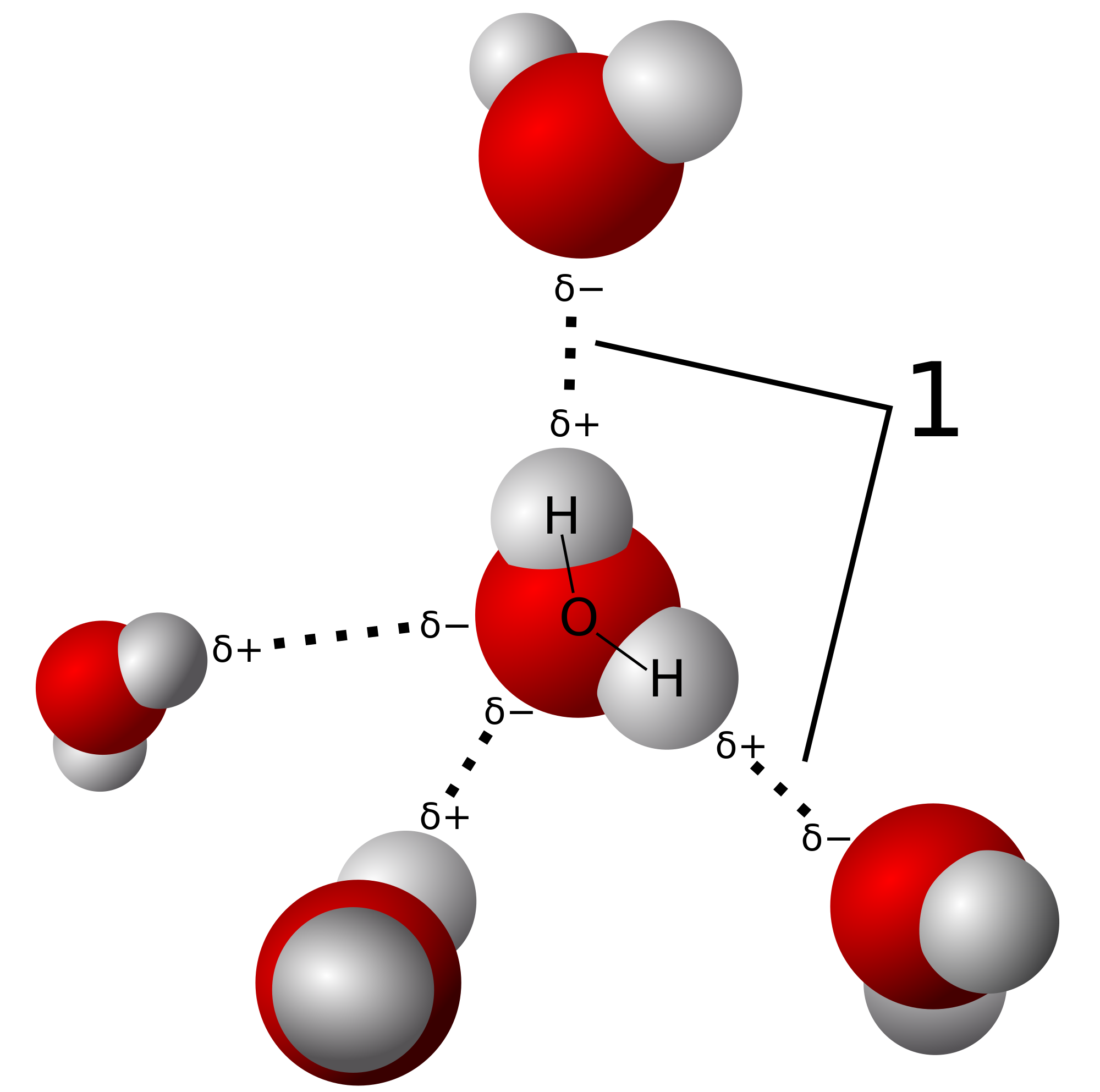
A hydrogen bond refers to the attraction between a hydrogen atom that is covalently bonded to an element with high electronegativity, usually nitrogen, oxygen, or fluorine, and another highly electronegative atom. The hydrogen bond is often described as a strong electrostatic interaction. However, it also has some features of covalent bonding: it is directional, stronger than a van der Waals force interaction, produces interatomic distances shorter than the sum of their van der Waals radii, and usually involves a limited number of interaction partners, which can be interpreted as a kind of valence. The number of hydrogen bonds formed between molecules is equal to the number of active pairs. The molecule which donates its hydrogen is termed the donor molecule, while the molecule containing lone pair participating in H bonding is termed the acceptor molecule. The number of active pairs is equal to the common number between number of hydrogens the donor has and the number of lone pairs the acceptor has.
Though both are not depicted in the diagram, water molecules have four active bonds. The oxygen atom’s two lone pairs interact with a hydrogen each, forming two additional hydrogen bonds, and the second hydrogen atom also interacts with a neighbouring oxygen. Intermolecular hydrogen bonding is responsible for the high boiling point of water (100 °C) compared to the other group 16 hydrides, which have little capability to hydrogen bond. Intramolecular hydrogen bonding is partly responsible for the secondary, tertiary, and quaternary structures of proteins and nucleic acids. It also plays an important role in the structure of polymers, both synthetic and natural.
The attraction between cationic and anionic sites is a noncovalent, or intermolecular interaction which is usually referred to as ion pairing or salt bridge. It is essentially due to electrostatic forces, although in aqueous medium the association is driven by entropy and often even endothermic. Most salts form crystals with characteristic distances between the ions; in contrast to many other noncovalent interactions, salt bridges are not directional and show in the solid state usually contact determined only by the van der Waals radii of the ions. Inorganic as well as organic ions display in water at moderate ionic strength I similar salt bridge as association ΔG values around 5 to 6 kJ/mol for a 1:1 combination of anion and cation, almost independent of the nature (size, polarizability, etc.) of the ions. The ΔG values are additive and approximately a linear function of the charges, the interaction of e.g. a doubly charged phosphate anion with a single charged ammonium cation accounts for about 2x5 = 10 kJ/mol. The ΔG values depend on the ionic strength I of the solution, as described by the Debye-Hückel equation, at zero ionic strength one observes ΔG = 8 kJ/mol.
Hub AI
Intermolecular force AI simulator
(@Intermolecular force_simulator)
Intermolecular force
An intermolecular force (IMF; also secondary force) is the force that mediates interaction between molecules, including the electromagnetic forces of attraction or repulsion which act between atoms and other types of neighbouring particles (e.g. atoms or ions). Intermolecular forces are weak relative to intramolecular forces – the forces which hold a molecule together. For example, the covalent bond, involving sharing electron pairs between atoms, is much stronger than the forces present between neighboring molecules. Both sets of forces are essential parts of force fields frequently used in molecular mechanics.
The first reference to the nature of microscopic forces is found in Alexis Clairaut's work Théorie de la figure de la Terre, published in Paris in 1743. Other scientists who have contributed to the investigation of microscopic forces include: Laplace, Gauss, Maxwell, Boltzmann and Pauling.
Attractive intermolecular forces are categorized into the following types:
Information on intermolecular forces is obtained by macroscopic measurements of properties like viscosity, pressure, volume, temperature (PVT) data. The link to microscopic aspects is given by virial coefficients and intermolecular pair potentials, such as the Mie potential, Buckingham potential or Lennard-Jones potential.
In the broadest sense, it can be understood as such interactions between any particles (molecules, atoms, ions and molecular ions) in which the formation of chemical (that is, ionic, covalent or metallic) bonds does not occur. In other words, these interactions are significantly weaker than covalent ones and do not lead to a significant restructuring of the electronic structure of the interacting particles. (This is only partially true. For example, all enzymatic and catalytic reactions begin with a weak intermolecular interaction between a substrate and an enzyme or a molecule with a catalyst, but several such weak interactions with the required spatial configuration of the active center of the enzyme lead to significant restructuring in the energy states of molecules or substrates, all of which ultimately leads to the breaking of some and the formation of other covalent chemical bonds. Strictly speaking, all enzymatic reactions begin with intermolecular interactions between the substrate and the enzyme, therefore the importance of these interactions is especially great in biochemistry and molecular biology, and is the basis of enzymology).
A hydrogen bond refers to the attraction between a hydrogen atom that is covalently bonded to an element with high electronegativity, usually nitrogen, oxygen, or fluorine, and another highly electronegative atom. The hydrogen bond is often described as a strong electrostatic interaction. However, it also has some features of covalent bonding: it is directional, stronger than a van der Waals force interaction, produces interatomic distances shorter than the sum of their van der Waals radii, and usually involves a limited number of interaction partners, which can be interpreted as a kind of valence. The number of hydrogen bonds formed between molecules is equal to the number of active pairs. The molecule which donates its hydrogen is termed the donor molecule, while the molecule containing lone pair participating in H bonding is termed the acceptor molecule. The number of active pairs is equal to the common number between number of hydrogens the donor has and the number of lone pairs the acceptor has.
Though both are not depicted in the diagram, water molecules have four active bonds. The oxygen atom’s two lone pairs interact with a hydrogen each, forming two additional hydrogen bonds, and the second hydrogen atom also interacts with a neighbouring oxygen. Intermolecular hydrogen bonding is responsible for the high boiling point of water (100 °C) compared to the other group 16 hydrides, which have little capability to hydrogen bond. Intramolecular hydrogen bonding is partly responsible for the secondary, tertiary, and quaternary structures of proteins and nucleic acids. It also plays an important role in the structure of polymers, both synthetic and natural.
The attraction between cationic and anionic sites is a noncovalent, or intermolecular interaction which is usually referred to as ion pairing or salt bridge. It is essentially due to electrostatic forces, although in aqueous medium the association is driven by entropy and often even endothermic. Most salts form crystals with characteristic distances between the ions; in contrast to many other noncovalent interactions, salt bridges are not directional and show in the solid state usually contact determined only by the van der Waals radii of the ions. Inorganic as well as organic ions display in water at moderate ionic strength I similar salt bridge as association ΔG values around 5 to 6 kJ/mol for a 1:1 combination of anion and cation, almost independent of the nature (size, polarizability, etc.) of the ions. The ΔG values are additive and approximately a linear function of the charges, the interaction of e.g. a doubly charged phosphate anion with a single charged ammonium cation accounts for about 2x5 = 10 kJ/mol. The ΔG values depend on the ionic strength I of the solution, as described by the Debye-Hückel equation, at zero ionic strength one observes ΔG = 8 kJ/mol.