Hubbry Logo
search
logo

Invariant subspace

logo
Community Hub0 Subscribers
Read side by side
from Wikipedia

In mathematics, an invariant subspace of a linear mapping T : VV i.e. from some vector space V to itself, is a subspace W of V that is preserved by T. More generally, an invariant subspace for a collection of linear mappings is a subspace preserved by each mapping individually.

For a single operator

[edit]

Consider a vector space and a linear map A subspace is called an invariant subspace for , or equivalently, T-invariant, if T transforms any vector back into W. In formulas, this can be writtenor[1]

In this case, T restricts to an endomorphism of W:[2]

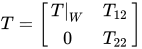
The existence of an invariant subspace also has a matrix formulation. Pick a basis C for W and complete it to a basis B of V. With respect to B, the operator T has form for some T12 and T22, where here denotes the matrix of with respect to the basis C.
Examples

[edit]

Any linear map admits the following invariant subspaces:

  • The vector space , because maps every vector in into
  • The set , because .

These are the improper and trivial invariant subspaces, respectively. Certain linear operators have no proper non-trivial invariant subspace: for instance, rotation of a two-dimensional real vector space. However, the axis of a rotation in three dimensions is always an invariant subspace.

1-dimensional subspaces

[edit]

If U is a 1-dimensional invariant subspace for operator T with vector vU, then the vectors v and Tv must be linearly dependent. Thus In fact, the scalar α does not depend on v.

The equation above formulates an eigenvalue problem. Any eigenvector for T spans a 1-dimensional invariant subspace, and vice-versa. In particular, a nonzero invariant vector (i.e. a fixed point of T) spans an invariant subspace of dimension 1.

As a consequence of the fundamental theorem of algebra, every linear operator on a nonzero finite-dimensional complex vector space has an eigenvector. Therefore, every such linear operator in at least two dimensions has a proper non-trivial invariant subspace.

Diagonalization via projections

[edit]

Determining whether a given subspace W is invariant under T is ostensibly a problem of geometric nature. Matrix representation allows one to phrase this problem algebraically.

Write V as the direct sum W ⊕ W; a suitable W can always be chosen by extending a basis of W. The associated projection operator P onto W has matrix representation
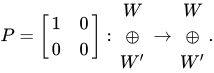
A straightforward calculation shows that W is T-invariant if and only if PTP = TP.

If 1 is the identity operator, then 1-P is projection onto W. The equation TP = PT holds if and only if both im(P) and im(1 − P) are invariant under T. In that case, T has matrix representation
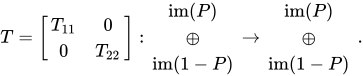
Colloquially, a projection that commutes with T "diagonalizes" T.

Lattice of subspaces

[edit]

As the above examples indicate, the invariant subspaces of a given linear transformation T shed light on the structure of T. When V is a finite-dimensional vector space over an algebraically closed field, linear transformations acting on V are characterized (up to similarity) by the Jordan canonical form, which decomposes V into invariant subspaces of T. Many fundamental questions regarding T can be translated to questions about invariant subspaces of T.

The set of T-invariant subspaces of V is sometimes called the invariant-subspace lattice of T and written Lat(T). As the name suggests, it is a (modular) lattice, with meets and joins given by (respectively) set intersection and linear span. A minimal element in Lat(T) in said to be a minimal invariant subspace.

In the study of infinite-dimensional operators, Lat(T) is sometimes restricted to only the closed invariant subspaces.

For multiple operators

[edit]

Given a collection T of operators, a subspace is called T-invariant if it is invariant under each TT.

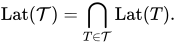
As in the single-operator case, the invariant-subspace lattice of T, written Lat(T), is the set of all T-invariant subspaces, and bears the same meet and join operations. Set-theoretically, it is the intersection
Examples

[edit]

Let End(V) be the set of all linear operators on V. Then Lat(End(V))={0,V}.

Given a representation of a group G on a vector space V, we have a linear transformation T(g) : VV for every element g of G. If a subspace W of V is invariant with respect to all these transformations, then it is a subrepresentation and the group G acts on W in a natural way. The same construction applies to representations of an algebra.

As another example, let T ∈ End(V) and Σ be the algebra generated by {1, T }, where 1 is the identity operator. Then Lat(T) = Lat(Σ).

Fundamental theorem of noncommutative algebra

[edit]

Just as the fundamental theorem of algebra ensures that every linear transformation acting on a finite-dimensional complex vector space has a non-trivial invariant subspace, the fundamental theorem of noncommutative algebra asserts that Lat(Σ) contains non-trivial elements for certain Σ.

Theorem (Burnside)Assume V is a complex vector space of finite dimension. For every proper subalgebra Σ of End(V), Lat(Σ) contains a non-trivial element.

One consequence is that every commuting family in L(V) can be simultaneously upper-triangularized. To see this, note that an upper-triangular matrix representation corresponds to a flag of invariant subspaces, that a commuting family generates a commuting algebra, and that End(V) is not commutative when dim(V) ≥ 2.

Left ideals

[edit]

If A is an algebra, one can define a left regular representation Φ on A: Φ(a)b = ab is a homomorphism from A to L(A), the algebra of linear transformations on A

The invariant subspaces of Φ are precisely the left ideals of A. A left ideal M of A gives a subrepresentation of A on M.

If M is a left ideal of A then the left regular representation Φ on M now descends to a representation Φ' on the quotient vector space A/M. If [b] denotes an equivalence class in A/M, Φ'(a)[b] = [ab]. The kernel of the representation Φ' is the set {aA | abM for all b}.

The representation Φ' is irreducible if and only if M is a maximal left ideal, since a subspace VA/M is an invariant under {Φ'(a) | aA} if and only if its preimage under the quotient map, V + M, is a left ideal in A.

Invariant subspace problem

[edit]

The invariant subspace problem concerns the case where V is a separable Hilbert space over the complex numbers, of dimension > 1, and T is a bounded operator. The problem is to decide whether every such T has a non-trivial, closed, invariant subspace. It is unsolved.

In the more general case where V is assumed to be a Banach space, Per Enflo (1976) found an example of an operator without an invariant subspace. A concrete example of an operator without an invariant subspace was produced in 1985 by Charles Read.

Almost-invariant halfspaces

[edit]

Related to invariant subspaces are so-called almost-invariant-halfspaces (AIHS's). A closed subspace of a Banach space is said to be almost-invariant under an operator if for some finite-dimensional subspace ; equivalently, is almost-invariant under if there is a finite-rank operator such that , i.e. if is invariant (in the usual sense) under . In this case, the minimum possible dimension of (or rank of ) is called the defect.

Clearly, every finite-dimensional and finite-codimensional subspace is almost-invariant under every operator. Thus, to make things non-trivial, we say that is a halfspace whenever it is a closed subspace with infinite dimension and infinite codimension.

The AIHS problem asks whether every operator admits an AIHS. In the complex setting it has already been solved; that is, if is a complex infinite-dimensional Banach space and then admits an AIHS of defect at most 1. It is not currently known whether the same holds if is a real Banach space. However, some partial results have been established: for instance, any self-adjoint operator on an infinite-dimensional real Hilbert space admits an AIHS, as does any strictly singular (or compact) operator acting on a real infinite-dimensional reflexive space.

See also

[edit]

References

[edit]

Sources

[edit]
  • Abramovich, Yuri A.; Aliprantis, Charalambos D. (2002). An Invitation to Operator Theory. American Mathematical Society. ISBN 978-0-8218-2146-6.
  • Beauzamy, Bernard (1988). Introduction to Operator Theory and Invariant Subspaces. North Holland.
  • Enflo, Per; Lomonosov, Victor (2001). "Some aspects of the invariant subspace problem". Handbook of the geometry of Banach spaces. Vol. I. Amsterdam: North-Holland. pp. 533–559.
  • Gohberg, Israel; Lancaster, Peter; Rodman, Leiba (2006). Invariant Subspaces of Matrices with Applications. Classics in Applied Mathematics. Vol. 51 (Reprint, with list of errata and new preface, of the 1986 Wiley ed.). Society for Industrial and Applied Mathematics (SIAM). pp. xxii+692. ISBN 978-0-89871-608-5.
  • Lyubich, Yurii I. (1988). Introduction to the Theory of Banach Representations of Groups (Translated from the 1985 Russian-language ed.). Kharkov, Ukraine: Birkhäuser Verlag.
  • Radjavi, Heydar; Rosenthal, Peter (2003). Invariant Subspaces (Update of 1973 Springer-Verlag ed.). Dover Publications. ISBN 0-486-42822-2.
Revisions and contributorsEdit on WikipediaRead on Wikipedia
from Grokipedia
In linear algebra, an invariant subspace of a linear transformation $ T: V \to V $ on a vector space $ V $ is a subspace $ W \subseteq V $ such that $ T(W) \subseteq W $, meaning the transformation maps $ W $ into itself.[1] This concept captures how $ T $ preserves the structure of certain subspaces, allowing for the decomposition of $ V $ into simpler components under $ T $. Trivial examples include the zero subspace $ {0} $ and the entire space $ V $, while non-trivial invariant subspaces, such as eigenspaces, reveal the spectral properties of $ T $.[2] In finite-dimensional spaces over algebraically closed fields like the complex numbers, every linear operator on a space of dimension at least 2 admits non-trivial invariant subspaces, and the full collection of these subspaces determines the Jordan canonical form of the operator's matrix representation.[1] Eigenspaces corresponding to eigenvalues $ \lambda $ are invariant, as are generalized eigenspaces and kernels of powers of $ (T - \lambda I) $, enabling the block-diagonal decomposition that simplifies computations like powers of matrices or solvability of linear systems.[1] These subspaces facilitate the study of nilpotency, diagonalizability, and minimal polynomials, forming the backbone of matrix theory and applications in differential equations and Markov chains.[2] In the broader context of functional analysis, invariant subspaces extend to bounded linear operators on infinite-dimensional Banach or Hilbert spaces, where they play a crucial role in operator theory and spectral analysis.[2] For compact operators, non-trivial closed invariant subspaces always exist, but the general invariant subspace problem—asking whether every bounded operator on a separable complex Hilbert space has a non-trivial closed invariant subspace—remains unsolved, despite counterexamples in Banach space settings by Enflo (1987) and Read (1985).[3] This problem, posed by von Neumann in the 1930s, underscores deep connections to complex analysis, as seen in Beurling's 1949 characterization of invariant subspaces for multiplication operators on Hardy spaces.[2] Advances, such as Lomonosov's 1973 theorem guaranteeing invariant subspaces for operators commuting with non-zero compacts, highlight ongoing research into operator classifications and universal models.[2]

Fundamentals

Definition and Basic Properties

In linear algebra, the study of invariant subspaces begins with the foundational concepts of vector spaces and linear operators. Let $ V $ be a vector space over a field $ \mathbb{F} $, and let $ T: V \to V $ be a linear operator. A subspace $ W \subseteq V $ is a subset that is closed under addition and scalar multiplication by elements of $ \mathbb{F} $, containing the zero vector. A subspace $ W $ of $ V $ is said to be invariant under $ T $ if $ T(W) \subseteq W $, meaning that for every $ w \in W $, $ T(w) \in W $. This condition ensures that the action of $ T $ does not map elements of $ W $ outside of $ W $. Equivalently, $ W $ is invariant under $ T $ if the restriction $ T|_W: W \to W $, defined by $ T|W(w) = T(w) $ for $ w \in W $, is a well-defined linear operator on $ W $. In terms of matrix representations, if $ {v_1, \dots, v_k} $ is a basis for $ W $ extended to a basis $ {v_1, \dots, v_k, v{k+1}, \dots, v_n} $ for $ V $, then the matrix of $ T $ with respect to this basis has a block upper triangular form:
(AB0C), \begin{pmatrix} A & B \\ 0 & C \end{pmatrix},
where $ A $ is the $ k \times k $ matrix representing $ T|_W $, the zero block reflects the invariance, and $ B, C $ account for the action on the complement.[4][5][6] The invariance property preserves the subspace structure of $ W $, as $ T(W) $ is itself a subspace contained within $ W $, maintaining closure under addition and scalar multiplication. The collection of all invariant subspaces under $ T $ forms a lattice under inclusion, where the meet and join operations correspond to intersection and the span of the union, respectively; however, this lattice is not necessarily a Boolean algebra unless $ T $ has additional structure. Trivial invariant subspaces always exist: the zero subspace $ {0} $, since $ T(0) = 0 $, and the entire space $ V $, since $ T(V) \subseteq V $. Nontrivial examples include the kernel $ \ker(T) = { v \in V \mid T(v) = 0 } $, as $ T(\ker(T)) = {0} \subseteq \ker(T) $, and the image $ \operatorname{im}(T) = { T(v) \mid v \in V } $, as $ T(\operatorname{im}(T)) \subseteq \operatorname{im}(T) $.[4][7]

Finite vs. Infinite Dimensions

In finite-dimensional vector spaces over the complex numbers, every linear operator admits at least one nontrivial invariant subspace. This result stems from the fact that the characteristic polynomial of the operator always has a root in the complex numbers, yielding an eigenvector and thus a one-dimensional invariant subspace.[8] More comprehensively, the Jordan canonical form decomposes the space into a direct sum of generalized eigenspaces, each of which is invariant under the operator.[9] This finite-dimensional theorem traces back to the work of Camille Jordan in the 1870s, particularly his development of canonical forms for linear transformations.[10] In infinite-dimensional settings, such as Banach or Hilbert spaces, no analogous general existence theorem holds for arbitrary bounded linear operators. Counterexamples exist in separable Banach spaces, where Per Enflo constructed a bounded operator without any nontrivial closed invariant subspaces, highlighting pathologies unique to infinite dimensions.[11] For Hilbert spaces, the invariant subspace problem—whether every bounded operator has a nontrivial closed invariant subspace—remains unresolved, though specific classes like normal operators do possess them via the spectral theorem. A key distinction lies in the structural decompositions available: finite dimensions permit a complete primary decomposition into invariant generalized eigenspaces, enabling full classification of the operator up to similarity. In infinite dimensions, such decompositions require extra conditions; for instance, the spectral theorem for normal operators on Hilbert spaces yields a resolution into invariant subspaces corresponding to Borel sets in the spectrum, but general operators may evade this without additional structure like compactness, which guarantees eigenvalues and thus invariant subspaces. These differences underscore how finite-dimensional theory provides robust guarantees, while infinite-dimensional analysis often demands functional analytic tools to mitigate counterexamples and achieve partial resolutions.[11]

Single Linear Operator

Examples of Invariant Subspaces

A prominent example of invariant subspaces arises with the rotation operator TT on R2\mathbb{R}^2, defined by T(x,y)=(xcosθysinθ,xsinθ+ycosθ)T(x, y) = (x \cos \theta - y \sin \theta, x \sin \theta + y \cos \theta) for some angle θ\theta. The one-dimensional subspaces, which are lines through the origin, are invariant under TT only if θ=0\theta = 0^\circ or 180180^\circ (modulo 360360^\circ); in these cases, every such line is mapped to itself.[4] For all other θ\theta, including irrational multiples of π\pi, the only invariant subspaces are the trivial ones: {0}\{0\} and R2\mathbb{R}^2 itself, as the operator has no real eigenvalues and rotates every nonzero vector out of its span.[4] For a diagonalizable operator TT on a finite-dimensional vector space VV over C\mathbb{C}, the eigenspaces corresponding to distinct eigenvalues provide minimal nontrivial invariant subspaces. Specifically, if λ\lambda is an eigenvalue with eigenvector v0v \neq 0, then the one-dimensional span {αv:αC}\{ \alpha v : \alpha \in \mathbb{C} \} is invariant under TT, since T(αv)=αλvT(\alpha v) = \alpha \lambda v remains in the span. The direct sum of these eigenspaces decomposes VV into invariant components, highlighting how diagonalizability ensures a rich structure of invariant subspaces.[12] Nilpotent operators offer another key construction, such as the differentiation operator DD on the space Pn1\mathcal{P}_{n-1} of polynomials over R\mathbb{R} (or C\mathbb{C}) of degree less than nn, where D(p)=pD(p) = p' and Dn=0D^n = 0. This operator is cyclic, generated by the basis {1,x,x2,,xn1}\{1, x, x^2, \dots, x^{n-1}\}, and its invariant subspaces are the cyclic subspaces Pk1=span{1,x,,xk1}\mathcal{P}_{k-1} = \operatorname{span}\{1, x, \dots, x^{k-1}\} for k=1,,nk = 1, \dots, n, each consisting of polynomials of degree less than kk. These subspaces form a chain where DD maps Pk1\mathcal{P}_{k-1} into Pk2\mathcal{P}_{k-2}.[13][14] In the case of a Jordan block JJ of size nn for eigenvalue λ\lambda, acting on a basis {e1,e2,,en}\{e_1, e_2, \dots, e_n\} where Je1=λe1J e_1 = \lambda e_1 and Jek=λek+ek1J e_k = \lambda e_k + e_{k-1} for k>1k > 1, the invariant subspaces form a flag {0}span{e1}span{e1,e2}span{e1,,en}=V\{0\} \subset \operatorname{span}\{e_1\} \subset \operatorname{span}\{e_1, e_2\} \subset \cdots \subset \operatorname{span}\{e_1, \dots, e_n\} = V. Each successive subspace in this chain is invariant, with JJ mapping it to the previous one, illustrating the canonical chain structure for non-diagonalizable operators.[15] Geometrically, invariant subspaces represent directions or higher-dimensional "slices" preserved by the linear transformation, in the sense that applying the operator to any vector in the subspace yields another vector within the same subspace, allowing the transformation to act internally without escaping.[6] As a non-example illustrating scarcity of invariants, consider the irrational rotation on the circle S1S^1, induced by rotation by an angle 2πα2\pi \alpha where α\alpha is irrational; this unitary operator on L2(S1)L^2(S^1) has no nontrivial finite-dimensional invariant subspaces, as the dense orbits prevent rational (periodic) invariant directions beyond the full space or zero.

One-Dimensional Cases

In the context of a linear operator TT on a finite-dimensional vector space VV, a one-dimensional subspace WVW \subseteq V is invariant under TT if and only if WW is an eigenspace corresponding to some eigenvalue λF\lambda \in \mathbb{F}, where F\mathbb{F} is the underlying field. This means there exists a basis vector v0v \neq 0 for WW such that T(v)=λvT(v) = \lambda v, ensuring T(W)WT(W) \subseteq W.[16] Such subspaces represent the minimal nontrivial invariants for TT, as the action of TT on WW is simply scalar multiplication by λ\lambda.[16] The existence of one-dimensional invariant subspaces is tied to the spectrum of TT. In finite dimensions over an algebraically closed field like C\mathbb{C}, every nonzero operator TT admits at least one eigenvalue, hence a one-dimensional invariant subspace, due to the fundamental theorem of algebra guaranteeing roots for the characteristic polynomial det(TλI)=0\det(T - \lambda I) = 0. Over R\mathbb{R}, existence is not guaranteed if the characteristic polynomial has no real roots, though complex eigenvalues always exist in pairs.[17] The dimension of the eigenspace ker(TλI)\ker(T - \lambda I), termed the geometric multiplicity of λ\lambda, satisfies dim(ker(TλI))mλ\dim(\ker(T - \lambda I)) \leq m_\lambda, where mλm_\lambda is the algebraic multiplicity of λ\lambda as a root of the characteristic polynomial. Equality holds if and only if the eigenspace achieves the full multiplicity, which is necessary for complete diagonalizability over the base field.[18] To identify such a subspace explicitly for a matrix representation AA of TT, compute an eigenvalue λ\lambda and solve the equation
(AλI)v=0 (A - \lambda I)v = 0
for a nonzero vector vFnv \in \mathbb{F}^n, which spans the one-dimensional eigenspace if the geometric multiplicity is 1.[16]
A notable special case arises with real matrices, where nonreal complex eigenvalues preclude one-dimensional real invariant subspaces, as any corresponding eigenvectors would have complex entries. For example, the rotation matrix (0110)\begin{pmatrix} 0 & -1 \\ 1 & 0 \end{pmatrix} has eigenvalues ii and i-i, yielding no real eigenvectors and thus no one-dimensional real invariant subspaces.[17]

Projections and Diagonalization

In linear algebra, invariant subspaces play a central role in decomposing a vector space under the action of a linear operator T:VVT: V \to V. Suppose V=WUV = W \oplus U, where both WW and UU are invariant subspaces under TT. Then, there exists a unique projection P:VWP: V \to W along UU such that TP=PTTP = PT, meaning the projection commutes with the operator. This property ensures that TT preserves the decomposition: T(W)WT(W) \subseteq W and T(U)UT(U) \subseteq U, allowing VV to be expressed as a direct sum of invariant components. Such decompositions facilitate the analysis of TT by restricting it to each summand separately.[16] For diagonalizable operators, the space VV decomposes into a direct sum of eigenspaces, each of which is a one-dimensional invariant subspace. Specifically, if TT is diagonalizable, then V=λσ(T)EλV = \bigoplus_{\lambda \in \sigma(T)} E_\lambda, where Eλ=ker(TλI)E_\lambda = \ker(T - \lambda I) is the eigenspace corresponding to eigenvalue λ\lambda, and each EλE_\lambda is TT-invariant. In the case where TT is normal (i.e., TT=TTT^* T = T T^* on an inner product space), this decomposition admits orthogonal projections PλP_\lambda onto EλE_\lambda, yielding the spectral decomposition T=λσ(T)λPλT = \sum_{\lambda \in \sigma(T)} \lambda P_\lambda. These projections satisfy Pλ2=PλP_\lambda^2 = P_\lambda, λPλ=I\sum_{\lambda} P_\lambda = I, and PλPμ=0P_\lambda P_\mu = 0 for λμ\lambda \neq \mu, enabling a full diagonal representation of TT in an orthonormal basis of eigenvectors.[19] To compute such decompositions numerically, especially for large matrices, iterative algorithms exploit invariant subspaces. Krylov subspace methods generate a sequence of subspaces Kk=span{v,Tv,T2v,,Tk1v}K_k = \operatorname{span}\{v, Tv, T^2 v, \dots, T^{k-1} v\} for an initial vector vv, which approximate dominant invariant subspaces and facilitate partial diagonalization by projecting TT onto KkK_k and solving the resulting smaller eigenproblem. Similarly, the Schur triangulation algorithm computes a unitary similarity transformation QAQ=TQ^* A Q = T, where TT is upper triangular, revealing a flag of nested invariant subspaces corresponding to the eigenvalues on the diagonal. These approaches approximate the diagonal form by iteratively refining subspaces, though convergence depends on eigenvalue separation.[20][21][22] However, not all operators admit a direct diagonalization via invariant subspaces. If TT is not diagonalizable, its minimal polynomial has repeated factors, and the primary decomposition theorem yields a direct sum V=ker(pi(T))V = \bigoplus \ker(p_i(T)), where pip_i are the distinct irreducible factors, but these generalized eigenspaces require the Jordan canonical form for full structure, using chains of generalized eigenvectors within each invariant component.[19]

Lattice of Invariant Subspaces

The collection of all invariant subspaces of a linear operator TT on a finite-dimensional vector space VV forms a lattice under the partial order of set-theoretic inclusion \subseteq. The meet operation is the intersection of subspaces, which preserves invariance since if UU and WW are TT-invariant, then T(UW)UWT(U \cap W) \subseteq U \cap W. The join operation is the linear sum (or span of the union) U+WU + W, which is also TT-invariant because T(U+W)=T(U)+T(W)U+WT(U + W) = T(U) + T(W) \subseteq U + W.[23] In the finite-dimensional case, this lattice, denoted Lat(T)\mathrm{Lat}(T), is modular, inheriting the modularity from the full lattice of subspaces of VV, which satisfies the modular identity dim(U+W)+dim(UW)=dimU+dimW\dim(U + W) + \dim(U \cap W) = \dim U + \dim W for any subspaces U,WVU, W \subseteq V. The dimension function dim()\dim(\cdot) serves as a rank function on Lat(T)\mathrm{Lat}(T), providing an invariant of the lattice that measures the "size" of elements in a way compatible with the operator TT, as TT maps each invariant subspace to itself. Lat(T)\mathrm{Lat}(T) is distributive if and only if TT is cyclic, a condition equivalent to TT having a cyclic vector (e.g., when its rational canonical form consists of a single companion matrix block). In the general diagonalizable case, Lat(T)\mathrm{Lat}(T) decomposes as a direct product of the subspace lattices of the eigenspaces, which may not be distributive if any eigenspace has dimension greater than one.[23] The atoms of Lat(T)\mathrm{Lat}(T) are the minimal nontrivial (nonzero) invariant subspaces, which cover the zero subspace in the lattice order. For a primary operator (minimal polynomial a power of an irreducible), the covering relations in Lat(T)\mathrm{Lat}(T) increase the dimension by a fixed amount equal to the dimension of the kernel of the primary component. The height of the lattice, given by the length of a maximal chain from {0}\{0\} to VV, relates to the degree of the minimal polynomial of TT: for a single primary component, the height equals the degree of the minimal polynomial. In general, Lat(T)\mathrm{Lat}(T) decomposes into a direct sum of lattices corresponding to the primary components of TT, with the overall structure determined by the invariant factors or Jordan form.[23] A concrete example arises for a nilpotent operator TT represented by a single Jordan block of size nn, where the minimal polynomial has degree nn. Here, Lat(T)\mathrm{Lat}(T) is a chain (totally ordered lattice) isomorphic to the total order {0<1<<n}\{0 < 1 < \cdots < n\}, consisting of the subspaces span{e1,,ek}\mathrm{span}\{e_1, \dots, e_k\} for k=0,,nk = 0, \dots, n in the standard Jordan basis {e1,,en}\{e_1, \dots, e_n\}, with height nn. This chain structure reflects the cyclic nature and the index of nilpotency.[23]

Multiple Linear Operators

Joint Invariant Subspaces

In linear algebra, a subspace $ V $ of a vector space $ W $ is called a joint invariant subspace for a family of linear operators $ {T_i : i \in I} $ on $ W $ if $ T_i(V) \subseteq V $ for every $ i \in I $.[24] This generalizes the notion of an invariant subspace for a single operator, which corresponds to the special case where the family consists of a single $ T $. The collection of joint invariant subspaces for $ {T_i} $ forms a lattice under inclusion, with key properties inherited from those of single-operator invariants. In particular, the intersection of any family of joint invariant subspaces is itself joint invariant, as the intersection of subspaces invariant under each $ T_i $ remains closed under the action of every $ T_i $. Finite direct sums of joint invariant subspaces are also joint invariant. The trivial subspaces $ {0} $ and $ W $ are always joint invariant. When the operators commute, i.e., $ [T_i, T_j] = T_i T_j - T_j T_i = 0 $ for all $ i, j \in I $, joint invariant subspaces exhibit richer structure, particularly in finite-dimensional spaces over an algebraically closed field like $ \mathbb{C} $. If each $ T_i $ is diagonalizable, the family admits simultaneous diagonalization: there exists a basis of $ W $ consisting of common eigenvectors, and the corresponding one-dimensional joint eigenspaces (spanned by simultaneous eigenvectors $ v $ with $ T_i v = \lambda_i v $ for eigenvalues $ \lambda_i $) are joint invariant subspaces.[25] More generally, commuting operators on finite-dimensional spaces can be simultaneously upper triangularized, yielding chains of joint invariant subspaces that reflect the joint generalized eigenspace decomposition.[25] For noncommuting families, identifying nontrivial joint invariant subspaces is generally more difficult, as the lack of commutativity prevents simultaneous triangularization or diagonalization in general. In such cases, the joint invariant subspaces may coincide with those invariant under individual operators, though constructing them often requires case-specific analysis or reduction to single-operator problems.[26] A further generalization considers invariance under the algebra $ \mathcal{A} $ generated by $ {T_i : i \in I} $ and the identity operator, consisting of all finite linear combinations $ \sum a_k P_k $ where each $ P_k $ is a product of the $ T_i $'s. A subspace $ V $ is $ \mathcal{A} $-invariant if $ A(V) \subseteq V $ for every $ A \in \mathcal{A} $, which is equivalent to joint invariance under the $ T_i $'s since polynomials in the generators preserve the property.[27] This perspective connects joint invariance to representations of noncommutative algebras, where the lattice of invariant subspaces corresponds to submodules.[27]

Examples for Commuting Operators

A fundamental example of commuting operators and their joint invariant subspaces arises when one operator is a polynomial in the other. Consider linear operators AA and B=p(A)B = p(A) on a vector space VV, where pp is a polynomial with coefficients in the base field. Since powers of AA commute with AA, it follows that BB commutes with AA. Any AA-invariant subspace WVW \subseteq V is also BB-invariant, as Bw=p(A)wB w = p(A) w lies in WW for wWw \in W, given that WW is closed under applications of AA. In particular, the eigenspace Eλ={vVAv=λv}E_\lambda = \{ v \in V \mid A v = \lambda v \} of AA for eigenvalue λ\lambda satisfies BEλ=p(λ)EλEλB E_\lambda = p(\lambda) E_\lambda \subseteq E_\lambda, making EλE_\lambda a joint invariant subspace for the pair {A,B}\{A, B\}.[28] In quantum mechanics, sets of commuting observables provide natural examples of joint invariant subspaces through their shared eigenspaces. Commuting self-adjoint operators on a Hilbert space can be simultaneously diagonalized, meaning there exists an orthonormal basis of common eigenvectors, with the corresponding eigenspaces being joint invariant under the operators. For spin systems described using Pauli matrices, consider a two-qubit Hilbert space where the operators σz(1)=σzI\sigma_z^{(1)} = \sigma_z \otimes I and σz(2)=Iσz\sigma_z^{(2)} = I \otimes \sigma_z act on the first and second qubits, respectively. These operators commute, as [σz(1),σz(2)]=0[\sigma_z^{(1)}, \sigma_z^{(2)}] = 0, since they operate on disjoint subsystems. The joint eigenspaces are the one-dimensional subspaces spanned by the computational basis states 00,01,10,11|00\rangle, |01\rangle, |10\rangle, |11\rangle, each with joint eigenvalues (±1,±1)(\pm 1, \pm 1), and each such subspace is invariant under both operators.[29] In representation theory, irreducible representations illustrate minimal joint invariant subspaces for commuting families derived from group algebras. For a group GG acting on a vector space VV via a representation ρ:GGL(V)\rho: G \to \mathrm{GL}(V), the operators ρ(g)\rho(g) for gGg \in G generate an algebra of linear operators on VV. If GG is abelian, these operators commute. A subspace WVW \subseteq V is jointly invariant if ρ(g)WW\rho(g) W \subseteq W for all gGg \in G. The representation is irreducible if the only joint invariant subspaces are {0}\{0\} and VV, making VV a minimal nontrivial joint invariant subspace for the commuting family {ρ(g)gG}\{\rho(g) \mid g \in G\}. This structure underlies the decomposition of representations into irreducibles, each serving as a building block of joint invariants.[30] For finite-dimensional spaces over an algebraically closed field, a commutative family of operators admits a primary decomposition into generalized joint eigenspaces, which are joint invariant subspaces. Consider a finite set of commuting operators T1,,TkT_1, \dots, T_k on a finite-dimensional space VV. By the simultaneous triangularization theorem, there exists a basis in which all TiT_i are upper triangular, with diagonal entries forming joint eigenvalues (λ1,,λk)(\lambda_1, \dots, \lambda_k). The space decomposes as V=αVαV = \bigoplus_{\alpha} V_\alpha, where each VαV_\alpha is the generalized joint eigenspace for a multi-eigenvalue α=(λ1,,λk)\alpha = (\lambda_1, \dots, \lambda_k), defined as the kernel of i(TiλiI)ni\prod_i (T_i - \lambda_i I)^{n_i} for dimensions nidimVn_i \leq \dim V. Each VαV_\alpha is invariant under all TiT_i, providing a direct sum decomposition into joint invariant components analogous to the primary decomposition for a single operator.[31]

Fundamental Theorem for Noncommutative Algebras

In the context of noncommutative algebras of linear operators on a vector space, the fundamental theorem on invariant subspaces arises from the structure theory of rings. For a semisimple Artinian ring $ R $ acting on a left $ R $-module $ M $ (where $ M $ corresponds to the vector space and submodules to invariant subspaces), $ M $ decomposes as a direct sum of simple submodules.[32] These simple submodules are precisely the minimal nonzero invariant subspaces under the action, ensuring that every invariant subspace has an invariant complement.[33] This decomposition guarantees a rich lattice of invariant subspaces, structured by the ring's block form. Wedderburn's theorem extends this to finite-dimensional algebras over a field, implying that every finite-dimensional representation decomposes into a direct sum of irreducible representations, each corresponding to an indecomposable invariant subspace.[34] In the noncommutative setting, if the algebra generated by the operators is semisimple, the vector space admits a canonical invariant decomposition mirroring the algebra's Wedderburn components, even when the operators do not commute.[35] For instance, operators forming a matrix algebra over a division ring yield invariant subspaces isomorphic to those of the underlying simple modules. This framework applies broadly: operators generating a semisimple noncommutative algebra possess a highly structured invariant subspace lattice, with the number and dimensions of minimal invariants determined by the algebra's matrix block sizes.[33] The Artin–Wedderburn theorem, originally proved by Wedderburn in 1908 for finite-dimensional algebras and generalized by Artin in 1927 to Artinian rings, bridges classical linear algebra—where decompositions rely on spectral theory—with abstract ring theory during the early 20th century developments in noncommutative structures.[34] In contrast, non-semisimple algebras lack such guarantees. The Weyl algebra, a simple infinite-dimensional non-Artinian ring generated by differential and multiplication operators, admits no finite-dimensional nontrivial representations and thus features only trivial invariant subspaces in polynomial module contexts, illustrating the absence of rich decompositions.[36] Commuting operators represent a special abelian semisimple case within this theory.

Algebraic Connections

Relation to Left Ideals

In the theory of a single linear operator TT on a finite-dimensional vector space WW over a field FF, the space WW naturally becomes a left module over the polynomial ring F[x]F[x] by defining the action of a polynomial p(x)F[x]p(x) \in F[x] on wWw \in W as p(T)wp(T)w. Under this structure, a subspace VWV \subseteq W is TT-invariant if and only if it is a submodule of the F[x]F[x]-module WW.[37][38] To each invariant subspace VV, one associates the left ideal IV={pF[x]p(T)WV}I_V = \{ p \in F[x] \mid p(T)W \subseteq V \} in F[x]F[x] (noting that F[x]F[x] is commutative, so left ideals coincide with two-sided ideals). This ideal IVI_V is the annihilator of the quotient module W/VW/V, and the map VIVV \mapsto I_V provides an order-reversing correspondence between the lattice of TT-invariant subspaces of WW and the lattice of ideals of F[x]F[x] containing the annihilator ideal of WW.[37] In particular, VV is a maximal proper invariant subspace if and only if IVI_V is a maximal ideal in F[x]F[x], which occurs precisely when IV=(f)I_V = (f) for some irreducible polynomial fF[x]f \in F[x].[39] When WW is a cyclic F[x]F[x]-module (i.e., generated by a single element under the action of F[x]F[x]), the correspondence is bijective: every ideal IF[x]I \subseteq F[x] yields a unique invariant subspace V=IW={p(T)wpI,wW}V = IW = \{ p(T)w \mid p \in I, w \in W \}, and in this case, the invariant subspaces take the form V=p(T)WV = p(T)W for some polynomial pF[x]p \in F[x].[37] For example, the annihilator ideal of the entire space WW (corresponding to the trivial invariant subspace V=WV = W) is the principal ideal generated by the minimal polynomial mT(x)m_T(x) of TT, since IW={pF[x]p(T)W={0}}=(mT(x))I_W = \{ p \in F[x] \mid p(T)W = \{0\} \} = (m_T(x)).[38] More generally, if V=kerTV = \ker T, then IVI_V consists of all polynomials pp such that Tp(T)=0Tp(T) = 0, which is the principal ideal generated by mT(x)/gcd(mT(x),x)m_T(x)/\gcd(m_T(x), x) assuming the minimal polynomial is monic.[37] This ideal-theoretic perspective mirrors the lattice of invariant subspaces with that of ideals in F[x]F[x], a principal ideal domain, enabling the use of algebraic tools to classify them. In particular, the primary decomposition theorem decomposes WW as a direct sum of primary components iker(qi(T)ki)\bigoplus_i \ker (q_i(T)^{k_i}), where qi(x)q_i(x) are distinct irreducible polynomials and ki1k_i \geq 1; each component has annihilator ideal (qi(x)ki)(q_i(x)^{k_i}), and the full lattice of invariant subspaces is the product of the chains of submodules in these cyclic primary modules.[38] This classification via ideals facilitates the rational canonical form and provides a complete description of the invariant subspace lattice.[37]

Invariant Subspaces in Module Theory

In module theory, the concept of an invariant subspace generalizes to that of a fully invariant submodule. Given an RR-module MM over a ring RR, a submodule MM' of MM is fully invariant if f(M)Mf(M') \subseteq M' for every endomorphism f\EndR(M)f \in \End_R(M), the endomorphism ring of MM.[40] This condition ensures that MM' is preserved under the action of all RR-linear maps from MM to itself, extending the invariance idea from linear operators on vector spaces to more general algebraic structures. A key property arises in the context of finite-length modules. The Krull-Schmidt theorem asserts that any finite-length module decomposes uniquely (up to isomorphism and permutation of summands) into a direct sum of indecomposable modules, where these indecomposables serve as invariant summands under the endomorphism ring action.[41] This uniqueness facilitates the study of module structure, as fully invariant submodules often align with these decompositions, providing a canonical way to analyze invariance in bounded-length settings. Applications of fully invariant submodules appear prominently in representation theory. For Lie algebra representations, an invariant subspace of a representation on a module corresponds to a subrepresentation, where the submodule remains closed under the Lie algebra action, preserving the bracket relations.[42] Similarly, in group representations, consider a representation ρ:G\GL(V)\rho: G \to \GL(V) on a module VV; a submodule VV' is invariant if ρ(g)(V)V\rho(g)(V') \subseteq V' for all gGg \in G, making VV' a subrepresentation invariant under the group action.[43] Unlike the case of vector spaces over fields, where every subspace is free and admits a complement, fully invariant submodules in general modules can involve complications due to torsion elements or non-free structures. Torsion modules, for instance, may lack direct summand decompositions for invariant submodules, as the ring action can introduce dependencies not present in field-based settings.[44] This broader framework connects to left ideals in the commutative case, where ideals serve as fully invariant submodules under ring endomorphisms.

Advanced Topics and Problems

The Invariant Subspace Problem

The invariant subspace problem (ISP) asks whether every bounded linear operator on a complex separable infinite-dimensional Hilbert space admits a nontrivial closed invariant subspace, meaning a closed subspace that is neither the zero subspace nor the entire space and is mapped into itself by the operator.[45] This question, central to operator theory, contrasts with the finite-dimensional case where every operator has eigenvalues and thus invariant one-dimensional subspaces, but extends unresolved into infinite dimensions.[45] The problem traces its origins to the 1930s, when John von Neumann proved unpublished that compact operators on Hilbert spaces have nontrivial invariant subspaces, a result later formalized and extended by Aronszajn and Smith to arbitrary Banach spaces.[45][46] It gained prominence in the mid-20th century amid efforts to generalize finite-dimensional spectral theory. Affirmative results hold for specific classes: the spectral theorem ensures nontrivial invariant subspaces for normal and self-adjoint operators, as they diagonalize with respect to an orthonormal basis of eigenvectors.[47] Compact operators also possess such subspaces, often via eigenspaces corresponding to nonzero eigenvalues.[46] The classical Volterra integration operator on L2[0,1]L^2[0,1], defined by (Vf)(s)=0sf(t)dt(Vf)(s) = \int_0^s f(t)\, dt, admits a totally ordered lattice of closed invariant subspaces, providing a concrete affirmative example. Partial progress includes the 1970s work of Brown, Chevreau, and Pearcy, who established that polynomially bounded operators—those for which p(T)Cp\|p(T)\| \leq C \|p\|_\infty for some constant CC and all polynomials pp—possess nontrivial hyperinvariant subspaces, invariant under the entire commutant algebra.[48] No counterexamples exist for the Hilbert space case, unlike Banach spaces where Enflo constructed a quasinilpotent operator without nontrivial closed invariant subspaces in 1973 (published 1987).[45] A negative resolution would challenge generalizations of finite-dimensional theory, while an affirmative one would unify spectral decompositions across operator classes. The ISP carries implications for quantum mechanics, where invariant subspaces under observables or time-evolution operators correspond to conserved quantities like energy levels or symmetries, aiding analysis of systems such as angular momentum quantization.[49] In partial differential equations, it influences the stability and spectral properties of evolution operators on function spaces, impacting solutions to problems in quantum field theory and dynamical systems.[49] As of 2025, the problem remains open for separable Hilbert spaces, with a 2023 preprint by Per Enflo claiming an affirmative solution but lacking peer review or wide acceptance. Recent advances focus on almost-invariant subspaces and perturbations but no definitive resolution or counterexample.[50][51]

Almost-Invariant Halfspaces

In operator theory, particularly within the study of the invariant subspace problem, almost-invariant halfspaces provide a relaxation of the notion of exact invariance. A closed subspace YY of a Banach space XX is said to be almost-invariant under a bounded linear operator T:XXT: X \to X if there exists a finite-dimensional subspace FXF \subseteq X such that T(Y)Y+FT(Y) \subseteq Y + F; the minimal dimension of such an FF is called the defect of the almost-invariance. A halfspace is a subspace YY that is both infinite-dimensional and of infinite codimension in XX. This concept was introduced to explore weaker forms of invariance in infinite-dimensional settings where exact invariant subspaces may not exist.[52] The motivation for studying almost-invariant halfspaces stems from their role as approximations to true invariant subspaces, offering insights into the unresolved invariant subspace problem. Every bounded operator on an infinite-dimensional Banach space admits an almost-invariant halfspace, a result established in the late 2000s, which contrasts with the existence of counterexamples to the exact problem. In Hilbert spaces, this strengthens to the existence of an almost-invariant halfspace with defect at most 1 for any operator. These halfspaces relate to the invariant subspace problem by providing a quantitative measure of "near-preservation" under TT, where small defects indicate behavior close to invariance.[53] Key properties of almost-invariant halfspaces include the potential for chains or sequences of such subspaces with decreasing defects to approximate exact invariant subspaces in certain limits, facilitating numerical approximations in computational operator theory. For instance, in Hilbert spaces without eigenvalues, operators always possess almost-invariant halfspaces of defect 1. An illustrative example arises with the backward shift operator on the Hardy space H2H^2, where finite-dimensional Toeplitz kernels serve as almost-invariant halfspaces with defect 1, capturing near-preservation despite the lack of nontrivial exact invariants in some cases.[51][53][51] Recent developments connect almost-invariant halfspaces to counterexamples like those constructed by Enflo in the 1980s, which lack exact invariant subspaces but necessarily admit almost-invariant ones with finite defect. Notably, any operator, including Enflo's, admits a rank-one perturbation that possesses an exact invariant halfspace, highlighting the fragility of non-invariance under finite-rank changes. Ongoing research focuses on quantitative bounds for defects and extensions to algebras of operators, with applications in perturbation theory and numerical methods for spectral analysis.[51]

References

User Avatar
No comments yet.

