
Recent from talks
Invasion of Minorca (1781)
Knowledge base stats:
Talk channels stats:
Members stats:
Invasion of Minorca (1781)
The Franco-Spanish reconquest of Menorca (historically called "Minorca" in English) from the British in February 1782, after the siege of Fort St. Philip lasting over five months, was an important step in the achievement of Spain's aims in its alliance with France against Britain during the American Revolutionary War. The ultimate result was the devolution of the island to Spain in the Treaty of Paris in 1783.
At the eastern end of the island of Menorca is the port of Mahón, one of the best deep-water anchorages in the Mediterranean Sea. For a naval power with no Mediterranean coast, possession of Menorca, therefore, was of major strategic advantage, and for most of the 18th century, Menorca was under British control. The narrow entrance to the port was guarded by a fort, known to the British as St. Philip's Castle, a translation of the original Spanish, el castillo de San Felipe, which (with two outlying fortlets, San Carlos and Marlborough) was massively strengthened after the events of 1756, when Admiral John Byng judged the safety of his fleet more important than the possession of the fort, and was subsequently shot to encourage other admirals to take a more positive view of their duties. Although the French won that battle, they lost the Seven Years' War in 1763, and so Menorca was returned to Britain rather than France's ally Spain, to which the island was historically tied. The Spanish government renewed its alliance with France against Britain by means of the Treaty of Aranjuez (12 April 1779), with the recapture of Menorca as one of its main aims. Although secondary to the recapture of Gibraltar, Britain's other Mediterranean sea-fortress, removing Menorca from British control was important because it was home to a thriving fleet of privateers, licensed by the British Governor, Lieutenant-General James Murray, to seize merchant vessels which might be doing business with Britain's enemies.
The attempt at recapturing Gibraltar in 1779 led to a protracted siege, and by the end of 1780, Spain's military leaders were accepting that they would have to embark on some of their other projects in parallel with the siege there. An invasion of Menorca was therefore planned during the first few months of 1781, largely by Don Luis Berton de los Blats, Duque de Crillon (or rather, Duc de Crillon, for he was actually French, a descendant of "the man without fear", Louis des Balbes de Berton de Crillon). In theory, he was working with Spain's War Ministers, and Foreign Minister José Moñino y Redondo, conde de Floridablanca; in practice, the relationship between the two men seems to have been somewhat strained, and de Crillon perhaps did not take as much advice as he should have.
On 25 June 1781, a French force of about 20 warships, commanded by Admiral Guichen, left Brest on a coastal patrol, which happened to involve sailing into the Mediterranean. They were going to provide additional protection for the invasion fleet, but, in order to fool the British, they would not be joining their Spanish allies until they were close to the target. The Spanish invasion fleet (51 troop carriers, 18 supply vessels, 3 hospital ships, 3 "viveres", 2 bombardment ships, a fireship, and 13 armed escorts), departed Cádiz on 23 July 1781, initially heading westward to appear as if its destination was America, but turned in the night and passed Gibraltar on 25 July. Facing contrary winds in the Mediterranean, by 29 July the convoy was beginning to break up, and was forced to take shelter at La Subida cove, near Cartagena. At some time over the next few days the Spanish were discreetly joined by the French warships. The combined fleet left La Subida on 5 August, came within sight of Alicante on 14 August, then in the night of 17 August headed away from the Spanish coast and sailed parallel to Formentera. On 18 August, as it passed the little island of Cabrera, south of Majorca, the fleet was joined by another 4 warships, from Palma. That night, the wind blew from the south-east, and the fleet had to take precautions to avoid being blown aground on Majorca, but Menorca was sighted the next morning.
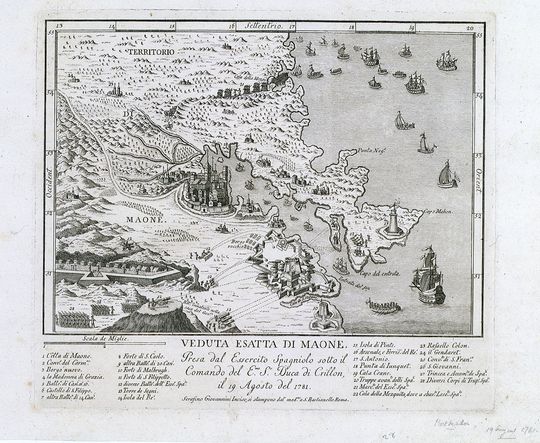
A main force was to be landed at Mesquida bay, just north of the main target, Port Mahón, and a secondary force at Alcaufar bay, south of the port, while the other two significant harbours on the island, at Ciudadela and Fornells, were to be blockaded. The Mesquida force was to move rapidly to the town of Mahón, where the Governor lived, to capture him and as many British soldiers as possible. The Alcaufar force was to block the road that led from the British residential suburb, Georgetown (now Es Castell), to the fort of St. Philip's Castle. At about the same time, a third force was to land on Degollador beach at Ciudadela, to block the main road across the island. Finally, a detachment would be landed at Fornells, to take the small artillery fort there.
This plan had one basic flaw – the assumption that the British would believe a vast convoy approaching Menorca had friendly intentions. Additionally, further modifications had to be made because of the wind, which forced the main part of the fleet to sail round the south of the island, rather than the north; the landing at Ciudadela was also temporarily impossible. So, about 10:30 am, the fleet rounded Aire island, at the south-east tip of Menorca, and began the approach to Port Mahón, while the Alcaufar contingent headed for land. A little after 11:30, the leading vessel of the fleet, San Pascual passed St. Philip's Castle, its crew at battle stations (immediate battle was not anticipated, but this was a naval tradition). Finally, around 1:00 pm, San Pascual arrived at Mesquida, and the rest of the fleet gradually caught up, and preparations for landing began. At 6:00 pm, the Spanish flag was raised on the beach, and received a 23-gun salute.
The British had a watchtower on the south coast of Menorca, and had spotted the fleet approaching. An urgent message was immediately sent to Mahón; later reinforced by a more detailed report from the watchtower on Monte Toro, in the centre of the island. By midday, most of the British personnel around Mahón had been moved within the walls of St. Philip's Castle, a chain had been fixed across the entrance to the port, and small vessels were being sunk in the narrow channel, making entry by sea impossible. Some dependants, including the Governor's family, made preparations to sail to safety in Italy aboard a Venetian ship, and a message about the invasion was sent to the British envoy at Florence, ending with an assurance that the garrison was in "high health and Spirits" and would make "a vigorous resistance". The ship reached Leghorn – Livorno in Italian – on 31 August). When the Spanish troops entered the town of Mahón, most of the remaining population was on their side, and greeted them with cheers. At Georgetown only 152 prisoners were taken, and the troops sent to Ciudadela and Fornells on 20 August found only token British forces of about 50 men. While arrangements were made to put the island under a Spanish administration, letters were exchanged between de Crillon and Governor Murray, and the invaders began preparing their own defences against counter-attacks. By 23 August there were over 7,000 Spanish soldiers on Menorca, and 3,000 more soon joined them. The bulk of the fleet left once the troops were securely established, and Guichen arrived back at Brest on 15 September.
When news of the invasion got back to Britain about four weeks later, newspapers reported that the garrison consisted of some 5,660 men. However, of that number, 1,500 were members of the local militia, and 400 were civilian workers. Very few members of those groups actually went into the fort, except for a few members of the international business community the British had welcomed onto Menorca – North Africans, Jews, Greeks, etc. (Incidentally, the invaders expelled the remainder of the African and Jewish communities on 11 September, and various other foreign nationals shortly afterwards). Also, the number of soldiers included those captured elsewhere on the island by the invaders, so the real total of fighting men in the fort would be closer to 3,000 – and it seems that even that was an exaggeration to discourage the invaders.
Hub AI
Invasion of Minorca (1781) AI simulator
(@Invasion of Minorca (1781)_simulator)
Invasion of Minorca (1781)
The Franco-Spanish reconquest of Menorca (historically called "Minorca" in English) from the British in February 1782, after the siege of Fort St. Philip lasting over five months, was an important step in the achievement of Spain's aims in its alliance with France against Britain during the American Revolutionary War. The ultimate result was the devolution of the island to Spain in the Treaty of Paris in 1783.
At the eastern end of the island of Menorca is the port of Mahón, one of the best deep-water anchorages in the Mediterranean Sea. For a naval power with no Mediterranean coast, possession of Menorca, therefore, was of major strategic advantage, and for most of the 18th century, Menorca was under British control. The narrow entrance to the port was guarded by a fort, known to the British as St. Philip's Castle, a translation of the original Spanish, el castillo de San Felipe, which (with two outlying fortlets, San Carlos and Marlborough) was massively strengthened after the events of 1756, when Admiral John Byng judged the safety of his fleet more important than the possession of the fort, and was subsequently shot to encourage other admirals to take a more positive view of their duties. Although the French won that battle, they lost the Seven Years' War in 1763, and so Menorca was returned to Britain rather than France's ally Spain, to which the island was historically tied. The Spanish government renewed its alliance with France against Britain by means of the Treaty of Aranjuez (12 April 1779), with the recapture of Menorca as one of its main aims. Although secondary to the recapture of Gibraltar, Britain's other Mediterranean sea-fortress, removing Menorca from British control was important because it was home to a thriving fleet of privateers, licensed by the British Governor, Lieutenant-General James Murray, to seize merchant vessels which might be doing business with Britain's enemies.
The attempt at recapturing Gibraltar in 1779 led to a protracted siege, and by the end of 1780, Spain's military leaders were accepting that they would have to embark on some of their other projects in parallel with the siege there. An invasion of Menorca was therefore planned during the first few months of 1781, largely by Don Luis Berton de los Blats, Duque de Crillon (or rather, Duc de Crillon, for he was actually French, a descendant of "the man without fear", Louis des Balbes de Berton de Crillon). In theory, he was working with Spain's War Ministers, and Foreign Minister José Moñino y Redondo, conde de Floridablanca; in practice, the relationship between the two men seems to have been somewhat strained, and de Crillon perhaps did not take as much advice as he should have.
On 25 June 1781, a French force of about 20 warships, commanded by Admiral Guichen, left Brest on a coastal patrol, which happened to involve sailing into the Mediterranean. They were going to provide additional protection for the invasion fleet, but, in order to fool the British, they would not be joining their Spanish allies until they were close to the target. The Spanish invasion fleet (51 troop carriers, 18 supply vessels, 3 hospital ships, 3 "viveres", 2 bombardment ships, a fireship, and 13 armed escorts), departed Cádiz on 23 July 1781, initially heading westward to appear as if its destination was America, but turned in the night and passed Gibraltar on 25 July. Facing contrary winds in the Mediterranean, by 29 July the convoy was beginning to break up, and was forced to take shelter at La Subida cove, near Cartagena. At some time over the next few days the Spanish were discreetly joined by the French warships. The combined fleet left La Subida on 5 August, came within sight of Alicante on 14 August, then in the night of 17 August headed away from the Spanish coast and sailed parallel to Formentera. On 18 August, as it passed the little island of Cabrera, south of Majorca, the fleet was joined by another 4 warships, from Palma. That night, the wind blew from the south-east, and the fleet had to take precautions to avoid being blown aground on Majorca, but Menorca was sighted the next morning.
A main force was to be landed at Mesquida bay, just north of the main target, Port Mahón, and a secondary force at Alcaufar bay, south of the port, while the other two significant harbours on the island, at Ciudadela and Fornells, were to be blockaded. The Mesquida force was to move rapidly to the town of Mahón, where the Governor lived, to capture him and as many British soldiers as possible. The Alcaufar force was to block the road that led from the British residential suburb, Georgetown (now Es Castell), to the fort of St. Philip's Castle. At about the same time, a third force was to land on Degollador beach at Ciudadela, to block the main road across the island. Finally, a detachment would be landed at Fornells, to take the small artillery fort there.
This plan had one basic flaw – the assumption that the British would believe a vast convoy approaching Menorca had friendly intentions. Additionally, further modifications had to be made because of the wind, which forced the main part of the fleet to sail round the south of the island, rather than the north; the landing at Ciudadela was also temporarily impossible. So, about 10:30 am, the fleet rounded Aire island, at the south-east tip of Menorca, and began the approach to Port Mahón, while the Alcaufar contingent headed for land. A little after 11:30, the leading vessel of the fleet, San Pascual passed St. Philip's Castle, its crew at battle stations (immediate battle was not anticipated, but this was a naval tradition). Finally, around 1:00 pm, San Pascual arrived at Mesquida, and the rest of the fleet gradually caught up, and preparations for landing began. At 6:00 pm, the Spanish flag was raised on the beach, and received a 23-gun salute.
The British had a watchtower on the south coast of Menorca, and had spotted the fleet approaching. An urgent message was immediately sent to Mahón; later reinforced by a more detailed report from the watchtower on Monte Toro, in the centre of the island. By midday, most of the British personnel around Mahón had been moved within the walls of St. Philip's Castle, a chain had been fixed across the entrance to the port, and small vessels were being sunk in the narrow channel, making entry by sea impossible. Some dependants, including the Governor's family, made preparations to sail to safety in Italy aboard a Venetian ship, and a message about the invasion was sent to the British envoy at Florence, ending with an assurance that the garrison was in "high health and Spirits" and would make "a vigorous resistance". The ship reached Leghorn – Livorno in Italian – on 31 August). When the Spanish troops entered the town of Mahón, most of the remaining population was on their side, and greeted them with cheers. At Georgetown only 152 prisoners were taken, and the troops sent to Ciudadela and Fornells on 20 August found only token British forces of about 50 men. While arrangements were made to put the island under a Spanish administration, letters were exchanged between de Crillon and Governor Murray, and the invaders began preparing their own defences against counter-attacks. By 23 August there were over 7,000 Spanish soldiers on Menorca, and 3,000 more soon joined them. The bulk of the fleet left once the troops were securely established, and Guichen arrived back at Brest on 15 September.
When news of the invasion got back to Britain about four weeks later, newspapers reported that the garrison consisted of some 5,660 men. However, of that number, 1,500 were members of the local militia, and 400 were civilian workers. Very few members of those groups actually went into the fort, except for a few members of the international business community the British had welcomed onto Menorca – North Africans, Jews, Greeks, etc. (Incidentally, the invaders expelled the remainder of the African and Jewish communities on 11 September, and various other foreign nationals shortly afterwards). Also, the number of soldiers included those captured elsewhere on the island by the invaders, so the real total of fighting men in the fort would be closer to 3,000 – and it seems that even that was an exaggeration to discourage the invaders.
Recent media