
Recent from talks
Inverness cape
Knowledge base stats:
Talk channels stats:
Members stats:
Inverness cape
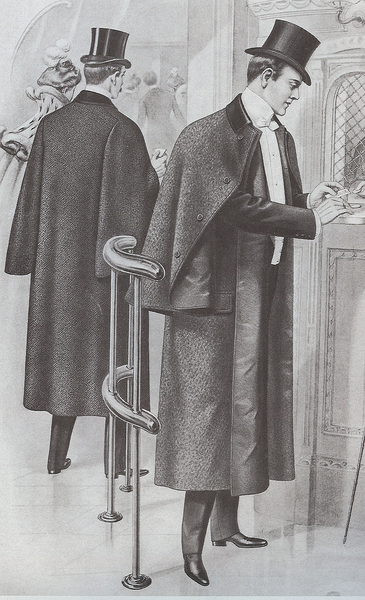
The Inverness cape is a form of weatherproof outer-coat. It is notable for being sleeveless, the arms emerging from armscyes beneath a cape (the sleeved version is an Inverness coat; the shorter-caped, sleeved version is an Ulster coat). The cape is also called havelock after Henry Havelock.[citation needed]
The Inverness cape is a water-repellent garment. The extra layer of cloth at the shoulders traditionally hindered rain from soaking through the wool.
The garment began in the 1850s[contradictory] as the Inverness coat, an outer coat with sleeves covered by a long cape, reaching the length of the sleeve. By the 1870s, the cape was divided in two, and a small "capelet"-like "wing" on each side was sewn into the side seams, not taken across the back. In the 1880s, the sleeves were removed entirely, leaving only the armholes beneath the cape, to form the Inverness cape.
The fronts of the coat may be finished in either of two styles: in one, the more formal, the topcoat is finished with short lapels and the capes are set back behind them. In another style, there are no lapels. A simple fall collar with a tall stand is used, the capes buttoning across. These were also favored for less formal wear, particularly by coachmen and cab drivers, who needed free movement of their arms. Indeed, this style is usually called a "coachman's cape."
Still worn in the United Kingdom, the Inverness cape is often made of heavy Harris tweed of plaid and checked designs. The commonly held image of the cape as worn by Holmes is one made of tweed, specifically in a grey hound's tooth pattern. It is usually worn for country wear. Lighter-weight black cape-coats are associated with formal evening attire. Modest capes, made of Gore-Tex, nylon, or twill-weave fabrics and usually black, are commonly used by members of pipe bands.
Even though a wide variety of coats, overcoats, and rain gear are worn with Highland dress to deal with inclement weather, the Inverness cape has come to be almost universally adopted for rainy weather by pipe bands the world over, and many other kilt wearers also find it to be the preferable garment for such conditions. Unlike most raincoats or other conventional overcoats, the Inverness cape has no sleeves. Instead, it has wide-cut armholes in the sides to accommodate the arms. This enables the wearer to access a sporran without unbuttoning and opening up the cape. The opening in the side is covered by a short cape, which can be buttoned up in the front.
The Inverness coat was introduced into Japan during the Meiji era, and a modified version, the tonbi or tombi (とんび) coat, gained much popularity. The coat style was called tonbi because the flaps on either side of the shoulders looked similar to that of a kite. The tonbi could be worn over a kimono, which was a reason for its popularity. Historically, the use of wool was limited in Japan until the Meiji era; however, the increased demand for new overcoats which could be worn over the kimono, including the tonbi, ignited the market. The tonbi remained in common use as an overcoat worn by men during the Meiji, Taishō and Shōwa eras.
Arguably the most famous example in fiction, Arthur Conan Doyle's famous detective Sherlock Holmes is often associated with the Inverness cape. However, in the novels, Holmes is described as wearing an Ulster. Holmes's distinctive look, which was usually complemented with a deerstalker cap and a calabash pipe, is a composite of images, originally credited to a series of illustrators including David Henry Friston and Sidney Paget. But as adapted to the stage by the actor-playwright William Gillette, Holmes did not wear a cape-coat at all, and the origin of the calabash pipe is something of a mystery, although it might have had something to do with Gillette's introduction of a full-bend briar pipe for his performances. Paget had depicted Holmes as smoking straight pipes, exclusively.
Hub AI
Inverness cape AI simulator
(@Inverness cape_simulator)
Inverness cape
The Inverness cape is a form of weatherproof outer-coat. It is notable for being sleeveless, the arms emerging from armscyes beneath a cape (the sleeved version is an Inverness coat; the shorter-caped, sleeved version is an Ulster coat). The cape is also called havelock after Henry Havelock.[citation needed]
The Inverness cape is a water-repellent garment. The extra layer of cloth at the shoulders traditionally hindered rain from soaking through the wool.
The garment began in the 1850s[contradictory] as the Inverness coat, an outer coat with sleeves covered by a long cape, reaching the length of the sleeve. By the 1870s, the cape was divided in two, and a small "capelet"-like "wing" on each side was sewn into the side seams, not taken across the back. In the 1880s, the sleeves were removed entirely, leaving only the armholes beneath the cape, to form the Inverness cape.
The fronts of the coat may be finished in either of two styles: in one, the more formal, the topcoat is finished with short lapels and the capes are set back behind them. In another style, there are no lapels. A simple fall collar with a tall stand is used, the capes buttoning across. These were also favored for less formal wear, particularly by coachmen and cab drivers, who needed free movement of their arms. Indeed, this style is usually called a "coachman's cape."
Still worn in the United Kingdom, the Inverness cape is often made of heavy Harris tweed of plaid and checked designs. The commonly held image of the cape as worn by Holmes is one made of tweed, specifically in a grey hound's tooth pattern. It is usually worn for country wear. Lighter-weight black cape-coats are associated with formal evening attire. Modest capes, made of Gore-Tex, nylon, or twill-weave fabrics and usually black, are commonly used by members of pipe bands.
Even though a wide variety of coats, overcoats, and rain gear are worn with Highland dress to deal with inclement weather, the Inverness cape has come to be almost universally adopted for rainy weather by pipe bands the world over, and many other kilt wearers also find it to be the preferable garment for such conditions. Unlike most raincoats or other conventional overcoats, the Inverness cape has no sleeves. Instead, it has wide-cut armholes in the sides to accommodate the arms. This enables the wearer to access a sporran without unbuttoning and opening up the cape. The opening in the side is covered by a short cape, which can be buttoned up in the front.
The Inverness coat was introduced into Japan during the Meiji era, and a modified version, the tonbi or tombi (とんび) coat, gained much popularity. The coat style was called tonbi because the flaps on either side of the shoulders looked similar to that of a kite. The tonbi could be worn over a kimono, which was a reason for its popularity. Historically, the use of wool was limited in Japan until the Meiji era; however, the increased demand for new overcoats which could be worn over the kimono, including the tonbi, ignited the market. The tonbi remained in common use as an overcoat worn by men during the Meiji, Taishō and Shōwa eras.
Arguably the most famous example in fiction, Arthur Conan Doyle's famous detective Sherlock Holmes is often associated with the Inverness cape. However, in the novels, Holmes is described as wearing an Ulster. Holmes's distinctive look, which was usually complemented with a deerstalker cap and a calabash pipe, is a composite of images, originally credited to a series of illustrators including David Henry Friston and Sidney Paget. But as adapted to the stage by the actor-playwright William Gillette, Holmes did not wear a cape-coat at all, and the origin of the calabash pipe is something of a mystery, although it might have had something to do with Gillette's introduction of a full-bend briar pipe for his performances. Paget had depicted Holmes as smoking straight pipes, exclusively.
Recent media